
COMMERCE IN COTTON MANUFACTURES Commerce in cotton goods is a subject as wide and complicated as it is interesting and romantic. Cotton cloth is an article of necessity in almost every part of the world. The term "cotton cloth" embraces a vast number of fabrics; a Manchester dic tionary of recognized sorts contains 243 entries. The unlimited geographical distribution of the trade, coupled with its internal variety, gives it exceptional interest. Wherever clothing is worn, cotton cloth forms at least part of it. In the East, it is the stand ard fabric for the clothes of both men and women.
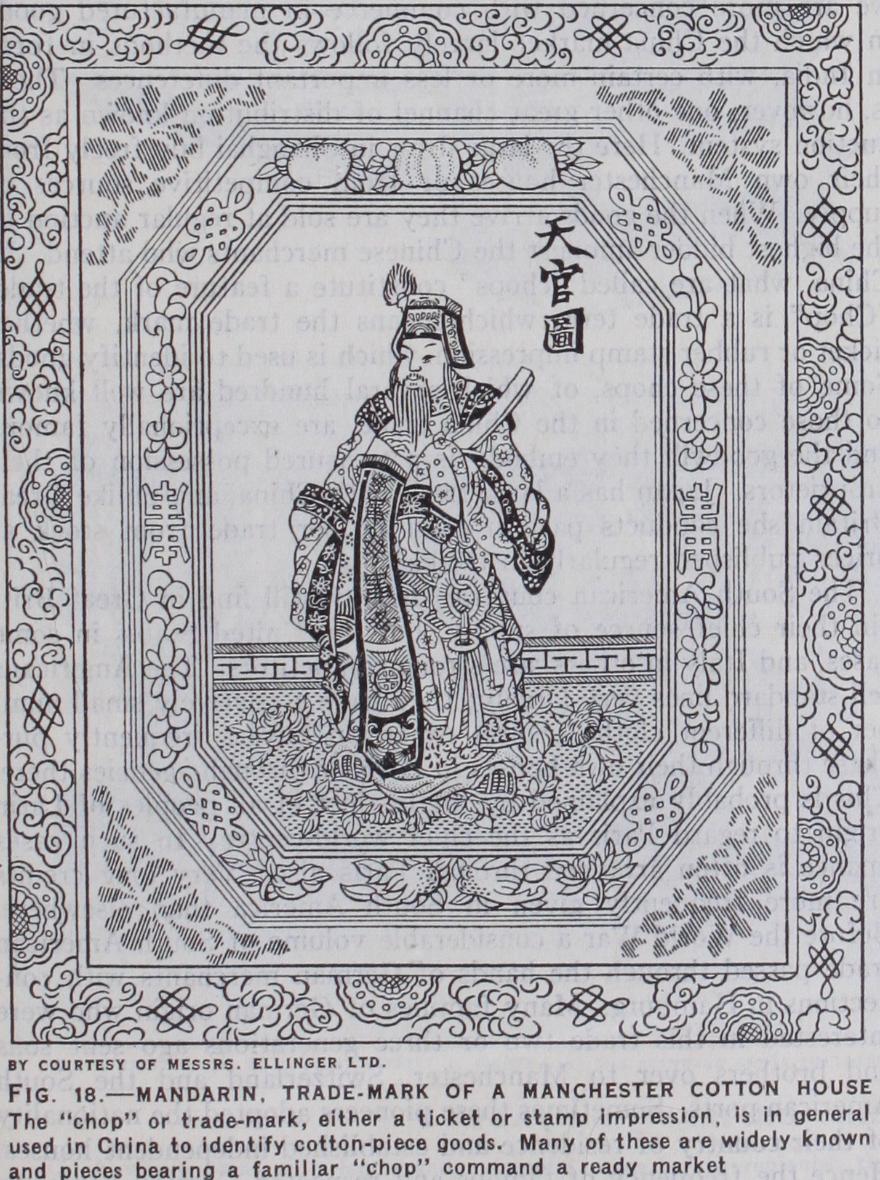
Between the time when the cloth is in its simple manufactured state—or to use the trade term, in the "grey"—and the time at which—duly bleached, printed, dyed or otherwise finished—it is ready to be placed before the ultimate consumer, a considerable period must elapse, particularly if the market of destination involves a lengthy journey by sea. Throughout this period the cloth must be financed, and many manufacturers do not possess sufficiently large resources to do this in addition to covering the period between their purchase of yarn and the sale of the cloth. It is unusual for the British cotton manufacturer to possess the necessary plant to print, bleach or dye the cloth. The general cus tom is for a merchant to buy cloth from a manufacturer, and then send it to a printer, dyer or bleacher for a finishing process to be performed on it. This is the explanation of the lengthy period during which a merchant has to finance the operations.
If goods sold direct are printed, bleached or dyed it implies that the producers in question also possess finishing plant. Manu facturers able to turn out fully finished goods are few and far between, although they are known to exist and prosper, notably in Italy. The range of variety which they can achieve is neces sarily limited, but they secure the advantage of standardization and simplification in producing and distributive processes. Their disadvantage lies in their inability to meet a mixed and general demand. In almost all markets of importation a further merchant ing operation takes place before the cloth reaches the retailer. The importer or dealer purchases large quantities of goods and distributes them to the retailers.
The countries which export a greater quantity of cotton goods than they import, in the order of the importance of their export trade, are Great Britain, Japan, Italy, Czechoslovakia, France, the United States and Belgium (based on figures for 1925 published by the League of Nations) . Other countries import a greater proportion of their total requirements than they themselves produce, with the possible exception of Switzerland, which con ducts a special entrepot trade, of which more will be said later. These facts support the contention that internal trade in cotton goods is generally of less importance and interest than external trade.
In most European countries the cloth passes into consumption mainly through two channels. It may be sold to the eventual con sumer as cloth by a retailer, who will have purchased it either from a merchant or wholesaler, or more infrequently direct from the manufacturer. Alternatively, the final consumer will buy it in the form of a garment ready for wear, in which case the cloth will have been purchased by a garment maker, either from a merchant or a manufacturer. In modern times, this second channel of distribution increasingly displaces the former. By far the greater proportion of women's clothing is now made in fac tories and fashion shops. Dressmaking in the home has virtually disappeared partly on account of the cheapness and attractive ness of the factory-made article. In Europe, very little cloth, relatively speaking, is sold under brand-names, or trade marks, belonging to the producer or supplier. One or two famous houses sell their products under advertised names or marks, but gener ally speaking, the cotton industry has not exploited the modern tendency for consumer-advertising. The reasons, no doubt, are two in number : first, that the immense variety of cotton goods renders it impossible in practice to teach consumers to know them by name; and second, the fact that virtually all cotton cloth (except for handkerchiefs, towels and such articles) is destined to be cut up into garments, makes it next to impossible to identify a given brand-name on the final garment for which the cloth is used. There are noteworthy exceptions to this generalization, as, for example, men's shirts which are quite frequently sold under a name or trade mark which belongs to the maker or supplier of the cloth.
In the United States and Canada, however, there is a growing tendency to sell cloth and garments under brand-names, and to stimulate sales by advertising. There are obvious limits to the number of brand-names which any firm can afford to advertise separately, and the consequence is that in America there is a far greater concentration on a few well defined types. This factor in the sale of cotton goods fits in well with the prevailing belief amongst producers in America in the virtues of standardization and simplification of production, and it may confidently be anticipated that the cotton trade in America will develop further and further along these lines.
Internal trade in the Eastern countries such as India and China and amongst the negro population of Africa is conducted on lines entirely different from those obtaining elsewhere. In each case the native dealers selling to the final consumer follow the customs of trade peculiar to their country. Space is lacking to follow out in detail the ramifications of bazaar trade and even barter into which this aspect of our subject would lead us. Some of the general features will be gathered from later paragraphs, and here it must suffice to point out that in such markets it is cloth which is sold rather than made-up garments.
External Trade in Cotton Goods.—Export trade in cotton goods is of immense importance to every centre of the industry. Great Britain is the largest exporter to the rest of the world, although her percentage share of world trade is very much less than it was at the beginning of the loth century. Japan, Italy and the United States had not then achieved very much in the way of an exportable surplus, but now they and other countries present a strong challenge to Great Britain's former supremacy.
Every market requires different classes of goods; the trade with each is conducted upon distinctive lines. Each market buys in a different way. In India, for example, in the chief ports of Bombay, Calcutta, Karachi and Madras are dealers who buy from Manchester, Japan, Italy and other sources of supply. They cable offers for goods and their suppliers cable counter-suggestions as to price : the contract is fixed for delivery at some time or times in the future, which is normally two or three months ahead, but quite often may be f our, five or even six. This is necessary to allow time for the goods to be manufactured. It is not the general thing to sell from stock except in the case of standard lines. The transaction is usually on terms known as "documents against payment" with the option to take up the goods within 6o or 90 days of presentation. Several famous Eastern banks with strong positions in the market take part in the business in the way of financing a good deal of the trade.
The trade with India is noteworthy also for the existence of a few very large merchant houses with their own establishments in India. They have their headquarters for the most part in Great Britain—in London, Manchester or Glasgow. The Indian branches call for shipments from Great Britain, or buy in the other markets either against definite orders from dealers or as they think the goods will be required. These firms will normally keep a limited amount of goods in stock. Many of them export Indian produce and the balancing of import accounts with the credits created by their exports often secures for them an exceptionally strong and flexible financial position. The dealers dispose of the goods in the bazaars of the port or to up-country dealers, who in their turn dispose of them in their own bazaars. The finer goods are mostly imported from Great Britain: the coarser are made partly by the Indian mills and partly by Japan. In addition a large volume of cotton goods, amounting to nearly one-third of the total con sumption, is produced by home-workers up and down India on hand looms. The distribution of these goods needs a distinct train of mercantile activities.
Trade marks consisting of tickets or stampings are a feature of Indian trade in mill-made cotton goods. Tickets are coloured prints representing animals, inanimate objects of everyday use, familiar scenes and so forth. They are gummed to the paper in which the goods are packed and to the outermost fold of the piece of cloth. Their main purpose is to give the purchaser something by which he may recognize and describe a cloth which, being illiterate, he could scarcely otherwise differentiate from thousands of other competing articles. Stampings or face-plates, as they are called in the trade, are ink impressions made on the top fold of a piece of cloth by means of a carved metal or wooden stamp. They also ,consist of representations of familiar objects or of some recognizable design and name. Some of these tickets and stampings are legally registered as trade marks : others are used by those concerned without such legal protection.
In China 75% of the total consumption of cotton cloth is satisfied by hand-loom production. In the present article, however, we are more concerned with commerce in manufactured goods in which the China market largely follows the methods in force in India, with certain more or less important differences. There is, however, one other great channel of distribution known as the auction system. Here the large firms in Shanghai buy freely from their own Manchester houses or from competitive sources of supply. When the goods arrive they are sold at regular auction to the highest bidder amongst the Chinese merchants who attend. In China, what are called "chops" constitute a feature of the trade. "Chop" is a trade term which means the trade mark, whether ticket or rubber stamp impression, which is used to identify goods. Some of these chops, of which several hundred are well known to those concerned in the China trade, are exceptionally famous and the goodwill they embody is a treasured possession of their proprietors. Japan has a large trade with China, and unlike Great Britain she conducts part at least of her trade from stock at prices published regularly in Osaka.
The South American countries mostly still find in Great Brit ain their chief source of supply, but the United States in some cases, and Italy in others, are strong competitors. The Americans sell standard lines very largely; they have a relatively small num ber of different cloths. South American buyers frequently pur chase through their own houses in Paris or through agencies there. This is probably explained by the instinct of all peoples of Latin origin to regard Paris as the chief world-centre. In such cases finance is often arranged through Paris also. Very long credits are more frequently given in South America than elsewhere. Before the World War a considerable volume of South American trade passed through the hands of German merchants with con nections in Hamburg. Many families of German origin who were interested in this trade two or three generations ago sent sons and brothers over to Manchester, Switzerland and the South American ports. Sometimes these pioneers adopted the nationality of their country of residence and established independent houses. Hence the frequency of famous and respected German names in many centres of commerce in cotton goods.
In the 19th century, Amsterdam obtained a hold on the trade with the Dutch East Indies, and unlike Hamburg, she suffered no interference by war. Even if cotton goods were shipped from another country direct to the Indies, it nevertheless was fre quently the case that the actual order came through and was placed by a Dutch firm in Amsterdam. In this case, as in the earlier instance quoted regarding India, an equal interest in the export of the produce of the country strengthens the hold of the Dutch firm on the channels of trade.
A similar circumstance obtains in West Africa; the importation of cotton goods is very largely wrapped up with the sale of palm kernels, cocoa, etc.
In Switzerland another distinctive channel for commerce in cotton goods may be found. Switzerland possesses certain finish ing works which dye, print or bleach goods manufactured in Great Britain or elsewhere as well as Swiss goods. Her embroi dery is added to cloth imported for the purpose. Merchants are required to finance these opera tions, to buy the cloth in the grey state and to sell it when finished.
Swiss merchants also have special familiarity with the markets of central Europe, and this enables them to sell where other mer chants could not. Goods made in Lancashire often pass to Poland or Austria by the intermediary of a Swiss firm in Zurich or Basle.
This vast and complicated trade with its world-wide ramifi cations is of great importance to the shipping industry, because it supplies a type of cargo par ticularly suitable to be carried on liners with regular sailings. Textiles and cotton goods in par ticular are one of the most regular and important classes of mer chandise carried by the shipping lines who conduct advertised transportation on specified routes.
The packing of cotton goods for shipment constitutes an inter esting branch of the commerce in cotton goods. Packing is a special art. Goods which will not suffer damage by the process are packed in bales. Hydraulic presses are used to compress large quantities into a surprisingly small compass. Pressure up to as much as two and a half tons per square inch is quite frequently employed. A covering of hessian, tarpaulin and paper surrounds the pieces of cloth and the bale is made secure by hoops of iron fitted whilst the goods are under pressure. Other and finer goods are packed in wooden cases, often lined with tin as a protection against damage by water, damp or Tropical insects.
Design plays an important part in the trade in cotton goods, and merchants all over the world wield considerable influence in the progress of design. As the agency for distribution, they have found it essential to co-operate with producers in the matter of designs. Many woven or printed designs are originated and owned by merchant firms. Paris is a great centre of designing for cotton goods, particularly those which are printed.
Added to the problems arising from the variety of the goods in which they deal, cotton goods merchants have the problem of the course of prices in raw cotton to overcome, and they must be masters of the languages of the countries to which they export, the tastes of their customers, the intricacies of credit and finance, and the vagaries of hundreds of differing codes of law and com mercial usages. No wonder therefore that commerce in cotton goods has become one of the most specialized forms of modern commercial activity, in which the rewards of skill have been considerable and the penalties of inefficiency frequently disastrous. No wonder either that producers with worries of their own have largely left the task of distribution to those who have painfully and laboriously equipped themselves to fulfil it.
The figures in the table in opposite column show the value of the British commerce in cotton manufactures for 1 S 16-192 7.
It will be seen that despite the rise in prices since 1913, the value of the exports in 1927 was rather less than in 1913.
(E. R. S.)