
COTTON CLOTH OUTPUT Although cotton cloths find a ready market in nearly every country in the world, their production is mainly conducted in less than a dozen countries. This concentration of output assists cot ton merchants and manufacturers in the leading exporting centres to estimate the quantity and kind of goods produced in other countries, so far as this information is reflected in the export statistics. Few countries, however, even attempt continuously to measure actual production, though many countries have periodical stock-takings, such as the British Census of Production.
The only comprehensive index of changes in the world's produc tion of cotton cloth is contained in the returns collected from spinning mills by the International Cotton Federation. (See the previous section.) These show approximately, by analysis, the amount of yarn produced annually in factories associated with the federation, and to the extent to which the federation includes the bulk of the cotton spinning industry, they show approximately how much yarn was available for weaving sheds in the periods to which they refer. As a substantial but incalculable weight of yarn pro duced in power-driven spinning mills is sold ultimately to hand loom weavers, who still account for an appreciable part of the cloth production of India, China and other Eastern countries, the consumption of mill yarn is probably a better indication of the world's cloth production than could be obtained from any other source. The table given below is based on the half-yearly returns of active spindles and cotton consumption, issued by the Interna tional Cotton Federation : Estimated World Production of Cotton Yarn in Spinning Mills (As percentage of 1911-13 production.) 1911-13 (average) too 1924 99 1922 Io4 1925 113 93 1926 116 1927 121These figures, of course, ignore the undetermined, but certainly great, amount of yarn that is still produced outside factories in the countries which use most cotton (India, China, etc.), and therefore an allowance must be made for the growth or decline of hand-spinning, as well as for hand-weaving. Broadly, however, it may be assumed that the figures represent the progress of cotton cloth production, and that, as they show, there has been a steady increase, broken only temporarily by the trade depression of 1921-23, in the output of cloth.
This expansion of the weaving industry has been unevenly distributed among the countries mainly concerned in textile pro duction. The World War, which cut off Germany, Austria and Poland from their foreign markets, and restricted the supply of British and French textiles, caused the United States and Japan, in particular, to develop their production at a truly remark able rate. The cotton manufacture of other countries, such as Canada, Brazil and other South American States, also grew, and was designed to meet as much as possible of the local demand, instead of, as previously, an almost insignificant fraction. In 1919, therefore, the world's productive capacity was probably much larger than in 1913, while demand was not in a position to absorb the whole of the output.
The degree to which the vitality or impetus of production is maladjusted to productive capacity may be illustrated by the fact that although Great Britain still heads the list of loom-owning countries, in actual output of cloth she has been overtaken by the United States.
Production of Cotton Piece Goods in Great Britain (In million linear yards.) 190 7 . . . . . . . . . . . . 7,058 1912 • . . . . . . . . . . . 1924 . . . . . . . . . . . . 5,426 British cloth production in 1924 was 67% of the 1912 figure. Approximately io% of the total output was woven from dyed yarn, the remainder being grey (unbleached) cloth, of which the greater part must pass through one or more of the finishing pro cesses before being sold. Of exported cloth, 3o% was sold in the grey or unbleached state, 3o% as bleached and 4o% as dyed or printed cloth.
United States Cloth Production (Millions of square yards.) 1914 . . . . . 6,165 1923 . . . . . 7,131 1921 . . . . . 5,872 1925 . . . . . 6,446 Nearly half the output is classed as either sheetings or print cloth. There has been a decrease in the production of sheetings, and the tendency in the United States as in Great Britain and the Continental countries, is evidently towards finer and more expen sive fabrics, with a high finish.
The Continent of Europe.—The cotton industries of the various Continental countries are mainly concerned with their home markets, and export figures are not here, as elsewhere, a reliable guide to production. Badly handicapped in most instances by the World War, they seem to have made remarkable progress since. French production has nearly regained pre-war position as shown by the following table.
French Cloth Production (Millions of metres.) 1913 1,310 1924 . . • 1922 . . . . 1,034 1925 . . . . . 1,198 1923 . . . . I,I IO The annual production of the Italian industry has also increased. In 1913, 162,00o tons of Italian yarn were consumed in the Italian weaving industry. In 1925 the amount had risen to 193,000 tons and in the same year the annual production of cloth was approximately i,000 million metres, of which 2 7 % was over one metre in width.
The Czechoslovakian industry, which formerly served the whole of Austria-Hungary has suffered from the break up of its market into several economic units. Output fluctuated considerably dur ing the years 19 2o-2 7, but was generally below full capacity. Russian production rose from 684 million yards in 1923 to 1,812 in 1925 and to 2,888 in 1927, and is now as great as in pre-war years.
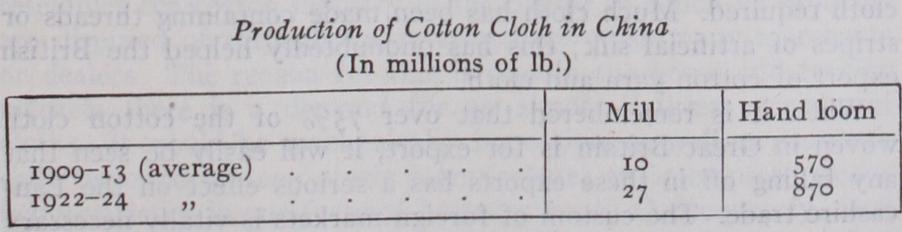
Far figures for India, China and Japan are difficult to assess owing to the prevalence, already mentioned, of hand looms. In Japan hand-loom production is less than half that of the factories, in India of nearly equal amount, while in China hand looms produce, it is estimated, more than ten times the pro duction of Chinese weaving factories. The production of factory cloth in India is above the pre-war level and its growth has not slackened.
Indian Mill Cloth Production (Millions of yards.) 1912-13 . . . . I,164 1924-25 . . . . 1922-23 . . . . 1,725 1925-26 . . • • 1,954 1923-24 . . . . 1,702 1926-27 . . • • 2 ,2 59 The hand-loom production of India, in addition to the above figures, exceeds I,000 million yards.
The expansion of the Japanese cotton industry has been one of the most notable post-war developments. Japan's consumption of raw cotton during the period 1912 to 1926 increased 77%, and the following table representing the output of members of the Japan Cotton Spinners' Association only, confirms the impression of rapid growth.
Mill Cloth Production in Japan (Millions of yards.) 1913 . . . . . 417 1924 I,o31 192I . . . . . 701 1925 1,18o 1922 869 1926 . . . . . 1,278 1923 . . . . I,OOI 1927 . . . . . 1,295 (By members of the Japanese Cotton Spinners' Association.) China is probably increasing her production of cotton cloth, but lack of internal organization makes it difficult to form an exact idea of the amount. An estimate by G. W. Daniels and J. Jewkes shows the following increases both in mill and hand-loom output.
In comparison with the output of the countries already described that of the rest of the world is of much less significance. Ger many, Belgium, Holland, Switzerland and Poland are the other large-scale textile producers of Europe. Details of their produc tion are not available on a basis comparable to the foregoing figures.
United States.—Census of Production. Bureau of the Census, Washington.
Italy.—Italian Cotton Association, Milan. Annual reports on cloth production, with particulars of width.
India.—Department of Commercial Intelligence and Statistics. Monthly reports of yarn and cloth production.
Japan.—Cotton Spinners' Association. Monthly and half-yearly reports of yarn and cloth production. Annual report of Department of Commerce and Industry, production of cloth, with particulars of finish and bind. (H. G. Hu.)