COTTON AND THE COTTON INDUSTRY. Cotton, the most important of vegetable fibres, has made economic his tory, and has had a potent effect upon the progress and politics of the leading industrial nations. In England its employment changed obscure places into great towns and played a great part in what is called the Industrial Revolution (q.v.). In the United States its cultivation has been so long and so well established that it is with an effort one recalls the fact that the cotton plant is not indigenous in that -country. It has come to spell the daily bread of millions, and its supply and price determine the welfare of wide-flung regions. Its output, transport and varied manu facture create wealth which is reflected in the trade accounts of great nations, and which reacts directly or indirectly upon all other industries. In the British economy, cotton has long played a determining part, the Manchester school of economics reflect ing the conceptions of the cotton world. It is significant that the Anti-Corn Law League was formed in Manchester, that John Bright's father was a cotton spinner, and that Richard Cobden, although the son of a Sussex yeoman, sold cotton goods at Man chester and afterwards became a calico printer.
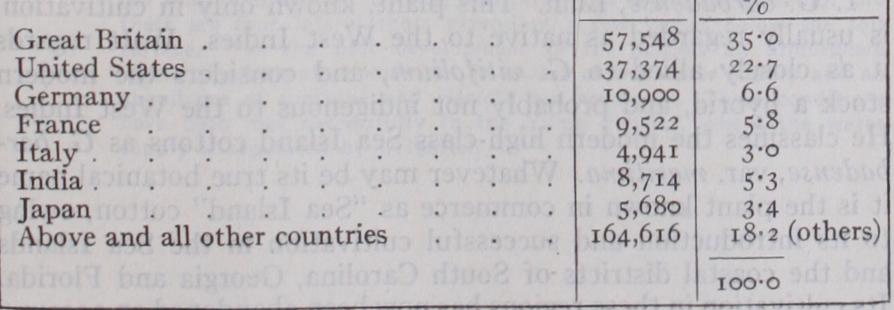
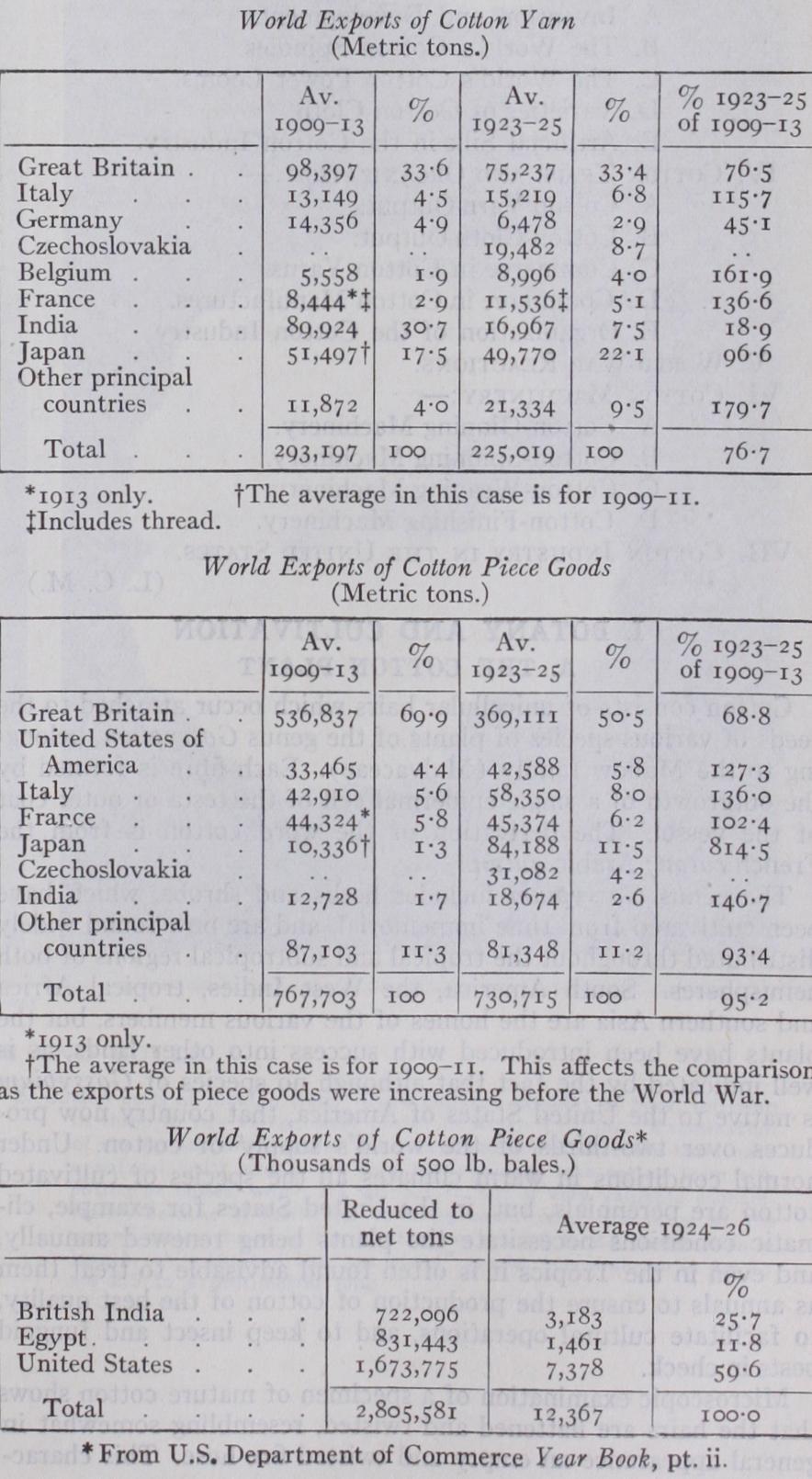
After many years, and even after the hazards and dislocations of the World War, the cotton industry still plays a great part in the British economy, but its relative importance has considerably decreased. In the world as a whole, too, the British cotton in dustry, although still supreme, has lost something of its pre dominance. If we look at the cotton spindles record, we see how great a change has taken place in the relative positions of the chief nations in this matter. At the close of the i 9th century, tak ing the average of the five years 1895-99, Great Britain possessed more cotton spindles by far than all the rest of the world put together; in spindles out of a world total of 164,616: The World's Cotton Spindles (in Thousands) Thus, Great Britain began 1927 with rather more than one-third The British exports of cotton piece-goods suffered very seri ously, it will be seen, between 1909-13 and 1923-25. The world trade in cotton piece-goods dropped by 5%, while the British share of the whole fell from 7o% to 5o.5 %. The greatest loss was in the Far East; in 1926 Great Britain exported to that market only 44% of the yardage she supplied in Thus the post-war period has been for the cotton trade one of deeply interesting development. The great changes that have occurred in the industry in Great Britain, Europe, the United States and elsewhere; the enhanced cost of cotton, the variations in popular taste, the introduction of artificial silk and other fac tors are examined in the following sections, which have been planned to survey the entire field of the industry, from the culti vation of the cotton plant to the manufacture of the ingenious machines used in the cotton industry. The sections will be found in the following order :—