
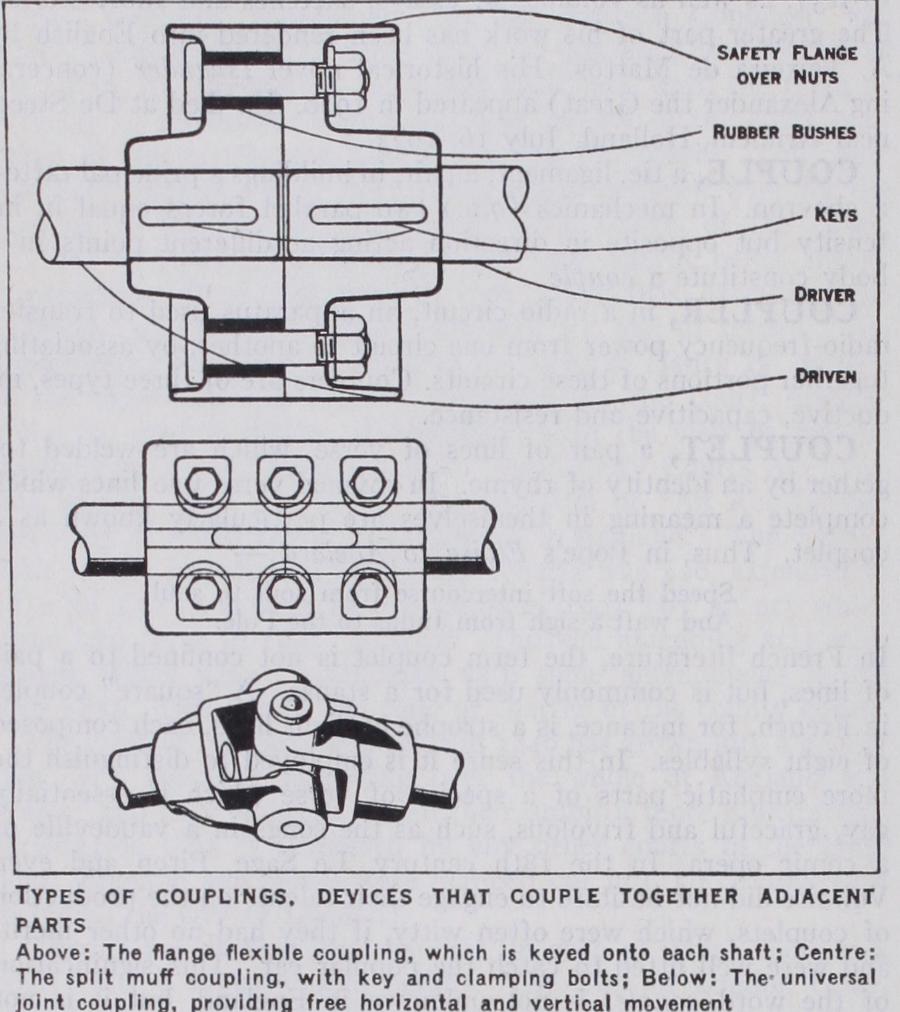
COUPLING. When lengths of shafting have to be joined up, in factories or ships, couplings are employed, as they are also to connect a prime mover to a machine. Usually the coupling connection is permanent ; if frequent disconnections are required, a clutch has preference. Flange couplings are the most often used, the end of the shaft being forged into a flange, or a flange being keyed on and united to a companion one by bolts. Split muff couplings fit over each end of the shaft and are contracted by bolts, while the split compression type is also quick to apply and remove, being tightened by three bolts. These draw hoods together over the tapered exterior of a split sleeve causing the latter to grip the shaft ends and drive without need for keys. When one shaft has to assume various angular relations, a uni versal joint coupling is preferred, having two pivots located at right angles, and connected either through a steel member or a composition plate (see MOTOR CAR). Huge universal couplings of a rather elaborate kind are needed in rolling-mill drives, to com pensate for the varying heights of the rolls.
Flexible couplings on shafts are extensively utilized. They protect engines, electric motors, or machines, against the shocks due to variations in the driving power or in the loads ; and their flexibility also allows for slight irregularities in the alignments of shafts. A favourite class is the flange coupling above alluded to, but with leather or rubber bushings surrounding the bolts in one flange, and sometimes with soft washers interposed between the faces of the flanges. Another kind has rims with interlocking lugs; these do not touch, but the drive is transmitted by rubber blocks, or a long leather belt is interwoven between the lugs so as to take the drive flexibly without any metal-to-metal contact occurring. These also electrically insulate the motor from the machine which is coupled to it. Steel springs in some instances perform a like service.
A coupling is employed to join up the ends of hose, being either a screw type with nut turned by a spanner, or a hand instantane ous grip, for fire-hose or the brake-hose of trains. The railway carriage and wagon coupling is either of hand-tightened screw type, or automatic in action.