
COURTSHIP OF ANIMALS. When we see a peacock spreading his beautiful train to the full, and, occasionally vibrat ing the quills to produce a rustling sound, turning from side to side before his mate, or a barn-door cock with drooped wing and special call circling close round a hen, we are witnessing familiar examples of animal courtship.
Courtship may be defined to include all forms of action exe cuted by members of one sex to stimulate members of the other sex to sexual activity. Such actions include the display of bright colours, or adornments such as crests; special tactile contacts; dances or other antics; pursuit; music, vocal or instrumental; the discharge of scents and perfumes ; and the presentation of prey or of inedible but otherwise stimulating objects.
It is unfortunate that "courtship" is the only term available to denote these activities, since in our own species courtship is usually taken to mean only such as occur before marriage. in other words those which conduce to the finding of a more or less permanent mate. In most animals, however, marriage (in the sense of the living together of one or more males with one or more females in sexual association for considerable periods of time) does not exist, and in many birds "courtship" displays do not begin until of ter the selection of mates has taken place. Courtship, in the biological sense, primarily leads up to the act of pairing; where some form of marriage exists, courtship may also, or even primarily, be connected with the choice of mates.
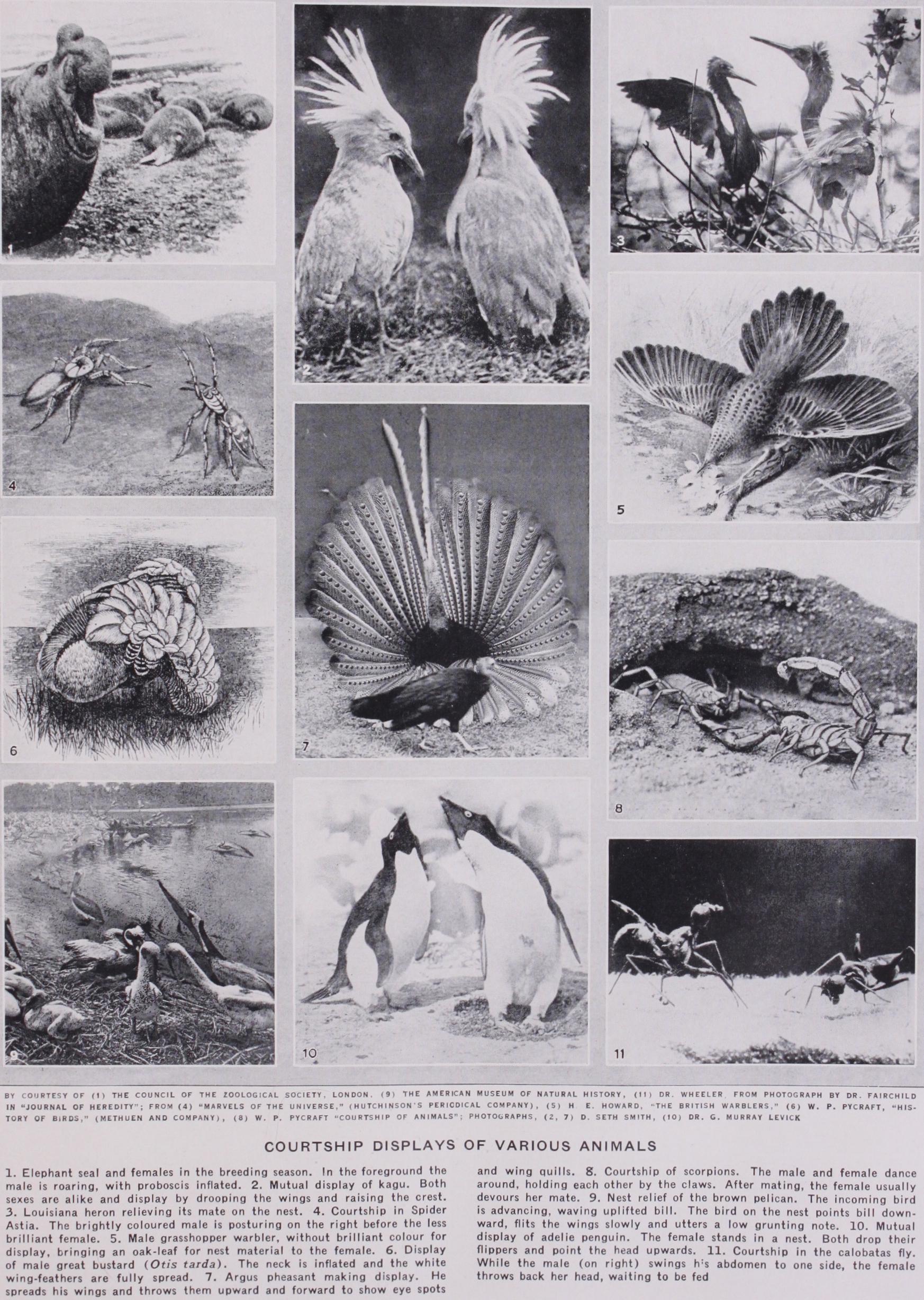
By no means all organisms show even the most primitive form of courtship. It is not present in plants, or in any of the lower groups of animals. A few instances of rudimentary courtship occur in annelid worms, but otherwise it is confined to the verte brates, the molluscs, and the Arthropods. Even here it is absent from many of the lower sub-divisions of these groups. This be comes intelligible when the function of courtship is more closely looked into. No organism without a nervous system and sense organs can be expected to show courtship. In other forms, the union of the sexual cells is either entirely a matter of chance; or of simultaneous ripening and discharge (as when all sea-urchins over a wide area discharge eggs and sperm at one time) ; or of passive transference, as in flower pollination ; or of purely re flex reactions. Courtship will only be needed where the active co-operation of the sexes is needed for fertilization to be effected; and this will only be the case where the eggs and sperms are not blindly discharged, but are economized, either by means of in ternal fertilization or by being discharged in close proximity. Further, courtship will not be required where the nervous organi zation is so simple that pairing is a simple reflex action ; but only when the reflex machinery of pairing is under the control of higher centres in the brain, and the nerve-processes of these centres and their emotional accompaniments need to be stimulated in a particular way before pairing can occur.
A similar proclamation of a "sexual situation" appears also to be the main function of the courtship of male spiders. This, in certain of the hunting spiders (e.g., Lycosidae, Attidae), which possess good vision, consists in dances or contortions in which brightly coloured parts are prominently displayed. Web-spinning spiders, however, have poor vision; accordingly in some of them the courting male vibrates a strand of the web in a peculiar way. The importance to the males and to the race of inducing a sexual reaction in the female is here very great, since the female's nor mal reaction to any small animal would be to attack and devour it. The female does actually sometimes attempt to seize the male as prey, but gradually desists as the courtship proceeds. The male in spiders is occasionally devoured after fertilization. This appears to be the rule in scorpions, in which courtship takes the form of a dance with inter-locked claws.
Special food of a protein nature is needed by many female insects if their eggs are to undergo their final ripening. Accord ingly we find that a number of male insects present animal prey to the females as a part of courtship. In this way, two birds are killed with one biological stone. In some species of little flies of the family Enapidae, the proffered prey is embedded in a "balloon" of glistening bubbles secreted by the male, and usually larger than himself, which renders him and his gift very conspicuous. In other species a strange modification of this habit has taken place. The balloon is still made and carried, but in place of the prey, bright objects such as flower-petals are placed in it, and the flies will avail themselves of coloured paper if this is provided. This utilization of foreign objects in courtship is only paralleled elsewhere by the bower-birds and man.
In the sticklebacks there are violent combats between males for the possession of nesting territory, but it is not certain whether display of the bright colours assumed by breeding males has any sexually stimulating effect on the females.
In amphibia the most specialized group (frogs and toads) have no display-courtship, since the males' habit of embracing the females and waiting thus until the eggs are shed, when they dis charge their sperm, renders it unnecessary. However, the meet ing of the sexes is facilitated by the croaking of the males, which is often very loud owing to the development of huge vocal sacs. Here again possibly, though by no means certainly, the croaking has also a sexually stimulating function. If the chirping of male grasshopper-like insects was the first deliberate sound produced by life, the croaking of male frog-like amphibia was almost cer tainly life's first vocal music. In the Urodeles, or tailed amphibia, fertilization is internal, and here courtship is not infrequent. It usually consists in the male's rubbing himself against the female, at the same time discharging the secretion of special scent-glands.
It reaches its highest pitch in the European newts—Molge (Tri ton) and related genera—where the breeding males are usually brightly coloured, and dance round the females in striking postures while fanning scent from special glands upon them with their tails. The sexually stimulating function of this performance is here very definite. The males of these genera deposit their sperm in a packet or spermatophore, and this must be actually picked up by the female for fertilization to occur. It has been shown that females are quite irresponsive to the presence of isolated sper matophores, but will pick them up when stimulated by the male's performance.
0f reptilian courtship comparatively little is known; its study, especially in the more active lizards and snakes, would be certain to yield many interesting facts.
In monkeys and apes there appears the tendency, which reaches its climax in civilized man, of emancipating the female's sexual emotions from the strict cyclical control of hormones, and allow ing them free play at other times than at oestrus. The mating season is extended over more of the year, and the animals be come ready to pair at other periods of the menstrual cycle than oestrus. In such circumstances it would be expected that stimu lation by courtship and display would once more become of biological importance, and in point of fact primates do show a number of striking sexual adornments, such as beards, mous taches, or whiskers ; bright coloured hair on the face ; or brilliant ly coloured patches of bare skin on the face and buttocks. De tailed studies of simian courtship would be of great interest. In man, of course, courtship is highly developed, and obviously plays an important biological role; but it cannot be discussed in a purely zoological article.
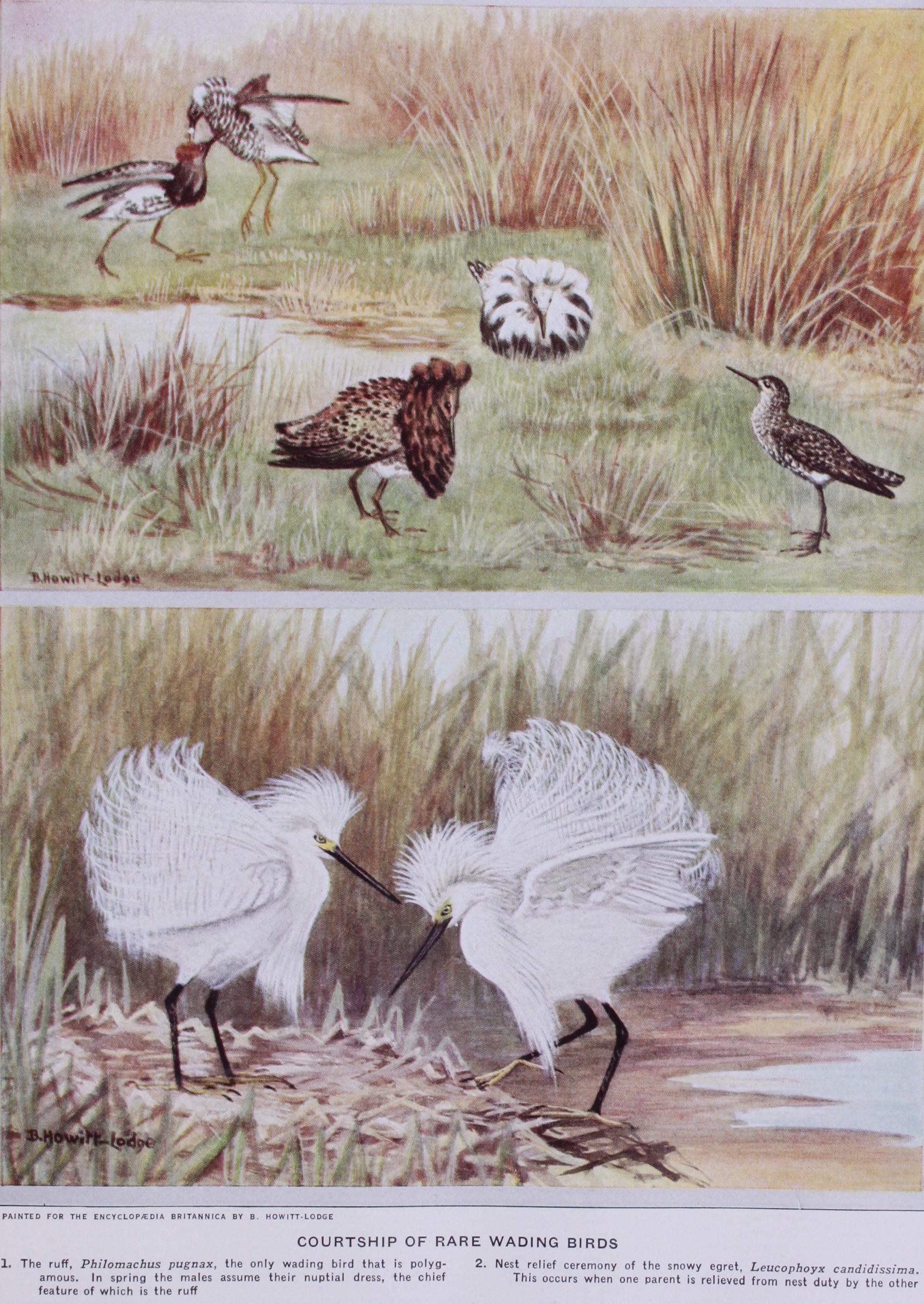
(I) The racial function of the male bird may be confined to fertilization (ruff, black grouse) ; or he may also mount guard during the female's incubation (most ducks) ; or may also share in feeding the young (most passerines and hawks) ; or also in incubation (grebes, herons, etc.) The more duties he executes for the good of the offspring, the greater is what may be called his racial value. To kill a male ruff immediately after fertili zation has no deleterious effects on the next generation, whereas the death of a male grebe or heron at the same period seriously imperils the chances of the eggs and young.
(2) The "marriage systems" of birds vary from permanent monogamy (parrots, ravens), through monogamy for one season (most monogamous birds) or one brood (some wrens), to polyg amy of the "small harem" type (jungle fowl, many pheasants), or of the promiscuous type (ruff, blackcock, probably some birds of paradise).
(3) The need for protection by means of protective coloration and inconspicuous habits varies considerably. Birds which nest gregariously in general need less protection at the nest-site than do birds nesting solitarily.
(4) The need for a continuous supply of food to the naked young of most passerine birds has resulted in the adoption by species of the system of "food-territory" in which the male and later the pair defend from intruders an area of some extent round their nest. (See