
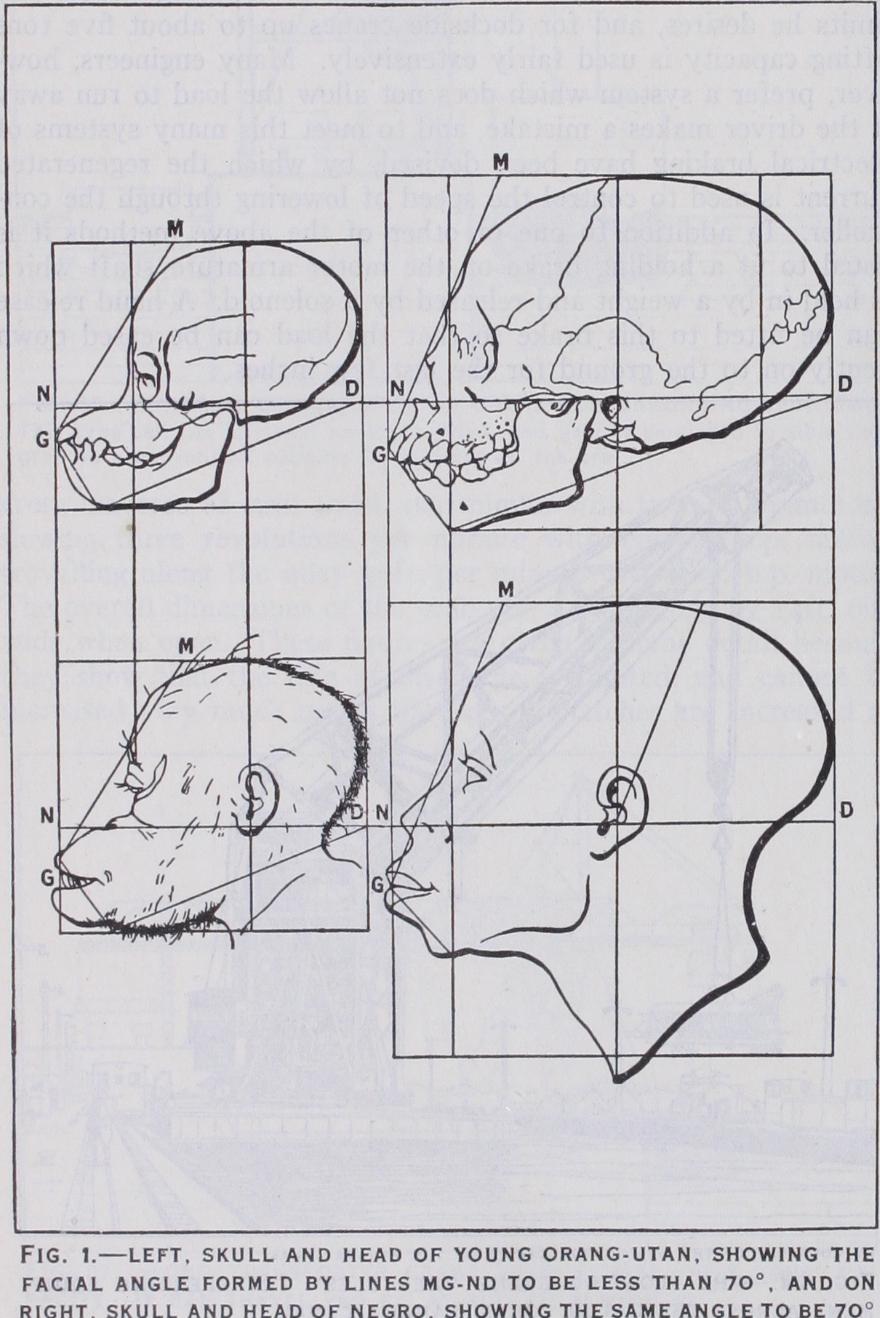
CRANIOMETRY. The application of precise methods of measurement in craniometry, a comprehensive expression for all methods of measuring the skull (cranium) is of great importance in anthropological studies. The measurements were first made with a view to elucidating the comparison of the skulls of men with those of other animals. This wide comparison constitutes the first subdivision of craniometric studies. And craniometric methods have rendered the results of comparison clear and com prehensible. Among the first measurements employed angular de terminations occur, and the "facial angle" invented by Camper (fig. 1), was employed for comparative purposes, as will appear from the following extract from the translation of the original work: "The two extremities of the facial line are from 7o to 8o° from the negro to the Grecian antique : make it under 7o, and you describe an ourang or an ape : lessen it still more, and you have the head of a dog. Increase the minimum, and you form a fowl, a snipe for example, the facial line of which is nearly parallel with the horizon." (Camper's Works, p. 42, translated by Cogan, 1821.) The International Anthropological Association at its meeting in 1882 established a plane now known as the Frankfort plane or horizontal, and in general use, despite serious defects when deal ing with imperfect skulls.
The second division of craniometric studies includes those in which the skulls of the races of mankind are compared and classi fied. And in this domain, the advent of accurate numerical methods of recording observations brought about great advances, completed by a system of com paring various dimensions of the skull, and of a classification based on such comparisons. Many other measurements and data are necessary. The skull should be viewed from above, from below, from in front, from behind and from the side (figs. 2, 3, 4). Path ological conditions and other ab normalities, natural or artificial, must be estimated. The thick ness of the skull, the points of muscular attachment, the age and sex, require attention. The shape of the head varies and six dis tinct type-forms are found (fig. 5) . The height of the head gives important indications. The size of the skull and its capacity should be estimated or computed and the general conditions of the skeletal formation as a whole come into consideration. In the skull itself, the eye-orbits, nasal aperture, width of cheek-bones, depth and length of the jaw, the proportions of its attachment, the relative position and size and proportions of the elements of the bony structure of the skull are capable of measurement and therefore are valuable for the purpose of classification by ad vanced mathematical and statistical processes. (See ANTHROPOM