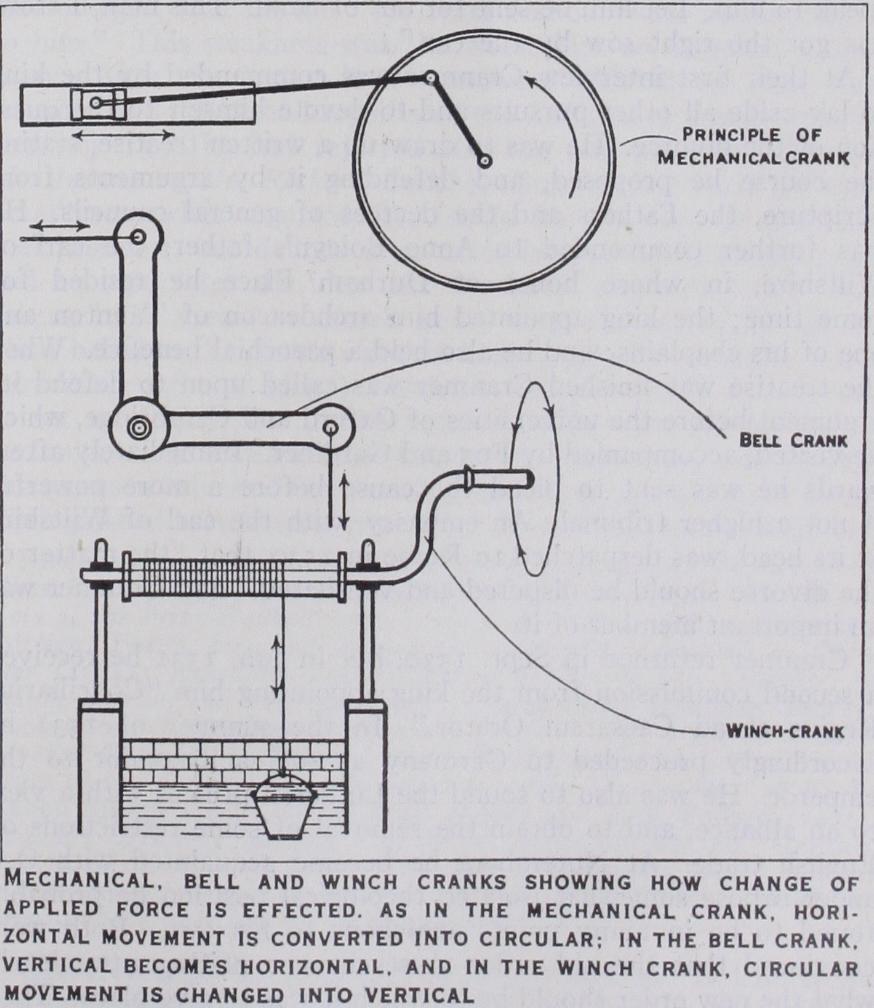
CRANK. In mechanics, a crank is a device by which recip rocating motion is converted into circular motion or vice versa, consisting of a crank-arm, one end of which is fastened rigidly at right angles to the rotating shaft or axis, while the other end bears a crank-pin projecting from it at right angles and parallel to the shaft. When the reciprocating part of a machine, as the piston and piston-rod of a steam engine, is linked to this crank by a crank-rod or connecting rod, one end of which works on the crank-pin and the other on a pin in the end of the reciprocating part, the to-and-fro motion of the latter imparts a circular motion to the shaft and vice versa. The crank, instead of being made up as described above, may be formed by bending the shaft to the required shape, as sometimes in the handle of a winch. A bell-crank, so called because of its original use in bell-hanging to change the direction of motion of the wires from horizontal to vertical or vice versa, consists of two arms rigidly connected at an angle, say of 9o°, to each other and pivoted on a pin placed at the point of junction.
Crank is also the name given to a labour machine once used in prison as a means of punishment (see TREADMILL). Other uses of the word, connected with the primary meaning, are for a crooked path, a crevice or chink, and a freakish turn of thought or speech, as in Milton's phrase "quips and cranks." It is also used as a slang expression, American in origin, for a harmless lunatic, or a faddist, whose enthusiasm for some one idea or hobby be comes a monomania. "Crank" or "crank-sided" is a nautical term used of a ship which by reason of her build or from want of balance is liable to overturn.