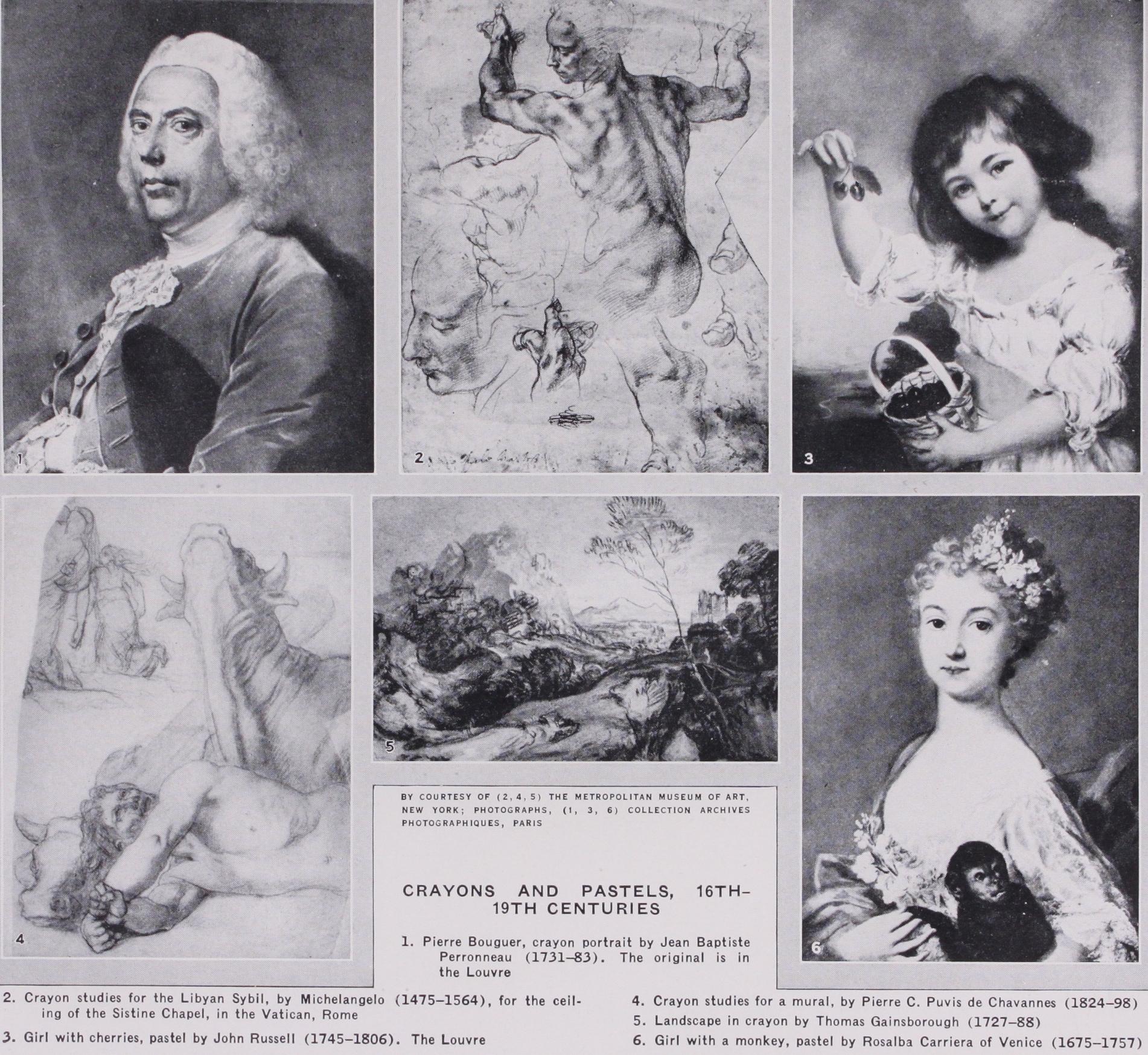
CRAYON, a black or coloured material for drawing, gener ally in the form of pencils, but sometimes in powdered form. Ob tainable, to some extent, from native earthy and other compact and friable mineral substances, crayons are, for the most part, artificially prepared mixtures of a base of pipe or china clay with Prussian blue, chrome yellow, vermilion, ochres, umbers and other pigments cemented together by the introduction of some weak ad hesive, usually gum tragacanth. Calcined gypsum, talc and com pounds of magnesium, bismuth and lead are occasionally used as bases. The required shades of tints are obtained by adding vary ing amounts of colouring matter to a given quantity of the base. The use of chalks, especially red earth, is of ancient origin as testi fied by surviving examples, and Horace's rubrica picta ant carbone would show that the conflicts of the famous gladiators were deline ated in red chalk as well as charcoal. It is, however, with the use of the medium in more modern ages that we are now mainly con cerned, especially when, in the i6th century, the artists used black chalk on white paper, and when, as the century advanced, they began more and more to employ it together with other mediums for the purpose of suggesting colour. First black chalk heightened with white, on a tinted paper, then black and red crayon, heightened with white, on papers of various tonality. With the specific use, however, of red crayon, in sanguine, as the French call it, draughtsmanship seemed to extend its scope and capacity, as we see particularly in the exquisite drawings of Watteau, done in infinite numbers; not only as notes and studies for pictures, but for the sheer joy of drawing, with all their in expressible sense of grace and vitality inherent in the just em phasis of the accents of every figure, and the rhythmic signifi cance of every line, and a general expression of animation. "C'est de la sanguine qui contient de la pourpre" wrote Edmond de Goncourt a propos- the incomparable Watteau, "c'est du crayon noir qui a usv veloicte a mul autre pareil; et cela melange de craie avec la pratique savante et spirituelle de l'artiste, devient, sur du papier chamois, de la chair blonde et rose." There is little in the use of crayon that we could not learn from the inimitable draw ings of Watteau if only we had the wit to divine the magic of his art. How to commingle the red, black and white strokes with the tone of the paper so as to suggest the illusion of a natural garment of colour, how to rub the vermilion chalk on the black with the finger or a stump or a rag, so that a lovely tone shall evolve, how to draw those expressive lines that positively sparkle with the living accent, how to judge the exact tones of white that shall lighten the contours and the shadows, which the paper always shows between as a half tone ; in all these is the secret of Watteau's pre-eminence. This secret was never quite shared, for all their talent and charm, with Boucher, Greuze, Lagonard, Lancret, Baudouin or Chardin, who put their touch in sanguine to the test of unconscious rivalry.
Most of the old masters used chalk for their drawings at one time or another, giving it preference in many instances to pencil, or reed, pen and ink, or sepia wash, as for instance in the 15th century Gentile Bellini did a self-portrait in black chalk, and Francesco Morone a "Virgin enthroned with Saints" in red. There were, however, certain outstanding masters whose expressive lines in red and black chalk reflected a clear vision of character in herent in the contours. There were the Clouets, Jean and Fran cois, successively court painters to Francis I. whose crayon drawings, almost in outline, were so peculiarly distinguished for their psychological truth, and there was Holbein, whose series of portrait drawings at Windsor, is one of our glorious possessions. To obtain a full effect of colour he would variously tint the paper, and rub the tint away where light was wanted, or he would add white, the drawing being done with red or black chalk, the essential character of the face and head being exactly defined, and the chalk then rubbed to soften the tone suggestively, and a supplementary line or so of silver point being introduced for accent. The magnificently rich drawings of Rubens were done with black chalk heightened with white, or with the red crayon, while Van Dyck used chalk on a blue or brown paper, the choice of paper, by the way, influencing very much the effect of the chalks in the drawing. Titian and Tintoretto drew in black and white on blue paper, and Fra Bartolommeo on salmon pink or yellowish paper, while Correggio used red chalk with washes of red bistre heightened with white, Leonardo caressed the toned paper, so to speak, with his exquisite enfolding lines in red, and Piero di Cosimo, among others, reflected his influence. The black or red crayon was used characteristically with individual powers and finesse by Michelangelo, Raphael, Andrea del Sarto, Pon torno, Carpaccio, Lorenzo di Credi, Diurer and Lucas van Leyden, Rembrandt, Ruisdael, Esias van de Velde, Claude Loraine, Callot, Gravelot. Of English artists, Richard Wilson used chalk for classic landscape studies with beautiful effect, but the supreme master of the crayon in English art was Gainsborough, who, with the softening influence of the stump, made nature speak pictorially with grace, beauty and vivacity as well in landscape as in the human figure. A notable series of drawings in red chalk is that by Alfred Stevens, the famous sculptor, but among the moderns Whistler's manner of using coloured chalks was most lovely and distinguished. A new invention of oil colours in crayon form, purporting to be used as a substitute for brush painting, was in vented at the beginning of the century by I. F. Raffaelli, the French painter and etcher, who painted many pictures with the new medium. The colours, however, are said to have soon lost their brilliancy. See also PASTEL.