
CRECY (Cressy), a town of northern France, in the depart ment of Somme, on the Maye, i 2m. N. by E. of Abbeville by road. It is famous in history for the great victory gained here on Aug. 26, 1346, by the English under Edward III. over the French of King Philip of Valois. After landing near Cherbourg, on July 12, and making a pillaging march through Normandy, Edward decided, in view of reports of the gathering French forces, to re tire towards his allies the Flemings. If this merely meant a con tinuance of his actual direction of march, it also meant that he had to find feasible crossings over the Seine and Somme. For the first he had to go upstream almost to Paris, and the second, after being thwarted four times, he eventually achieved near the river mouth. His line of retreat at last secure, he decided to halt and face his pursuers on a well-chosen site, to this end encamping, on Aug. 25, at Crecy, the French king in the meantime marching from Abbeville on Braye. Early on the 26th Edward's army took up its position for battle, while the French army continued their pursuit, in a straggling column and in much disorder. The English lay on the forward slope of a hillside, with their right in front of the village of Crecy, their left resting on Wadicourt. Two of the three divisions, or "battles," were in first line, that of the young prince of Wales (the Black Prince) on the right, that of the earls of Northampton and Arundel on the left ; the third, under the king's own command, in reserve, and the baggage was packed to the rear. Each battle consisted of a centre of dismounted knights and men-at-arms and two wings of archers. The total force was at most 3,90o men-at-arms, I',000 English archers, and 5,000 Welsh light troops (Froissart, first edition; the second gives a lower estimate) . The French were far stronger, having at least 12,000 men-at-arms, 6,000 mercenary crossbowmen (Genoese), perhaps 20,000 of the milice des communes, besides a certain number of foot of the feudal levy. Along with these served a Luxemburg contingent of horse under John, king of Bohemia, and other feudatories of the Holy Roman Empire.
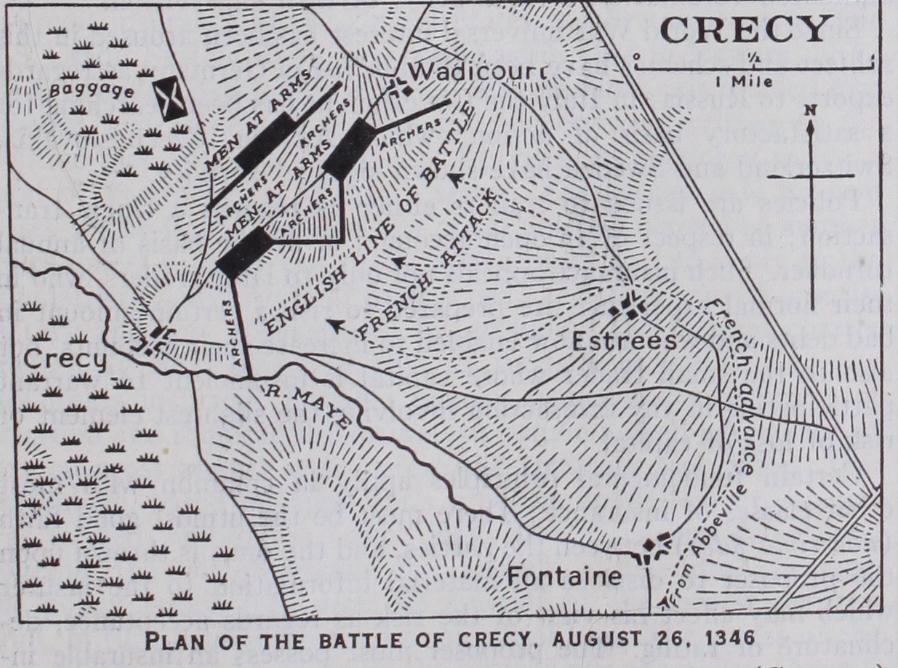
The day was far advanced when the French came unsuspect ingly upon the English position. Philip, near Estrees, decided to halt and bivouac, deferring the battle until the army was better closed up; but the independence and indiscipline of his feudal lords committed him to an immediate action, and he ordered forward the Genoese crossbowmen, while a line of men-at-arms deployed for battle behind them ; the rest of the army was still marching in an irregular column of route along the road from Abbeville. A sudden thunderstorm caused a short delay, then the archers and the crossbowmen opened the battle. Here, for the first time in Continental warfare, the English long-bow proved its worth. After a brief contest the crossbowmen, outranged and outmatched, were driven back with enormous loss. Thereupon the first line of French knights behind them charged down upon the "faint-hearted rabble" of their own fugitives, and soon the first two lines of the French were a mere mob of horse and foot struggling with each other. The archers did not neglect the opportunity, and shot coolly and rapidly into the helpless target in front of them. The second attack was made by another large body of knights which had arrived, and served but to increase the number of the casualties though here and there a few charged up to the English line and fell near it, among them the blind king of Bohemia, who with a party of devoted knights penetrated, and was killed amongst, the ranks of the prince of Wales's men-at-arms.
The battle was now one long series of desperate but ill-con ducted charges, a fresh onslaught being made as each new corps of troops appeared on the scene. The English archers on the flanks of the two first-line battles had been wheeled up, the cen tres of dismounted men-at-arms held back, so that the whole line resembled a "herse" or harrow with three points formed by the archers (see sketch). Each successive body of the French sought to come to close quarters with the men-at-arms, and exposed them selves therefore at short range to the arrows on either flank. Un der these circumstances there could be but one issue of the battle. Though 16 distinct attacks were made, and the fighting lasted until long after dark, no impression was made on the English line. At one moment the prince was so far in danger that his barons sent to the king for aid. Even then Edward was not disquieted and he sent a mere handful of knights to the prince's battle, say ing, "Let the boy win his spurs." The left battle of the English, hitherto somewhat to the rear, moved up into line with the prince and the French attack slackened. By midnight the army of France had practically annihilated itself ; 1,542 men of gentle blood were left dead on the field and counted by Edward's heralds, the losses of the remainder are unknown. Some so of the victors fell in the battle, which established England as a great military power, helped to ring the curfew on the long day of cavalry supremacy, proved the value of fire-power as represented in the long-bow, and revealed the magic defensive properties of a tactical combination of ground, archery-fire and the stability afforded by steady spear men. As the long-bow had been acquired from the Welsh wars, so the new tactical combination had been learnt from the Scottish wars. But all that the French learnt was to dismount their cavalry when making attacks! The story that the Black Prince adopted from the fallen king of Bohemia the crest and motto now borne by the princes of Wales lacks foundation (see JoHN, King of Bohemia). A memorial to the French and their allies was erected, by public subscription in France, Luxemburg, and Bohemia, in 1905.
See H. B. George, Battles of English History (1895), and C. W. C. Oman, A History of the Art of War in the Middle Ages (1924)• See also BANNOCKBURN, HALIDON HILL.