
CROSSWORD. A crossword puzzle consists of a diagram, usually rectangular, divided into squares, each of which, when not cancelled, has eventually to contain a letter of the alphabet ; and the great majority of these letters form part of two words, one running downwards and one across. Each number in a diagram represents the beginning of a word (an occasional reversal or jumbling of letters of accepted abbreviation being permitted) continuing until it reaches an obstacle, and corresponds with the number of a printed clue which has to suggest the word to the solver.
The first crosswords seem to have been printed in England during the 19th century. These were of an elementary kind, and occurred in books of general puzzles for the nursery. They had to cross the Atlantic, as did the game of rounders, before being developed into a serious adult pastime. In 1923 they became the most talked-of form of entertainment in the United States, being published by most of the popular newspapers, and in a few months had returned to take England by storm. Though American enthusiasm for them has diminished somewhat and though they have failed to become firmly established in other European coun tries England has remained faithful to these puzzles for five years, and there seem to be no signs of waning in their popularity.
At first diagrams were confined to (a) symmetrical patterns of shaded or blacked out squares within the rectangle ; but soon there Across Down I. Science of lying I. A cheese II. Passes the summer 2. Wave 12. Class of a ship 3. Lower part of river 13. A gasteropod 4. Instruments 14. Horse for riding 5. Mark of a blow 16. Dog that hunts by scent 6. Across 19. Springy 7. House god 22. Kind of beetle 8. Eary 23. Respectful address g. Seize 24. A metal Io. A life interest (rev.) 25. Short promissory note 15. Oily fruit 26. Various years (abbrev.) 17. An inflammation 27. Lifting tool 18. Drink made from dough 29. Objector on conscientious 20. To corner grounds (abbrev.) 21. Daughter of Inachus 3o. Old sneeze 22. Dreadful 31. Disciple (rev.) 28. State of America (abbrev.) were introduced (b) an asymmetrical scattering of squares, (c) a plain diagram with no squares cancelled and the ends of words marked simply by a thick line (fig. I), (d) isolated but quite successful examples of pictorial designs, either in outline con taining the diagram, or in line inside the diagram, or a combina tion of both and (e) diagramless puzzles with no clue given to the position or length of the words.
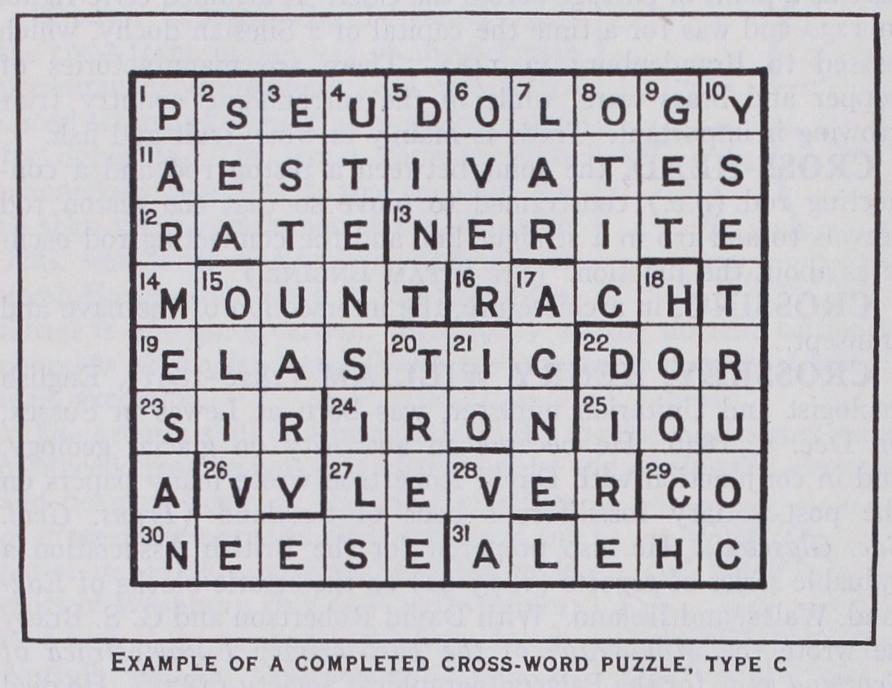
There have been many variations from the "general" type of crossword, and these seem to become increasingly popular. All or most of the words in one puzzle, for instance, will bear upon some announced theme, as cricket, or Gilbert and Sullivan. Again, some clues will be omitted altogether, but a direction be given that the words thus neglected belong to a particular class: jewels, for example, or the words in a quotation. Or every word will have some given prefix, suffix, or part in common, and only the rest of the word will actually fill the spaces in the diagram: (cat)alepsy, (Cat)hay, etc.; unc(tion), cap(tion), etc.; qu(it)e, cr(it)ic, etc.
The crossword is also being used in a few journalistic series as a medium for searching literary and generally recondite examina tion. The puzzle is set with a view to difficulty, though fair diffi culty, and the clues, presented either in prose or verse, are made as allusive as playing upon words or a tortuous humour can make them. This development, though of its nature it can never appeal to the average newspaper reader, has made the crossword popular in circles for which the ordinary type was inevitably too simple.
(E. P. M.)