
CRUSADES, the name given to the series of campaigns undertaken by the Christians of western Europe from I o96 to 1291 for the recovery of the Holy Land from the Mohammedans, so called from the cross worn as a badge by the Crusaders. By analogy the term "crusade" is also given to any campaign undertaken in the same spirit.
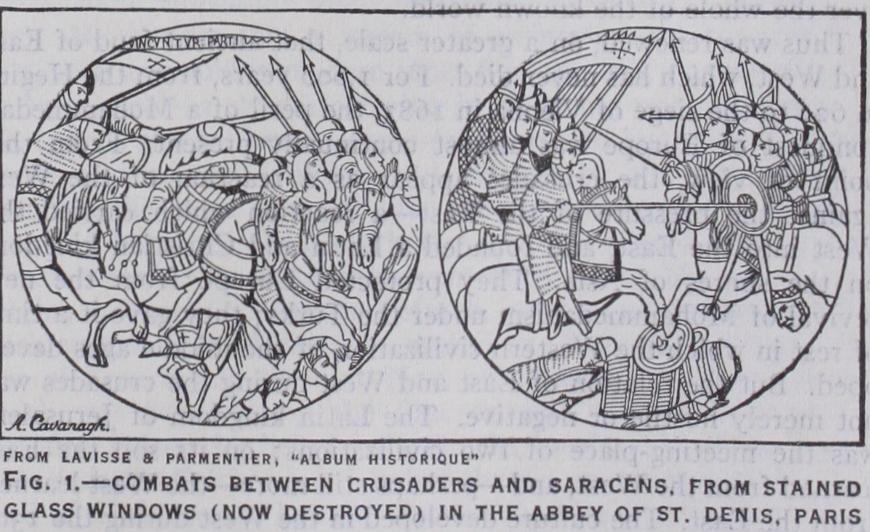
Thus was renewed, on a greater scale, that ancient feud of East and West, which has never died. For 1,000 years, from the Hegira in 622 to the siege of Vienna in 1683, the peril of a Mohammedan conquest of Europe was almost continually present. From this point of view, the crusades appear as a reaction of the West against the pressure of the East—a reaction which carried the West into the East, and founded a Latin and Christian kingdom on the shores of Asia. They protected Europe from the new revival of Mohammedanism under the Turks ; they gave it a time of rest in which the Western civilization of the middle ages devel oped. But the relation of East and West during the crusades was not merely hostile or negative. The Latin kingdom of Jerusalem was the meeting-place of two civilizations : on its soil the East learned from the West, and—perhaps still more—the West learned from the East. The culture developed in the West during the 13th century was not only permitted to develop by the protection of the crusades ; it grew upon materials which the crusades enabled it to import from the East. Yet the debt of Europe to the crusades in this last respect has perhaps been unduly emphasized. Sicily was still more the meeting-place of East and West than the kingdom of Jerusalem ; and the Arabs of Spain gave more to the culture of Europe than the Arabs of Syria.
It was thus natural, for these reasons, that the conquest of the Holy Land should gradually become an object for the ambition of Western Christianity—an object which the papacy, eager to realize its dream of a universal church subject to its sway, would natu rally cherish and attempt to advance. Two causes combined to make this object still more natural and more definite. On the one hand, the reconquest of lost territories from the Mohammedans by Christian Powers had been proceeding steadily for more than 100 years before the first crusade ; on the other hand, the position of the Eastern empire after 1071 was a clear and definite summons to the Christian West, and proved, in the event, the immediate occasion of the holy war. As early as 970 the recovery of the terri tories lost to Mohammedanism in the East had been begun by emperors like Nicephorus Phocas and John Zimisces : they had pushed their conquests, if only for a time, as far as Antioch and Edessa, and the temporary occupation of Jerusalem is attributed to the East Roman arms. At the opposite end of the Mediter ranean, in Spain, the Omayyad caliphate was verging to its fall: the long Spanish crusade against the Moor had begun ; and in 1018 Roger de Toeni was already leading Normans into Catalonia to the aid of the native Spaniard. In the centre of the Mediterranean the fight between Christian and Mohammedan had been long, but was finally inclining in favour of the Christian. The Arabs had begun the conquest of Sicily from the East Roman empire in 827, and they had attacked the mainland of Italy as early as 84o. The popes had put themselves at the head of Italian resistance : in 848 Leo IV. is already promising a sure and certain hope of salvation to those who die in defence of the cross; and by 916, with the cap ture of the Arab fortress on the Garigliano, Italy was safe. Then came the reconquest of the Mediterranean islands near Italy. The Pisans conquered Sardinia at the instigation of Benedict VIII. about 1016; and, in a 3o years' war which lasted from 106o to 1090, the Normans, under a banner blessed by Pope Alexander II., wrested Sicily from the Arabs. The Norman conquest of Sicily may with justice be called a crusade before the crusades; and it cannot but have given some impulse to that later attempt to wrest Syria from the Mohammedans, in which the virtual leader was Bohemund, a scion of the same house which had conquered Sicily. But while the Christians of the West were thus winning fresh ground from the Mohammedans, in the course of the 11th century, the East Roman empire had now to bear the brunt of a Moham medan revival under the Seljuks—a revival which, while it crushed for a time the Greeks, only acted as a new incentive to the Latins to carry their arms to the East. The Seljuk Turks, first the mer cenaries and then the masters of the caliph, had given new life to the decadent caliphate of Baghdad. Under the rule of their sul tans, who assumed the role of mayors of the palace in Baghdad about the middle of the 11th century, they pushed westwards towards the caliphate of Egypt and the East Roman empire. While they wrested Jerusalem from the former (1071), in the same year they inflicted a crushing defeat on the Eastern emperor at Manzikert. The result of the defeat was the loss of almost the whole of Asia Minor ; the dominions of the Turks extended to the Sea of Marmora. An appeal for assistance, such as was often to be heard again in succeeding centuries, was sent by Michael VII. of Constantinople to Gregory VII. in 1073. Gregory listened to the appeal; he projected—not, indeed, as has often been said, a cru sade', but a great expedition, which should recover Asia Minor for the Eastern empire, in return for a union of the Eastern with the Western Church. In 1074 Gregory actually assembled a con siderable army ; but his disagreement with Robert Guiscard, fol lowed by the outbreak of the war of investitures, hindered the realization of his plans, and the only result was a precedent and a suggestion for the events of 1095. The appeal of Michael VII. was re-echoed by Alexius Comnenus himself. Brave and sage as he was, he could hardly cope at one and the same time with the hostility of the Normans on the west, of the Petchenegs (Patzi naks) on the north, and of the Seljuks on the east and south. Already in 1087 and 1088 he had appealed to Baldwin of Flanders, verbally and by letter', for troops ; and Baldwin had answered the appeal. The same appeal was made more than once, to Urban II.; and the answer was the first crusade. The first crusade was not, indeed, what Alexius had asked or expected to receive. He had appealed for reinforcements to recover Asia Minor ; he received hundreds of thousands of troops, independent of him, and intend ing to conquer Jerusalem for themselves, though they might inci dentally recover Asia Minor for the Eastern empire on their way. Alexius may almost be compared to a magician, who has uttered a charm to summon a ministering spirit, and is surrounded on the instant by legions of demons. In truth the appeal of Alexius had set free forces in the West which were independent of, and even • ultimately hostile to, the interests of the Eastern empire.
Mixture of Motives.—The primary force, which thus trans muted an appeal for reinforcements into a holy war for the con quest of Palestine, was the Church. The creative thought of the middle ages is clerical thought. It is the Church which creates the Carolingian empire, because the clergy think in terms of empire. It is the Church which creates the first crusade, because the clergy credits a pope still earlier than Gregory VII. with the idea of a crusade. Silvester II. is said to have preached a general expedi tion for the recovery of Jerusalem, and the same preaching is attributed to Sergius IV. in I011. But the supposed letter of Silvester is a later forgery ; and in i000 the way of the Christian to Jerusalem was still free and open.
believe in penitentiary pilgrimages, and the war against the Seljuks can be turned into a pilgrimage to the Sepulchre; because, again, it wishes to direct the fighting instinct of the laity, and the conse crating name of Jerusalem provides an unimpeachable channel; above all, because the papacy desires a perfect and universal church, and perfect and universal church must rule in the Holy Land. But it would be a mistake to regard the crusades (as it would be a mistake to regard the Carolingian empire) as a pure creation of the Church, or as merely due to the policy of a theoc racy directing men to the holy war which is the only war possible for a theocracy. It would be almost truer, though only half the truth, to say that the clergy gave the name of crusade to sanctify interests and ambitions which, while set on ends other than those of the Church, happened to coincide in their choice of means. There was, for instance, the ambition of the adventurer prince, the younger son, eager to carve a principality in the far East, of whom Bohemund is the type ; there was the interest of Italian towns, anxious to acquire the products of the East more directly and cheaply, by erecting their own emporia in the eastern Mediter ranean. The former was the driving force which made the first crusade successful, where later _crusades, without its stimulus, for the most part failed; the latter was the one staunch ally which alone enabled Baldwin I. and Baldwin II. to create the kingdom of Jerusalem. So far as the crusades led to permanent material results in the East, they did so in virtue of these two forces. Unregulated enthusiasm might of itself have achieved little or nothing; enthusiasm caught and guided by the astute Norman, and the no less astute Venetian or Genoese, could not but achieve tangible results. The principality or the emporium, it is true, would supply motives to the prince and the merchant only; and it may be urged that to the mass of the crusaders the religious motive was all in all. In this way we may return to the view that the first crusade, at any rate, was un fait ecclesiastique. It is indeed true that to thousands the hope of acquiring spiritual merit must have been a great motive ; it is also true, as the records of crusading sermons show, that there was a strong element of "reviv alism" in the crusades, and that thousands were hurried into tak ing the cross by a gust of that uncontrollable enthusiasm which is excited by revivalist meetings to-day. But it must also be admit ted that there were motives of this world to attract the masses to the crusades. Famine and pestilence at home drove men to emi grate hopefully to the golden East. In 1094 there was pestilence from Flanders to Bohemia : in 1095 there was famine in Lorraine. Francigenis occidentalibus facile persuaderi poterat sue rura relin quere ; nam Gallias per annos aliquot nunc seditio civilis, nunc fames, nunc mortalitas nimi ` afflixerat (Ekkehard, Chronica, p. 213) . No wonder that a stream of emigration set towards the East, such as would in modern times flow towards a newly discov ered gold-field—a stream carrying in its turbid waters much ref use, tramps and bankrupts, camp-followers and hucksters, fugitive monks and escaped villeins, and marked by the same motley grouping, the same fever of life, the same alternations of afflu ence and beggary, which mark the rush for a gold-field to-day.
Such were the forces set in movement by Urban II., when, after holding a synod at Piacenza (March, 1095), and receiving there fresh appeals from Alexius, he moved to Clermont, in the south east of France, and there on Nov. 26 delivered the great speech which was followed by the first crusade. In this speech he appealed, indeed, for help for the Greeks, auxilio . . . saepe accla mato indigis (Fulcher i. c. i.) ; but the gist of his speech was the peril of Christianity. Let the truce of God be observed at home; and let the arms of Christians be directed to conquering the infidel in an expedition which should count for full and complete penance. Like Gregory VII., Urban had thus sought for aid for the Eastern empire ; unlike Gregory, who had only mentioned the Holy Sepul chre in a single letter, and then casually, he had struck the note of Jerusalem. The instant cries of Deus vult which answered the note showed that Urban had struck aright. Thousands at once took the cross ; the first was Bishop Adhemar of Puy, whom Urban named his legate and made leader of the first crusade (for the holy war, according to Urban's original conception, must needs be led by a clerk) . Fixing Aug. 15, 1096, as the time for the depar ture of the crusaders, and Constantinople as the general rendez vous, Urban returned from France to Italy. It is noticeable that it was on French soil that the seed had been sown'. Preached in France by a pope of French descent, the crusades began—and they continued—as essentially a French (we may almost say a Norman French) enterprise ; and the kingdom which they established in the East was essentially a French kingdom, in its speech and its customs, its virtues and its vices. It was natural that France should be the home of the crusades. She was already the home of the Cluniac movement, the centre from which radiated the truce of God, the chosen place of chivalry ; she could supply a host of feudal nobles, somewhat loosely tied to their place in society, and ready to break loose for a great enterprise ; she had suffered from battle and murder, pestilence and famine, from which any escape was welcome. To the Normans particularly the crusades had an intimate appeal. They appealed to the old Norse instinct for wan dering—an instinct which, as it had long before sent the Norseman eastward to find his El Dorado in Micklegarth, could now find a natural outlet in the expedition to Jerusalem : they appealed to the Norman religiosity, which had made them a people of pilgrims, the allies of the papacy, and, in England and Sicily, crusaders before the crusades : finally, they appealed to that desire to gain fresh territory, upon which Malaterra remarks as characteristic of Norman princes. No wonder, then, that the crusading armies were recruited in France, or that they were led by men of the stock of the d'Hautevilles. Meanwhile newly conquered England had its own problems to solve ; and Germany, torn by civil war, and not naturally quick to kindle, could only deride the "delirium" of the crusader (Ekkehard, Chronica, p.