
CUCURBITACEAE, a botanical family of dicotyledons, containing 90 genera and about 75o species, found in the tem perate and warmer parts of the earth but especially developed in the tropics. The plants are generally annual herbs, climbing by means of tendrils and having a rapid growth. The long-stalked leaves are arranged alternately, and are generally palmately lobed and veined. The flowers or inflorescences are borne in the leaf axils, in which a vegetative bud is also found, and at the side of the leaf-stalk is a simple or branched tendril. There has been much difference of opinion as to what member or members the tendril represents ; the one which seems most in accordance with facts regards the tendril as a shoot, the lower portion representing the stem, the upper twining portion a leaf. The flowers are uni sexual, and markedly epigynous, the perianth and stamens being attached to a bell-shaped prolongation of the receptacle above the ovary. The five narrow pointed sepals are followed by five petals which are generally united to form a more or less bell-shaped corolla. There are five stamens in the male flowers; the anthers open towards the outside, are one-celled, with the pollen-sacs often elaborately twisted and variously united. The carpels, normally three in number, form an ovary with three thick, fleshy, bifid placentas bearing a large number of ovules on each side, and generally filling the interior of the ovary with a juicy mass. The short thick style has generally three branches, each bearing a fleshy, usually forked stigma. The fruit is a fleshy many-seeded berry with a tough rind (pepo), and often attains considerable size. The embryo completely fills the seed.
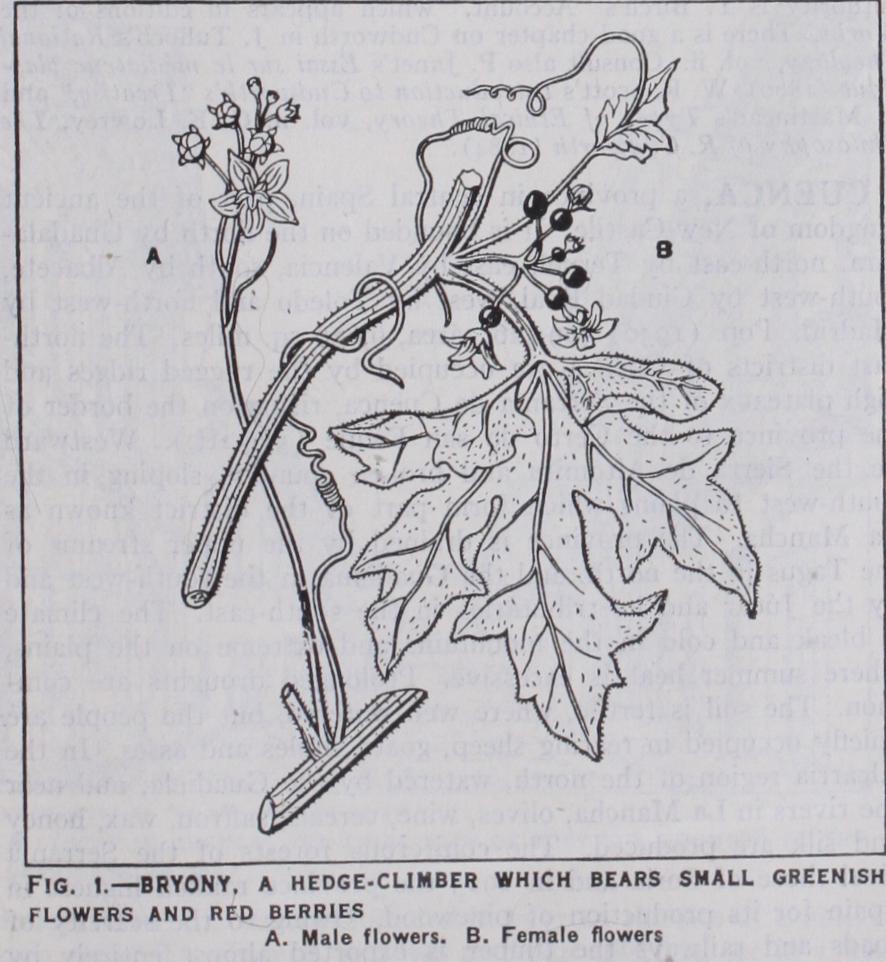
The family is represented in Britain by bryony (Bryonia dioica), (fig. 1) a hedge-climber, perennial by means of large fleshy tubers which send up each year a • number of slender angular stems. The leaves are heart-shaped with wavy margined lobes. The flowers are greenish, - to a in. in diameter; the fruit, a red several-seeded berry, is about 4, in. in diameter.
In North America the family is represented by a few genera comprising about 4o species, which occur chiefly in the southern parts of the United States and Mexico. Among these are the climbing wild cucumber or balsam apple (Echinocystis lobata) and the star-cucumber (Sicyos angulatus), of the eastern United States and Canada; the calabazilla or mock orange (Cucurbita foetidissima), of the southwestern United States and Mexico ; and the man-root (Echinocystis f abacea), of California.
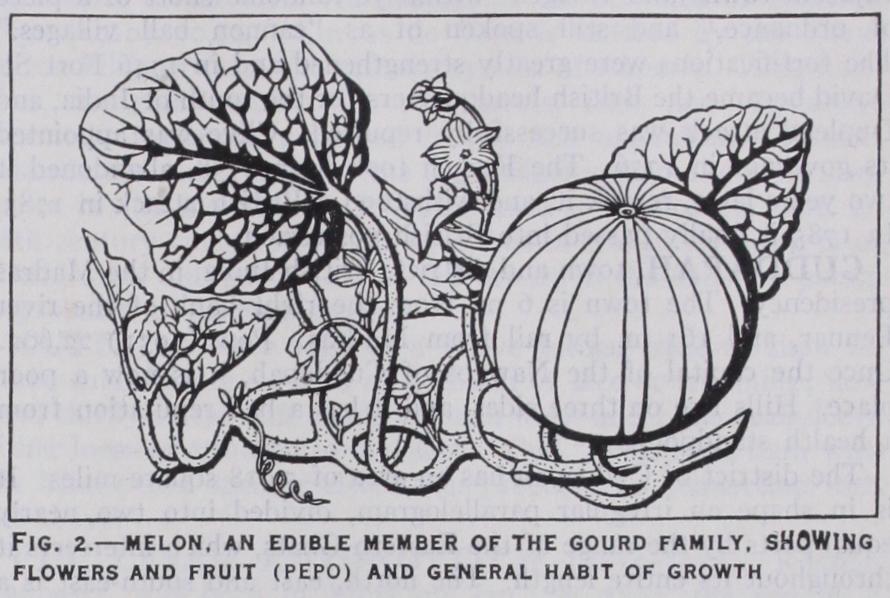
Many genera are of economic importance; Cucumis affords cucumber (q.v.) and melon (q.v.) ; Cucurbita, pumpkin and marrow; Citrullus vulgaris is water-melon, and C. Colocynthis, colocynth; Ecballium Elaterium (squirting cucumber), ejects its seeds, with a watery fluid, by the contraction of the wall of the fruit ; Sechium edule (chocho), a tropical American species, is cultivated for its edible fruit ; it contains one large seed which germinates in situ. Lagenaria is the gourd (q.v.). The fruits of Lu f f a cylindrica have closely netted vascular bundles in the pericarp, forming a kind of loose felt which supplies the well known loofah or bath-sponge.