
CZECH (ech), a name signifying an inhabitant of "Cechy," the native name for Bohemia, but in use confined to the native Slavonic inhabitants of that country and of Moravia. The Czechs, with the Lusatians, Poles and Slovaks, form the west ern group of the Slav family; for their ethnographical position within that family, and their language, see EUROPE : Ethnology. The native home of the Czechs to-day lies in the Czechoslovak republic (see CZECHOSLOVAKIA), in which they are the dominating race, occupying about two-thirds of Bohemia, four-fifths of Moravia, and the districts which formerly were known as Austrian Silesia. To the north-west, west and south they are neighbours with a Germanic population; to the north-east, in the district of Teschen (q.v.) they border on the Poles, the ethnographical dividing line being difficult to draw in this region. Eastward, the Czechs have for neighbours the Slovaks, a race closely akin to them, who inhabit the southern slopes of the northern Carpa thians, in what until 1918 was northern Hungary. While dog matic statement is difficult, there was probably no real distinction between the original "Czechs" and "Slovaks." The accident of history, the former forming, first an independent state, and later a part of Austria, while the latter remained for a thousand years under Hungarian rule, led to separate development, which was accentuated by religious differences. The Slovaks contributed some of the most prominent Panslavist and Czech national apostles of the late 18th and early 19th centuries. Political con siderations, however, led some of them to crystallize Slovak into a literary language, distinct from Czech, and this feeling of Slovak individuality afterwards became a confusing political factor, some of the Slovaks being prepared to sink their differences in their community with the Czechs, even at the cost of some sacri fices, while others considered that the Czechoslovak republic, in which the two nations were united, should have made much greater allowance for the differences between them.
The early history of the Czechs is very obscure, and cannot be discussed apart from that of the Slays in general. Czech legend, as preserved by the chronicler Cosmas of Prague, relates that Cech, a noble of Croatia (probably White Croatia, or Galicia), having committed homicide, fled with his followers to Bohemia, and first settled on the Rip mountain, near Roudnice. The young est of Krok's three daughters, Libusa, became ruler of Bohemia, founded Prague, and married a ploughman, who became the founder of the Nemyslides, or first native Bohemian dynasty.
It is probable that the Slays arrived in Bohemia, which was then tenanted by Germanic tribes, not later than the 7th century A.D., perhaps earlier. They are first mentioned unmistakably in A.D. 805 and the first certain historical state in these provinces is the kingdom of Great Moravia (see MORAVIA), destroyed by the Magyars in 904-905. While Slovakia now passed under Magyar rule, the Czechs founded the kingdom of Bohemia (q.v.), which for centuries was among the most powerful and glorious in Eu rope. During this early period the religious movement among the Czechs (see HUSSITES) influenced all Europe. The Czechs were always in close contact with the Germans who with them in habited Bohemia, and Germanic influence undoubtedly accounted for their cultural development, which in many ways was far in advance of that of any other Slavonic race. Under the Habsburgs, however, and especially in the days of the Counter-Reformation, the Czech national life and language were almost eliminated. The national revival began in the 18th century, and its manifestations filled much of the public life of Austria-Hungary in the 19th century (see AUSTRIA). At last the nation achieved independence, with the Slovaks, in 1918 (see CZECHOSLOVAKIA).
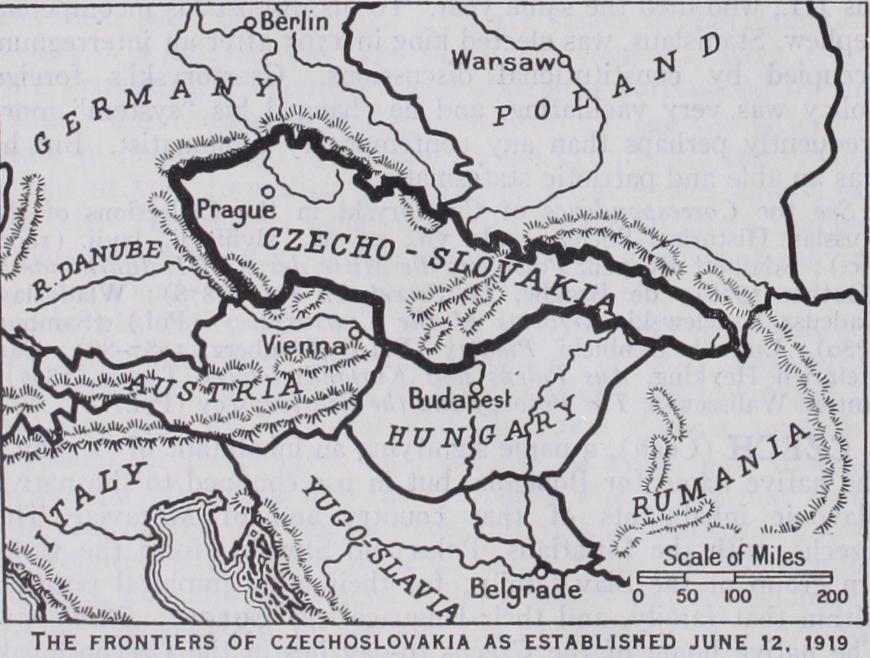
According to the official census of 1918, the Czechs and Slovaks of Czechoslovakia numbered 8,760,937, or 65.5% of the popula tion of that state. There were also considerable colonies in Can ada, the United States of America, and other countries, a large Czech colony in Vienna, and many Slovak settlements in Hun gary. Czechs supplied a very high proportion of the domestic servants and of the tailors in Central Europe, Czech tailors, in particular, thriving even in England. The romantic national call ing of the Slovaks was that of itinerant broom-binders. Besides this, however, Czechs supplied a high proportion of distinguished names in the history of the Austrian empire. They have a fine national literature (see CZECH LANGUAGE AND LITERATURE) and art, while in music they are particularly distinguished. It is suffi cient to mention the names of the Czech composers Dvorak and Smetana. Business in Bohemia and Moravia was largely in the hands of Germans or Jews until the 20th century, when the Czechs began to make rapid progress in this field also.
(C. A. M.)