
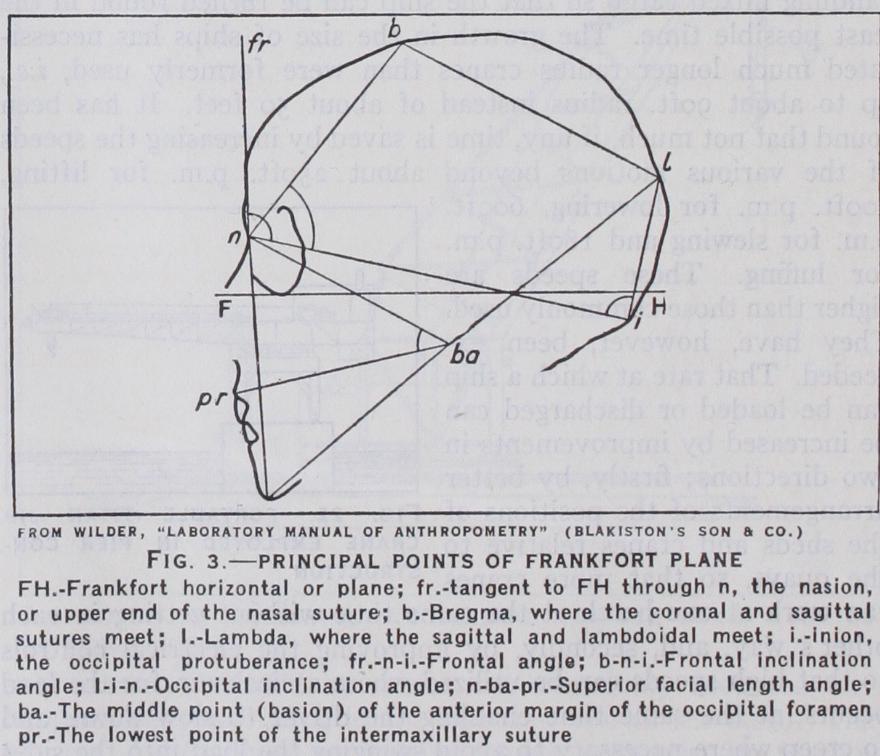
ETRY.) Endocranial casts afford precious indications of the conforma tion of the brain itself. No one feature, no single index, can be held sufficient by itself for definitive classification. Many of the data yielded by craniometry can be contrasted usefully with anal ogous measurements on living subjects which allow information yielding further criteria. (See RACES OF MAN.) The contours and angles of the elements of the skull may be recorded and measured by the diagraph and goniometer.
The third subdivision of craniometric researches is one in which the field of comparison is still further narrowed. For herein the various sub-racial types such as the dark and fair Europeans are brought together for the purposes of comparison or contrast. But although the range of research is thus narrowed and restricted, the guiding principles and the methods remain unchanged. By the method of expressing as a formula two cranial dimensions which have been measured are compared, one skull may be so propor tioned that its greatest width measures 75% of its greatest length (i.e., its width is to its length as three to four) .
This ratio (of 75%) is termed the cephalic or breadth-index. A skull providing a breadth-index of 75 possesses different propor tions from one with an index of 85.
The fourth subdivision of craniometry deals with the com parison of the prehistoric and the recent types of mankind. The methods resemble those em ployed in the comparison of liv ing races ; but in some particular instances where the prehistoric individual is represented only by a comparatively minute portion of the skull, special modifications of the usual procedures are needed.
The complexity of craniomet ric studies has inevitably in creased. International agree ments for the unification of the various measurements have been established, and the application of the methods of statistical sci ence in dealing with large num bers of craniometric data has been greatly developed. (See