
PESTS AND DISEASES OF THE COTTON PLANT Insect is common knowledge that when any plant is cultivated on a large scale various diseases and pests appear. In some cases the pest was already present but of minor importance. As the supply of its favourite food plant is increased, conditions of life for the pest are improved, and it accordingly multiplies also, possibly becoming a serious hindrance to successful cultiva tion. At other times the pest is introduced, and under congenial conditions possibly in the absence of some other organism which keeps it in check in its native country) increases accord ingly. Some idea of the enormous damage wrought by the col lective attacks of individually small and weak animals may be gathered from the fact that a conservative estimate places the loss due to insect attacks on cotton in the United States at the astounding figure of $6o,000,000 (.(i a,000,000) annually. Of this total no less than $40,000,000 (£8,000,000) is credited to a small beetle, the cotton boll weevil, and to two caterpillars.
The cotton boll weevil (Anthonornus grandis) a small grey weevil often called the Mexican boll weevil, is the most serious pest of cotton in the United States, where the damage done by it in 19o7 was estimated at about £5,00O,O00. It steadily increased in destructiveness during the preceding eight years. Attention was drawn to it in 1862, when it caused the abandonment of cot ton cultivation about Monclova in Mexico. About 1893 it ap peared in Texas, and then rapidly spread. It is easily transported from place to place in seed-cotton, and for this reason the Egyptian government in 1904 prohibited the importation of American cotton seed. Not only is the pest carried from place to place, but it also migrates, and in 1907 it crossed from Louisiana, where it first appeared in 1905, to Mississippi. That the insect is likely to prove adaptable is perhaps indicated by the fact that in 1906 it made a northward advance of about 6om. in a season with no obvious special features favouring the pest. Its eastern prog ress was also rapid. "The additional territory infested during 1904 aggregates about i 5,000sq.m., representing approximately an area devoted to the culture of cotton of 90o,000ac." (Year book, United States Dept. Agriculture, 19o4). In 1906 the addi tional area invaded amounted to i,5oo,000 acres (ibid., 1906).
The adult weevils puncture the young flower-buds and deposit eggs; and as the grubs from the eggs develop, the bud drops. They also lay eggs later in the year in the young bolls. These do not drop, but as the grubs develop the cotton is ruined and the bolls usually become discolored and crack, their contents being ren dered useless.
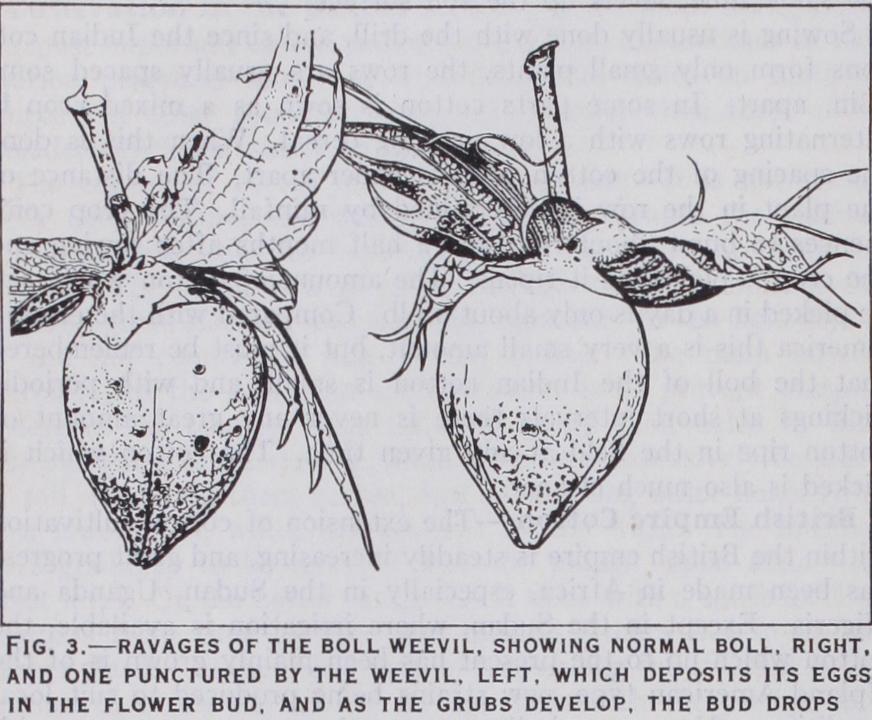
No certain remedy is known for the destruction on a com mercial scale of the boll weevil, but every effort has been made in the United States to check the advance of the insect, to ascertain and to encourage its natural enemies and to propagate races of cotton which resist its attacks.
The cotton boll worm (Chloridea obsoleta, also known as Heliothis armiger) is a caterpillar. The parent moth lays eggs, from which the young "worms" hatch out. They bore holes and penetrate into flower-buds and young bolls, causing them to drop. Fortunately, the "worms" prefer maize to cotton, and the inter planting at proper times of maize, to be cut down and destroyed when well infested, is a method commonly employed to keep down this pest. Paris green kills it in its young stages before it has entered the buds or bolls. The boll worm is most destructive in the south-western States of the United States, where the damage done is said to vary from 2 to 6o% of the crop. The boll worm is widely spread through the tropical and temperate zones. It may occur in a country without being a pest to cotton ; e.g., in India it attacks various plants but not cotton.
The Egyptian boll worm (Earias insulana) is an important in sect pest in Egypt and occurs also in other parts of Africa. Indian boll worms include the same species, and the closely related Earias fabia, which also occurs in Egypt.
The cotton worm (Aletia argillacea)—also called cotton cater pillar, cotton army worm, cotton-leaf worm—is also one stage in the life-history of a moth. It is a voracious creature, and un checked will often totally destroy a crop. Dusting with paris green is, however, an efficient remedy if promptly applied at the outset of the attack. It is the most serious pest of cotton in the West Indies. The Egyptian cotton worm is Prodenia littoralis.
The caterpillars ("cut worms") of various species of Agrotis and other moths occur in all parts of the world and attack young cotton. They can be killed by spreading about bran, etc., poisoned with paris green.
Locusts, green-fly, leaf-bugs, blister mites and various other pests also damage cotton, in a similar way to that in which they injure other crops.
The "cotton stainers," various species of Dysdercus, are widely distributed, occurring in America, the West Indies, Africa, India, etc. The larvae suck the sap from the young bolls and seeds, caus ing shrivelling and reduction in quantity of fibre. They are called "stainers" because their excrement is yellow and stains the fibre; also if crushed during the process of ginning they give the cotton a reddish coloration. The Egyptian cotton-seed bug or cotton stainer belongs to another genus, being Oxycarenus hyalinipennis. Other species of this genus occur on the west coast of Africa. They do considerable damage to cotton seed.
The pink boll worm (Gelechia gossypiella) is a serious and widespread cotton pest found in India, Ceylon, Burma, Straits Settlements, Japan, Philippine islands, East and West Africa, Zanzibar, Egypt and the Sudan. Its original home is probably India, whence it has been distributed in seed, etc. The larvae in the seed may remain dormant for over a year. It may also be spread in unginned samples, bales of cotton still containing some cotton seed, or by resting pink boll worms spun up in folds of jute covering the bales. Its aestivating powers show it to have come from some country where long, hot and rainless periods occur, where little vegetation could exist at all. In some coun tries, notably Egypt, its spread has been rapid since its introduc tion. It causes loss by direct damage to the crop and indirect by loss of fibre and loss of seed. The little moth which has a wing expanse of about s of an inch, has brownish upper wings with darker brown markings, grey hind wings and long fringes. It lays its eggs on cotton anti species of Hibiscus and probably wild Malvaceae ; they, are laid under the surface of the leaves and on the cotton bolls, and on the seed capsules of Hibiscus. The egg hatches in from three to seven days; at first the egg is pallid but becomes orange-red. Young larvae are yellowish and are active, and they may immediately bore into a boll, or feed for a short time on the leaves. When in the boll they become white and then pink or red. They feed on the seed and so may reduce the crop, or even stop all cotton formation. The larvae feed for two or three weeks and eventually reach half an inch long. They later leave the bolls by a more or less circular exit and pupate in a slight cocoon in or under shelter on the ground. Later broods, instead of leaving the bolls, pupate in the interior of the seed or between them and remain in the larvae stage some time, and later change to the moth. Generally winter is passed in the larvae stage spun up in the seed or in refuse, or buildings where seed has been stored. Practically all cotton refuse will help to hold it over the resting period. Control consists of destroying infested bolls, the Hibiscus and other food hosts, etc. More especially must the seed be treated; this is done by subjecting the seed to the fumes of disulphide of carbon, or hydrocyanic acid gas, or better still, heat. When possible seed may be sun-dried, as is done in the Sudan. The pink boll worm has several natural enemies including the predaceous acarid (Pediculoides ventricosus), but none seem to have any effectual control.
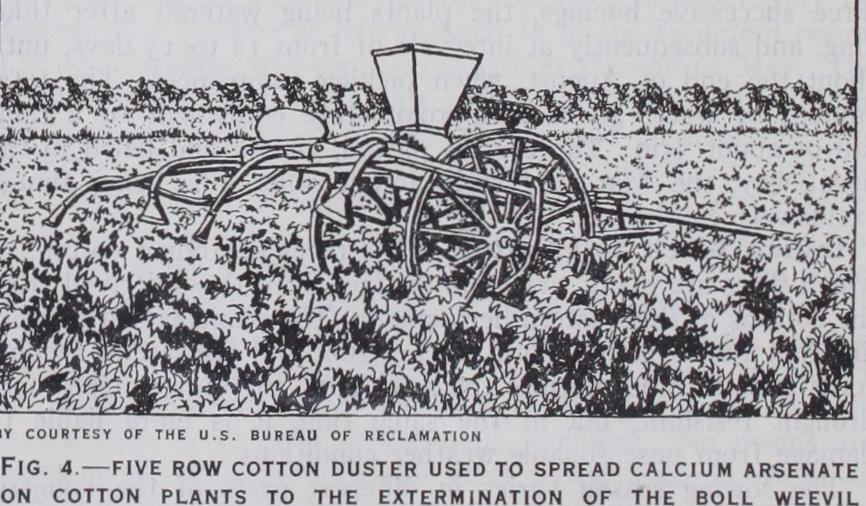
The Cotton Aphis (Aphis gossypii, Glover) is also often harm ful to cotton all over the world.
In "root rot," as the name implies, the roots are attacked, the fungus being a species of Ozonium, which envelops the roots in a white covering of mould or mycelium. The roots are prevented from fulfilling their function of taking up water and salts from the soil; the leaves accordingly droop, and the whole plant wilts and in bad attacks dies. It has yearly proved a more serious danger in Texas and other parts of the south-west of the United States. No remedy is known for the disease, and cotton should not be planted on infected land for at least three or four years.
"Boll rot" or "Anthracnose" is a disease which may at times be sufficiently serious to destroy from I o to 5o% of the crop. The fungus which causes it (Colletotrichum gossypii) is closely related to one of the fungi-attacking sugarcane in various parts of the world. Small red-brown spots appear on the bolls, gradually enlarge, and develop into irregular black and grey patches. Many other diseases occur, but the above are sufficient to indicate some of the principal ones in the most important cotton countries of the world. (X.)