
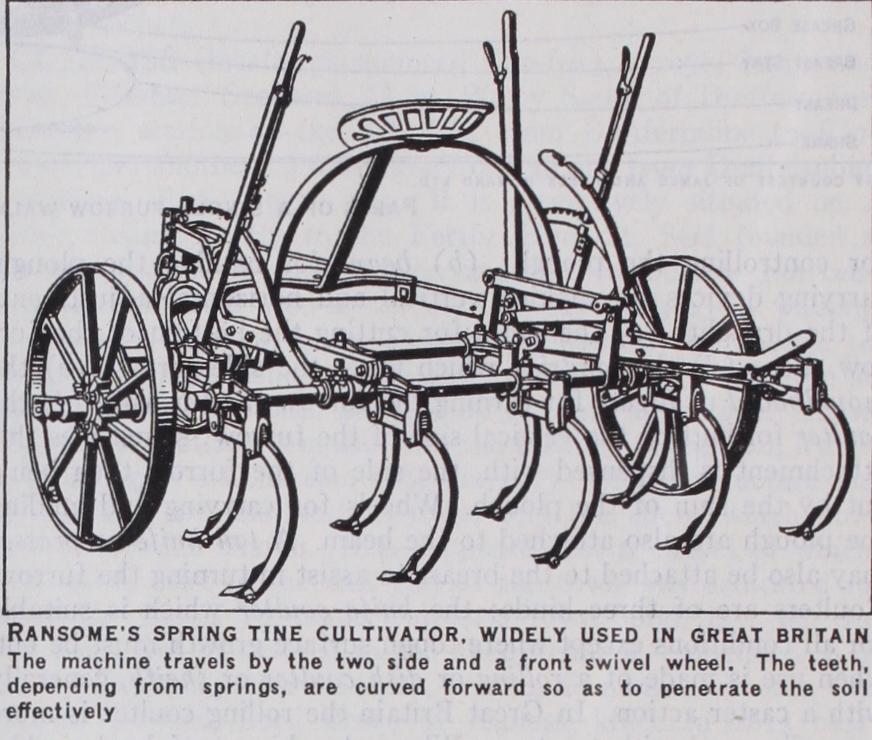
PULVERIZING AND CONSOLIDATING IMPLEMENTS After land has been ploughed it must be broken down into very fine particles and consolidated in order to form a seed-bed. The chief pulverizing implements are cultivators, harrows and rollers. Cultivators and harrows work practically on the same principle and use either tines or teeth, which are drawn through the soil, or disks which cut into the surface; but the cultivator works to a greater depth than the harrow. Except in the case of seed har rows, rigid tines are generally inclined forward to penetrate the soil. Spring tines, which depend upon C or S springs or coiled springs, are curved forwards and so attain the same end : they are less liable to breakage than rigid tines and are as a rule more effective in pulverizing the soil. Tines may be provided with de tachable and replaceable points varying in shape, according to the purpose in view, from chisel points to broad duck-foot shares, the latter being intended less for pulverizing the soil than for under cutting weeds. Disks are particularly useful on hard ground or when turf has been ploughed in.
Disk harrows have saucer-shaped disks from i 2 to coin. in diameter which may be set at varying angles to the direction of travel. The disks pulverize and loosen the soil by their eccentric motion, producing much the same effect as a disk plough but giving a finer tilth. They are particularly useful for preparing a seed-bed when turf has been ploughed in, and are also used in America be fore ploughing hard, dry ground, to facilitate subsequent opera tions. They will also aid in working out annual weeds, but if used upon land infested with twitch or couch grass will tend to spread the weed. The disks may be either full-bladed or cut-away. The former are used for general purposes and the latter for deeper and coarser cultivation particularly on stony land. Disk harrows for tractor haulage have transport wheels and lever adjustments which usually work on the self-lift principle. A common practice is to use two disk harrows tandem fashion with tractors, the front disks throwing the soil upwards and the others inwards.
Excellent work has been performed by these machines and for garden and orchard cultivation and for some forms of tropical agriculture their usefulness appears to be established. It is yet open to question whether in temperate regions rotary tillage can satisfactorily replace the action of the weather in breaking down furrows set up in autumn ploughing.
Rollers.—These implements are used to consolidate the soil, to crush clods and to smooth the surface. The consolidation of the seed-bed affects the aeration and moisture content of the soil and the proper use of the roller is of great importance. The fiat, smooth or land roller which may be of steel, wrought iron, wood or even stone, is constructed in two or three sections to facilitate turning. A common width for a roller is seven feet, with a diam eter from 18 to 20 inches. The weight may vary between 7 and i 2 cwt., Cambridge or ridge rollers consist of a number of rings two to three inches wide which taper to a point and are used for crush ing clods as well as consolidating the land. Size for size they are slightly heavier than the flat roller and have a slightly heavier draught. Since the ribbed surface which they leave is less liable to coalesce after heavy rain than a flat surface, they are very useful on heavy land. In America it is a common practice to use two sets of rollers so hitched that the front ridges are cut by the sec ond set. For clod crushing on heavy land bar or tubular rollers may be used and also crosskill rollers which have serrated rings. Land pressers or subsurface packers, consisting of a number of heavy wheels about three feet. in diameter, are used in dry dis tricts to consolidate the soil at the bottom of the furrow.