
DOCK GATES, CAISSONS, ETC.
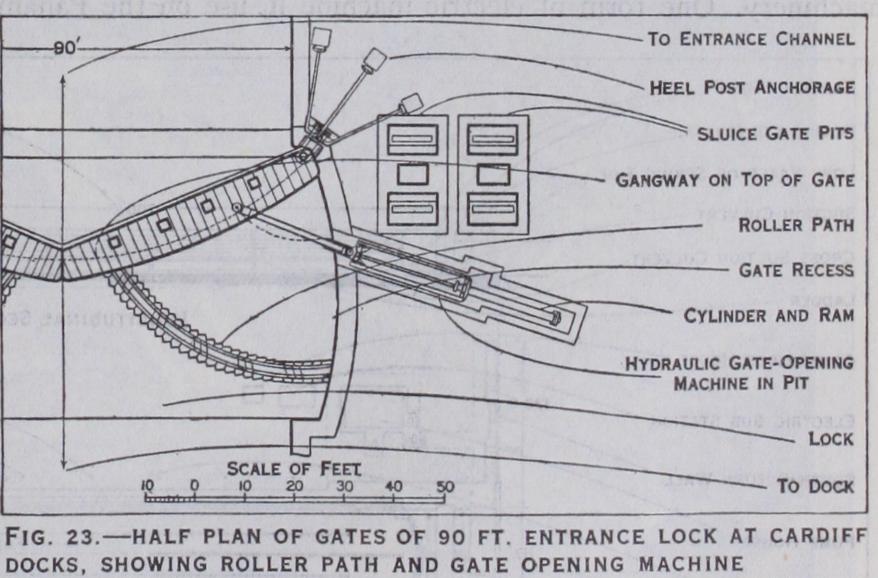
Wooden gates consist of a series of horizontal framed beams, made thicker and placed closer together towards the bottom to re sist the water-pressure which increases with the depth. The beams are framed and fastened to the heel post and mitre post at the ends and there are usually intermediate uprights. On the inner face watertight planking is fixed (fig. 2 I) .
Steel gates have generally an outer as well as an inner skin of plating braced vertically and horizontally by steel plate ribs and girders. Steel gates have the important advantage over those built of timber in that they can be made with buoyancy chambers which relieve the gate anchorage at the head of the heel post of a great part of the horizontal stress, due to the weight of the gate, and the pivot support, at its foot, of all weight except so much as is necessary to prevent the gate floating out of its seat :mg. They are thus much easier to move in the water than wooden gates. On the other hand the latter are less likely to be seriously damaged if run into by a vessel. All anchorages and supports of a steel gate should, however, be made strong enough to sustain its weight in the event of the buoyancy chambers becoming water logged.
The adoption of the semi-buoyant type of steel gate, now generally employed in modern docks, has made it possible to dispense with the roller and roller path under the gate near the mitre post formerly provided to sustain the weight. These were always a source of trouble and anxiety and their use is now practically abandoned in new construction. The buoyancy of the gate is maintained at a practically constant value by construct ing the watertight air or buoyancy cham ber in the lower part of the gate, all the chambers formed by the skin plating above the watertight compartments being open on the outside face to the free flow of the tide. Thus, so long as the buoyancy cham bers are submerged, the unbalanced weight remains practically unchanged whatever the depth of water may be. In this way the unfloated weight of the gate can be reduced to a few tons.
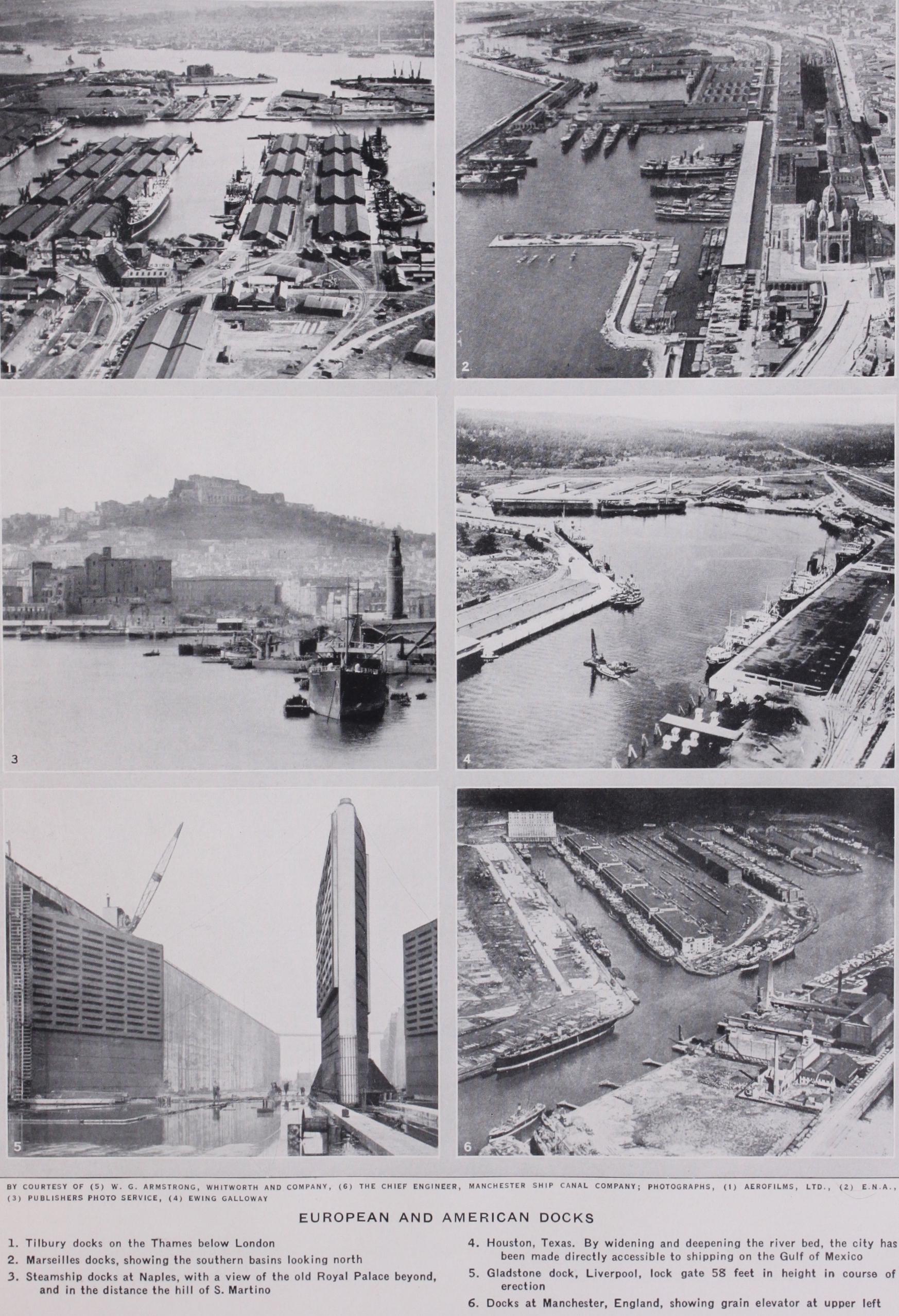
Formerly dock gates were sometimes made segmental in plan on both faces with the inner faces forming a continuous circu lar arc. It is now usual to make gates with perfectly straight faces on the sill side, the pressure or inside faces being either curved or polygonal. Fig. 2 2 illustrates one of the Gladstone lock gates with curved inner face which weighs 496 tons. The width of a gate leaf at its centre is usually made about -A- of its length.
The pressures produced by a head of water against gates when closed depend not only on the form of the gates but also upon the projection given to the mitre of the sill in proportion to the width of the opening. This projection is called the "rise" of the gate and is usually about (more or less) the width of the open ing. In straight gates, the stresses consist : first, of a transverse stress due to the water pressure against the gate and, secondly, of a compressive stress along the gate, resulting from the pres sure of the other gate against its meeting post. This pressure varies inversely with the rise. Though an increase in the rise re duces this stress, it increases the length of the gate and the transverse stress, and also the length of the chamber. By curv ing the gates, the transverse stress is reduced and the longitudinal compressive stress is augmented, till at last, when the gates f orm a horizontal segmental arch, the stresses become wholly compres sive. The straight fronted and curved or straight backed gate now usually adopted is a compromise mainly dictated by prac tical considerations. Gates are, however, always designed so that the horizontal line of thrust falls within the skin plating.
Storm gates, pointing in the reverse direction to the Impounding gates and placed outside them, are occasionally employed in en trances which are subjected at times to extraordinarily high tides, floods or strong wave action. Strut gates are auxiliary hinged and framed shores, housed at the back of the gate recess. They can be swung into position at the back of the impounding gates to support them against the pressure of waves at or about high water in exposed situations. Single leaf semi-buoyant gates, hinged on a horizontal axis below the level of the sill, have been used in some dry dock entrances. The gate is lowered into the water to open the entrance until it lies flat on a platform or apron outside and below the level of the sill.
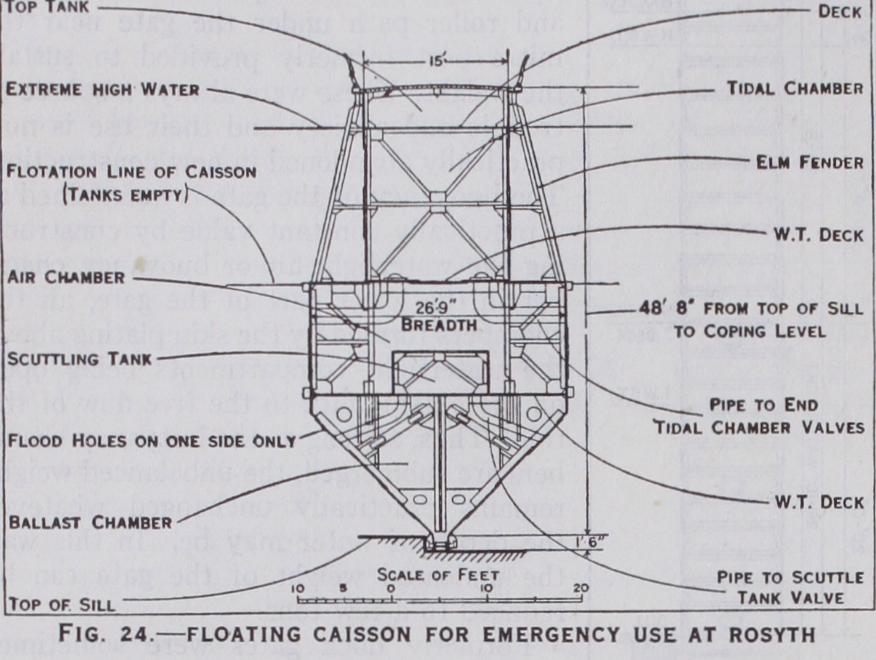
The second and third types require a long recess or "camber" to be formed in the side of the entrance into which the caisson may be withdrawn when the passage is to be opened. In a few cases, e.g., a dry dock at Dundee, floating caissons have been hinged at one end and arranged to swing out into a recess in the dock wall. Floating caissons are in use for closing many dry docks. They are also often provided at wet docks for emergency use and for closing entrances when a sliding caisson is, or gates are, taken out for repairs (fig. 24) .
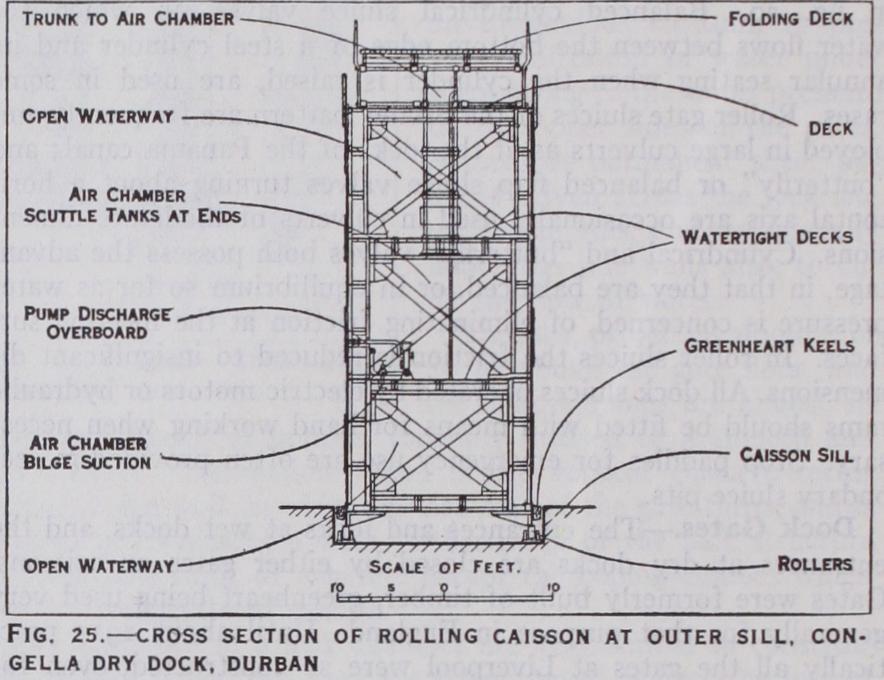
One of the earliest examples of a rolling caisson was used at the Garvel dry dock, Greenock, in 1874. Other instances of their use are at the entrance lock of the Bruges ship canal, the Congella dry dock, Durban (1925) (fig. 25) ; the Kruisschans lock, Ant werp (1927) ; and the new Ymuiden lock (1928). The three caissons at the latter are the largest in the world.
For closing the entrances of large dry docks sliding caissons have been adopted in many recent instances (see table III.) . They are employed less frequently in the case of wet docks and locks, but of this use there are, however, important examples. Thus, most of the recent naval wet dock entrances in Great Britain, including Rosyth and Portsmouth, are closed by sliding caissons as is also the i 4of t. entrance, made in 1917, at Cammell Laird & Co.'s fitting out dock at Tranmere on the Mersey. Among commercial docks they are in use at Bremen and Bremerhaven, and at the Ramsden dock, Barrow. A recent example is the Calcutta lock (building, 1928).
A floating caisson is occasionally made to draw back into a camber and in this form differs but slightly from a sliding cais son. The large dry dock at Havre (19 2 7) is closed by a caisson of this type. Sliding or rolling caissons, although more costly than simple floating caissons, are more easily and rapidly moved.
In situations where it is necessary to provide for carrying a road or railway over a sliding or rolling caisson, one or other of two methods is usually adopted for effecting this. In the first the cam ber is covered by a fixed roof carrying the rail tracks, and a lower ing platform forms the deck of the caisson and is depressed before the latter is hauled into the recess (fig, 25). In the alternative arrangement the roof of the camber itself is carried on elevating jacks which raise it sufficiently to allow the caisson to be run in under it, only the guard railings at the sides of the caisson deck being lowered. A modification of this arrangement is used in British naval docks. The ways on which the caisson slides are formed on a gradient sloping downwards into the camber and the movable deck is hinged at the inner end and raised at the outer end to allow the caisson to pass under it. The caisson when in the camber is at a level which will allow the deck to be again lowered into its normal position flush with the coping.

Sliding and rolling caissons are hauled in and out of the cam bers by means of wire ropes or chains and hauling machinery. The large sliding caisson at Portsmouth is hauled by compressed air motors; those at Rosyth, the Gladstone dry dock, Liverpool, and the Congella dock, Durban, in South Africa, are operated electrically.