
COMPOSITION OF COMMON FOODSTUFFS The composition of the common foodstuffs must now be sur veyed.
Table of composition and calorie value of more important foodstuffs adopted by the Inter-Allied Scientific Food Commission. (The carbohydrate content is not quoted but is taken into account in calculating the energy values.) The percentage carbohydrate content of the different classes of food are: cereals 66-75; meat and poultry, eggs, fish, butter, olive oil, nothing or a trace; milk 5; cheese 24; peas and beans 6o; potatoes 14-18; fruits 4-14; starch 9o; sugar ioo.
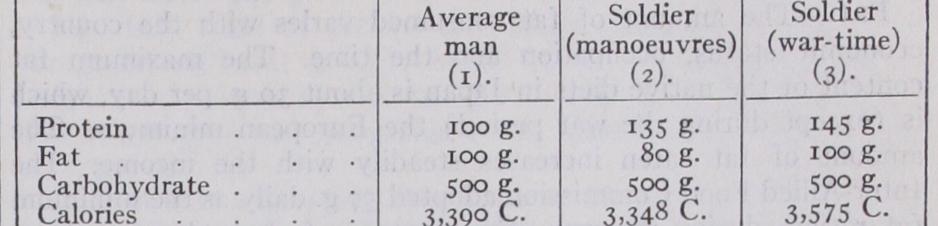
The percentage composition of bread is: protein 9.o, fat 1.5, carbohydrate 53, calories ',zoo per lb.
The proportions of protein, carbohydrates and fat in a normal diet have been given somewhat differently by different authorities.
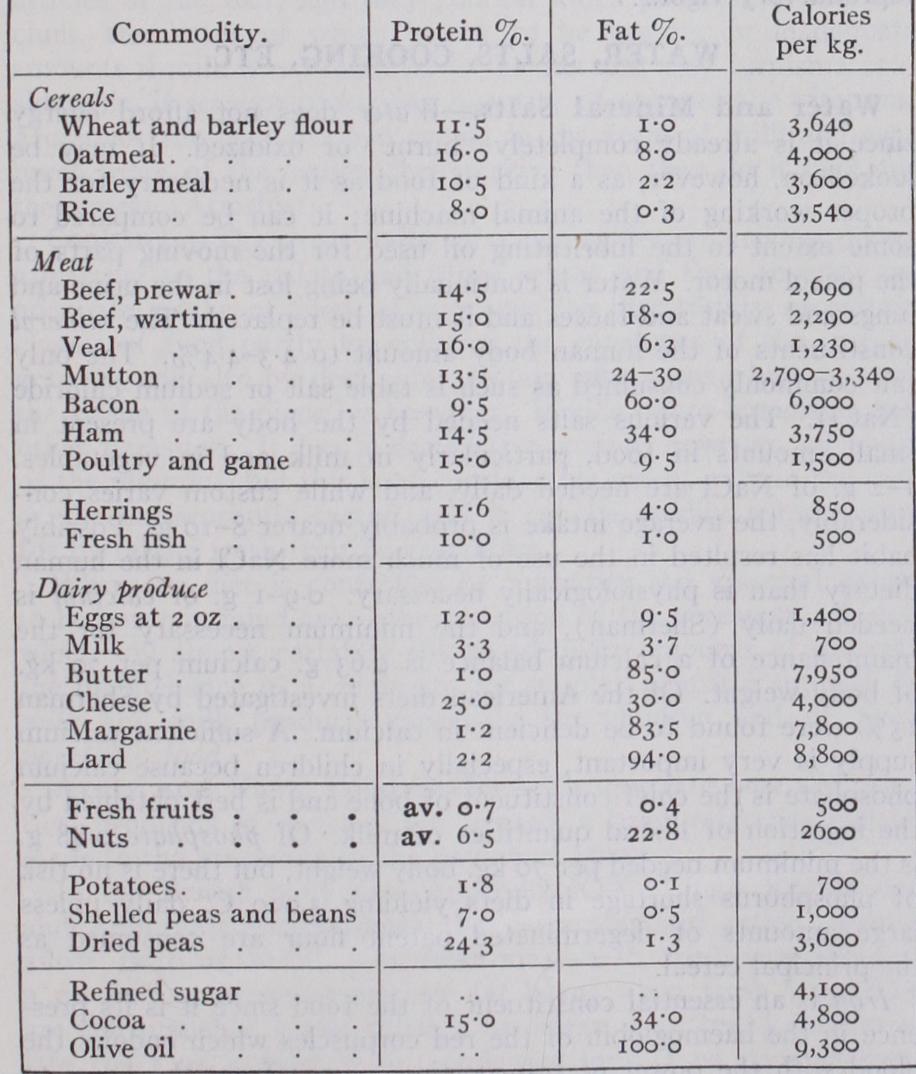
(I) Royal Society Food (War) Committee; (2) and (3) from Voit.
Anywhere in the world except among the destitute, the protein consumption does not fall below g. per kilo. per diem, or 7o g. for a man of average weight ; in N. Europe and the U.S.A. the figure is more like 1.3 g. to 1.5 g. per kilo. or about oo g. per man. 8.5% of the total calories needed are obtained from protein in the Orient and among the poorer classes of mankind; 18 to 19% in Swedish and Finnish diets; 44% among the Esquimaux; the average for normal diets is 12-15% and only exceeds 18% in exceptional circumstances. The amount of protein consumed varies directly with the wealth and social position of the indi vidual; it is not increased in the case of men doing hard work. Thus the lumber men of Maine or Sweden who consume 8,000 9,000 calories daily, obtain only io.5% of their calories from pro tein and about 58% from fat.
The minimum protein requirements are probably 3o to 4o g. per day, provided that the protein is of the proper constitution. On such a ration, if enough carbohydrate and fat is consumed to provide the full energy requirements of the individual nitrogenous balance may be maintained, the amount of nitrogen lost (chiefly in the urine), being no greater than the amount ingested. But with certain kinds of protein it is impossible to obtain nitrogen balance no matter how much is consumed. Some of the amino acids present in protein are essential for the proper functioning of the body, presumably because they cannot be synthesized and so must be provided in the food and serve for the formation of essential secretions or enzymes. These amino-acids are trypto phane, tyrosine, lysine, cystine and histidine. Without trypto phane or histidine body weight cannot be maintained; without lysine growth cannot occur. Adequate amounts of cystine are essential if a normal rate of growth is to occur. Proteins which are deficient in any of these amino-acids are of inferior biological value and cannot in themselves produce healthy development. Gliadin of wheat contains no lysine; zein of maize is deficient in tryptophane and lysine; gelatin contains no tryptophane or tyro sine; casein is deficient in cystine but together with the lactalbu men of milk forms a satisfactory source of protein. Proteins which contain all the essential amino-acids are ovalbumen (egg), glutein (wheat), glutelin (maize), excelsin (brazil nut), lactal bumen (milk).
Experiments have been carried out by Chittenden, Hindhede and others, in which nitrogenous equilibrium, unimpaired health, and mental and physical vigour have been maintained for months or years on diets which contained no more than 3o to so g. protein daily. But the proteins were specially selected and were of high biological value. To provide a margin of safety when consuming a mixed diet, a minimum of 8o g. should be aimed at and this tallies better with the general experience of mankind. Bayliss said "Take care of the calories and the proteins will take care of themselves" because if dietaries are studied it is found that if the calorie value of a mixed diet is adequate it will probably contain ioo g. of protein or even more.
Vegetable proteins as a class are rather less effective as body builders, but there are marked exceptions; the proteins of potato being one of the most efficient. The mixed proteins of wheat or maize as found in flour or meal will maintain nitrogenous equilib riuni at a fairly low level, particularly if whole grain is used and if it be supplemented by small quantities of other proteins such as those of milk.
The bulk of the food becomes of importance when the total energy requirements of the body are very large. Weight for weight fat has double the calorie value of starch or sugar. Fat, in addition, is taken without admixture in a pure form, whereas the other foods are all mixed with a considerable proportion of water; when starch is cooked it is swollen up with five to ten times its volume of water. As has been pointed out, the Swedish and Ameri can lumbermen and the Welsh miners obtain a large part of their huge calorie intake from fat. Carbohydrates are more subject to fermentative changes in the intestine with the production of gases and general discomfort. A study of dietaries shows that a normal diet of 3,00o C. should contain 75 g. fat (698 C.) ; the proportion of fat in the diet may be increased to 35% of the total calories where there is abundance of animal food ; the fat ration should always be high if there is a large increase in the energy expenditure of the body, either in the form of work or in consequence of exposure to cold (Starling) .
As is shown below, the animal fats are the most important sources of some of the vitamins; i.e., A, D and E. The vegetable fats are an equally effective source of energy, but are deficient in vitamins. It is advisable from the point of view of the health of the community that margarine should not be made exclusively from vegetable oils, but should have added to it animal fats (not lard) or milk fats.
Vitamin A (fat soluble A) is found associated with certain animal fats; e.g., butter, cream, beef-fat, cod liver oil, eggs and the embryo of seeds; and green vegetables. It is absent from root vegetables and from vegetable fats; e.g., linseed oil, olive oil. It is not found to any extent in lard. It is therefore absent in purely vegetable margarine. It is a fairly stable substance and can resist the ordinary processes of cooking. It is essential for growth in young animals and promotes the resistance of the various mucous membranes, as of the intestinal or respiratory tract or the eye, against infection. In its absence disorders like broncho-pneumo nia, enteritis and inflammation of the eyes are common.
Vitamin B (water soluble B) is found in most natural foodstuffs, especially in seeds and eggs. In the pulses it is found throughout the seed; in the cereals it is only found in the germ and the bran. It is present in yeast. It is absent from white flour and is apparently present in inadequate amounts in white bread, in spite of the yeast which is added previous to baking. Wholemeal bread is an important source of the vitamin. This vitamin probably exerts a specific stimulating action on the functions of the diges. tive tract, increases the movements of the bowel and aids effective digestion and absorption of the food.
Vitamin C (antiscorbutic vitamin) is found in fresh foodstuffs: fruit juices; e.g., lemon, orange ; vegetables; e.g., raw cabbage leaves, raw juice of swedes, and to some extent in potato. It is present in small amounts in fresh milk, and it is formed during the process of germination of seeds. This vitamin is rapidly destroyed by heating at 100° C. (especially in an alkaline medium) and by drying. It is absent from dried, canned or preserved foods. The absence of the vitamin results in a condition called scurvy which is characterized by haemorrhages from different parts of the body.
Vitamin D (anti-rachitic vitamin) has a very similar distribu tion in nature to Vitamin A. It can be synthesized from a complex lipoid, ergosterol, by means of ultra-violet rays. It is present in cod-liver oil, beef suet, lard and to a less extent in vegetable fats. It is believed to promote the absorption of calcium and phos phorus from the bowel and thus ensure sufficient concentrations of these substances in the blood to ensure normal development of the skeleton.
Vitamin E is a recently described accessory factor which is necessary for fertility in both sexes. It is present in whole wheat, wheat germ, lettuce, rolled oats and milk fat.
It is clear from this brief survey of the distribution and prop erties of the vitamins that animal fats, eggs, milk, fresh fruit and vegetables and whole cereals should be present in adequate amounts in the dietary to ensure normal growth, health and reproductory vigour.