
DOMESTIC SERVICE, employment in household service. In this branch of employment in Great Britain, females outnum ber males by about five to one. At the census of 1921, this group was included under the heading "personal service" in the occupa tional classification, the figures being as follows:— Nearly one-third of all female workers and about io% of all females aged 12 and upwards enumerated were found to be em ployed in personal service. These proportions would, of course, be immensely increased if account could also be taken of those females not working for payment or profit who were occupied with the domestic duties of the home, of which the occupations within this classification may he regarded as an extension.
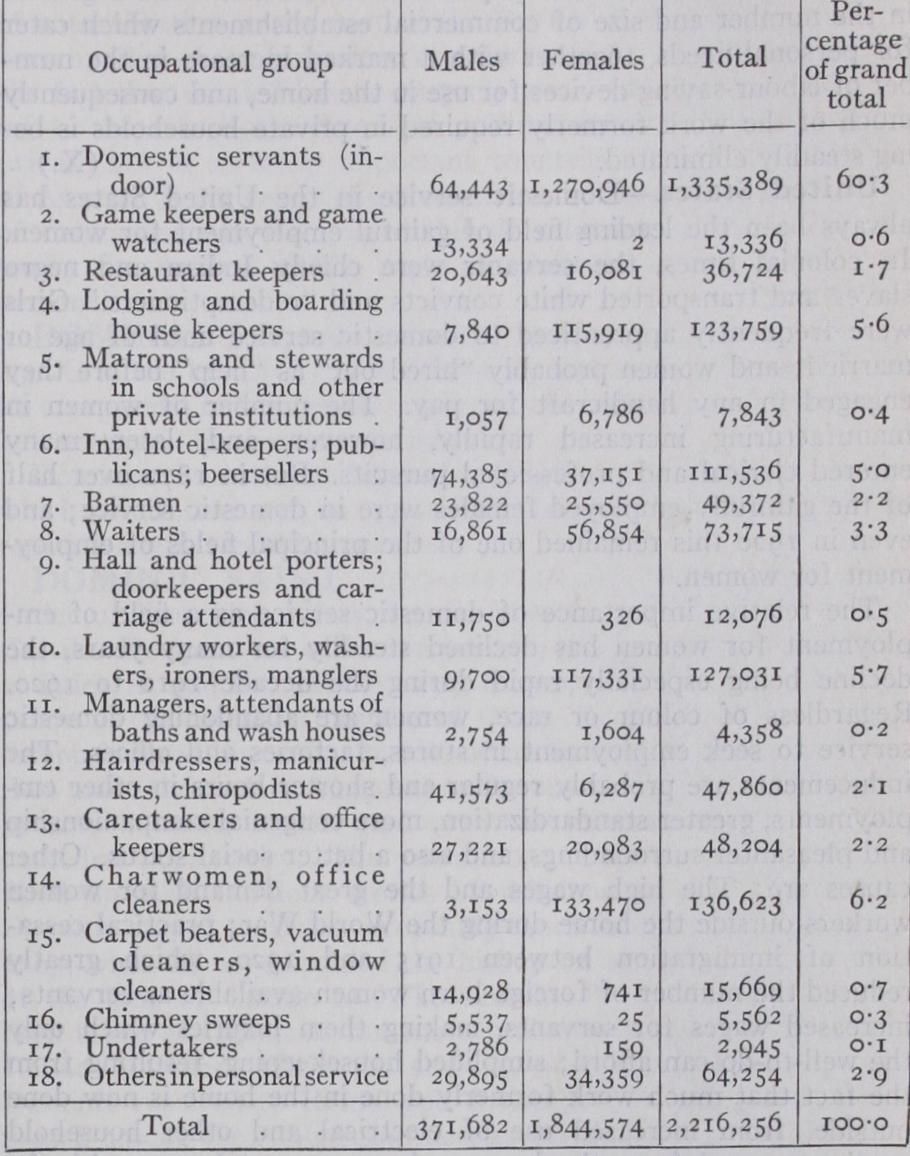
Between 1881 and 1901 the number of females engaged in indoor domestic service (including service in hotels, lodging houses and eating houses, as well as in private families) increased from 1,230,406 to 1,330,783, or by about 8%. This rate of in crease was much below that of the population as a whole. In 1881 there were in England and Wales approximately 123 female domestic indoor servants to every i,000 of the population aged ten years and upwards, 47 per i,000 of the total population and 218 per i,000 families. By 1901 the ratio had declined to Ioi per I,000 of the population aged ten years and upwards, 41 per ',coo of the total population and 189 per i,000 families. In Scotland the ratio of the population aged ten years and upwards fell dur ing the same period from 91 per i,000 to 8o per i,000.
Changes introduced in 1921 into the basis of classification pre vent comparison of the foregoing occupational statistics to the re sults of the census of 1921. The figures already quoted include all domestic servants, whether employed in private families or in establishments which were carried on for purposes of gain. It is possible, however, to make a rough comparison between the results of the censuses of 1911 and 1921 so far as they relate to private personal service and to service in hotels, boarding houses, etc.
In England and Wales, between 1911 and 1921, the number of females in private personal service declined from about I, 261,00o to about 1,005,000, or by over 20%. This represents a decline from 159 per i,000 families in 1911 to I I S in 1921. In the same period the number of males in private personal service decreased from 266,00o to 227,000, or by 14.6%.
The tendencies in the various branches of the personal service group outlined above, when looked at as a whole, may also re flect in some degree changes which are occurring in the social habits, of a section of the population. There has been a growth in the number and size of commercial establishments which cater for personal needs, together with a marked increase in the num ber of labour-saving devices for use in the home, and consequently much of the work formerly required in private households is be ing steadily eliminated. (X.) United States.—Domestic service in the United States has always been the leading field of gainful employment for women. In colonial times, the servants were chiefly Indian and negro slaves and transported white convicts and "redemptioners." Girls were frequently apprenticed to domestic service until of age or married; and women probably "hired out" as "help" before they engaged in any handicraft for pay. The number of women in manufacturing increased rapidly, however, and, later, many entered clerical and professional pursuits. But in 1870 over half of the gainfully employed females were in domestic service; and even in 1920 this remained one of the principal fields of employ ment for women.
The relative importance of domestic service as a field of em ployment for women has declined steadily for many years, the decline being especially rapid during the decade 1910 to 1920. Regardless of colour or race, women are abandoning domestic service to seek employment in stores, factories and offices. The inducements are probably regular and shorter hours in other em ployments, greater standardization, more congenial companionship and pleasanter surroundings, and also a better social status. Other causes are : The high wages and the great demand for women workers outside the home during the World War; practical cessa tion of immigration between 1915 and 1920, which greatly reduced the number of foreign-born women available as servants; increased wages for servants, making them luxuries which only the well-to-do can afford; simplified housekeeping, resulting from the fact that much work formerly done in the home is now done outside, from increased use of electrical and other household appliances, and from the increase in apartment homes with the growing custom of taking meals in cafes and restaurants. Servants are less necessary than formerly, and people are doing without them. The number of servants per i,000 of the population de creased from 19.1 in 190o to 13 in 1920. During the half century from 1870 to 1920, the proportion of non-agricultural female workers of all ages employed as servants or in similar pursuits declined from 60.7 to 18.2%, while the proportion in clerical and similar pursuits increased from o.8 to 25.6%, the proportion in factory occupations increased from 17.6 to 23.8%, and the pro portion in the principal professions increased from 6.4 to Notwithstanding the marked decline in the relative importance of domestic service for female gainful workers, 1,358,665 of them were employed as servants or in similar pursuits in 1920. Of these, native whites formed 46.9%, foreign-born whites 20.7%, negroes 32.1% and others 0.3%. The native whites were rather widely distributed, the foreign-born whites were largely in the north-east, and the negroes mostly in the South. (A. M. E.)