
DOMINICANS, otherwise called Friars Preachers, and in England Black Friars, from the black mantle worn over a white habit, an order of friars founded by St. Dominic (q.v.). Their first house was in Toulouse, where the bishop established them at the church of St. Romain, 1215. Dominic at once went to Rome to obtain permission to found an order of preachers whose sphere of activity should be the whole world, but Innocent III. said they must adopt one of the existing rules. Dominic returned to Toulouse and it was resolved to take the Rule of St. Augustine, Dominic himself having been an Augustinian canon at Osma (see AUGUSTINIAN CANONS). Dominic went again to Rome, and in 1216 obtained from Honorius III. a series of confirmations of the community at Toulouse as a congregation of Canons Regular of St. Augustine with a special mission to preach. Early in I218 an encyclical bull was issued to the bishops of the whole Catholic world recommending to them the "Order of Friars Preachers," followed in 1221 by another ordering them to give to the friars faculties to preach and hear confessions in their dioceses. By this date the friars had penetrated into some parts of Italy, France, Spain, Poland and Bohemia, and some were on their way to England.
The order took definite shape at the two general chapters held at Bologna in I 2 20 and 1221. The manner of life was very austere —midnight office, perpetual abstinence from meat, frequent dis ciplines, prolonged fasts and silence. At St. Dominic's sugges tion, and under his strong pressure, but not without considerable opposition, the general chapter determined that the poverty prac tised in the order should be not merely individual, as in the monastic orders, but corporate, as among the Franciscans; so that the order should have no possessions, except the monastic buildings and churches, no property, no fixed income, but should live on charity and by begging. Thus, doubtless in imitation of the Franciscans, the Dominicans became a mendicant order.
The extraordinarily rapid propagation of the institute suffered no diminution through the founder's death in 1221, for his four immediate successors in the generalate were men of conspicuous ability and high character. In a few years the Dominicans pene trated into Denmark, Sweden, Russia, Prussia and Poland, preach ing and missionizing in the still pagan districts of these coun tries; and soon they made their way to Greece and Palestine and thence to central Asia. From the 14th century until the middle of the I7th the Dominicans had numerous missions in Persia, India and China, and in the northern parts of Africa. They fol lowed the Spanish and Portuguese explorers and conquerors to both East and West, converting, protecting and civilizing the aborigines. Many suffered martyrdom.
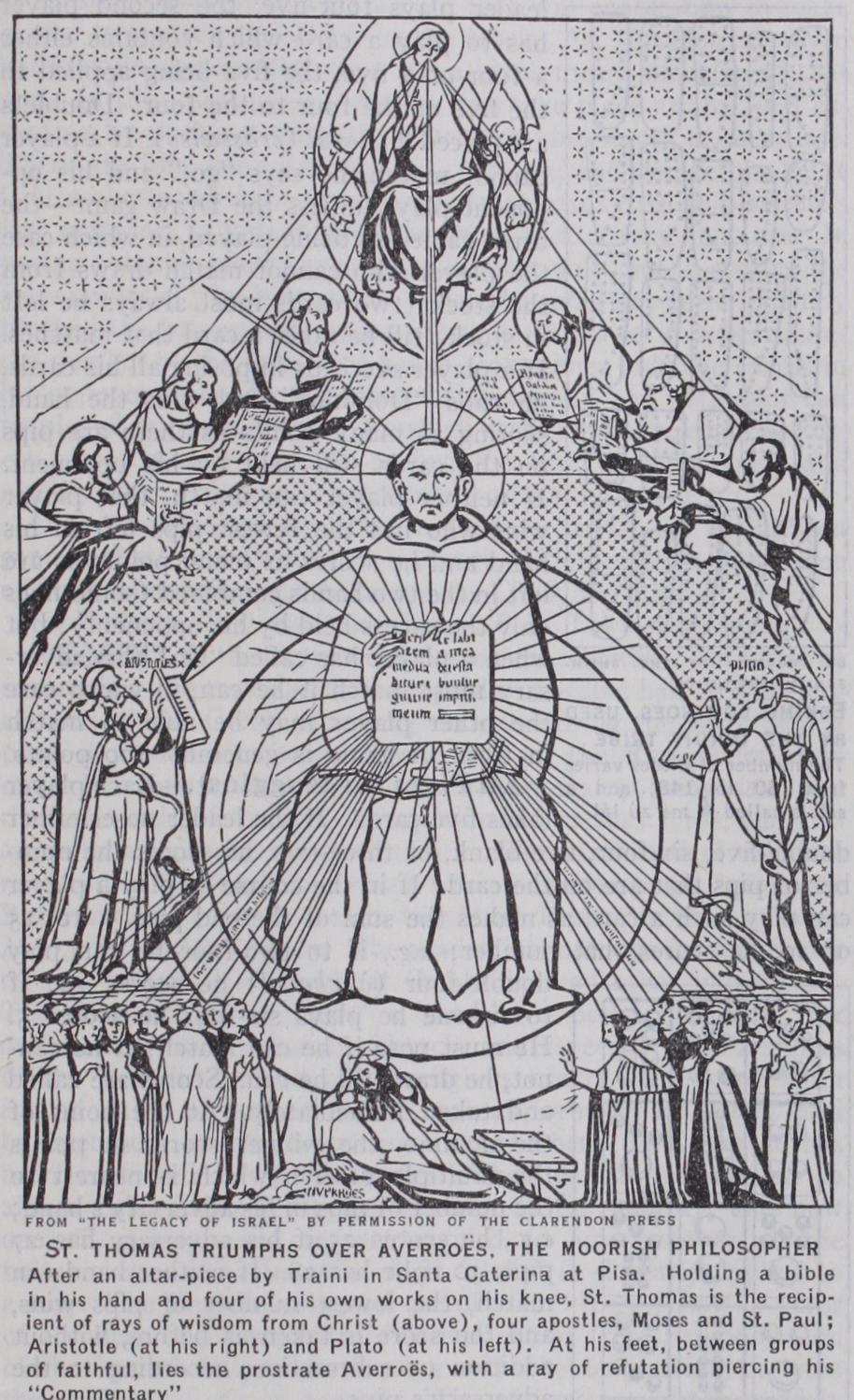
Another conspicuous field of work of the Dominicans lay in the universities. It had been St. Dominic's policy to aim at founding houses first of all in the great university towns—at Paris, Bo logna, Palencia, Oxford. This policy was adhered to, and the Dominicans soon became a power in the universities, occupying chairs in those just named and in Padua, Cologne, Vienna, Prague and Salamanca. The scholastic doctors Albert the Great and Thomas Aquinas were the leaders in this side of Dominican activ ity, and the order's influence on the course of mediaeval theologi cal development was exercised mainly by these doctors and by the Dominican school of theology, which to this day has main tained the principles and methods elaborated by St. Thomas.
The Dominican name is in a special way associated with the Inquisition, the office of Inquisitor in all countries, including Spain, having usually been held by Dominicans. The vicissitudes of the order have been much like those of other orders—periods of relaxation being followed by periods of revival and reform ; but there were not any reforms of the same historical importance as in most other orders, the policy having been to keep all such movements strictly within the organization of the order. In 1425 Martin V. relaxed for some houses the law of corporate poverty, allowing them to hold property, and to have fixed sources of in come; and so years later Sixtus IV. extended this mitigation to the entire order, which thereby ceased to be mendicant. This change caused no troubles, as among the Franciscans, for it was felt that it did not touch St. Dominic's fundamental idea.
The Friars Preachers came to England and were established at Oxford in 1221, and by the end of the century 5o friaries were in existence in England, usually in the towns, and several in Ire land and Scotland. In London they were first on the site of Lincoln's Inn, but in 1275 migrated to that now occupied by Printing-house Square, their name, "Blackfriars," surviving as that of the adjacent district. The only nunnery was at Dartford. In Mary's reign some of the scattered friars were brought to gether and established in Smithfield, and the remnant of the nuns were restored to Dartford. In 1559 these houses were suppressed and the nuns and friars expatriated, and for a hundred years there was no English Dominican community. In 1658 Friar Thomas Howard (afterwards Cardinal) succeeded in establishing at Born hem near Antwerp a house for the English friars. From that time there has always been an organized body of English Domini cans, again and again reduced almost to extinction, but ever sur viving; it now has half a dozen thriving friaries. The Irish province also survived the days of persecution and possesses a dozen friaries. In 184o Lacordaire restored the French province. Missionary work still holds a prominent place in Dominican life; there are missions in Annam, Tongking and China, and in Meso potamia, Mosul and Kurdistan. They have also a remarkable school for Biblical studies and research at Jerusalem, and the theological faculty in the Roman Catholic university at Fribourg in Switzerland is in their hands. There have been f our Dominican popes: Innocent V. (d. 1276), Benedict XI. (d. 13o4), Pius V. (d. 1572), Benedict XIII. (d. 173o).
The friars form the "First Order"; the nuns, or Dominica nesses, the "Second Order." The latter may claim to have chrono logical precedence over the friars, for the first nunnery was es tablished by St. Dominic in 1206 at Prouille in the diocese of Toulouse, as a refuge for women converted from the Albigensian heresy. The second convent was at San Sisto in Rome, also founded by Dominic. From that time the institute spread widely. The rule resembled that of the friars, except that the nuns were to be strictly enclosed and purely contemplative; in course of time, however, they undertook educational work. They have schools and orphanages in South Africa, especially in the Trans vaal.
See the Catholic Encyclopaedia, art. "Dominicans" and kindred top ics; Heimbucher, Orden and Kongregationen (1896) , §§ 86-91 ; and on the English houses: Gasquet, English Monastic Life.; Palmer, Life of Cardinal Howard (1867) and Jarrett, The English Dominicans.