
DRY DOCKS, ETC.
Provision has often to be made at ports for the repairs of ves sels frequenting them. The primitive method of effecting repairs and cleaning was by careening the vessel or by beaching.
The simplest structure designed for the purpose of effecting minor under-water repairs and cleaning is the gridiron, still em ployed in some ports, where the tidal rise is suitable, for vessels of moderate size. It is a level platform of timber beams, con structed on a firm foundation, on which the ship settles with a failing tide and can then be inspected at low water.
A dry dock is a narrow basin, closed by gates or by a caisson, in which a vessel may be placed and from which the water may be pumped or let out, leaving the vessel dry and supported on blocks. A dry dock is sometimes used, especially in naval dock yards, for building ships. Many old dry docks were built of timber, and there are several such still in use in the port of London. In the United States timber dry docks are in common use even for large vessels. The typical modern dry dock, however, consists of concrete side walls, resembling those of a lock, but stepped back towards the top, with a substantial concrete floor upon which the keel blocks, and sometimes bilge blocks also, rest (figs. 26 and 27). The floor usually has a slight fall from back to front, and from the centre to the sides, to facilitate drainage.
Dry docks should, for preference, be founded on a solid im pervious stratum, but this is not always possible. It is often impracticable to obviate the presence under the dock bottom of water which may exert a hydrostatic upward pressure when the dock is pumped out. Such conditions are usually met in one or other of two ways. The floor may be made comparatively thin with vents formed in it or low down in the side walls to relieve the pressure of the water which is allowed to leak into the dock and is dealt with by drainage pumps. The alternative is to make the dock floor and walls of sufficient weight and dimensions to resist the maximum pressure due to saturation of the surrounding soil. That is to say, the floor must act as an inverted arch and the whole body of the dock when empty must be of sufficient weight to resist the tendency to flotation. In bad ground and when the floor is thin, bearing piles are often driven under the dock floor in way of the keel blocks, and, in some cases, under the whole of the floor and side walls also. In any case the floor must be of sufficient strength to bear the weight of the heaviest ship which the dock can take in, concentrated on the lines of the supporting blocks. Thus far very few dry docks have been built of reinforced concrete, forming a rigid box, usually supported on piling.
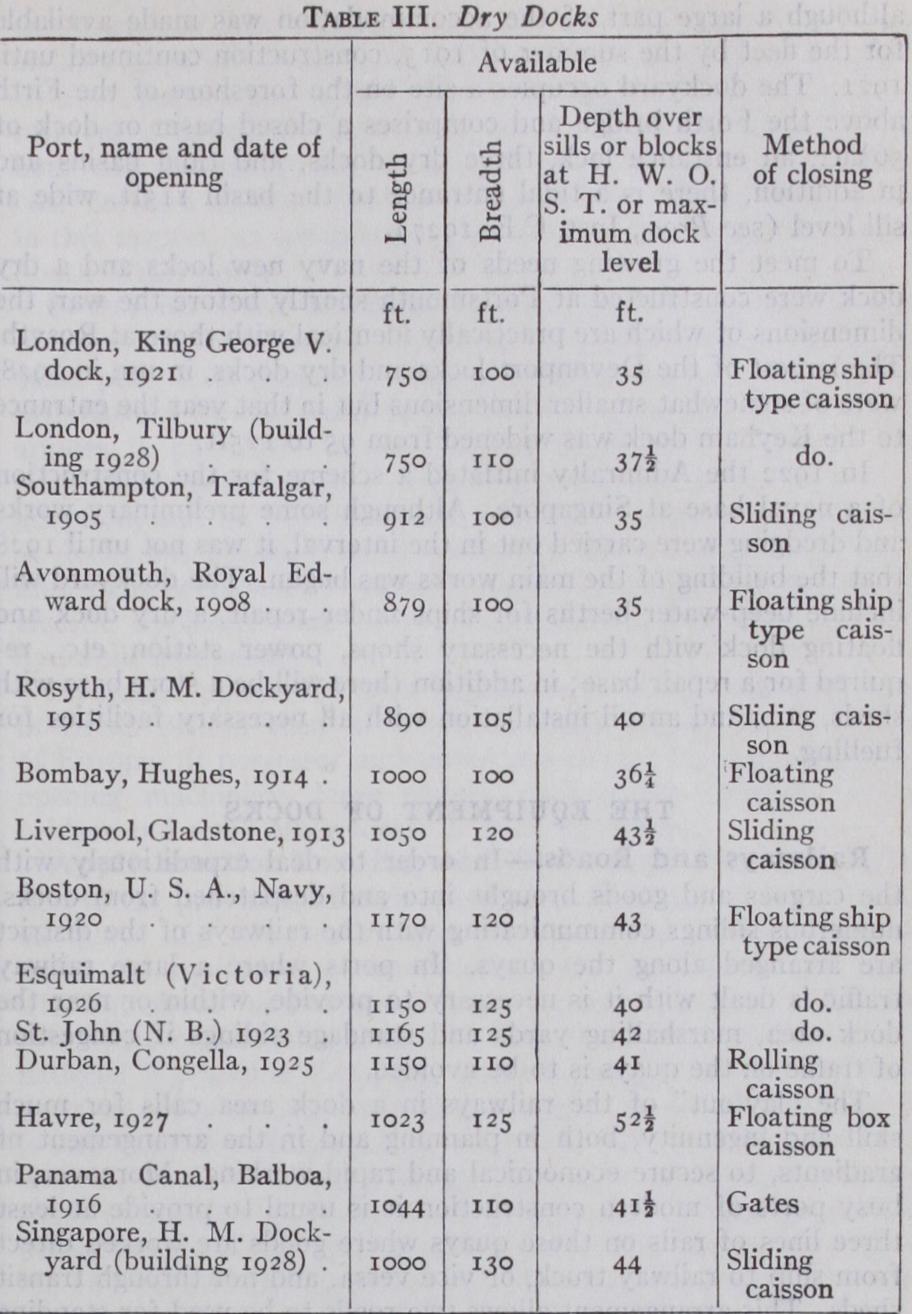
A dry dock at Havre (see table III.) , opened in 1927, is of par ticular interest on account of the method adopted for its con struction on a deep stratum of sand and silt. The entire dock structure was built in and upon a huge steel caisson framework 1,132 x 197ft. which was floated into position over the site of the dock, previously dredged to the required depth, and there sunk in place. The caisson was constructed on levelled ground within a containing embankment and portions of the floor and side walls were built in it before it was floated out to the permanent site.
The stepped courses provided in the upper parts of the side walls of a dry dock are called "altars" and are used for the support of- side shores between them and the ship. Culverts, controlled by sluice gates (fig. 20), are built in the side walls of the entrance for flooding the dock when it is necessary to let a ship out. Centrifugal pumps—usually electrically driven in modern docks— are employed for pumping out the dock and maintaining effective drainage. The water flows to the pump sump chamber and from the pumps to the outside of the dry dock through culverts. (See figs. 26 and 27). In many old docks, in positions where the tidal range is suitable, water is run out as the tide falls; but in modern practice it is customary to provide for pumping out the whole of the water in about 3 hours—more or less.
In ports where the tidal rise is considerable and there are wet docks, it is preferable, when practicable, to construct a dry dock with its entrance from within the wet dock and not from the tide way. There are many advantages attending this arrangement: still water for manoeuvring the ship ; availability for use at all states of the tide; and comparative freedom from siltation may be instanced. In situations where a dry dock is entered from tidal water of considerable range, it is desirable to provide for holding up the water inside the dock above the level of the falling tide in order that ample time shall always be available for shoring and other dock operations.
Equipment of Dry Docks.—The machinery employed at dry docks for working gates, caissons, sluices and capstans is generally on the same lines as for entrance locks. It is necessary, however, to equip a dry dock, in addition to the pumps already referred to, with powerful cranes, travelling along the dock side, to deal with the heavy lifts sometimes necessary in effecting ship repairs (see fig. 27). As an example of such provision the Trafalgar dry dock at Southampton has an electric travelling portal crane lifting 5o tons at a radius of 87ft. Most of the modern dry docks thus far constructed are also well equipped for working electric and compressed air tools.
Unfortunately the dredging of such deep pits below the general level of the harbour bed as are required in some situations for a floating dock of very large dimensions is sometimes followed by rapid silting and this has occurred at Southampton where redredg ing has been necessary at intervals of less than 2 years.