
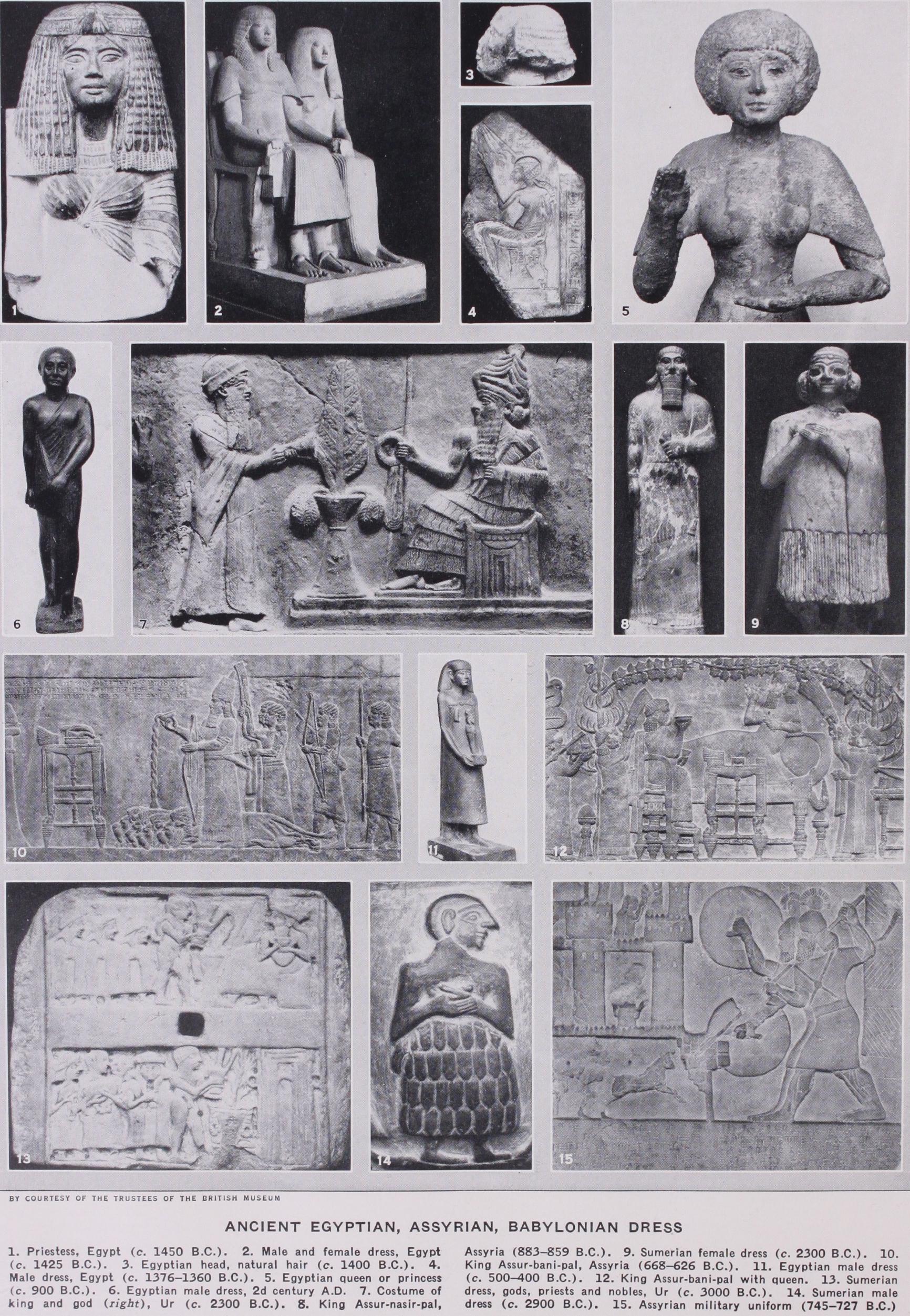
BABYLONIAN AND ASSYRIAN COSTUME c. 3000-2000 B.C.—In Sumerian days (300o-200o B.c.) Baby lonian men wore a fringed garment of wool, known to us generally by the name of the kaunakes (a graecized form of the classical period) : the wool seems to have been unspun, and probably the garment consisted merely of natural locks without the hide. It has been conjectured that kaunakes of feathers were also worn. One shoulder was generally covered by this garment, the other left bare, but a long and heavy cloak, open in front, was often worn. The feet were bare. Men and women both wore their hair equally long. Men dressed it in a catogan or chignon at the back, often with the addition of two plaited tails crossed at the back beneath the chignon and with their ends fastened over the forehead. Women had rather more elaborate chignons, sometimes three, one at the back and two at the sides. Priests had their heads shaven and performed certain rites stark naked, as also did the kings and great men, who on these occasions wore their hair down their backs. Beards were occasionally worn. Large hats with brims indicated a mark of dignity, and were worn by gods and kings. Gods had them adorned with horns. Later on we find the kings and important personages wearing a turban consisting of a round cap with a thick band around it. A tunic, sometimes sleeved, and long robes also came in. Warriors wore conical copper helmets, like the mediaeval bassinet, and carried shields and spears; a king could wear a gold helmet made in imitation of his own headdress (tomb at Ur) and use golden swords and javelins. Copper breast plates may also have been used. Feet were generally bare; but in later days in Assyria sandals and elaborate high boots were worn. A cylinder-seal of stone was carried, fastened to a great pin with lapis lazuli and round gold head, and used to fasten the garment. It was also used as a stiletto, if needed. Large-knobbed walking sticks were always carried. Herodotus correctly describes the seal and stick carried by every Babylonian. Daggers had often gold and lapis hilts, sometimes even gold blades in early times. In later days the well-known Assyrian "Tiara" with its spike was worn by the kings; the bull-horn headdress was given to gods. The heavily ornamented robes of the Assyrian period are well-known ; the enormous earrings and necklaces, the elaborately curled hair and beards of the Assyrian have been familiar to us since the days of Layard. The war-gear of the later period shows, of course, the development from copper to bronze and then to iron weapons, the helmet taking the characteristic Assyrian peaked form, and in the 7th century it is crowned with the Graeco-Carian crest, adopted from the West. Great round shields were carried and hauberks worn of metal plates or scales sewn on leather.
We have so few representations of Babylonian or Assyrian women, other than goddesses (who wear long flounced robes) that it is almost impossible to say much of their costume. In the early period one sees them wearing a modification of the men's kaunakes, with hair rather more elaborately dressed than the men's (see above) and ornamented with nodding balls or flowers of gold and lapos on a comb-like ornament that was stuck into the catogan with a sharp-ended shank. Later on they wore a shape less robe, with the hair usually "down." Assyrian women wore earrings of great length and weight like the men's, and other adornments like theirs. The Ur excavations have shown that the Sumerian women of 2,000 years before already used "vanity-cases" of gold, with tweezers, earpick and head-scratcher complete.

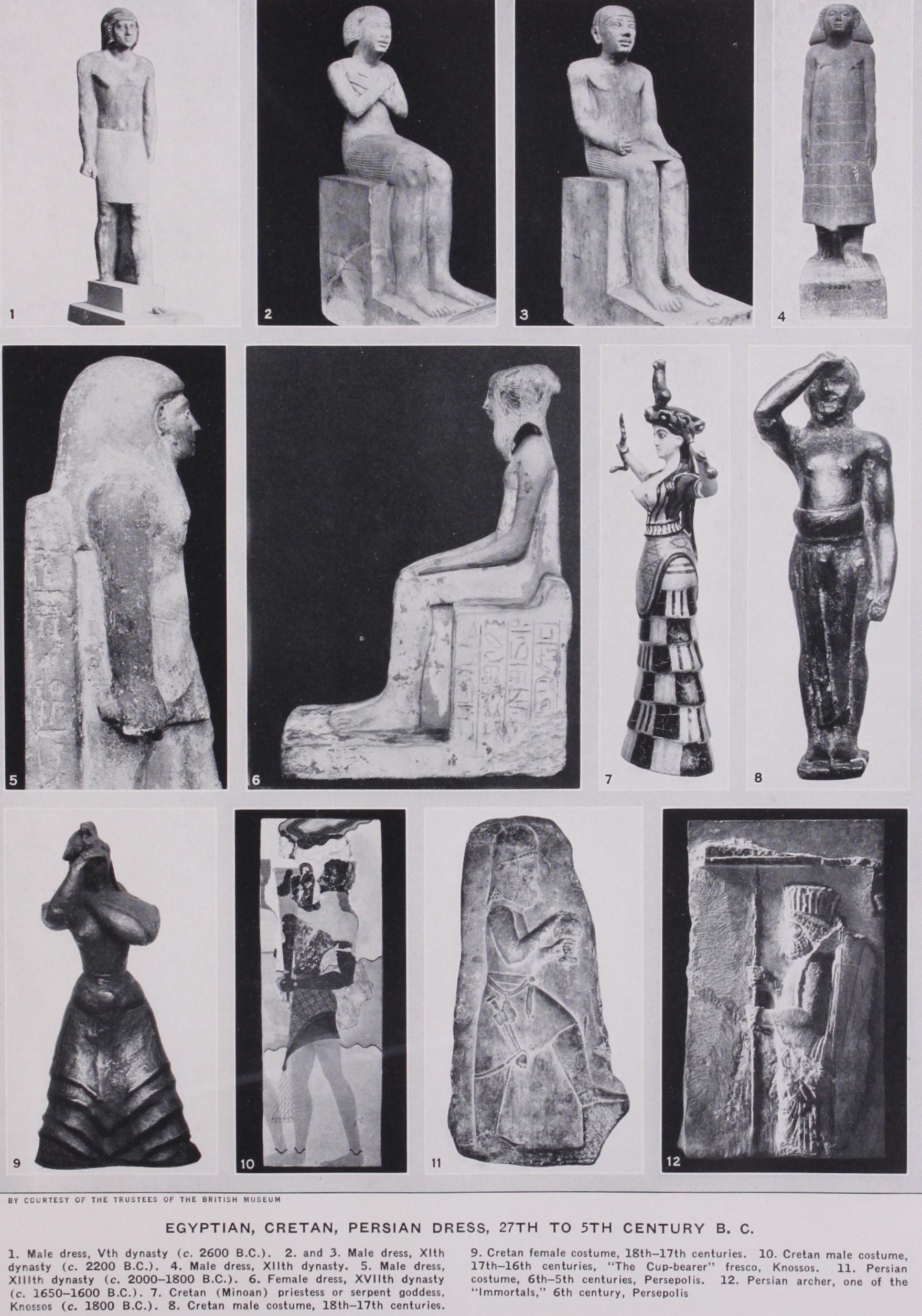
The Persians wore as court-dress a modification of the As syrian gear, including the tiara and curled hair and beard. Their native headdress was a "Phrygian" hood, sometimes worn with a veil or scarf across the mouth to keep the dust out, like the litham of the Tuareg. Small felt hats, square-topped or round, were worn as their descendants are to this day; a waisted tunic and gaily coloured pyjama-trousers, confined at the ankle; were characteristic of the Persian male costume, so far as it was not influenced by that of Mesopotamia.
In later times in Persia we find the Sassanian kings wearing a development of the old Persian dress, with high tiaras and many chaplets and necklaces of beads, earrings, etc. The hair was worn very bushy, over the shoulders; this was characteristic of the men. We know little of what the Persian women wore.