
DRAGONETTI, DOMENICO Italian double bass player, was born in Venice on April 7, 1763, and died in London on April 16, 1846. Dragonetti was a virtuoso of the first rank, and one of the best-known figures in the musical life of his day. His first appearance in London was in 1794. In Lon don he met Lindley, with whom he played regularly from that time. In 1798 he visited Haydn at Vienna, and in 18o8-o9, on another visit to Vienna, he met Beethoven, whom he worshipped. In 1845, at the age of 82, he led the double-basses in the Beet hoven Festival at Bonn.
the popular English name applied to bers of a remarkable group of insects forming the order Odonata (or Paraneuroptera). They are sometimes known among country folk as "devils' darning needles" or "horse stingers," though they are incapable of stinging. Dragon-flies are easily recognized by their large eyes, minute antennae, two pairs of very similar narrow, glassy wings, the forward position of the legs, and their very elongated abdomen. They pass through an incomplete morphosis and their nymphs or naiads are aquatic. They attract notice by their rapid, skilful flight and the beauty of their form and coloration : none of the cies is very small, and they are often large insects, the female of Megaloprepus coerulatus, for ex ample, has a wing-expanse of 72in., while the Carboniferous fossil Meganeura measures eft. across the wings.
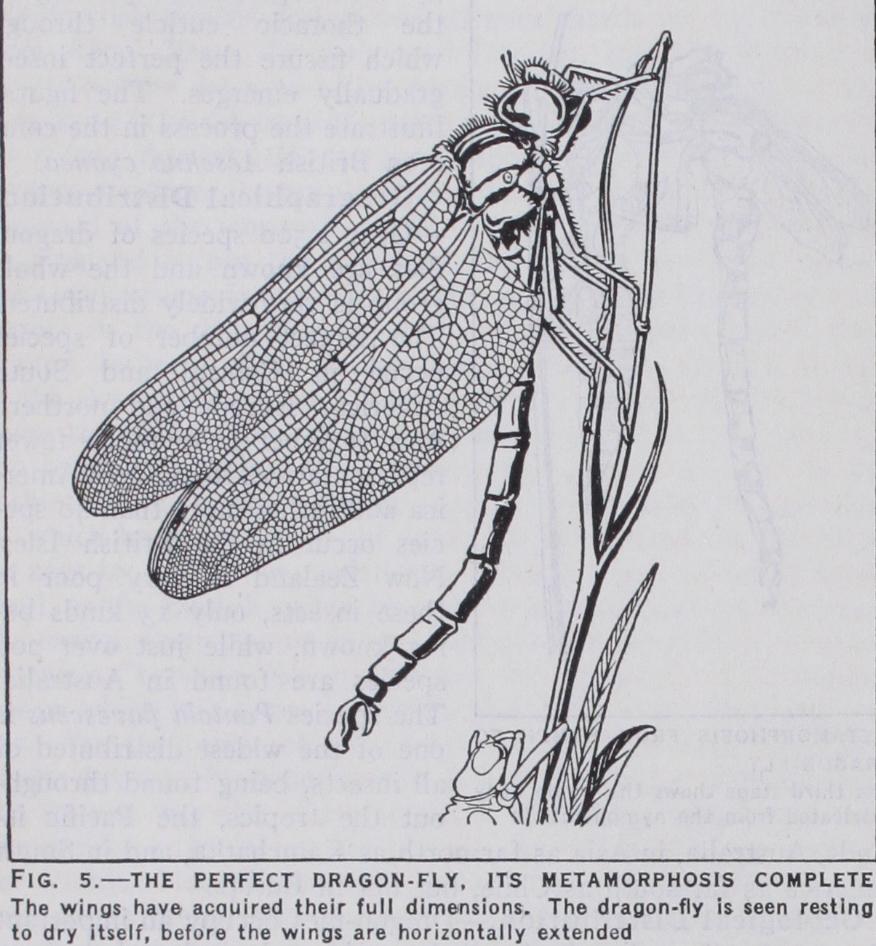
General Structure.—The head is large and very mobile, being capable of turning almost as on a pivot. Correlated with the great size of the eyes the an tennae are correspondingly re duced and represented by very short 3- to 8-jointed bristle-like organs. The mouth-parts are adapted for biting, the mandibles being armed with powerful teeth while the labium is broad and plate-like. The wings are elon gate, sub-equal and membranous with a complex network of vein lets between the principal veins, the wing-membrane being thus divided up into numerous cells which may exceed 3,00o in a sin gle wing. The legs, being placed near together and far forward are little used for walking and are mainly employed for alighting and grasping. The abdomen is elongate and often extremely slender, and the male intromittent organ is placed beneath the second segment instead of at the apex as in other insects.
The Anisoptera hold their wings open when at rest and the hind wings are broader at their bases than are the fore wings. Included here are all the larger and stouter species to which the name dragon-fly is commonly applied. There are five families, and well known genera are Libellula, Aeschna and Sympetrum.
The Zygoptera hold their wings closed in the vertical plane above the body when at rest, both pairs being closely alike with very narrow bases. The weaker, slow-flying species, often called damsel-flies, belong here : the sub-order includes nine families, and among common genera are .4grion, lschnura and Calopteryx.
A third sub-order—the Anisozygoptera_includes a number of fossil dragon-flies and the single living genus Epiophlebia from Japan and India.
In most Zygoptera these take the form of three leaf-like lamellae at the caudal end of the body, but in the Anisoptera there is a very elaborate system of gills within the rectum or terminal chamber of the gut. In both sub-orders the gills are penetrated by tracheae and are covered by a thin membrane which allows of the inward passage by osmosis of oxygen dissolved in the water: in the Anisoptera water is alternately taken in and expelled from the rectum, and, in this way, the gills are kept aerated.
Dragon-fly nymphs undergo frequent moults which probably range between about I z and 15 in number. The length of life in nymphs of different species is subject to wide variation : in the smaller forms it does not exceed one year, but in some species it is probable that two, three or more years are spent in the water.
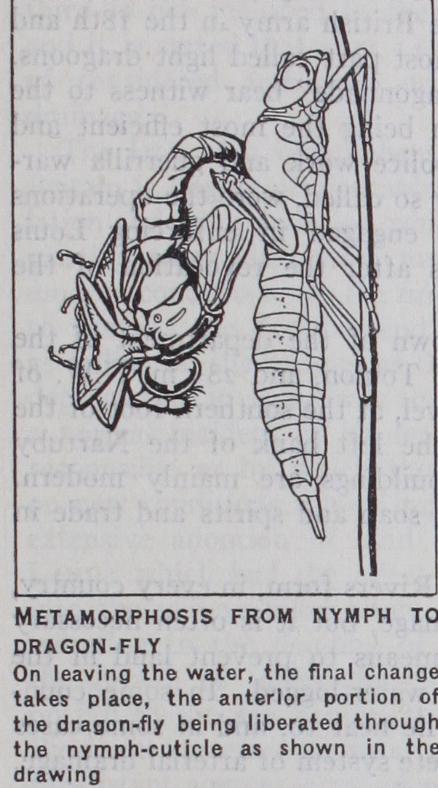
Certain structural changes occur during growth, and in the later stages the developing wings becoming evident on the dorsal side of the body. When a nymph has attained its full growth it ceases to feed, leaves the water and often wanders some distance before it comes to rest for the final change : the latter is effected by the longitudinal splitting of the thoracic cuticle through which fissure the perfect insect gradually emerges. The figures illustrate the process in the mon British Aeschna cyanea.
Geographical Distribution. —Over 2,50o species of dragon flies are known and the whole group is very widely distributed. The largest number of species occur in Central and South America : Europe and northern Asia together have much fewer representatives than North Amer ica and rather more than 4o spe cies occur in the British Isles. New Zealand is very poor in these insects, only 13 kinds be ing known, while just over 200 species are found in Australia. The species Pantala flavescens is one of the widest distributed of all insects, being found through out the tropics, the Pacific is lands, Australia, in Asia as far north as Kamchatka, and in South America as far south as Chile, but not in Europe Geological Distribution.—Dragon-flies occupy an important place as fossils and occur in all the main geological periods from the Carboniferous onwards. In strata of Carboniferous age at Commentary, France, C. Brongniart has brought to light several gigantic fossil forms which differ sufficiently from those of to day to require a separate order (the Protodonata) for their re ception. These great insects extend into the Permian age where they seem to die out. The earliest true dragon-flies occur in the lower Permian rocks of Kansas and, although very rare in the Trias, they become more frequent in Liassic times when the Ani sozygoptera flourished—a sub-order which is almost extinct to day. In the Jurassic rocks of Siberia dragon-fly nymphs have been found : the Purbeck and Stonesfield-slate beds of England and the Solenhofen slates of Bavaria have all yielded dragon-fly remains. Coming to Tertiary times, the Miocene beds of Colo rado and of Oeningen (Switzerland) have yielded abundant re mains, including Libellulid nymphs from the latter locality. Scarcely any dragon-flies have been found in amber; probably such insects could release themselves if entrapped in the resin.
Probably no order of insects rivals Odonata in the beauty of their coloration. In some species a whitish or bluish pruinescence is often present over the usual body colours, appearing as a kind of bloom as on some fruits. It is abraded by age or wear and is most frequent in the male. The coloration of the two sexes is commonly very different—the males in some species may be unicolorous and their females bicolorous : in other species the females exist in two colour forms, one of which closely resembles that of the male. Most dragon-flies have hyaline wings, but in species of Calopteryx, and other genera, the males have deep metallic green or blue wings : in certain tropical forms the wings exhibit a combination of glistening metallic green, purples, bronzes etc., that almost baffles description.
BIBLIOGRAPHY.—The best general work on Odonata is R. J. TillBibliography.—The best general work on Odonata is R. J. Till- yard, The Biology of Dragon-flies (1917 bibl.). The British species are dealt with by W. J. Lucas, British Dragon-flies (19oo) ; and an account of the European species is given by F. Ris, in Siisswasserfauna Deutschlands (19o9), and by R. Tumpel, Die geradfliigler Mitteleuro pas (1922). For habits and transformations see L. C. Miall, Natural History of Aquatic Insects (1912) . Keys to the North American genera and their nymphs are given in H. B. Ward and G. C. Whipple, American Freshwater Biology (1918). (A. D. I.)