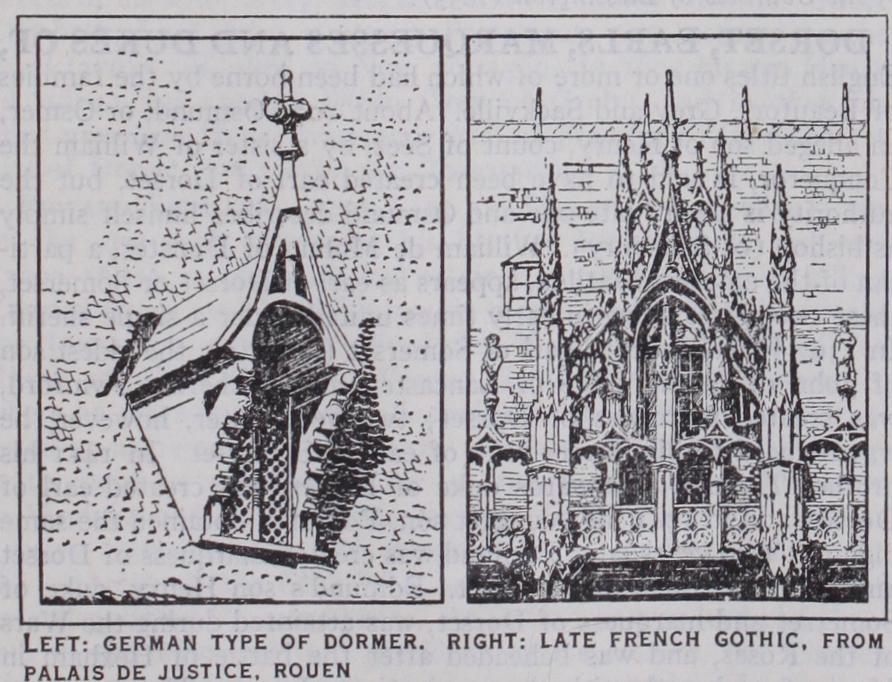
DORMER, in architecture, a projection from a sloping roof, containing a window. Dormers may occur either on the face of the wall or high up on the roof ; their roofs may be gabled, hipped, Hat or with one slope. Wherever steep, high roofs are common, dormers are common, in order to light the space within. Simple dormers, frequently in several rows, characterize the steep roofs of Teutonic countries, but in the late Gothic and early Renais sance periods, certain dormers, whose fronts were on the wall line of the building, were built in masonry and richly decorated. Similar elaborate dormers, usually with gabled roofs, are characteristic of the French chateaux from the time of Louis XII. to that Louis XIV., and of Tudor work in England and Scotland; ex amples of dormers, ornamented with pinnacles, tracery and but tresses, occur in the Palais de Justice at Rouen (end of the 15th century). Heidelberg castle (1 56), and the chateaux of Blois and Chambord (time of Francis I.) show characteristic Renais sance enrichment. The term "dormer" arose from the windows being those of sleeping-rooms. The phrase "dormer beam" is the equivalent of the modern "sleeper."