
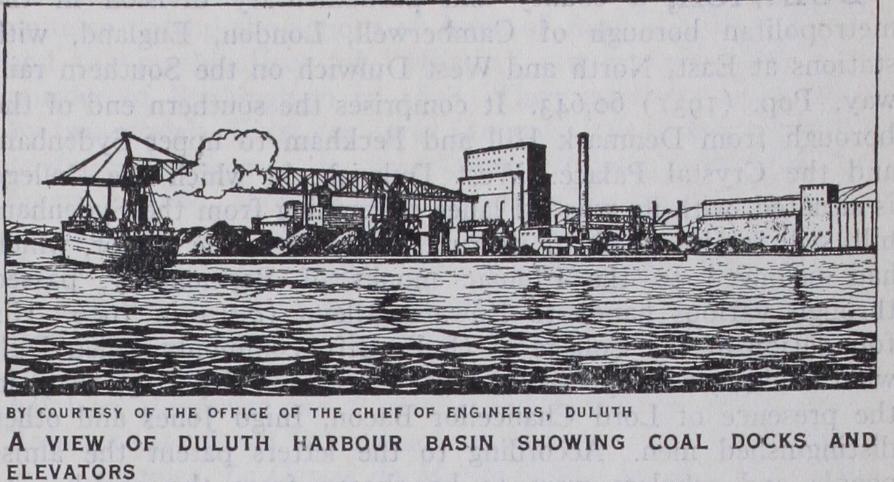
DULUTH, a city of Minnesota, U.S.A., on the western tip of Lake Superior, at the mouth of the St. Louis river, opposite Superior, Wis. ; the county seat of St. Louis county. It is on Fed eral highways 2, I I, 53 and 61; and is served by the Chicago and North Western, the Duluth and Iron Range, the Duluth, Missabe and Northern, the Duluth, South Shore and Atlantic, the Great Northern, the Northern Pacific, the Soo Line and Canadian Na tional railways, and by many lake steamers. The population was 98,917 in 1920, of whom 30,118 were foreign-born white (over half from Sweden, Norway and Finland), and was 101,463 in 1930 by the Federal census of that year. The city has a beautiful site (67.34 sq.m.) on slopes rising to 600ft. above the level of the lake, commanding fine views of harbour, lake, river and sur rounding country. A 29m. boulevard runs along the top of the bluff back of the city, and there are 2,5ooac. in public parks. The Duluth-Superior harbour, with 49m. of water-frontage, formed by long narrow strips of land projecting from either shore (Minne sota Point and Wisconsin Point), is one of the finest in the world, and it ranks second only to New York, among American ports, in the commercial tonnage handled. It is well equipped with mod ern machinery for transferring cargoes, and has (1928) 22 coal docks, 9 iron ore docks, 43 wharves for general freight, 27 grain elevators and a cement storage elevator with a capacity of 114,000 barrels. Its commerce in 1927 was 52,712,269 tons (valued at $520,640,087), consisting largely of iron ore from the Ver milion and the Mesabi ranges, wheat and other grains from the Red river valley and the plains of Canada, butter and eggs from adjacent territory, automobiles and coal from Lake Erie ports. Among the manufacturing industries, which are increasing in im portance, the largest are the great mills of the Minnesota Steel Company, established here in 1909. The aggregate factory output in 1927 was valued at $54,859,845. The assessed valuation of property in 1927 was $61,888,506, and bank clearings amounted to $465,061,788. Since 1912 a commission form of government has been in effect. A zoning ordinance was adopted in 1925, and the city's development is under the supervision of a planning com mission. The recreation system includes provision for flying, ski ing, curling and ice-boating, as well as for the more ifsual sports. The charitable agencies are financed through a joint community chest. There are five daily papers, including one in Finnish. The evening classes of the public schools enrol about 5% of the adult population. An extension department of the University of Minne sota is maintained here, and there is a State teachers' college (es tablished in 1902). The Federal Government maintains a life saving station on Minnesota Point, and a fish hatchery at Lester river.
The first visitor on record to the site of Duluth was Daniel Greysolon, Sieur du Lhut (d. 1709), a French trader and explorer, who about 1678 built a stockaded trading-post at the mouth of Pigeon river on the north shore of the lake. About 1752 a second trading-post, which later became a depot of Astor's American Fur company, was established in the vicinity. Permanent settlement on the site of the city began in 1853. In 1870, when the city was incorporated and the first railway reached it, the population was 3,131, and in 1880 it was only 3,483. Between 1880 and 1890, with the development of railways, of commerce on Lake Superior, and of the iron mines of northern Minnesota, the population in creased nearly tenfold, to 33,115. The traffic of the port increased from 2,848,672 tons in 1890 to 46,875,416 tons in 1913, fluctuated considerably during the World War and the years immediately following, and reached its maximum (to 1928) in 1923, when the commerce was 59,274,812 tons. In 1904-05 a unique bridge (the only one of its kind in the United States) was constructed over the ship canal cut across Minnesota Point in 1871. Suspended from the bridge, 13 5f t. above the water, a car capable of carrying a load of 125,0001b. travelled safely back and forth by cable and electric power. In 1928 it was decided to substitute a "lift" bridge for this aerial ferry, because it was too slow and did not provide for vehicular traffic.