ECCLESIASTICAL COMMISSIONERS, in England, a body corporate, whose full title is "Ecclesiastical and Church Estates Commissioners for England," invested with very important powers, under the operation of which extensive changes have been made in the distribution of the revenues of the Established Church. Their appointment was one of the results of the vigorous movements for the reform of public institutions which followed the Reform Act of 1832. In 1835 two commissions were ap pointed "to consider the state of the several dioceses of England and Wales, with reference to the amount of their revenues and the more equal distribution of episcopal duties, and the prevention of the necessity of attaching by commendam to bishoprics certain benefices with cure of souls; and to consider also the state of the several cathedral and collegiate churches in England and Wales, with a view to the suggestion of such measures as might render them conducive to the efficiency of the established church, and to provide for the best mode of providing for the cure of souls, with special reference to the residence of the clergy on their respective benefices." And it was enacted by an Act of 1835 that during the existence of the commission the profits of dignities and benefices without cure of souls becoming vacant should be paid over to the treasurer of Queen Anne's Bounty. In consequence of the recommendation of these commissioners, a permanent corn mission was appointed by the Ecclesiastical Commissioners Act 1836 for the purpose of preparing and laying before the king in council such schemes as should appear to them to be best adapted for carrying into effect the alterations recited in the act. The new commission was constituted a corporation with power to purchase and hold lands for the purposes of the act, notwith standing the statutes of mortmain. The first members of the corn mission were the two archbishops and three bishops, the lord chan cellor and the principal officers of state, and three laymen named in the act.
The constitution of the commission was amended by the Eccle siastical Commissioners Acts, 1840-41, and 1868. The commis sion consists of the two archbishops, all the bishops, the deans of Canterbury, St. Paul's and Westminster, the lord chancellor, the lord president of the council, the first lord of the treasury, the chancellor of the exchequer, one of the principal secretaries of State, the lord chief justice, the master of the rolls, and certain lay members of the Church of England appointed by the crown and by the archbishop of Canterbury. The crown also appoints two laymen as church estates commissioners, and the archbishop of Canterbury one. These three are the joint treasurers of the com mission and form, with two members appointed by the commission, the church estates committee.
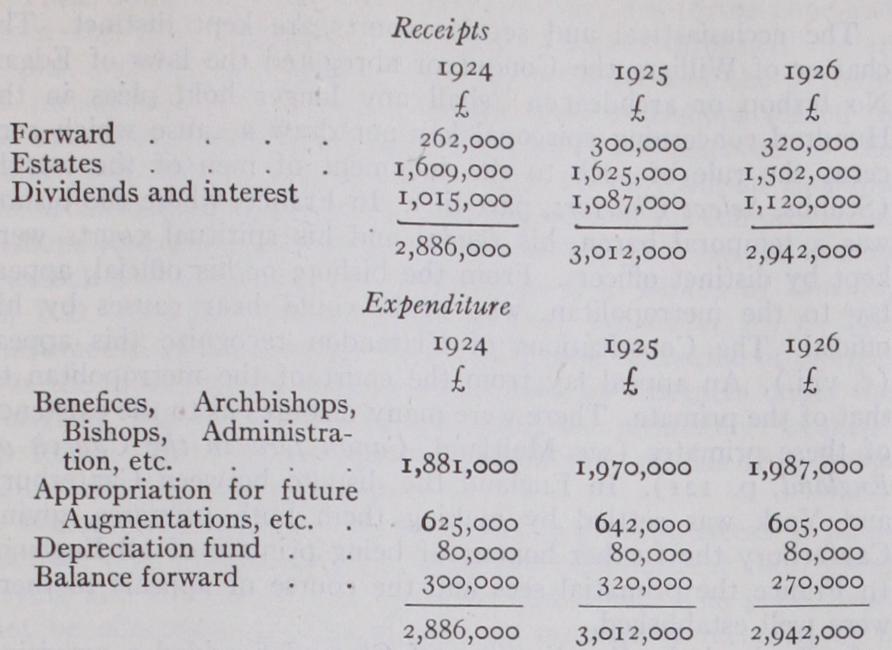
The commission presents an annual report to parliament in which full information is given as to its activities. Its main func tion at the present time is the management of the estates of the church in order to augment or endow benefices, etc. The following is a summary of the receipts and expenditure for the years 1924, 1925 and 1926:—