
ECLIPSES OF SATELLITES OF JUPITER In fig. 2 (3) we have a representation of eclipses of one of the outer planets, Jupiter say, and its satellites. Satellite I. is drawn inside the umbral cone of Jupiter and so, since it is not self-luminous, is temporarily (i.e., while passing through the cone) invisible from the earth (E). Satellite II. is drawn passing be tween Jupiter and the sun and so casting a shadow on Jupiter. If the umbral cone be long enough to reach the surface of Jupiter there will be a dark spot on the surface (the shadow of its moon) visible from the earth if it falls on the half of Jupiter visible to us.
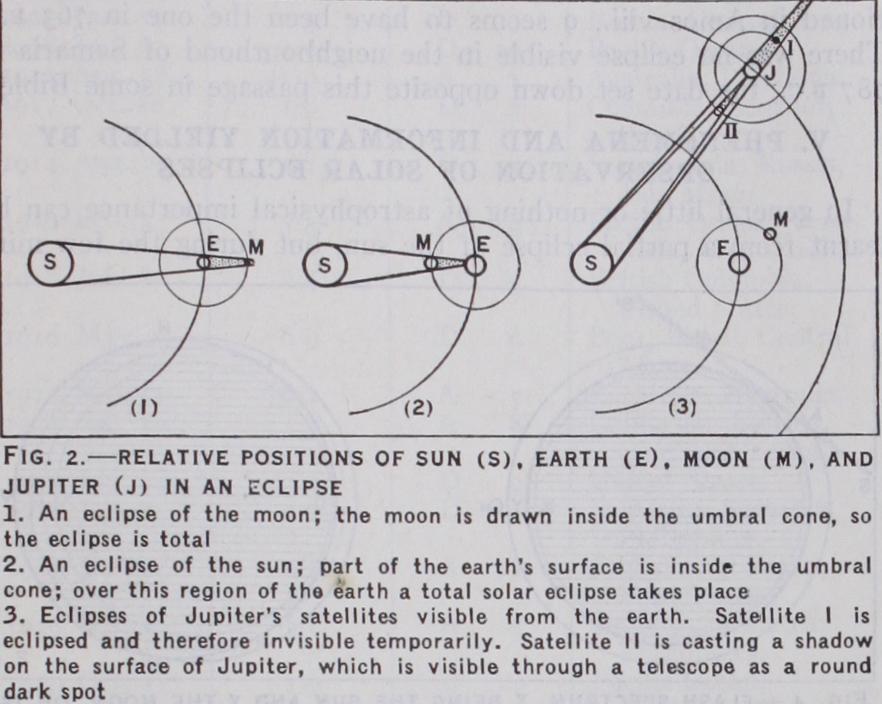
The eclipses of the satellites of Jupiter provide a frequent and interesting spectacle (of which details are given in the Nautical Almanac) and are of considerable astronomical interest. Histor ically they are important inasmuch as they provided one of the earliest proofs of the finite velocity of light. It is possible to cal culate with considerable precision the times of disappearance and reappearance of one of the satellites undergoing eclipse (as I.) and it was found by Romer that there were discrepancies between the observed and calculated times that could be explained if we supposed that we saw the eclipse a little early or a little late de pending upon whether the earth was at a point in its orbit nearer to or further from Jupiter than the sun ; the difference between the extreme variations being the time needed for light to travel the distance across a diameter of the earth's orbit.