ECLOGITE, in petrology a typical member of a small group of rocks now recognized as including both igneous and meta morphic representatives, and of special interest on account of the variety of minerals they contain and their geological relation ships. The eclogites (from Gr. a selection) are mostly coarse-grained and massive aggregates of green monoclinic pyrox ene and red garnet, but some varieties possess green hornblende wholly or partly replacing the pyroxene, thus giving rise to the two important groups—the pyroxene and the hornblende eclogites. The minerals associated with these essential constituents include rutile, apatite and iron ores, and, less commonly, quartz, mus covite, zoisite, cyanite, albite, bronzite, olivine and chlorite. The eclogites correspond closely in bulk composition with the gab bros and dolerites, but are characteristically assemblages with high density (3.2-3.6 as compared with gabbro 2.9-3.0).
The pyroxenes show considerable variation in composition, and include both non-aluminous and aluminous varieties. The latter contain significant proportions of the jadeite and aegirine mole cules and correspond to true omphacite. The red garnet is a pyrope-rich variety containing almandine and grossular, but is not so magnesia-rich as the garnet found in serpentines and peridotites. The hornblende is usually a green variety—smarag dite, or alkali-hornblende sometimes approaching glaucophane in composition.
Whether of metamorphic origin or considered as igneous rocks consolidating under excessive pressures, the almost complete ab sence of plagioclase felspar makes these rocks of peculiar inter est. The omphacite-garnet assemblages have undoubtedly crys tallized under high pressures, in place of augite, olivine and plagioclase in accordance with the principle of Van't Hoff and Le Chatelier. Magnesian garnet appears in place of the olivine anorthite pair, and a jadeite-chloromelanite-bearing pyroxene in place of the augite-plagioclase combination of the heteromorphous gabbros.
Under the name griquaite, eclogites are found as blocks or boulders in the kimberlite "pipes" of the diamond fields of South Africa. This pyroxene-eclogite is of special interest inasmuch as diamonds have been found as enclosures of the garnet of the rock, and according to one prevailing view eclogite is the parent rock of the diamonds of the South African fields, the diamonds of the "pipes" being derived from the explosive disruption of deep-seated masses of diamantiferous griquaite.
That some eclogites are of metamorphic origin is clearly re vealed by their geological associations and microscopic structures. Such often appear as lenses intercalated among crystalline schists and show unmistakable crystalloblastic structures.
Others, such as those of western Norway, occur as lenticular masses in granite gneiss or bands in olivine rocks (peridotites, dunites or their serpentine derivatives). These rocks possess no true crystalloblastic structure, and are believed to be unaltered igneous rocks. Probably some eclogites from other areas pre viously believed to be transmuted gabbros are of similar origin.
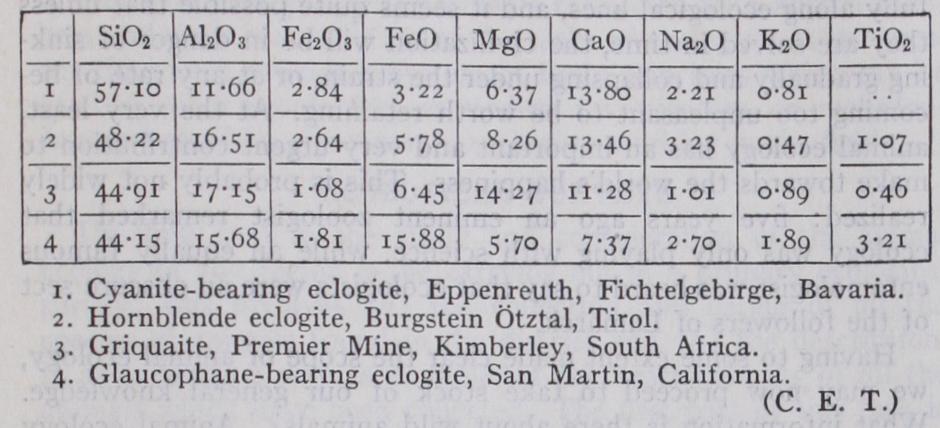
The amphiboles of the eclogites may represent either a direct crystallization from the magma, or arise by metamorphic proc esses from original pyroxene, and it is not improbable that many of the so-called "garnet-amphibolites" of archaean tracts are transformed eclogites. The clear recognition of eclogites as pri mary magmatic consolidations under high pressures has led to the conception of an eclogite zone in the earth's crust immediately below the more acid silicate shell. At depth magma of basaltic or gabbroid composition may exist stable as solid eclogite, and it is possible that in this zone is to be discovered the source of the eclogite blocks of the kimberlite "pipes." The chief localities for eclogites are archaean and palaeozoic metamorphic-igneous complexes. They are known from Suther landshire, western Norway, Saxony, Bavaria, the Alps, Austria, Greece and California. Glaucophane and jadeite-eclogites occur in Italy. The following analyses represent the compositions of some typical eclogites: