
ELECTRICITY SUPPLY: COMMERCIAL AS PECTS. The conditions influencing the supply of electricity in Great Britain have undergone a number of important changes since the legislative foundation of the industry in 1882. The position now, nearly half a century later, considered in the light of subsequent legislation, presents some interesting phases of rhythmic evolution. The events may be grouped in three periods. The first was one of varying activities instrumented by trial and error—technically, commercially, politically. The second was one of fatigue and recuperation followed by splendid performance during the World War. The third is one of re-organization by the Electricity Commissioners. As a consequence, we reach the emer gent conclusions that electricity can be transmitted more easily than coal, it can be sub-divided and applied more effectively than steam, and is more controllable than other forms of motive power. The industry offers scope for enterprise, for investment of capital, for employment of labour, which cannot be estimated without appearance of exaggeration.
With advances in technical practice the advantages of genera tion on a large scale, of distribution over wide areas at high voltages, and of application of electricity in various industries, were demonstrated in other countries, but in Great Britain special Acts of Parliament had to be promoted to authorize effect to be given to these principles. Before this could be done education of public opinion was necessary because strong opposition arose on the part of local authorities, who feared that municipally-owned electrical undertakings would be prejudiced. A joint committee of both houses of Parliament was appointed in 1898, with Lord Cross as Chairman, to consider the bills promoted by enterprising pioneers. This committee recommended that powers should be given for the supply of electrical energy over areas including the districts of several local authorities, and suggested that the then legislative conditions did not apply to such undertakings. While the Electric Power acts passed in 1900 were more consistent with economical development than the provisional orders granted under the acts of 1882 and 1888, the exclusion of the large towns from the acts, coupled with other restrictive provisions, disabled most of the Power act companies from raising the requisite capital, and progress under these special acts was at first very slow and difficult, because the sound policy of supplying cheap electricity in bulk had to be deferred. Successive bills were drafted by the Board of Trade to remove the obstacles, and eventually the Electric Lighting act (19o9) was passed. It conferred wider facilities upon undertakers in minor matters, but the traditional attitude of restraining private enterprise in deference to views in favour of municipal trading permeated the measure, and af forded very little assistance towards building up a comprehensive system of supply. The conspicuous feature in this phase of electrical history is the hundreds of comparatively small generat ing stations, scattered and isolated throughout the country, sup plying in restricted areas, and pursuing the uneconomic policy of independent development.
The transition from a state of depression in the industry was hastened by the outbreak of the World War, followed by un precedented demands for electric power in connection with pro duction of war material. The war changed entirely the general aspects of the industry and initiated radical modifications in the legislative standpoint. The exigencies of the war revealed elec tricity as a vital agent of industrial production; they brought out sharply the defects in the legislative situation, by which co-opera tion in production and distribution was impracticable, and isolated development was fostered. The interconnection of generating stations, desirable with a view to economy in plant, coal and other items of cost, was urged upon electricity undertakers by a Board of Trade circular in May, 1916, and a special department was formed under the Ministry of Munitions to organize the supply of electric power. Despite chaotic conditions the great efforts made by the industry to cope with the urgent and prac tically unlimited call for power were generally successful. The four years of war were equivalent in electrical growth to that of the previous 35 years. The proof afforded of the great national importance of electricity supply led the educated public to think electrically. The following committees were appointed: coal conservation sub-committee of the reconstruction committee (Cd. 888o, 1917) ; electrical trades committee (Board of Trade Cd. 9072, 1918) ; electric power supply committee (Board of Trade Cd. 9062, 1918) ; committee of chairmen of the advisory council of the Ministry of Reconstruction (Cd. 93, 1919). These reports led to the passing of the Electricity Supply act, 1919 (amended by the Act of 1922). As originally drafted the bill met with much opposition, directed chiefly against its compulsory nature and what was regarded in many quarters as a distinct bias towards nationalization in its financial provisions. The contentious clauses were withdrawn, and provision was made for the creation of joint electricity authorities empowered to acquire generating stations and main transmission lines by agreement, but not other wise. The act provided for the appointment of five electricity commissioners. Their general duties are defined as "promoting, regulating and supervising the supply of electricity." Their first specific duty was to determine provisionally "electricity districts," and consider schemes for improving the existing organization for the supply of electricity. Such schemes might provide for the establishment of joint electricity authorities representative of authorized undertakers, within the electricity district, either with or without the addition of representatives of county councils, local authorities, large consumers of electricity, and other interests within the district, and for the exercise by those authorities of the powers of the authorized undertakers. The machinery of the act was of a voluntary nature. The act as passed inspired confidence in the future of the industry; it broke down many prejudices, municipal, political and official; it simplified the procedure for extensions of supply areas, and in the general view constituted the one statesmanlike piece of legislation bestowed on the electrical industry. The appointment of electricity commissioners was in itself a salutary revolution. Their annual reports, the first to March 31, 1921, the seventh to March 31, 1927, are full and interesting records of important events and of beneficial work done.
Modern units ranging from 1 o,000kw. to over 3o,000kw. now constitute a considerable proportion of the generating plant in operation, and nearly 90% consists of steam turbo-alternators. The combination of change of type and enlargement of units, coupled with improvements in steam-raising plant and advances in furnace practice, has effected important economies in the utilization of fuel. The lowest fuel consumption recorded at any steam station in 1926 was 1.36 lb. per unit, and the highest thermal efficiency 21.51 %. Both figures relate to the Barton sta tion of the Manchester corporation. The average consumption of fuel, coal, coke and oil, at steam stations was 2-43 lb. per unit, to which figure it has progressively declined from the 3.42 lb. per unit recorded in 1920.
For the purpose of ascertaining what steps were being taken to encourage and extend the use of electricity for domestic purposes; the relative effectiveness of such steps; and what further steps could be taken to bring about increased consumption, an advisory committee was appointed by the electricity commissioners in April, 1925. The committee's Report was published in Oct. 1926. It refers to the increasing use of electricity for domestic purposes, emphasizing the great potential demand and the value of the load to the supply undertaking, on account of its high "diversity fac tor," and includes an interesting and useful analysis of various multi-part tariffs at present in use. The committee formed the opinion that none of the latter could be recommended as standard for exclusive adoption.
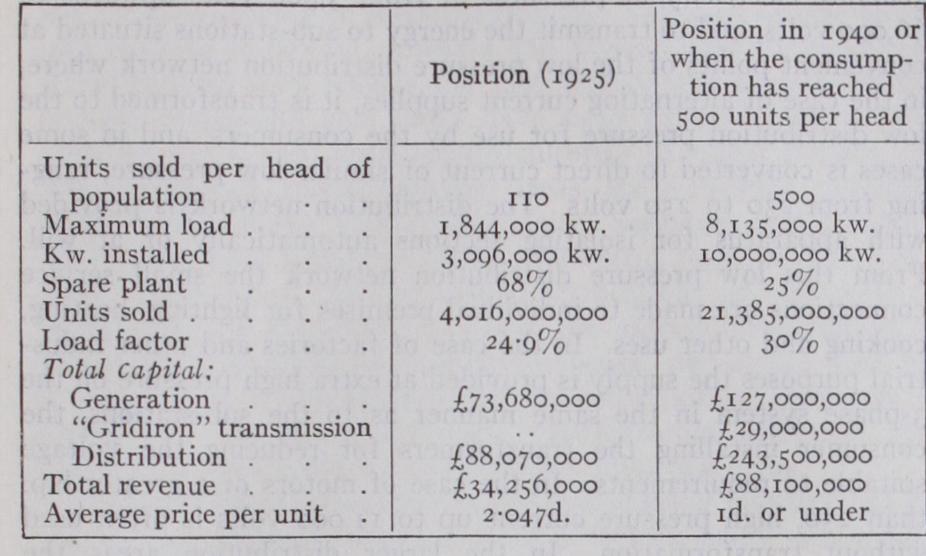
In order to secure the concentration of generation in a selected and limited number of stations, all interconnected and operated under one control, the act discards the principle of co-operative action on a voluntary basis (which was the principle embodied in the act of 1919) and substitutes a compulsory basis through the medium of a new body—the Central Electricity Board. This board, whose functions may be briefly described as the reorgani zation and control of generation, is established as an authorized undertaker for the whole of Great Britain, within the meaning of the Electricity (Supply) acts 1882-1922. The ultimate object in view is that all authorized undertakers shall obtain their sup plies of electricity in bulk from the board, either directly or in directly. For this purpose certain generating stations will be "selected" and interconnected, and operated by the owners on behalf and under the control of the board, who will purchase all the output of such stations at a price (being the cost of produc tion) to be ascertained in accordance with prescribed rules. Dis tribution and commercial development is left in the hands of the undertakers as heretofore, who will purchase from the board the supplies they require (within specified limits) at a price, unless otherwise agreed, equal to the cost of production as ascertained and adjusted, plus a proper proportion of the board's expenses or according to the tariff fixed under the act, whichever is the lower. In the case of non-selected stations, the owners (being authorized undertakers) may demand a supply of electricity from the board, in which case they may be required to close down their local generating stations and take the whole of their supplies from the board. There are other circumstances in which the owners of a non-selected station may be required (by an order of the elec tricity commissioners) to close down local generation, namely when the Board notify that they are in a position to supply the full requirements of the undertaking at a cost below the then prevailing cost of generation at the station in question. The act does not contemplate the construction or operation, or the trans fer of any generating stations to the board itself, except as a last resource, when they are unable to enter into an arrangement with any authorized undertakers or other company or person to operate such stations, or extend, alter or construct such stations as the case may be. The act contains various clauses for the pro tection of undertakers, but the commercial and, it is feared, the legal interpretations, are very involved. The board has power to borrow money with the consent of the commissioners and subject to regulations made by the minister of transport with the approval of the Treasury up td a maximum of £33,500,000, which money may be raised by the issue of central electricity stock, but power may be conferred on the board by special order to borrow in excess of that amount. The act makes provision for the prepara tion, adoption and carrying out of schemes of technical develop ment ultimately covering the whole country. The Central Elec tricity Board consists of a chairman and seven other members appointed by the minister of transport "after consultation with representatives of local government, electricity, commerce, in dustry, transport, agriculture and labour." (Sir Andrew R. Dun can [chairman], Sir James Devonshire, K.B.E., Frank Hodges, Sir James Lithgow, Bart., W. Walker, Sir Duncan Watson, W. K. Whigham and Lt.-Col. the Hon. Vernon Willey, C.M.G.) The chief engineer and manager is Mr. Archibald Page (formerly an electricity commissioner). The secretary is Sir John R. Brooke, C.B.
Four schemes under the act have already been drawn up by the electricity commissioners and published by the Central Elec tricity Board. The first was transmitted by the commissioners to the central board and published by the board on May i 1, 1927. It dealt with central Scotland, covering an area of about 4,980 sq.m. with a population of 34 millions, including roughly the whole of the industrial, shipbuilding and coalfield areas of Scotland. At the present time there are 42 authorized undertakers in the area, owning between them 36 generating stations. Under the scheme ten existing stations will be selected and operated for the board. The scheme contemplates the erection of two new stations of not less than ioo,000 kw. each by the year 1938. The transmission system is designed in a series of ring mains, so that there will be alternative routes to points of supply. The primary line voltage adopted is 13 2,00o volts. The scheme involves a large measure of standardization of frequency—no fewer than eleven under takings and five generating stations will have to be altered from 25 to 5o cycles. The scheme, with certain modifications, was adopted by the central board on July 1, 1927. The second scheme was transmitted on Sept. 29, 1927. It deals with south-east England, covers an area of 8,828 sq.m. including the London and home counties electricity district, and extends from Peterborough in the north to Brighton in the south, with a popu lation of over 11 millions. The third scheme is for Central Eng land and the fourth is known as the north-west England and north Wales scheme. Other schemes dealing with south-west England and south Wales are being prepared.
In the opinion of the commissioners the improvements in the organization for the supply of electricity which have taken place during the post-war period, will serve to facilitate the transition to the new regime laid down by the act of 1926. This important industry of nearly 5o years' standing is now for the first time placed under authorities able to deal authoritatively with tech nical, commercial and financial problems of the industry on their merits, in the national interests, in a large measure freed from local administrative restrictions. It is emerging from a state of bare existence to the full enjoyment of its life, with energies directed to rendering valuable services to the community. It has an ill-advised inheritance of legislation, but a naturally strong constitution which enables it to regard difficulties and adversity as normal antecedents to technical success and commercial pros perity. As a matter of historical interest 12 years hence, it may be said that though the objections to many of the provisions of the 1926 act are valid, it is generally agreed that loyal and co-opera tive effort on the part of undertakers to make the operation of the act successful, is now more important to the realization of the all-electric idea than adverse criticism of the legislative ma chinery. The complementary condition of this consummation is all-round confidence that justice will be done in the difficult ad justments of rights, duties and interests between investors and workers on the one hand, and consumers on the other, having regard to past sacrifices and future services of the former and the paramount demand by the latter for cheap electricity as an essen tial to maintenance of national welfare.
The cost of providing cables underground is approximately three times that of overhead conductors of similar current-carry ing capacity. In congested areas the density of the demand may justify the increased cost of underground cables, but the problem of distributing electricity in rural districts is now receiving atten tion ; and to enable these services to be given at prices which the consumers can pay, the cost of distribution must be kept down, because the distribution network in rural areas is large in relation to number of consumers. Overhead lines outside the more con gested centres of population are being increasingly adopted, but not sufficiently, if the rural load is to develop to the large extent which the potential demand indicates. The subject is closely bound up with questions of way-leaves and pole rentals, and the standard of construction demanded under the commissioners' 1923 code of regulations. A revised code of Overhead Line Regu lations was issued by the Commissioners in April 1928 (El. C. 53). The high cost of construction imposes a handicap on development, particularly with low voltage lines. A memorandum on electrical development in rural areas was issued by the electricity commis sioners in Aug. 1927, inviting the active support of local authori ties, landowners and others able to afford facilities in connection with overhead lines and way-leaves. Further steps were taken in Nov. 1927 by a conference of various bodies interested in different aspects of rural electrification, to review the whole position. A report was issued by the Electricity Commissioners in July 1928. The Overhead Lines Association was formed in Oct. 1927 at the suggestion of Mr. R. Borlase Matthews, M.I.E.E., to co-ordinate experience and special knowledge of the subject.
Rural electrification points to ruralization of industries, with electricity distributed economically to factories on relatively cheap land. Decentralization of large composite works and segregation cf factories for production of standard parts are easily conceiv able developments. The social effects are not at present calculable, as many factors are still indeterminate, but the beneficial influ ence of these impending changes upon the relations between labour and capital, and upon the problems of unemployment, cannot be overlooked. The important point to note is that there is no na tional monopoly in electricity ; it is an all-world development, with economic potentialities difficult to measure, with social and ethical probabilities interesting to contemplate. A few words on the sub ject of electricity in agriculture are apposite. Electro-farming is an important recent development. As farms employ more power, in the aggregate, than all other industries put together, the cap ture of the farming load is most interesting from the point of view of the electrical engineer, and the fact that probably over a mil lion of the world's farmers are using electricity (including 75o in this country) points to further advances. This new service has its own journals in Britain, America and Sweden, and a recently col lected bibliography reveals the fact that over 60o authoritative articles, pamphlets and books have been written upon it, over 20% of which deal with electro-culture. In Great Britain, the most `advanced electro-farming areas are Fifeshire, Ayrshire, south Wales, north 'Wales, Shropshire, Somerset and Cheshire, while near East Grinstead is an all-electric farm of 65o acres, where some 67 of the 200 known applications of electricity to agriculture are installed. In cities the annual consumption of electricity is based on units (kilowatt-hours) per square mile, but in rural areas it should be based on units (kw.hr.) per mile of distributor. On this basis, rural electrification compares very favourably with statistics available for suburban areas.
The following are financial figures relating to manufacturing undertakings in the three typical periods of the electrical industry : Number of Year companies Capital 1910 265 1920 280 £63,908,000 1926 . . . . . . . 365 £89,291,000 The average rates of net profits earned by such of the com panies and firms whose accounts are published are for the year 191o, 5.22%; for 192o, 9.98%; for 1926, 7.73%.
The aggregate subscribed capital and loans authorized in 1926 of 1633 British electrical undertakings of all kinds amount to over £8i8 millions.
These undertakings are classified as follows:— Telegraph Companies 50,165,000 Telephone, Companies . 9,251,000 Telephone, Government and Municipal Expenditure Electricity Supply, Companies 142,470,000 Electricity Supply Municipalities, Loans authorized 140,,568.000 Electric Traction, Companies 181,866,000 Electric Traction Municipalities, Loans authorized 89,686,000 Manufacturing . 89,291,000 Miscellaneous . . . . . . . 42,720,000 £818,752,000 Research Work.—Following the rapid expansion of the indus try during the war, it became evident that co-operative research was necessary for continued technical and commercial progress. An electrical research committee was formed in 1917, and a few years later this committee was reconstituted as the British Elec trical and Allied Industries Research Association (E.R.A.) under the scheme of the department of scientific and industrial research which was established in 1918, the Government placing at the disposal of the department one million sterling to enable it to encourage the industries of the country to undertake scientific research. It is estimated that the membership of the E.R.A. represents about 85% of the capital employed in manufacture in the industry. The work of the E.R.A. now covers a large part of the field of research in the industry. The results are embodied in technical reports issued to members of the association, and about one-third of the reports have been published for the general benefit of the industry, mostly through the Journal of the Institu tion of Electrical Engineers. There are many problems which show great promise but which have to be postponed for lack of adequate funds, notwithstanding that the solutions are urgently needed. It must be added that large sums are being spent on research by individual firms; and that brilliant achievements are recorded in the field of theoretical physics, which, however, lead to further technical investigations for their practical application. In 1925 the electricity commissioners addressed representative sections of the industry with the view of enlisting active support for the work of the association.
From the standpoint of production and distribution, the pre-war progress of electricity in old countries was not commensurate with the advance and potentialities of the science. A study of the causes shows that the main deterrent factors are to be found in the complexity of the industrial organism and the social conditions of the particular country and period. The industries in general were firmly established on a steam-using basis ; plant efficiency was high, and fuel cheap. Central power stations were therefore de pendent for the most part on the advent of new industries or on a combination of circumstances in old factories which justified the conversion of steam to electrically-driven equipment, and the concomitant sacrifice of capital in the discarded installation. The element necessary for the economical generation of electricity, namely, a large and diversified demand for power, was absent or available only in a small degree. The standard of wages, too, precluded a considerable section of the people from adopting electricity for domestic purposes in preference to gas, the mains for which were laid in all the streets, whereas electrical distribution mains were, by reason of their almost prohibitive cost in relation to inadequacy of demand for current, confined to the principal thoroughfares and the better-class residential districts. But a new orientation has arisen : the adaptation during the war period of sc many factories to electrical operation, the greatly increased cost of fuel which has deflected the scale against private steam plants, and the higher standard of living and domestic needs, constitute conditions which will enable the science of electricity to exercise a determining influence upon the future industrial and social development of European countries.
In new countries the door to electrical development was open from the outset ; the field for enterprise was ready for exploration. Industries were few and of small extent. Gas, where supplied, was dear. Oil and candles were the mainstay for illuminating purposes. Legislation, if any, was benevolent. In a comparatively short space of time, communities, even those remote from the arteries of communication, contrived to harness the local streams and to enjoy the benefits of electricity supply. In the case of America, the virile genius of the people quickly surmounted initial diffi culties standing in the way of obvious benefits to be secured ; by the end of the nineteenth century a few large central stations had displaced many small stations, and electric current for all purposes was available over wide areas. The primary need was capital for new steam and hydro-electric undertakings and extensions of existing stations. The funds at command nationally were relatively meagre. European money, mainly British, was available, but in amount too small to meet the needs. Nevertheless, the progress in the United States was considerable. Electricity supply had opened up a vista of cheaper manufacture of commodities imported from overseas. The industrial instinct of the nation was awakened. Heavy, if not prohibitive, import duties were imposed. And thus, step by step, the United States emerged from an agricultural country into an industrial state with vast potentialities for home and export trade. By fertile combination of natural resources, growing population, intellect unhampered by national tradition, and with freedom from anxiety for conservation of capital invest ments in obsolete plants—all these causes, conjoined with the rapid accretion of wealth, have enabled the United States to occupy a place far ahead of any other nation in the domain of electricity supply, inasmuch as its installed generating plant capacity of 2 2 million kw. equals that of all the European countries combined. Canada, inspired by the example of its prosperous neighbour, made strenuous efforts towards development through the agency of its beneficent water powers ; and not unsuccessfully, for with a popu lation of only 9 million it has already installed more than 21 million kw. of generating plant, whose output is largely utilized by the pulp and paper, mining and other industries which have con tributed so much to the country's welfare. Other constituent parts of the British Empire—Australia and New Zealand, South Africa, India, the Crown Colonies and Mandated Territories — are markedly active in the development of their civic and industrial life by means of electricity supply derived from water powers, coal, oil, and plantation refuse respectively to local conditions. The great republics of South America, stimulated by the influx of foreign capital, have schemes for electricity supply throughout their territories, and bid fair to become large producers of current and users of electrical plant. Japan continues steadily to western ize its industries, and has an installed generating plant capacity exceeding 21 million kw., and an estimated annual expenditure on electrical goods equivalent to £21 millions.
France, despite its war wounds, is forging ahead with ambitious electrical schemes, including networks of transmission lines and super-power steam stations in the industrial districts in the north, and hydro-electrical developments in the south. It possesses an installed plant capacity of over 41 million kw. Belgium, with revived industrial activity, uses about 14 million kw. of gener ating plant. Germany before the war, under the guidance and influence of its Government and the sustained assistance of its financial institutions, held a prominent, if not pre-eminent, posi tion in the hierarchy of producers of electrical plant, and is again striving to recover supremacy. It has an installed plant capacity of about 6 million kw. 8o% of the output of its public generating stations is utilized for industrial purposes, or the same percentage as in the case of France ; while the corresponding figure for Britain and the United States is only 65%. Scandinavia has over 2i million kw. of generating plant installed, and Switzerland 6,900 hydro-electric undertakings operating million kw. of plant. The engineers of these countries enjoy a high reputation, and water turbines and generators of Swiss and Swedish manufacture are found in many of the principal hydroelectric installations in North America. The industrial position attained by both these countries demonstrates the enormous value of electricity in overcoming the handicaps of mountainous terrain and absence of coal deposits. Switzerland has the distinction of producing 75o kw. hours of electricity per inhabitant per annum, or more than that of any other nation. Italy has nearly 2,400,00o kw. of steam and hydro electric plant in service, of which about 9o% is used for industrial purposes; while a government commission is engaged (1928) in elaborate investigations of the country's resources and markets for electricity supply. Russia has rehabilitated its generating stations and erected many new ones, but awaits capital resources for indus trial expansion. Spain has large existing and projected installations in the Pyrenean zone. The Netherlands, Czecho-Slovakia, and other countries of Europe also furnish evidence of substantial electrical progress.
The conference on the world's power resources held at the British Empire Exhibition at Wembley, London (June–July, 1924), under the aegis of the British Electrical and Allied Manu facturers' Association, and the patronage of the British Govern ment, was epochal in the annals of electricity supply and of international relations. The conference was attended by repre sentatives—technical, commercial, financial and legal—of foreign governments and of many electricity supply undertakings thtough out the world. Papers were read by experts of no less than 22 different nationalities, who contributed to the dissemination of information calculated to further the progress of electricity supply in all its ramifications throughout the civilized world. The Transactions of the Conference (5 volumes, Lund, Humphries and Company, Ltd., London) rank among the most valuable con tributions of modern times to applied science.
The following figures, extracted from publications by the B.E.A.M.A., indicate approximately the magnitude of the elec trical industry in the principal countries of the world : Total Production of Electrical Goods . . . £600 million Internal Consumption of Electrical Goods . . £528 million Exports (less Imports) of Electrical Goods . £ 72 million Capacity of Generating Plant installed . . 53 million kw.
Output of Electricity 141,00o millions of units (kw. hours) .
(E. GAR.) Electric central station service in the United States is available in every city of 5,000 population or more; in 97% of all com munities between i,000 and 5,000; in 5o% of all communities between 25o and 1,000; and in 25% of all hamlets of less than 2 5o inhabitants.
The electric utility industry, by which is meant the production, transmission and distribution of electric current by companies formed for that purpose and serving the general public without discrimination, had its birth in 1882 when Thomas A. Edison established the first central station in the world in New York City. This little Pearl Street station started with a few score customers in an area of 12 city blocks, and had a total generating capacity of 1,200 horse power. Current was used only for lighting, in electric arcs and the recently invented carbon-filament incandes cent lamps.
In 1927, less than half a century later, the electric utility in dustry in the United States had a total of 21,694,00o customers, reaching about 8o,000,000 of the population, and an installed generating capacity of nearly 40,000,00o horse power.
There are in the United States 4,40o electric utility enterprises, including both those privately and municipally owned. These represent an investment of more than 92 billions of dollars, and require about one billion of new capital a year for maintenance, expansion and development.
Following the demonstrated success of the Pearl Street station, electric utility plants were built in city after city and town after town in rapid succession. Water-power at this early period began to be used to drive dynamos to generate electricity, though the difficulties of transmitting current over long distances made only favourably located water-power sites available for this purpose. The first hydro-electric central station was established at Apple ton, Wis., in 1882, closely followed by the harnessing of Niagara Falls for the production of current for sale to the public. As late as 1891 the art of transmission was so little known that it was considered impossible to transmit power from Niagara Falls to Buffalo, 16 m. away. Niagara Falls now produces more than one million continuous horse power, part of which is transmitted zoo miles.
The economic theory underlying regulation of public utilities is one of reciprocal benefit ; in return for an exclusive privilege to serve a given territory and make use of public property, such as streets, the State assumes the right to supervise and regulate utility rates and standards of service for the benefit of the public.
Public service commissions have as their main function the assurance to the public of safe and adequate service at fair and reasonable rates. To this end they are given broad powers over accounting, financing, rates and service. Since it is equally in the public interest that a utility be able to maintain, improve and enlarge its service as the demand increases, it is also a function of public service commissions to see that properly managed com panies are permitted to charge rates which will provide a reason able return upon capital invested in furnishing the service.
It is under this general form of State regulation of private enter prise that the electric utility industry of the United States has made its extraordinary record of growth during the present cen tury, to a point where the country uses nearly as much electricity as all the rest of the world.
The total cost of Federal and State regulation of public utilities and railroads in the United States is estimated to be about $12, 000,000 a year, whereas the electric utility industry alone pays taxes aggregating more than 1 so million dollars.
During the early years of the electric service industry numerous municipally owned and operated central stations were built. In many cases these were established in smaller communities, into which private capital was fearing to venture. The number of municipal enterprises increased from 815 in 1902 to a peak of 2,581 in 1922. Of this number, 1,82o operated generating plants, and the remainder purchased current for distribution. Privately owned enterprises in this same period increased from 2,805 to 3,615. Between 1922 and 1927 the number of municipal establish ments decreased by more than one-fifth, and between 1917 and 1927 it is estimated that approximately 90o municipal electric enterprises throughout the United States were abandoned or put under private operation. Municipal electric companies in 1927 supplied less than 5% of the customers of the industry. The nationwide trend toward the consolidation of electric generat ing plants into interconnected, or so-called "superpower," sys tems has been an outstanding factor in the elimination of the small isolated unit. This development has applied peculiarly to municipal plants, which in the United States has tended to serve a restricted area only.
The relative economic merits of municipal and private opera tion of electric service systems is discussed in the 1927 report of the committee on public ownership and operation of the National Association of Railroad and Utilities Commissioners. Quoting a detailed study of electric utilities under private and public operation made by the chamber of commerce of the United States, the report says, "In every count the advantage is with the private concern. Excluding taxes, operating expenses in the public plants exceeded those of the private plants by 20%. In the manufacture of current the cost to the public plant was found to be 33% more per kilowatt-hour than to the privately owned plants. The distribution of current cost 20% more. Labour costs were 53% more, and costs of fuel 13% more. The labour effi ciency of the public plant was 26% below that of the private concern, while the loss of current through leakage showed an advantage in favour of the private business of 31%. As a general thing, utilities owned and operated by the public furnish inferior service to that furnished by privately owned and operated util ities. United States conditions thus present a direct contrast to British statistics.
An outstanding feature in the growth of the electric service industry in the United States has been the development, largely since 1914, of interconnected, or "superpower," systems, whereby transmission lines covering vast areas, sometimes several States, form great power pools, fed by a number of generating stations, both steam and water-power. These may belong to different utility companies, and may be widely separated. Increased relia bility of service and economies of operation result from inter connection, while the widespread network of transmission lines makes service available to many communities otherwise without it, or ill-served by small and isolated plants. Electric utilities in the United States have built more than 135,0o0 miles of trans mission lines.
Through the consolidation of smaller enterprises by intercon nection, and the abandonment of uneconomic isolated plants in many parts of the country, the number of individual electric systems decreased 33% between 1922 and 1928, whereas the num ber of communities served by them increased by 5,000 or about 37%. The ultimate destiny of the United States is to be cov ered with a network of interconnected transmission systems fed by strategically located generating plants and reaching every community.
Increasing size of generating units, i.e., steam turbines and high pressure boilers, has continued, and whereas in 1910 a io,000 kilowatt unit was considered large, 150,000 kilowatt units are now in service, and one of 200,000 kilowatts was recently con structed. With the construction of larger and more efficient plants, the coal required to generate one kilowatt-hour had de creased from more than 3 lb. in 1919 to less than 2 lb. as a national average in 1928.
The present installed capacity of all the central stations of the United States is approximately 36,000,00o horse power, of which 24,000,000 horse power are in fuel-burning plants, and 11,720,000 horse power in water-power plants.
The conservation of coal resulting from increased thermal effi ciency in electric utility plants, as compared with 1919, was in 1927 about 5% of all the coal used in the country. And if the electrical energy used to drive industrial motors in 1927 had been generated by small factory plants instead of being purchased from the water-power and high-efficiency steam plants of the utilities, it is estimated that 40,000,000 tons of coal more than were used would have been burned. The average efficiency of the country's steam generating stations in 1927 was 40% higher than in 1919, and while the production of electricity from fuel has increased 107% since 1919, the actual consumption of fuel increased but 19%. The U.S. Geological Survey states: "In 1927 the operators of the public utility power-plants performed the remarkable feat of generating 21 billion more kilowatt-hours of electricity with the use of 150,000 tons less fuel than in the previous year." In 1925 the United States generated 40% of all the elec tricity produced in the world, but in yearly per caput use of current ranked only fifth among the countries, according to figures presented at the Economic Conference, in Geneva, covering that year.
Norway, with a per caput consumption of 2,200 kilowatt-hours a year, led the world. Second came Canada, with 1,15o kilowatt hours. Switzerland was in third place with 990 kilowatt-hours. Others countries, in the order of their per caput use, were Ger many, France, Great Britain, Italy and Japan.
In production of electricity the United States had almost three times that of the next country, which was Germany, their totals being respectively 66 and 22 billion kilowatt-hours. Great Britain in 1925 produced 11 billion, and was followed by Canada, France, Italy, Japan, and Norway, in • that order. The figures for the United States and Canada cover only electric utility plant output, while for the other countries all generating plants are included. Of a total production by electric companies in the United States in 1927 of 75,116,000,00o kilowatt-hours, about two-thirds was produced by fuel burning plants, and one-third by water-power. There is available for development in the United States water power totaling approximately 5o million horse power, but it must be pointed out that a large part of the still undeveloped water power is not economically feasible under existing conditions of construction costs and markets and the severe competition of modem steam generating plants.
California ranks first among the States in public utility water power installations, with nearly two million horse power. New York, with 1,528,000 h.p., is second and the State of Washington, with 663,490 h.p., is third.
For a number of years after the establishment of the first cen tral station, electricity was used almost exclusively for lighting purposes. The earliest recorded use of an electric motor driven by central station power to do commercial work is about 1883, when a small motor is reported to have been set up in a grocery shop near the Pearl Street station and used to grind coffee. In 1927 electricity furnished 70%, or nearly three-fourths, of all the 41,000,000 h.p. used in American industry, and provided more than three horse power for every wage-earner. In 1900 there had been available only one-tenth of one h.p. per worker.
Between 1913 and 1928 the total electrical energy generated by the utilities of the country increased six times; the energy used for lighting increased six times, and that used for power increased eight times. Nearly 75% of the current produced is generated in the Atlantic and North Central States.
Despite the fact that the United States uses nearly as much electricity as the rest of the world, that country ranks only fifth in proportion of homes equipped for electric service. Switzerland is first, with 96.5% of her homes electrified. Japan, Denmark and Canada follow in that order, followed by the United States with 62% of her homes so equipped. Each of the countries lead ing the United States has large hydro-electric resources and rela tively short transmission distances to contend with, and most of their homes are in compact areas. There are more than million electrified homes in the United States, approximately as many as in the rest of the world, but tremendous areas of sparsely settled country have retarded the development of electric service therein. New York State has the largest number of electrified homes, with 2,550,00o, or more than 91% of the total number. Illinois and Pennsylvania follow, with about 1,450,000 each, and California is third, with 1,336,000.
Twelve per cent of the electricity generated by American utility companies is used for domestic purposes. This branch of the service produces approximately 3o% of the gross revenue of the electric utilities, but while the average domestic rate is 3.28 times the commercial rate, it is to be considered that the average com mercial customer is a wholesale purchaser, using more than 3o times as much as the average home.
Following the development of the electric incandescent lamp and the widespread establishment of central stations in the United States, small motors were perfected and the use of electric house hold labour-saving appliances began. It is impossible to obtain exact figures on the numbers of such appliances in use, but the following estimates, for 1927, are below rather than above the actual totals : Electric irons . . . . . . . . . . 13,500,000 Vacuum cleaners . . . . . . . . . 11,000,000 Clothes washers . . . . . . . . Electric fans . . . . . . . . . 4,600,000 Toasters . 4,500,000 Heaters . 2,300,000 Electric ranges 600,000 Electric refrigerators . . 500,000 Ironing machines . . . . . . . . . 350,000 These art the more widely used appliances for the home. A complete list would include dishwashers, radiators, sewing-ma chines, percolators, violet-ray outfits, heating pads, waffle-irons, hot plates, floor polishers, hair curlers, radio sets and many others.
High wages and increased purchasing power have made the American home the greatest user of electric appliances of any in the world. To the 171 million homes equipped for electric service, additional homes are being added at a rate of about 1 million yearly.
The increasing interconnection of utility systems, with their far-reaching transmission lines, has been a notable factor in rural electrification, in addition to which thousands of miles of rural lines have been built in farming districts. It is estimated that in 1928 there were 400,000 farms taking electric service from utility companies in the United States, about 6% of the total number of farms. Between 1923 and 1926 the number of electrified farms increased by 86.6%, at which rate there will be one million such farms in the country at the end of 1932.
California, where electric power is widely used for irrigation, leads the other States, having 62,000 farms served by the com panies. New York, with 44,000, is second, and the State of Wash ington, with 21,000, third.
Electricity in the farm home is used as in the urban dwelling, for light and to drive labour-saving appliances. Electric power for farm work is being economically used for a wide variety of purposes, among them : automatic water systems, baling presses, bone grinders, milk bottle washers, brooders, churns, cider mills, clippers and shearers, concrete mixers, corn shellers, cream sep arators, drills, fanning mills, feed grinders, hay hoists, incubators, limestone grinders, milking machines, potato graders, milk ref rig erators, saws, shredders, silo fillers, sorghum mills, sprayers, threshers and others.
Rural electrification in the United States is being hastened by the combined efforts of the utility companies, national and State Governments, through farm experiment stations and agricultural colleges, and other organizations. This work falls into two gen eral divisions : first, the application of electrical energy to present farming practices, and second, the development of new practices and farm equipment for which electricity may be peculiarly suited. Seventeen experimental rural lines have been built in as many States, and are serving as field laboratories. Information derived from their operation by utility companies, equipment manufacturers and agricultural experts is used both to avoid costly errors and to speed rural electrification to a sound and productive development.
Between 1914, when the demand for war material stimulated American industry of every sort, and 1925, the output of Ameri can factories, mills, and other plants increased by 70%. During the same period the power used increased by 61%, virtually the entire increase being electrical. In this time the number of work ers increased only 21%, indicating the greatly augmented output per worker.
Significant changes in industrial operation appear in recent industrial electrification. Between 1919 and 1925 the use of primary power in the United States increased 22%, from 29,300, 000 to 35,775,000 horse-power. There was in this period almost no increase in boilers and engines installed in plants. The in crease of more than 6 million horse-power was practically all in electric motors driven by power furnished by electric utility companies.
It is estimated that there are installed in American industrial plants electric motors which in 1927 consumed more than 38 billion kilowatt-hours of energy, as compared to less than 20 bil lion kilowatt-hours in 1920. The cost of all power and fuel, the latter including fuel used to produce heat as well as power, is about 63% of the "value added by manufacture," and about 21% of the total value of the finished products.
Interconnection and the wide distribution of electric service has had a further effect upon American industry in liberating the manufacturing plant in its choice of location. The factory no longer has to go to a power source; power comes to it. With electric service to be had nearly everywhere, factories have been made free to consider other elements such as transportation facili ties, markets, availability of raw materials and labour. Thus small towns are increasingly often chosen as factory sites because of the better living conditions for the workers. Decentralization of American industry is becoming an actuality. The use of electric motors and power purchased from the utility companies obviates investment in boilers and engines by factories, and so releases large sums of capital for other purposes, and facilitates the estab lishment of new factories.
The most recent authentic figures upon the electrification of industry are those for 1925, completed by the U.S. Census of Manufactures. These indicate the following percentage of elec tric power used, in relation to all power, in various industries: machinery manufacture 95.7; transportation equipment, includ ing automobiles, 95.1; rubber products, 91.7; non-ferrous metals, 89.6; tobacco products, 87.1; leather products, 83.3; stone, clay, glass, etc., 80.4; textiles and their products, 74-6; food and kin dred products, 65.7. The average for the 16 major industries examined was 7o% of electrification, a proportion which has since then materially increased. These industries had installed motors aggregating more than 25 million horse-power, of which nearly 16 million horse-power were supplied by energy purchased from the electrical utilities, and the rest by generators in the plants.
The electric service industry of the United States represented in 1927 an investment of $9,500,000,000. To maintain and ex pand the service, approximately $1,000,000,000 of new capital is required yearly. In 1926 American electric utilities sold secur ities of the value of $1,390,000,000, a total which was more than one-fourth of the country's entire security sales for that year. Of this sum, $370,000,000 were used for refunding purposes, and the remainder for improvements and extensions to meet increasing demands for service. (The sale of electric utility securities in 1926 was greater than those of the railroads, iron, steel, copper, coal, automobile, oil, rubber and shipping industries combined.) In 1927 the electric service companies raised $2,100,000,000 and expended $760,000,000 for additional facilities. Their 1928 budget was more than $900,000,000. Savings-banks, insurance companies, universities, colleges and other organizations are among the heaviest purchasers of electric company securities. American savings-banks alone have invested more than 300 million dollars, and insurance companies nearly a billion dollars in this industry. Nineteen states have passed laws permitting savings-banks to purchase utility bonds.
A feature in the financing of electric service companies, and to a lesser degree other utilities, has been the development chiefly since 1914 of "customer-ownership," i.e., the direct sale of their securities, chiefly stocks, by individual companies to the people using their service and to their employees. It is estimated that in 1926 there were nearly '1 million customer-owners of the elec tric service industry, holding more than 13 million shares of stock. To these were added in 1927 the investment of $ 240,000,000, through 344,000 individual sales, an average of about $700. Nearly 12 billion dollars' worth of electric utility stock has been sold to customers and employees since 1920. A single issue of stock sold on this plan showed purchasers in 57 trades or occupa tions, and included bakers, barbers, bricklayers, butchers, carpen ters, domestics, dressmakers, janitors, mail carriers, mechanics, nurses, plasterers, plumbers, policemen, railroad men and seamen; also artists, bankers, dentists, doctors, lawyers and clergymen.
The capitalization of American electric utilities has increased from about 600 million dollars in u9oo to more than 91 billions in 1928, about evenly divided between stocks and bonds. Upon this investment the industry in 1927 had a gross income of $1, 7 83,000,000, indicating an investment of nearly five dollars for each dollar of gross income. The net income was $1,017,000,000. Of the total income, about $1,075,000,000 was paid by lighting customers; $517,000,000 by power customers; $6o,000,000 by electric railways. Intersales between utility companies accounted for $129,000,000. This last item reflects the effects of intercon nection and the flexibility of the power supply over large transmis sion systems. Sales of current between companies doubled from 1923 to 1928, and in amount constitute about one-fifth of all the energy generated. In spite of these very large inter-company sales, less than of the current produced by American electric utilities is sent across State boundaries.
Electric service companies in the United States, with other util ities and the steam railroads, pay a higher percentage of their gross receipts in taxes than any other corporate group. (This does not include municipal or Government owned central stations, which are virtually tax-exempt.) For each dollar of gross income, electric utilities pay more than nine cents in the form of Federal, State, county and local taxes. This is a tax rate which has risen steadily from 31 cents in 1902. In 1927 the electric utilities contributed to Federal, State and local Governments taxes aggregating more than $150,000,000. Of this sum, approximately one-third was collected by the Federal Government and two-thirds by the State, county and municipal Governments. The ramification and variety of taxes appear in the following list of 11 taxes paid by one New York State company: Name of tax Assessed byGross earnings tax . State Excess dividend tax . . . . . . . . . State Real estate tax . . . . . Cities, towns, villages Franchise tax . . . . . . . Cities, towns, villages Auto and chauffeur license Municipality Street sprinkling, snow removal, etc City Improvement taxes City Capital stock tax . . . . . . . . Federal Gov't Federal income tax . . . . . . . Federal Gov't Excise taxes . . . . . . . State Gov't Bond interest withheld. . . . . . . Federal Gov't The growth and development of the electric utilities in the United States have been almost unparalleled in the history of in dustry. In capital invested it ranks fifth, the f our larger industries being agriculture, the largest, railroads, automobile manufactur ing, and construction, in the order named. In value of products, electric utilities industry ranks 13th, and in number of employees the same.
A new electric signal system stops machinery at the cry of "Help." This is done by wireless waves and a microphone so selective that it reacts only to the key-words chosen.
An electric arc burning in neon gas has been developed which glows with a brilliant red light and has the power to pierce fog.
A single tank, heated by electricity, melts 45 tons of zinc at one time, for galvanizing.
Electric lights of specific colours are being used to attract insect pests of different sorts in orchards and gardens.
Rays from ultra-violet lamps are being used to sterilize the water in indoor swimming-pools.
An automatic electric welder welds 150 ft. of scam an hour on steel pressure tanks without guidance or assistance.
Fish are "shocked" away and saved from turbine wheels of hydro-electric plants by a pair of electrodes which set up an elec tric field in the water nearby.
Wheat has been grown to maturity, entirely by electric light, in 13 weeks, the grain being put in jars of water containing the neces sary food elements.
An electric motor has been built no taller than a housefly, weigh ing a quarter of an ounce and consisting of 58 parts. It develops 400 revolutions a minute.
Violet rays from electric lamps are being used on cows and chickens to produce better milk and more fertile eggs.
Bullets in flight are photographed by means of an electric spark in a dark chamber.
Electricity weighs a moving web of paper as it is produced, through a tuned radio circuit. The paper passes between two metal plates and any variation in thickness affects the response of the circuit. The variation is recorded on a meter. (M. S. S.)