
ELECTRIFICATION OF STEELWORKS The application of the electric drive to steelworks forms a good example of the more recent advances into the field of heavy industries, where conditions were for many years most unfavour able to the use of the electric motor. The high acceleration required, the violent fluctuation of the load, and the huge power demand, all taxed the mechanical and electrical robustness of the motor to the limit, in a situation where continuity of service was all-important ; while the prevalent high temperatures and the all-pervading grit strongly militated against the durability of insulation and wearing parts. In spite of all these difficulties, electricity has won the day, and steam drive has been forced into obsolescence, by virtue of the developments in control methods that have been described in the first section, aided by the pro duction of the "mill" type of motor.
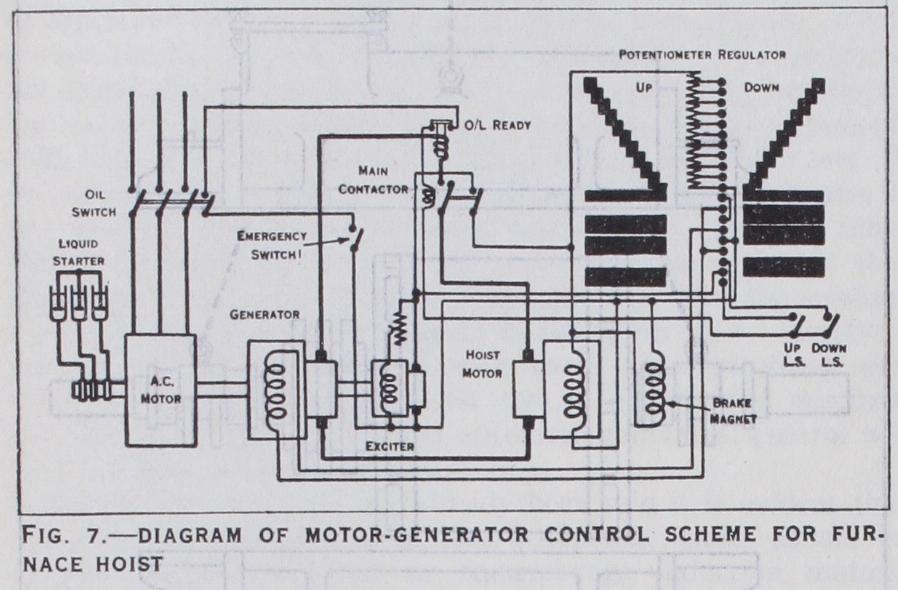
The chief pieces of steelworks equipment that call for comment are the following: (a) Furnace hoists; (b) main rolling-mill drives—large main rolls, requiring up to about 20,000 h.p.; smaller mills, requiring up to about Soo h.p. ; (c) mill auxiliaries— live rolls, lifting and tilting tables, screw-downs, manipulators, side-guards; (d) transport equipment—various highly developed cranes; (e) other equipment; e.g., hot saws, air compressors, etc.
The comparatively small size of the induction motor will afford an indication as to the equalizing of the load due to the fly-wheel and slip regulator. Something like a quarter of the whole input is stored and returned by this wheel in the form of regenerative braking.
Small main rolls and many large non-reversing (including three-high) mills are driven direct by induction motors, with or without gearing. For non-reversing (continuous) mills, a fly wheel is usually mounted on the mill shaft or that of the motor. The control gear is of the contactor type, with slip-regulator if a fly-wheel is employed.
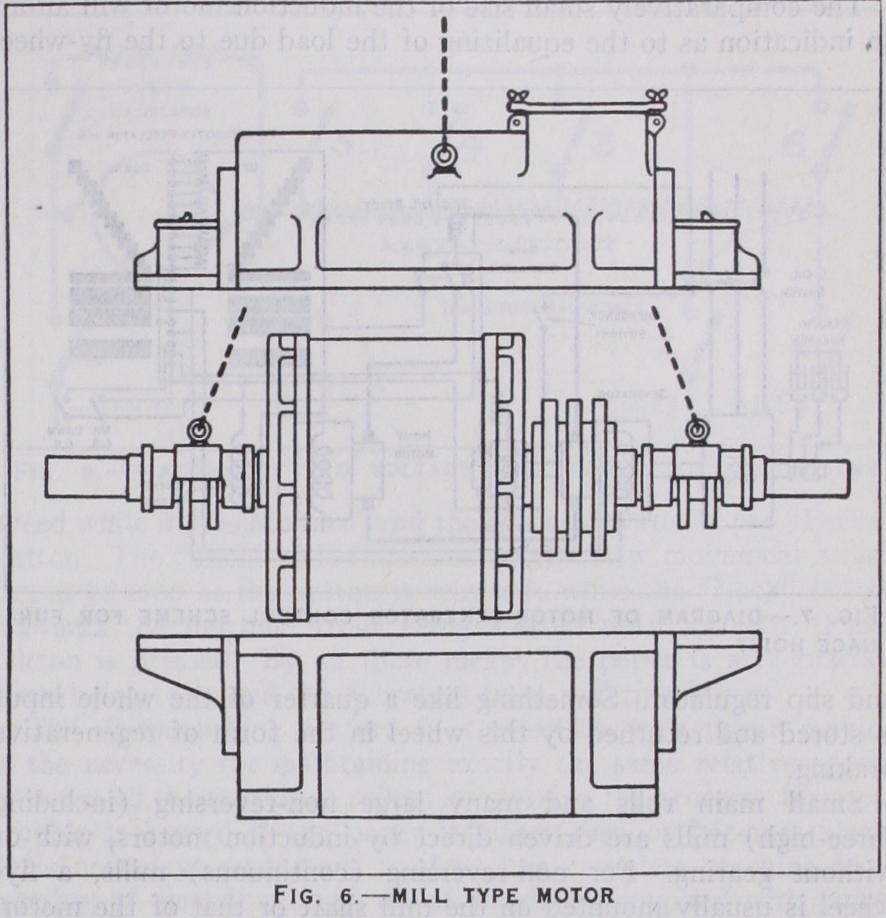
Auxiliaries.--It is for the drive of the auxiliaries, requiring from 5o to zoo h.p., that the mill type of motor was developed. The policy as to control gear is to keep it as simple as possible, and series or induction motors are in most general use, with plain reversing contactor equipment, braking being typically by plug ging. For screw-downs and similar equipment, a solenoid brake may be added. Lifting or tilting tables are operated by a non reversing motor through the medium of cranks, halting auto matically at either end of the stroke.
Cranes and Machine Tools--Except for the general need for robustness and for protection against grit, etc., the drive of steel works cranes and machine tools does not differ in principle from standard machine-shop practice.