
ELECTRON THEORY For most practical purposes it is sufficient to regard the media, in which electrical phenomena are observed , as con tinuous media possessing conductivity s, specific inductive capacity K and magnetic permeability j, in greater or less degree. These electrical properties of matter are the prop erties of matter in bulk, or of bodies containing enormous num bers of atoms. They represent average values taken over volumes very large compared with the volume of one atom. For scientific purposes it is desired to explain such properties of matter, and to do so it is necessary to develop a theory of the nature of the ultimate particles composing material bodies. According to the electron theory, matter consists of minute particles of negative electricity which are all equal, and are called electrons, together with minute positively charged particles, one in each atom. The positive particles are called positive nuclei, and an electrically neutral atom is supposed to consist of a positive nucleus sur rounded by a number of electrons; the charge on the nucleus being equal and opposite to that on the electrons. The electrons and nuclei are supposed to be so small that even in very dense matter, such as platinum, only a very minute fraction of the volume is occupied by them. (See NUCLEUS.) If we imagine a point selected at random inside a piece of mat ter, then there will almost always be nothing at the point except the electric and magnetic fields excited by the electrons and nuclei. If the point should happen to be inside an electron or a nucleus, we may suppose that there is also a certain density of electricity at it in addition to the electromagnetic field. According to this theory, the electromagnetic equations for the interior of matter are the equations for space containing nothing but electricity and the fields which it excites. The magnetic permeability and the specific inductive capacity are everywhere the same as in a vacuum. If F denotes the electric field strength, and p the den sity of the charge at a point, then we have we have also + ally = o, or dives= o, where H is ax az the magnetic field strength. For, if there is no magnetism, all the unit tubes of magnetic force must be closed so that the num ber starting in unit volume is zero In the electron theory it is customary to express the magnetic field strength in electromagnetic units, and the electric field strength and charge density in electrostatic units. The current density is equal to the dielectric current, I aF , together with 47r at the current due to the motion of the electricity, which is pv, where v is the velocity of the electricity.
Maxwell's equations (I), (2), (3) are therefore replaced by where are the components of v. The current components are divided by c, the number of electrostatic units of charge in one electromagnetic unit, because p and F are supposed expressed in electrostatic units, while H is in electromagnetic units. The speci fic inductive capacity K is put equal to unity, its value for a vacuum in electrostatic units. In the same way Maxwell's equa tions (4), (5), (6) are replaced by The magnetic permeability p, is put equal to unity, its value for a vacuum in electromagnetic units, and aH/at is divided by c, because the work to take an electrostatic unit of electricity round a closed curve is only i/c of that for an electromagnetic unit. The six equations are equivalent to the vector equations these with div F = 4irp, div H=o, and the equation for the force on a moving charge are the fundamental equations of the electron theory. The force, per unit charge, on a charge moving with velocity V is equal to F+ — [v . H] where [V . H] denotes the vector product of V and H, and is defined to be a vector, per pendicular to the plane containing V and H, equal to vHsinO, where 0 is the angle between v and H. The factor i/c is intro duced because vHsinO is the force on one electromagnetic unit of charge moving with velocity v in a magnetic field H.
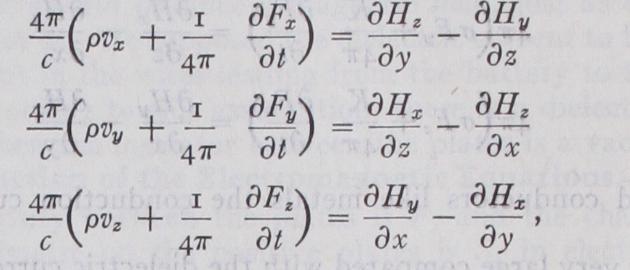
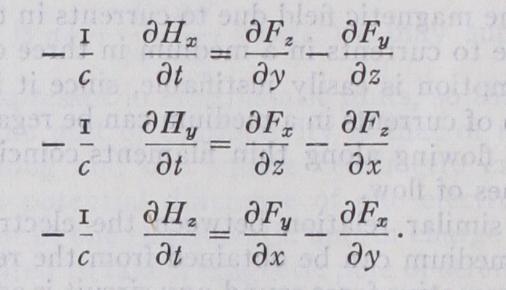
The fundamental equations can be simplified by expressing F and H in terms of units I (47r) times larger than the ordinary units, and p in terms of a unit J (47r) times smaller than the ordi nary unit. If this is done, the equations become The force in dynes on a charge per unit charge is still equal to F + I [v . H], because the unit of charge is \I (47r) times smaller, and the unit of field strength (47r) times larger than before. In what follows we shall use this simplified form of the electromag netic equations.
As a simple example, suppose an electron with charge e has been at rest at the origin from to a time and that, between and t2, it moves a small distance away from the origin and then back again, and then remains at rest. Up to the field will be along r, but when the electron begins to move, the field will change and the change will move out from it withwelocity c. If we describe two spheres with centres at the origin and radii and then outside the larger sphere the disturbance due to the motion will not have arrived, and inside the smaller sphere the disturbance will have passed by, so that the field will be along r, except in the space between the two spheres. Inside this space there will be a mag netic field due to the motion as well as the electric field. Thus the motion of the electron produces a wave in the field, which moves out from it with the velocity c.
If the energy density is E, and we suppose that the energy is moving along with velocity v, then we have P = Ev, and the momentum density, is We infer that energy has mass, equal to the energy divided by the square of the velocity of light, since momentum is equal to mass times velocity. Since one form of energy can be converted into any other form, it is natural to conclude that any form has this amount of mass. Since the electromagnetic field has energy, mass and momentum, and can move through space, it has all the essential characteristics of material bodies, and so may be regarded as a material sub stance. It moves through space by a process of growing in front and fading away behind, i.e., by wave motion, and differs from material bodies, as usually conceived, in this respect, but it may be that material bodies, such as electrons, also move through space by means of some sort of wave motion.
If the particle considered is an electron, m will be the mass of the field, which it excites and which moves along with it, together with any additional mass which it may have. If the electron is merely an electric charge, it may have no additional mass, but in any case its mass will vary with its velocity, in accordance with the equation m = — . The experiments of Kauf mann, Bucherer and others on the variation of the mass of electrons with their velocity have shown that the mass does vary approximately in accordance with this equation. These experiments confirm that momentum is due to flux of energy, but give no information as to the constitution of electrons. (See ELECTRON' and ELECTRICITY, CONDUCTION OF: in Gases.
It is supposed that some of the electrons in conductors are free to move about, and that an electric field causes these free electrons to move along in the direction of the field with an average velocity proportional to the field. If k denotes the average velocity due to unit field, and n the number of free elec trons per cubic centimetre, then the conduction current density, i, is given by i = nekF, where e is the electronic charge and F the electric field strength. The conductivity a• is equal to i/F, so that o = nek. If p denotes the density of the electricity at any point in the substance, and V its velocity, then the conduc tion current is easily seen to be equal to the average value of the part of pV due to the motion of the free electrons, the average being taken over a small volume large enough to contain a very great number of free electrons.
It is supposed that some of the electrons are not free to move about, but are acted on by restoring forces proportional to the distances of the electrons from their equilibrium positions. In an electrically neutral piece of matter the average field due to the electrons and nuclei is zero, but, when an electric field acts on the matter, the electrons are displaced from their equilibrium positions, and so produce a field. Consider a small volume S containing n electrons per cubic centimetre, and suppose these electrons are displaced from their equili brium positions through an average distance E. It is easy to see that the small volume will then produce the same field as two charges neS and —neS at a distance E apart ; for when the electrons are not displaced, the positive and negative charges, on the average, neutralize each other, so that, when the negative charges are displaced, the posi tive and negative charges are separated and no longer neutra lize each other. The electric moment of the volume S is equal to neES. The moment per unit volume is called the polari zation, so that, denoting this P, we have P=neE. The polari zation P is a vector quantity, and we may draw lines in the medium in the direction of the polarization. If we draw lines of polarization through the boundary of a small area, we get a tube of polarization. Consider a short length l of such a tube, and let its cross section be a, so that its volume is la and its electric moment Fla. This moment is the same as that of a charge +Pa and a charge —Pa separated by a distance 1. Thus we see that a tube of polarization starts from a charge —Pa and ends on a charge +Pa. A unit tube of polarization may be defined as one which ends on a unit charge, so that Pa= i for a unit tube. The number of unit tubes of polarization starting in a unit volume is therefore equal to —pp, where pp denotes the density of charge due to the variation of the polarization. We have therefore divP = —pp. If then pE denotes the average density of charge in the medium due to electricity in the medium, not due to variations in the polarization, and p the total average charge density over the small volume S, we have p = pE+ pP. The charge pp disappears when the polarization is reduced to zero, but the charge pE does not. The equation divF = p of the electron theory, when averaged over the small volume S, gives divF = p, where F denotes the average value of F. F is the value of the electric field which would be given by experimental methods. We have therefore divF = pE+pp or divF+divP = pE. If we now denote F+P by D, we get divD= pE. D is called the total polarization, or the electric induction. Also it is sometimes called the electric displacement.
When the polarization changes, there is a current due to the motion of the electrons. The current density is equal to ne dt or dP/dt. Thus we see that the total average current in a ma terial medium at rest, is equal to vF+dP/dt+dF/dt. rF is the conduction current, dP/dt the polarization current, and dF/dt the displacement current of the variation of the electric field.
The equation curl H = (—aF + of the electron theory, c at when averaged over the small volume S, gives In a non-magnetic substance the motion of the electrons and nuclei is such that it produces no magnetic field except that due to the conduction and polarization currents. The magnetic moment is everywhere. In such a substance the average value of H, or H, will be equal to the experimentally determined value of H, so that the equation curl F= — i a at H gives curl F = — i aH • The equation dives = o also gives dives = o. c at The equations for a non-magnetic material medium at rest are therefore divD = pE, dives = o In a magnetized medium, according to the electron theory, the motion of the electrons is such that it produces an observable magnetic field, even when the average current is zero. It is supposed that some of the electrons move round orbits in the atoms, so that the atoms have a magnetic moment. These atomic currents do not contribute anything to the average current over the small volume S containing many atoms, be cause as many electrons are moving in one direction as another, but they nevertheless produce a magnetic field and the medium is said to be magnetized. The average, or observable, current therefore does not correspond to the observable magnetic field, so that the equations for a non-magnetic substance are not ap plicable to a magnetic one. The total magnetic field, averaged over the small volume S, is called the magnetic induction and denoted by B, while the part of the magnetic field which is not due to the atomic currents in S is called the magnetic field strength, and denoted by H (see MAGNETISM). The equations for a magnetic substance at rest are then divD = pE, divB = o, curl H = I curl F= — z aB . The specific c c at ductive capacity K is equal to D/F, and the magnetic per meability µ is equal to B/H, so that the equations may be written divKF = PE, divµH = o, These are equivalent to the equations of Maxwell's theory.
Now suppose that the average restoring force on an electron in the medium is equal to —aE where a is a constant. _ The re sultant force on an electron is therefore equal to In a steady field this will be equal to zero, so that E = This equation, with K= i +P/F and P = neE, gives If the electric field is not steady, then it is necessary to take into account the inertia of the electrons. If m denotes the mass of an electron, we have nmE=—naq+ne(F+P/3), or, since P=ne so that P = net, this gives mP = — If we sup pose that F = cospt, we find that K = I +P/F is given by specific inductive capacity, and so the refractive index, which is equal to 1,K for a non-magnetic medium, vary with the frequency p/2 r. In this way an explanation of the phenomena of dispersion can be obtained from the electron theory. By introducing a frictional force on the electrons proportional to the velocity , absorption can also be explained (see LIGHT). The theory of magnetic permeability is discussed in the article on MAGNETISM.
Electron Theory of Metallic Conduction.—On the electron theory, some of the electrons in metallic conductors are supposed to be free to move about inside the material of the conductor. These free electrons are set in motion by an electric field, so producing a current. According to the classical electron theory, the free electrons were supposed to move about in the conductor like the molecules of a gas and to have the same average kinetic energy as gas molecules at the same temperature. This theory is no longer regarded as tenable. The question of metallic conduction is discussed under ELECTRICITY, CONDUCTION OF Solids.
Hall a metal plate carrying a current is put in a transverse magnetic field (H), it is found that a small electric field (F) is produced in the plate along the direction perpendicular to the current and to the magnetic field. This is known as the Hall effect. According to the electron theory, we should expect the transverse electric field to begivenby the equation Heu+Fe= o, or F= —Hu, where u is the average velocity of the electrons along the direction of the current. For Hen is the sideways force on the electrons due to their motion in the magnetic field and the transverse electric field must be such as to prevent any sideways motion. According to this the Hall effect should be in the same direction in all metals, whereas in fact it is in one direction in some and in the other direction in other metals. It is also usually very small and appears to be entirely absent in liquid metals. The classical electron theory therefore fails to explain the Hall effect.
It is found that the electric conductivity of metals is slightly diminished by a magnetic field. The change is nearly proportional to the square of the field strength. No satisfactory explanation of this effect is offered by the electron theory (see ELECTRICITY, CONDUCTION OF). In recent years modifications of the classical electron theory of metallic conduction have been developed which seem to agree with more of the facts than the classical theory. These modifications depend upon the principles of the theory of quanta (see QUANTUM THEORY, and THERMIDNIGS).