
HIEROGLYPHS.) Foreign Influence.—Under the r 8th Dynasty we find the first real differences from the classical civilization of the Old and Middle Kingdoms, owing to the conquest of the country by Semitic foreigners, the Hyksos, and the conquest of Hither Asia by the Egyptians that followed their expulsion. This event modified Egyptian culture profoundly, and sowed the seeds of its degeneration. The foreign influences, Asiatic, Cretan, Libyan, grew ever more potent to affect the externals of Egyptian culture, though the religion (except during the ephemeral revolution of Ikhnaton), and the writing maintained their characteristic form, and preserved the individual nationality of the people.
3. History of Egyptian Art: the Pre-dynastic Period.— The beginnings of Egyptian art antedate the arrival of the "Dy nastic Egyptians" from the north. We see them in the curious painted pottery figures of mourning women, standing or seated on the ground with their arms raised, and with their bodies decorated apparently with tattoo-marks, which are found in early pre-dynastic graves (a fine collection is in the British museum), in tusks of ivory with carved heads of long-bearded men, in a few crude scratched representations of animals on the early red and black pottery, and in the geometric and (rarely) animal-figure designs in thick white slip-paint on red ware. Combs of ivory with male heads, and figures of animals follow, and slate palettes in the form of animals, such as hippopotami, hyenas, bats, tortoises, fish and cuttlefish, on which face-paint was ground for use. Then come the pictures of men, women, goats, cattle and boats in thin red paint on the buff ware. These figures are not in outline and cross-hatched, as in the earlier white and red ware, but are solid. Male figures are rarer than female. The men are naked. The representations of boats are very curious, and with one or two exceptions are extremely unlike boats, so much so that they were formerly often taken to be pictures of stockaded village-settlements, the oars being the stockade, the cabins the houses, while the "totem-poles" with figures of animals would be appropriate to both conceptions. It seems, however, that we must regard them as boats. Then come the first wall-paintings with very similar scenes, as at al-Kab, in which we find the men wearing now the characteristic Egyptian waist-clout of white linen. The colours used are red, white and black. To this time probably belong the rude gigantic figures of the god Min from Koptos, in the Ashmolean museum at Oxford, with their reliefs of goats on hills.
As the conquest by the people of the North continues we find the level of art rising swiftly. The flint weapons are at their finest, the technique of stone-vase making rapidly improves, gold decoration begins to be used, as for instance on the handle of the famous flint knife from al-Araq. But pottery deteriorates. It would look as if the improvement in stone vessels meant less interest in the finer kinds of pottery. Stone and gold-work attract most attention. Stone sculpture begins in rude flat relief figures on limestone grave stelae. A parallel with contemporary Sumerian art is found in the sculpture of processions of animals, generally sheep, goats or cattle ; no doubt these were intended to ensure continuance of riches in flocks and herds in the next world. The slate paint-palettes develop into large objects with a circular ring-depression for the paint, and are decorated with most lively scenes in low relief of hunters, armed with bows and arrows and throwsticks pursuing lions, and of the corpses of the dead in battle being cast out to be devoured by vultures (British museum. Louvre). Other such fragments show ostriches (Brit. mus.), giraffes with a palm tree (Ashmolean) ; on another (Brit. mus.) is the earliest hieroglyph known, the symbol of the god Min, while on the British museum fragment of the large "hunt-palette" is the hieroglyph of a chest, the sign of "burial." The Archaic Period.—These works herald the beginning of the Dynastic Period, when we find a strongly marked upswing of artistic capacity. Progress is specially marked during the first five reigns, of Narmerza and `Ahai (who with the pre-dynastic Southern king and first conqueror of the North were probably together the originals of the legendary "Menes"), of Zer, Za and Den. We know the work of this time well from the discoveries at Abydos, Hierakonpolis, Tarkhan and Turra. A typical example of this progress is seen in the one instance of the figure of the hawk, typifying the king, above the serekji or "proclaimer" banner containing the name of the king, now written in genuine hiero glyphics which we can interpret. This hawk-figure develops in a most interesting way, till after the end of the reign of Den it takes on its characteristic form, which it has finally assumed by the end of the dynasty. And in order to appreciate not only the advance that was made during the early dynasties, but also the remarkable strength of conception and power of design in the work of the beginning of the r st Dynasty we may compare reliefs of the 3rd and 4th Dynasties with the chef-d'oeuvre of the archaic period, the remarkable slate "palette" of Narmerza from Hierakonpolis (Cairo museum; casts in the British museum and the Ashmolean), on which we see in relief "Menes" attended by his sandal-bearer, inspecting the bodies of his slain Northern enemies, while the hawk of his Upper Egyptian tribal god Horus seizes a strange half-human figure emblematic of the North : above, the queer fetish-heads of the cow-goddess Hathor, which we already know in the pre-dynastic period, seem to typify the union of the two races that was producing Egyptian civilization. The great ceremonial mace-heads of the Scorpion and Narmerza, also from Hierakonpolis (in the Ashmolean), commemorating the Scorpion's conquest of the North and the Jubilee festival of Narmerza also show very interesting reliefs. "One is struck by the naive energy of this commemorative art, which has preserved for us a contemporary record of the founding of the Egyptian kingdom." In ivory we have (Brit. mus.) the extraordinarily lifelike little figure of a king (No. 37,996) wearing the crown of Upper Egypt and a long and very foreign-looking patterned robe of a kind that we never see a king wearing later, which was found by Petrie at Abydos. It is probably the most precious relic of the archaic period.
Den-Semti was the first to bear the afterwards time-honoured title of "Insibya" or king of Upper and Lower Egypt, and in his time the first moment of crystallization in the development of art and culture occurred. After his time the tempo slows down; originality becomes rarer, crudities begin to be thrown aside. At the same time luxury increases noticeably. From the relics found in his tomb, or cenotaph, at Abydos we see already a rich and picturesque civilization, energetic and full of new ideas, both artistic and of a more practical character. Gold and ivory and valuable wood were lavishly used for small objects of art, fine vases of stone were made, and the wine of the grape (irp) was kept in great pottery vases stored in magazines like those of the pithoi at Knossos. The art of making the blue glaze "fayence," that typically Egyptian art, which had already been invented in pre-dynastic times, developed very much at this time. The king's jewellers made wonderful bracelets of gold and carnelian, sceptres of sard and of gold, and so forth. The king's carpenters "could make furniture of elaborate type; the well-known bull's hoof motif for chair-legs already appears." And they could make the interesting little labels of ivory and wood on which were inscribed the events of the king's reign, with incised representations of him smiting his enemies (Brit. mus.). Wood was imported for large and small work, for beams or for year-labels, into woodless Egypt from Syria already, no doubt by sea. It was used con siderably in building in conjunction with brick, for the art of stone building had not developed much yet ; that progress was reserved for the next age. Pottery had deteriorated badly since the pre-dynastic age. It is an interesting fact that elsewhere, in Babylonia and in Crete, for instance, the pottery also degen erated at the opening of the age of metal. It was still built up, made without the wheel, which hr.d not yet reached Egypt from Babylonia.
Possible Babylonian Influence.—The question of Baby lonian influence on the nascent Egyptian culture and art is inter esting and important. We see undoubted traces of it in many things, chief among them the style of building brick walls, which are simple reproduction of the Sumerian style, with its recessed panels, in everything but the shape of the brick, which in Egypt is always rectangular and long, never either plano-convex or a flat square, as often in Babylonia. It looks as if the crude brick had been invented independently in Egypt, as it naturally might be in a land of mud, but that the panelled style of building with bricks came from Babylonia. Again, the use of stone (and wood) seal-cylinders at this time in Egypt, and also of the peculiar conical macehead, points to Babylonian influence. A reverse in fluence, of Egypt on Babylonia, is improbable, because in Baby lonia at least the first of these things were at home, and were there to stay, whereas in Egypt they were not destined to last, the use of the seal-cylinder indeed being comparatively ephemeral there. Then there are the Babylonish-looking monsters on slate palettes, which disappeared from Egypt with the 1st Dynasty, the similar processions of animals in both arts at this time (al ready mentioned), and the identical early representation of the lion with open grinning jaws and round muzzle in both countries; already by the time of the 3rd Dynasty the Egyptian had dropped him and evolved his own dignified lion with closed mouth, whereas the Babylonian retained his own furious lion to the end of the chapter of his art. These things, and others, are important to note, especially now that we seem to be compelled by the latest discoveries at Ur to recognize the superior antiquity of Sumerian art. If Babylonia was the senior we could understand that she contributed something to the feverishly accumulating make-up of the young Egyptian culture, some of which was afterwards dropped. But there is the question whether the com munication was direct, or whether the fact was that both Egypt and Babylonia received certain similar elements of culture from a common source, which must have been in Syria. We do not yet know. The "dynastic Egyptian" who came from Syria probably brought certain elements of culture thence; besides developed agriculture and the connected Osiris-Isis worship, also probably the knowledge of copper, and probably the conical macehead, and possibly the panelled style of building. But other foreign elements seem later, and to be contemporary with the union of the kingdom; and it must be remembered not only that more or less direct communication with Babylonia through the Hauran and so across the desert was then possible as later, but that in all probability direct sea-communication existed between such ports as Qusair, at the sea-end of the Wadi Hamamat, and the ports of Southern Babylonia. The evidence of the al-`Araq knife with its gold-beaten handle-reliefs of foreign ships and a Baby lonish-looking god is evidence of this even in the pre-dynastic period; and we know that in all probability Kagan, "the place to which one goes in ships," from which the Sumerians derived some of their hard stone (unobtainable in their own country) was the Eastern Desert of Egypt and possibly Sinai.
However this may be, the two cultures very soon took each its own line of development, and Babylonia, at least, was never in fluenced in the smallest degree by Egypt except possibly at one single period, that of the Sargonide kings of Akkad (c. 2 700 B.c.) when a peculiar style of sculpture was in use that recalls the work of the early Egyptian dynasties more than anything else in tech nique, though the subjects show no sign of Egyptian influence.
The Epoch of Imhotep.—Under the long 2nd Dynasty we have little to record; a static period succeeded the dynamic 1st Dynasty. But with the advent of the short-lived 3rd, a new dynamic period set in suddenly with a political explosion. A new king from the South, Kha`sekhem, dispossessed the successors of Menes, who had taken up their abode in the conquered North, and as king of both countries called himself Kha`sekhemui ("Appear ance of the two Powers" instead of "Appearance of the Power"). His statue in the Ashmolean Museum, from Hierakonpolis, tells us that he took 47,209 Northerners captive, and on its base we see, summarily cut in outline, variously contorted figures of the slain. Evidently the twisted attitudes of their bodies were admired and sketched at the time, and were reproduced by the king's sculptor on his statue-base. "It was an age of cheerful savage energy, like most times when kingdoms and peoples are in the making." The statue of the new Menes however did not mark a very great advance on former work, though it was bigger; the lifesize figure was to come in the next reign, which marked a climacteric in the history of Egyptian art and science. His son Zoser (Tosorthros) was probably one of the greatest of the early pharaohs ; at any rate he was served by one of the greatest of Egyptian ministers, the wise Yemhatpe or Imhotep, who was later deified under his own name (in Ptolemaic days pronounced Imouth, the Imouthes of the Greeks), as the god of knowledge and especially of medical science the Egyptian Asklepios. He is depicted as a priestly man, seated, reading a scroll open on his knees. Imhotep was not only a physician, he was also an architect, and it is more than probable that the extraordinary architectural development that marks the reign of Zoser was due to his inspiration and teaching. He was certainly not deified for nothing, and when we find that it was in the reign of the king whose minister he, the divine patron of science, was, that a sudden and unparalleled advance in art and architecture was made, we can hardly err in attributing this advance to him. It was always recorded that it was in the reign of Tosorthros that "the first stone house was built," as we read in Manetho ; and the most ancient Egyptian pyramid, the "Step Pyramid" at Sakkara, was built by Zoser. No such great stone building was known before. And now Mr. Firth has revealed at Sakkara the original 3rd Dynasty funerary temple of the king, with the serdab, or recess, in which his lifesize statue (the oldest) was placed at his death and found by Mr. Firth; and it is more than likely that the royal tomb itself may be reached. And the most extraordinary thing about this temple is its architecture. It has panelled walls of fine limestone, and lotus-columns of the same beautiful oolite stone, long corridors of them; the work is the first of the developed Egyptian style which we know henceforth till the end. It has been said that such "style" means a long previous development through stages unknown to us. But yet there seems to be no time for any such development. In the work of the 1st Dynasty there was nothing like this. The conclusion seems un avoidable that this was a sudden development due to a single brain, that of the wise Imhotep, or to two brains, if Zoser is to be given a share of the credit. And such sudden developments do occur from time to time in history; such powerful brains do some times appear, and bend things to their superior will. We have later instances in the history of Egypt itself, notably that of Ikhnaton, though his work was impermanent. We are too apt to assume "long periods of development." Nature does not do things per saltuyn but man does. He sometimes creates specially, as Imhotep seems to have done. At any rate, in the absence of any evidence of any such previous development, we seem justified in assuming so.
It was not only in architecture that the creative genius, whom we have supposed to have been Imhotep, showed his hand. In re lief sculpture also the style that had already appeared in the memorials of the 1st and 2nd Dynasty kings on the rocks of Sinai now developed into the first examples of the historic Egyp tian style, with the king depicted in the manner in which we see him henceforward ; though it was not stereotyped till the time of the 5th Dynasty. Sculpture in the round remains more archaic in type, with curious human faces reminding us of certain extra ordinary sculptured heads hitherto usually attributed either to the Hyksos or to the gth Dynasty (at Cairo), which may however themselves be of the 3rd. The portrait-statue of Zoser is some what of this type, and the figure is distinctly archaic still. Sculp ture in the round was not to take its final form till the next dynasty, the age of the great pyramid-builders.
At this time begins the long series of private tombs decorated with reliefs representing the dead owner amid his daily surround ings, with his wife and family, hunting or overseeing his estates, and with his fellahin engaged in their daily avocations. The royal tombs themselves are not yet decorated in any way: but their fu nerary temples, close by, were, chiefly with religious scenes. At the same time sculpture in the round assumes its final form in the statues of the kings Khafre` and Menkaure`, the latter with his queen and with the goddesses of the "nomes" or provinces of Egypt, among the greatest treasures of the Boston and Cairo museums. We now see in the faces of the kings the first examples of the Egyptian genius for personal portraiture which later became one of the chief and most valuable characteristics of Egyptian art. Another portrait-figure of the time is the well-known "Skeikh al balad." And in the famous statues of the Prince Ra'hotep and his wife Nefert (also at Cairo), with the amazing lifelike effect of their eyes, produced by the means of a pin of copper representing the iris inserted into a crystal eyeball, we have a startling combination of accurate portraiture and appearance of life. This technique of eye-representation was often repeated in Egypt later on, in glass or obsidian, as well as crystal. It was paralleled contempo raneously in Babylonia, by means of shell for the white of the eye and jasper for the cornea, but not so successfully. Wood-carving is exemplified in the beautiful reliefs of the panels of Hesire` at Cairo. Pottery improves, a fine bright red polished ware coming into use, that continued till the time of the 7th Dynasty.
Under the sth and 6th Dynasties the pyramids deteriorate, and are largely composed of rubble with facing of limestone, whereas the great pyramids of the preceding dynasty had been made of the finest limestone blocks throughout. The actual tomb-chamber of the king now begins to be decorated with religious texts, the "Pyramid-Texts," spells relating to life in the next world calcu lated to secure the safety of the dead monarch there; precursors of the chapters from the "Book of the Dead" of a later epoch (see Religion) . The funerary temples on the other hand are magnifi cent, built with great papyrus-columns of red granite and deco rated with fine reliefs in which the official religious style is now fixed. Tomb-reliefs and portrait-statues continue excellent. Stone vases have become smaller and more delicate; under the 5th and 6th Dynasties beautiful unguent pots of alabaster (calcite) were often placed in the tombs.
Under the 6th Dynasty we have the magnificent statues from Hierakonpolis of king Pepi I. and his small son in copper (not bronze, as used to be thought owing to a mistaken analysis), at Cairo. The copper was apparently beaten, not cast, though this is not quite certain in the case of the head of the prince. Here we have a technique that first comes to our knowledge now, though it was probably older, since we have a record of a copper statue having been made of king Kha`sekhemui under the 3rd Dynasty. It is probable that this art came to Egypt from Babylonia, where we find it in the case of the great copper reliefs and figures of animals found at al-`Ubaid, near Ur, which date to about 3100 B.C., and are presumably contemporary with the 2nd Dynasty owing to the usual computation, but before the 1st if we adopt that of Scharff.
The small arts of ivory carving, of fayence-making, of gold and electrum work, and of cloisonné inlay in beautiful stones such as carnelian, lapis, turquoise and blue felspar, of scarab-making in glazed steatite, obsidian, crystal and amethyst, are all now at their apogee. Nothing so tasteful, so well proportioned, so grace ful, so delicate was made later. The figures of the royal princesses from Dashur and Lisht are of beautiful workmanship. Scarabs at this time came into general vogue. They had been used at the end of the Old Kingdom and made of blue glaze, without inscription, but with the labyrinthine designs common at the time on small seals, especially on a class known as "button-seals," probably of foreign origin, and usually made of ivory or steatite, which is closely paralleled in early Minoan Crete. From the 9th to the i 2th Dynasty the scarab develops with characteristic spiral de signs of Aegean (and possibly ultimately of Sumerian or of Central-European) origin, and under the i 2th inscriptions are added; it begins to be used as a seal. When inscribed its material was usually of glazed steatite; scarabs of the harder stones were generally not themselves inscribed, but often bore an inscription on a gold, electrum or silver plate cemented to the base. Twelfth Dynasty scarabs are among the finest known, both for design and beauty of glaze (see also SCARAB).
A quaint, often crude, but also often finely executed art of the period from the 6th to the r 2th Dynasty, is the making of the little model figures of people at work in the fields or the granaries, ploughing, winnowing, etc., also of boats with their rowers, con veying the funeral cortege across the Nile, which were placed in the tombs at this time. (See Religion.) Ivory carving was a specialty of this dynasty, very character istic being small seated male figures, like the wooden ones, often with inscriptions or spiral designs on the base. Small figures of this kind were characteristic of the time also in other materials, especially blue fayence; and magnificent small examples of figures of animals in this material, especially of hippopotami, with the water plants amid which they lived, painted in manganese black on their sides, are in the chief museums. The fayence has now largely abandoned the original pale blue colour of the Old King dom for a splendid deep blue. Ordinary pottery has now de teriorated again, the fine polished red ware of the Old Kingdom disappearing. Stone vases continue to be fine, especially those of alabaster and of a peculiar blue marble very popular at this time for unguent-vases or alabastra.
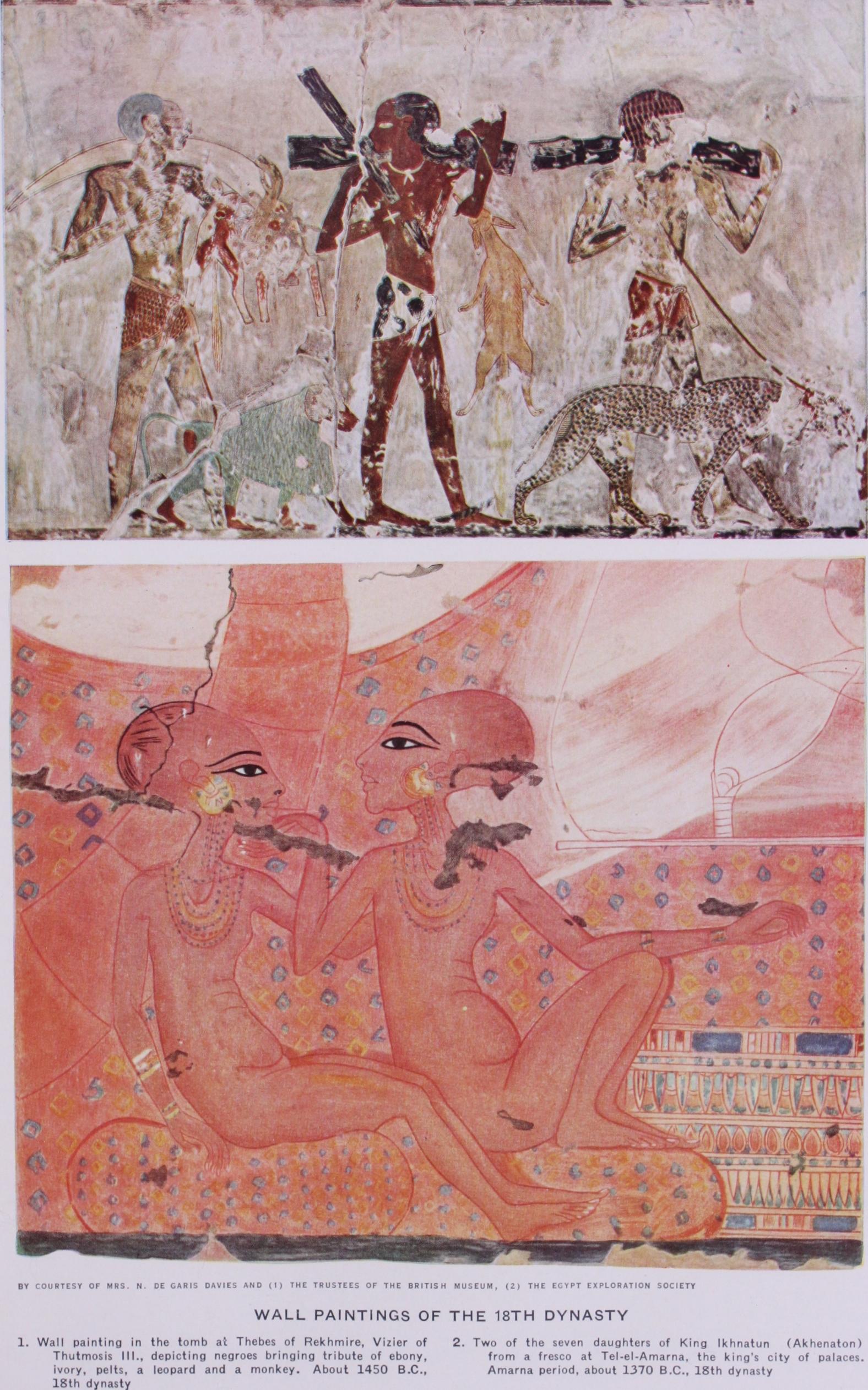
In architecture we do not see any very great development of previous ideas. We know very little of the temple-buildings of the I 2th Dynasty, as they were mostly rebuilt in later days, but it is probable that the i8th Dynasty introduced few new im provements on them. Even so original a building as Queen Hat shepsut's terrace-temple at Dair al-bahri is now known to be merely an enlarged adaptation of the older temple of the I i th Dynasty at the side of which it was built. The old tradition of adorning them with the statues of the kings who built them is carried on, with the same care of portraiture, and with a greatly developed tendency to gigantism, which began under the 12th Dynasty when the first colossi were produced. The colossal head of Amenhotep III. in the British museum is one of the finest Egyptian portraits existing. The extremely unbeautiful, but prob ably lifelike, colossal heads of Ikhnaton, lately discovered, are evidence that the colossus-convention was retained by him. Among smaller royal portraits the young Thutmosis III. at Cairo is one of the finest known ; it is unusually unconventional in treatment for the time, and no doubt a good likeness. A more conventional head, probably of the same king (but by some con sidered to be more probably his sister Hatshepsut) in the British museum, shows how the royal features could be toned down and regularized for an official portrait. Votive statues of private per sons show the same regularized portraits, but very often they are as true as under the i2th Dynasty, as we see from the famous figures of the sage minister, Amenhotep son of Hapu, at Cairo. The groups in white limestone of a man and his wife seated, side by side, which were either placed in the round in tombs or sculp tured in high relief in the rock at the end of the tomb-corridor, are very characteristic, and show the costume of the new age with careful accuracy. For costume had now altered and de veloped in a way unknown since the beginning of the Old King dom, though the change was in no way so radical as those known in Europe. There was, however, now an added note of grace in men's as well as women's costume, that contrasts greatly with the stiffness of the dress of the older dynasties (see Dress). Tomb-decoration for private persons of distinction consists chiefly of wall-portraits in distemper depicting the same scenes of daily life as before, to which great men add pictorial records of the honours they have received from the king, or of events of their time redounding to the honour and glory of their royal master, such as the reception of foreign ambassadors and tribute-bearers from Asia and from Greece. The tomb of Sennemut, the architect of Queen Hatshepsut, of Rekhmire`, the vizier of Thutmosis III., and of Menkheperre`senb, another great man of his time, are cases in point. In them we see pictures of the reception of Minoan ambassadors from Crete which are among the most important historical records of their time. In the reign of Amenhotep III. relief decoration comes into fashion again for tombs, as it had always been used in the temples. The delicate colour reliefs of the temple at Dair al-bahri, depicting Queen Hatshepsut's expedition to the land of Punt (Somaliland) are among the finest earlier works of the dynasty. Later on we have such fine work as that in the tombs of Khaemhe`t and Ramose at Thebes. The royal tombs do not yet show the elaborate painted decoration, repre senting scenes in the next world, so characteristic of the i9th and aoth Dynasties, and do not yet approach the extensive plan of those of the later time. Amenhotep II.'s is the finest, and is decorated with restraint. Tutenkhamon's tomb is but a sepulchre, with little wall-decoration and that unfinished.
The actual objects buried with the king are of unparalleled magnificence. In his case not only specifically funerary objects were buried with him but also, apparently, most of the things that he had actually used in life, his chairs, clothes, boxes, lamps, chariots, sticks, weapons, rings, amulets, necklaces, etc., and it is probable that much the same thing was done in the case of every deceased monarch. But only Tutenkhamon's has ever been found intact, though we have previously found objects, fewer in number, but of almost equal magnificence and interest, in the tomb of Iuya and Tuyu, the grandparents of King Ikhnaton whose successor Tutenkhamon was. These things enable us to form a picture of court life in the fourteenth century B.C. in Egypt more complete than that which we possess in the case of any other ancient civilization. Archaeological excavation has told us more of ancient Egyptian life than that of any other an cient nation. For details of the various wonders of ancient art that Tutenkhamon's tomb has revealed the published accounts of this find must be consulted. But little has been revealed by it that was actually unknown before. The forms, the motives, the types of decoration were all known. But we often find them in new and unprecedented combinations, especially in the royal jewellery, which shows how sumptuously the old 12th Dynasty tradition of gold and semi-precious stone inlay was carried on. The taste, however, is now not so good. The newer art is some times rather garish and vulgar, as seen in many other objects from Tutenkhamon's tomb such as, more especially, the great alabaster or calcite vases represented as on imitation wooden stands of alabaster and combined with the twining papyrus and lily-stems e7nblematic of South and North ; the conception is forced and ugly. Calcite vases with coloured lions on their lids look as if they were made of sugar and were intended to be eaten. Bad taste is beginning to creep in. But on the other hand we also see the characteristics of the new free conception of art intro duced by Amenhotep III. and Ikhnaton in the representations of the young king with his consort on the back of a chair, or the almost Persian miniature picture of a lion-hunt on a box. For eign influence we see too in such work as that of the king's iron and gold daggers, with their non-Egyptian type of hilt and gold filigree decoration.
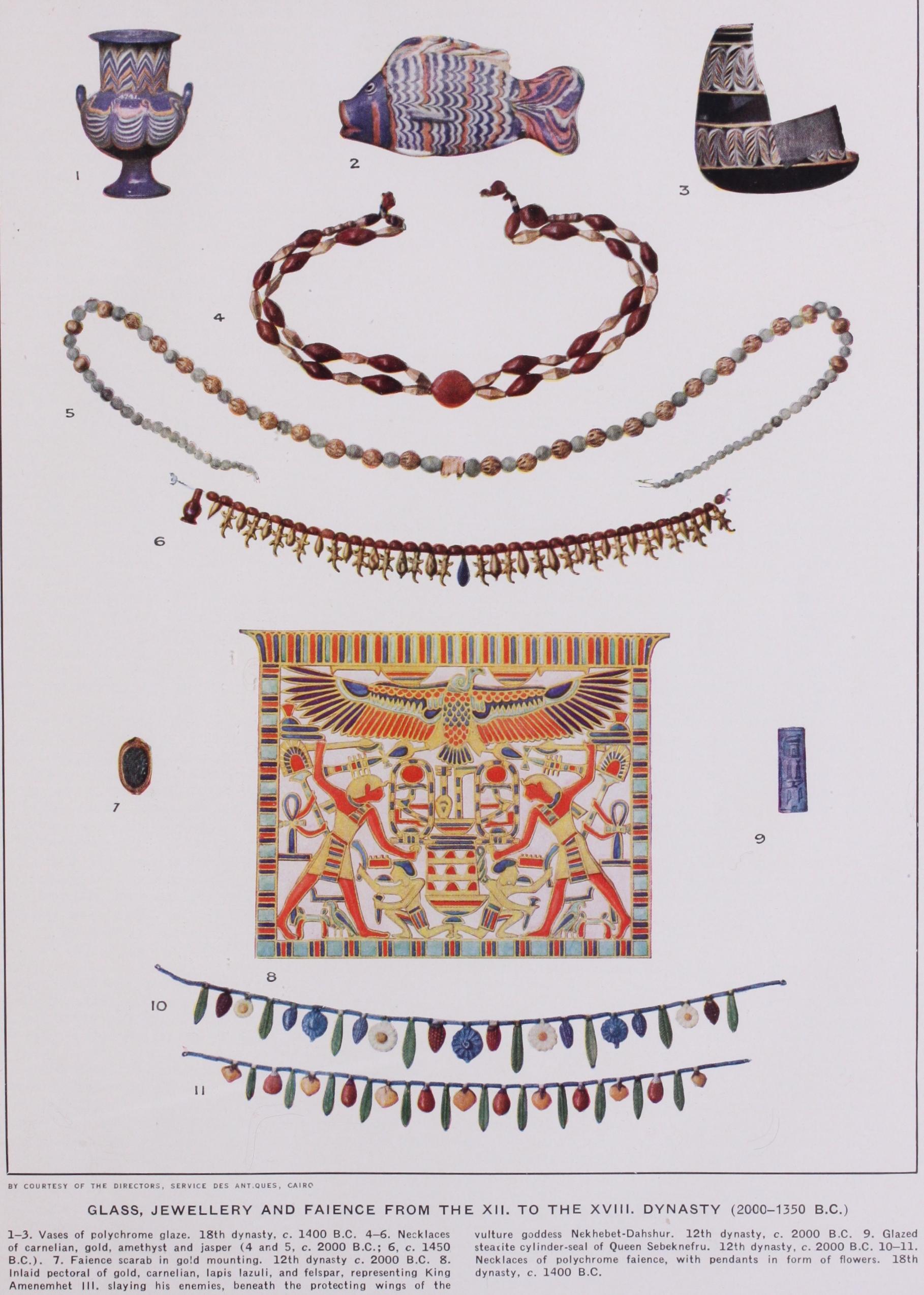
Small art shows the old characteristic of freedom in all things non-religious. Alabaster vases are specially beautiful; the jug shape, previously unknown, comes into use, and the globular bodied, high-lipped vase on a high foot. Scarabs alter very much in type, green glaze comes into vogue, fayence becomes a favour ite material, and in the first half of the 15th century the blue fayence is extraordinarily beautiful. Later on, under Amenhotep III., polychrome glazes are introduced, and all sorts of vivid shades of blue, violet, yellow, chocolate, apple-green are used, which are characteristic of the Amarna period. This polychromy arose from the new polychromy of glass. Under the lath Dynasty real glass, as opposed to glaze, appeared for the first time. It was at first plain blue ; but about the time of Thutmosis III. the art was discovered of making the wonderful opaque poly chrome glass vases that are among the most beautiful and most valuable contents of our Egyptian museums. The first produced were somewhat heavy and coarse, but very soon a remarkable lightness of handling was obtained. A particularly beautiful pale blue is characteristic, and an imitation of obsidian or black glass is excessively rare. Combination of all these materials with gold is common. Gold is lavishly used. "Gold is as dust in thy land, my brother," writes the king of Babylonia to Amenhotep III. Tutenkhamon had a solid gold coffin. And no doubt other kings had solid gold coffins also. Gold is used very freely in conjunction with wood, especially in furniture and in chariots. The arts con nected with chariot-wheel making and horse-trappings generally are new in Egypt at this time, as the chariot and horses were not introduced from Asia till the time of the Hyksos, about i800 B.C. previously the Egyptians had not employed wheeled vehicles at all, but sledges, and asses for draught. Bronze is now in regular use for weapons, and iron comes into more general use but is still precious and worthy of kings.
The Ramessides and the Decadence.—Under the kings of the 19th Dynasty the degeneration sets in. Gold is too much to the fore and is becoming vulgar. Growing vulgarity is the note of the age. The long reign of Rameses II. saw a progressive decline of the arts. We find a grandiose conception of Tutenkhamon's architects at Luxor imitated by Seti I. in a still more grandiose conception, the great Hypostyle hall at Karnak. But it is too big; too gigantic. It is coarse and clumsy. And this coarseness is seen in all the arts after the death of Seti. There is only one good statue of Rameses, that at Turin. The rest are either abominable, or else are not really his but are stolen from former kings. The great rock-cut temple of Abu-Simbel is an atrocity, with its great lumpish clumsy figures, everything out of propor tion, everything all wrong. The huge royal tombs are imposing, with their pictured halls showing the adventures of the soul in the underworld. But their painting is often coarsely executed. Relief is now, after Seti's low-relief work at Abydos, generally sunk, in cavo-rilievo, an old Egyptian idea not much in favour under the i8th Dynasty. Now we find it employed for the amaz ing scenes of royal wars that covered the outer walls and pylons of the temples in which the king, of an enormous size, slays hordes of foreign enemies. He had done this before, on a smaller scale, in art as far back as the time of the 1st Dynasty, but now he did it on the heroic scale. And the style is almost barbaric. Private tombs, excavated as before in the hillsides, show a progressive degeneration of the 18th Dynasty decoration.
In small art vulgarity progresses, but not so blatantly. Many beautiful small things of art were made under the 19th Dynasty, of faience, of alabaster and other stones. The fine alabaster vases of the 18th Dynasty continue, often with handles in the form of animals; but forms deteriorate. The blue faience is not quite so good ; polychromy continues in duller, dirtier tints. Red stones come into use, such as jasper, Bard and carnelian to the exclusion of blue, though blue stones of Asiatic origin, like lapis or chalcedony, were rather favoured. Asiatic influence becomes more and more marked; Semitic gods, Semitic names and Semitic ideas appear upon the monuments.
Under the loth Dynasty the pace of the deterioration increases, especially after the reign of Rameses III. Temples become hideous rows of sausage-pillars with hieroglyphs a yard high, miracles of bad taste. Gold becomes gilding, and it is everywhere ; vulgar dis play hides growing poverty of idea. There is nothing new, there is nothing distinguished now. Tomb-reliefs are stereotyped; even the old power of portraiture has gone. Under the 21st there is a short Indian summer of art at Thebes; almost a pathetic attempt at a revival of lost beauty. The blue faience is startlingly deep in colour; something had been recaptured here. But it is too harsh a blue, and the modelling it covers is worthless. The art of coffin making which had developed in the direction of complexity of re ligious ornament from the simple inscription bands of the 18th Dynasty is now very elaborate. The yellow-varnished coffin of the time, with their relief decorations and inscriptions in gesso, are well known. We have a very inter sting relic in the embroidered "funeral tent" of the Queen Isimkheb, which has been eclipsed as an example of an Egyptian luxury-textile by the older robe (?) of woven linen tapestry of Amenhotep II., found in the tomb of his son Thutmosis IV. We know that the Egyptians used em broidered linen in great variety (though little of it has come down to us) from the paintings. The national art of linen-making is of course characteristic of all periods from the pre-dynastic, when it first appears, though it may have been at its finest under the 11th and 12th Dynasties.
The Archaistic Renascence Under the Saites.—With the 22nd Dynasty everything becomes bad, poor and dull; it is the nadir of Egyptian art. Under the 25th however in the North a new spirit arose in the 8th century. The monuments of the pyra mid-builders in the vicinity of Memphis attracted the attention of the artists, and a new school of sculptors arose at Memphis characterized by a curious archaism. The style of the ancient statues and reliefs was adopted, often directly imitated. Notables of the new time were shown wearing, not their real clothes, but the plain loin-cloths of the 5th Dynasty, combined with the round wigs they usually wore; just as in the 17th and i8th centuries our worthies were often represented in Roman armour with wigs. Sometimes, as in a statue at the British museum, the archaism extends to the wig, so that but for the inscription it would hardly be possible to tell that the statue was not of the 5th Dynasty. The writing could not be archaized very much, though attempts were made in that direction. At Thebes something of the old imperial art-tradition remained, and there we see a neo-Theban school, with a touch of the Memphite archaism in it, which produced some re markable work in the 7th century, notably the portrait heads of the princes Nsiptah and Momtenhet and the unknown old man in the British museum (No. 37,883). Here the native genius for por traiture again shines forth after its eclipse since the loth Dynasty, and throughout the 26th Dynasty it persists, and later, till it again dies out under the Ptolemies. The Saite archaism was eclectic.
and we can often diagnose it by its mixture of the characteristics of historically different periods, such as the Pyramid-time and the 12th Dynasty. It appealed to the Egyptians of the seventh century as appropriate to the new course in national history which was now entered on after the emancipation from Assyrian conquest under the Saites. The old imperial order .constituted with such splendour under the i8th Dynasty was dead, and men turned for new inspiration to the ancient days of the pyramid-builders, before Asia, taken captive, had corrupted her conquerors and planted in them the seeds of decay. The result in the domain of art, as in other things, was the creation of an artificial simplicity and juven ility which, however, was by no means without beauty. The Saite sculptors were wonderful workers of the hardest stones, and their work in basalt and granite, combining the simplicity of old days with the delicacy and style that was wholly new, is characteristic of their period. In small art we see a conscious return to ancient ideas in the abandonment of the dark blue fayence for an imita tion—a most delicate and beautiful imitation—of the pale blue of the Old Kingdom. This pale blue faience, well exemplified in the ushabti-figures of the time, so well known in our collections, is characteristic. Scarabs and scaraboids were beautifully made of fine stones; the Saite engraver was a master. But it was not only in small things that the Saite artist excelled. He made very big things too, such as the huge monolithic shrines in the temples, equally characteristic of the period. Tombs were now built very often with a certain archaism, in the form of huge brick buildings above the actual chambers of the dead hollowed out of the rock below ; this was in some sort a return to the mastaba of the Old Kingdom, and a rejection of the hillside cham ber-tombs of the 12th and 18th-2oth Dynasties. Tomb reliefs im itate those of the 5th Dynasty, with a difference that does not escape the modern critical eye. And as time goes on we see this difference accentuating itself in a way that we cannot mistake ; it is being influenced by the renascent Greek art of the 6th and 5th centuries. Already under Apries and Amasis we see Egyptian figures adopting a curious simpering smile, which we can hardly fail to attribute to the influence of Greek archaic art, commun icated through the medium of Naukratis, of Daphnae and of Cyprus. This "archaic smile" which was natural to the young Greek art, was unnatural and artificial in Egypt, and was adopted there merely as a preciosity. It continued all through the Ptole maic period in Egypt, and became characteristic of the work of that age. Conversely, Egyptian archaistic figures influenced the early Greek sculptors in their figures of Apollos or victors in the games. In the 5th and 4th centuries Egyptian tomb-reliefs and vase-decorations show definite imitations of the new mature Greek art grafted on to the archaistic Saite style. The age of the last native kings is still in its art Saite, but of a curiously delicate re fined character to be carefully distinguished from the larger style of the 26th Dynasty.
The ancient symbol of "life," , easily became the Christian cross.
Honey was much eaten; cane-sugar of course being unknown. Land was usually held by the farmers from a landlord, either the king, a feudal chief, temple-chapter, local squire (a farmer him self) or in late times a wealthy townsman. The king was the nominal owner of all land, but in practice, even at the height of the royal power, he could not claim to own directly the lands of the priests, and if he dared to confiscate any he gained a very bad reputation thereby.
The tiger, of course, was unknown to the Egyptians, but the hyena, wolf and jackal were indigenous, the two latter animals being held in high religious honour, the jackal being thus placated in very early days in order to persuade him not to ravage the graves of the dead in the desert (see Religion). The giraffe was brought from Kordofan, as tribute from the negroes, with the baboon. The hippopotamus and crocodile were among the com monest denizens of the Nile; the former persisted in the Delta till the beginning of the 19th century, while the latter has only quite recently retired from Upper Egypt and Nubia to the region south of the Second Cataract. Both gave heads to Egyptian deities. Of other non-domesticated animals the ibis is the best known : also sacred to Thoth (see Religion) .
Arms and Armour.—The first copper weapons discovered in Egypt appeared about the middle of the pre-dynastic period in the shape of triangular daggers. Axe-heads of copper, of simple rounded shape, were common under the earlier dynasties. Under the r 2th Dynasty the usual Egyptian hatchet-shape was intro duced, sometimes for weapons of parade with decoration of groups of animals in open-work, sometimes with scenes in inlaid metal work, as in the case of the famous dagger of Queen A'ahhotep in the Cairo museum. Decoration of this kind, showing pictures of fighting and hunting in variously coloured metals, was probably of Aegean origin, introduced into Egypt. The finest known examples are the inlaid daggers from the shaft-graves at Mycenae (c. i600 B.e.). Spearheads, tanged, first appear in the early Middle Kingdom. The pear-shaped stone macehead, com mon as a weapon under the early dynasties, went out of use about the same time. The dagger, often with spiral inlay (also Aegean) on the blade, was hilted with a peculiarly-shaped handle of ivory. Bronze now came into use for the finer weapons. Under the Hyksos the Syrian scimitar or K'hepesli was introduced from Asia, and be came a characteristic Egyptian weapon. The axehead under the 18th Dynasty continued as before, and was still stuck through the haft and secured by leather bands; the invention of the socket, well-known in Babylonia nearly 2,000 years before, not yet having been adopted in Egypt for the axe : socketed spearheads appeared however. Long swords were of foreign make and only used by for eign mercenary troops from South-East Anatolia (Shardina) ; an example is to be seen in the British Museum. A heavy bill, with a peculiar blade weighted by a round ball, which took the place of the old mace, was also probably of foreign origin. The peculiar ivory round-tipped dagger-hilt of the Middle Kingdom and early i8th Dynasty was giver. up in favour of a hilt of foreign type, probably Aegean, made of fine stone such as crystal or chalcedony. The gold and iron daggers from Tutankhamun's tomb have hilts of this type, decorated with gold granulated chevron patterns. Bows and arrows were known from the beginning, but the Egyptian bow was not a very powerful weapon, although it was said that no man could bend the bow of king Amenhotep II. Iron, known for weapon making as early as the Hyksos period (a spear of that time was found in a Nubian grave), came first into gen eral use in the 14th and i3th centuries B.C., and by the time of the Saites was universally used in Egypt as elsewhere, bronze sur viving only for weapons of parade and for arrowheads, just as stone had survived for arrowheads well into the bronze age, the commoner and cheaper material being used at all times for weapons that could not be retrieved. The Egyptian flint arrow head was usually of a peculiar flat-edged, not pointed type, like a front tooth. For hunting plain hard wood points were generally employed. Arrows were carried in quivers, suspended at the side of the chariot. Body-armour was never in great favour in Egypt, no doubt owing to the heat. It does not appear at all till the late New Empire, when helmets, often plumed, of a laminated con struction (probably, again, of Aegean origin) began to be worn occasionally, though they were never common, and armour of slats or scales of metal or bone sewn on to a leather or linen hauberk ; laminated armour, apparently introduced by the Ana tolian mercenaries of the time, like the big broadswords already mentioned. This "linen" armour, sometimes made with crocodile skin, was still used under the Saites, when Greek metal armour was introduced, but was used probably only by princes.
Boats and Shipping.—Oared boats were known in the pre dynastic period, and carried insignia (so-called "totem-poles"), the sacred animals or symbols of tribes (later the names) on poles. A masted and sailed boat occurs on a vase of the middle pre dynastic period in the British museum; the sail is square. Square sailed boats were common under the Old Kingdom and thence forward. Great boats were used in the Mediterranean to fetch wood from Phoenicia (the Lebanon) at least as early as the 3rd Dynasty. Ships had navigated the Red sea as early as the pre dynastic age, and are represented on the handle of the al-'Araq knife, and we find them regularly mentioned as sailing to Punt (Somaliland) at least as early as the s r th Dynasty. A tale of the Middle Kingdom tells us of the strange adventures of a ship wrecked sailor in the Red sea, and voyages to Gebal (Byblos) in Phoenicia were common. Under Hatshepsut (i 8th) we have representations of great sailed and oared galleys going to Punt. Whether Egyptian ships ever got so far as Babylonia or India we do not yet know, but Babylonian vessels seem to have come up the Red sea to the Sinaitic peninsula in search of stone at a very early period. In the Mediterranean, the ubiquity of the Cretan and Phoenician sailors no doubt prevented any great development of Egyptian shipping : under the i 8th Dynasty we see a Phoenician ship depicted unloading at a quayside at Thebes. The anarchy in the Mediterranean after the fall of the Minoan civilization probably put an end to Egyptian maritime enterprise in the North. When an ambassador of the loth Dynasty goes to Phoenicia he sets sail in a Phoenician ship. Under the Saites, however, we see a revival of Egyptian enterprise on the water; very large vessels were built for war service on the Nile, and Egyptian sailors fought well in the service of Persia at Artemision and at Salamis. Egyptian ships were always known by individual names, such as "Appearing in Memphis" (early i8th Dynasty), "The sun-disk lightens," (late 13th Dynasty) "The Ship of Amon," and "The Great Ship of Sais" (26th Dynasty). Sailors and shipmen, espe cially those of the royal barges, are often mentioned on the monuments. Canopic Jars, Coffins, etc. (see Religion.) Ceramics.—Egypt affords us the most striking instance of the development of the potter's art. As in other countries pottery was made even in Neolithic times, for the Nile mud forms a fine plastic clay and sand is of course abundant. With these materials, various kinds of pottery, often extremely well made' and of good form, have been continuously produced for common domestic requirements, but such pottery was never glazed.
The wonderful glazes of the Egyptians were applied to a special preparation which can hardly be called pottery at all, it contained so little clay. Yet as early as the 1st Dynasty the Egyptians had learnt to shape little objects in this tender material and cover them with their wonderful blue glazes. We have there fore to study the development of two independent things : (1) the ordinary pottery of common clay left without glaze; (2) the brilliant glazed faience which appears to be special to Egypt, though it may have been the groundwork for the technique of the slip-faced painted and glazed pottery of the nearer East. We probably possess specimens of the most primitive Neolithic pot tery in that of "Badarian" type recently found by Sir Flinders Petrie at al-Badari in Upper Egypt. The black and red ware of Ballas and Naqada is later. This ware is very hard and com pact and the face is highly burnished. The red colour was pro duced by a wash of fine red clay; the black is an oxide of iron obtained by limiting the access of air in the process of baking, which was done, Prof. Sir Flinders Petrie suggests, by placing the pot's mouth down in the kiln, and leaving the ashes over the part which was to be burnt black. Both red and black colour go right through in every case. Allred and all-black vases are occasionally found, the red with geometrical decorations in white slip colour, and the black with incised decoration. The forms are usually very simple, but at the same time graceful, and the grace of form is more remarkable when it is remembered that none of this early pottery was made on the wheel.
A very similar red and black ware, usually of thinner and harder make, and often with a brighter surface, was introduced into Egypt at a later date (12th Dynasty), probably by Nubian immigrants who were descended from relatives of the Neolithic Egyptians. From their characteristic graves these people are called the Pan-Grave people, and their pottery is known by the same name.
Later in date than the early red and black wares, the second characteristic type of primeval Egyptian pottery is a ware of buff colour with surface decorations in red. These decorations are varied in character, including ships, birds and human figures; wavy lines and geometrical designs commonly occur (see Art). They are the most ancient handiwork of the Egyptian painter, and mark the first stage in the development of pictorial art on the banks of the Nile. Some other types of pottery, in colour chiefly buff or brown, were also in use at this period; the most noticeable form is a cylindrical vase with a wavy or rope band round it just below the lip, which developed out of a necked vase with a wavy handle on either side. This cylindrical type, which is probably of Syrian origin, outlived the red and black and the red and buff decorated styles (which are purely pre-dynastic) and continued in use in the early dynastic period, well into the cop per age. The other unglazed pottery of the first three dynasties is not very remarkable for beauty of form or colour, and is indeed of the roughest description, but under the 4th Dynasty we find beautiful wheel-made bowls, vases and vase-stands of a fine red polished ware. Under the 12th Dynasty, and during the Middle Kingdom generally, a coarser unpolished red ware was in use. The forms of this period are very characteristic ; the vases are usually footless and have a peculiar globular or drop like shape—some small ones seem almost spherical.
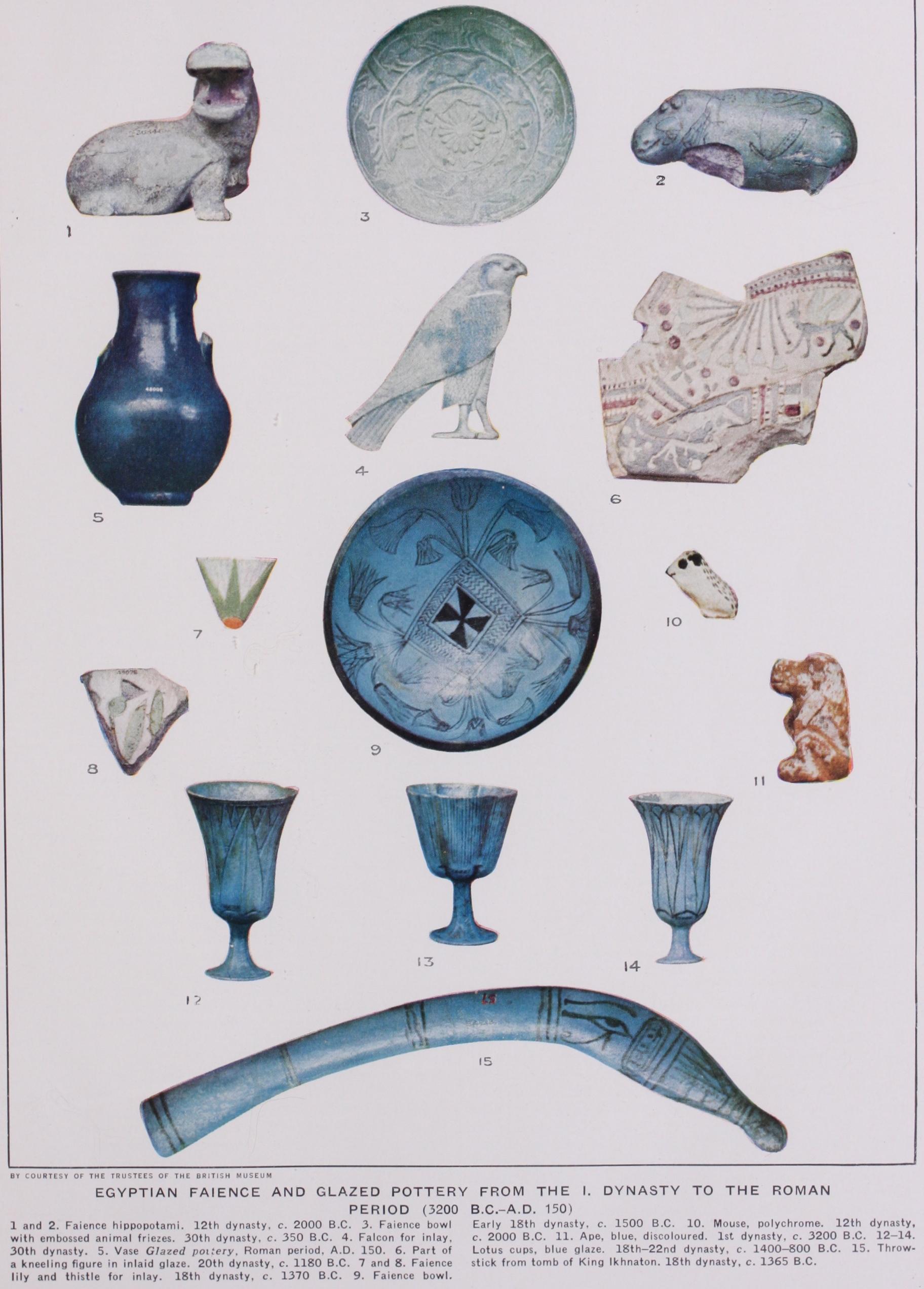
The art of making a pottery consisting of a siliceous sandy body coated with vitreous copper glaze seems to have been known unexpectedly early, possibly even as early as the period imme diately preceding the 1st Dynasty (4000 B.c.). The oldest Egyp tian glazed ware is found usually in the shape of beads, plaques, etc.—rarely in the form of pottery vessels. We find tiles made of it at Sakkara under the 3rd Dynasty, and under the 6th and 12th Dynasties pottery made of this characteristic Egyptian faience came into general use and continued in use down to the days of the Romans, and is the ancestor of the glazed ware of the Arabs and their modern successors. The colour is usually a light blue, which may turn either white or green ; but beads of the grey-black manganese colour are found, and on the light blue vases of King Aha (who is probably one of the historical originals of the legendary "Mena" or Menes) in the Brit. mus. (No. 38,010) we have the king's name traced in the manganese glaze on (or rather in) the blue-white glaze of the vase itself, for the second glaze is inlaid. This style of decoration in manganese black or purple on copper-blue continued till the end of the "New Em pire" shortly before the 26th (Saite) Dynasty. It was not usual actually to inlay the decoration before the time of the 18th Dynasty. The light blue glaze was used under the 12th Dynasty (Brit. mus., No. 36,346), but was then displaced by a new tint, a brilliant turquoise blue on which the black decoration shows up in sharper contrast than before. This blue, and a somewhat duller greyer or greener tint was used at the time for small figures, beads and vases, as well as for the glaze of scarabs, which, however, were usually of steaschist or steatite—not faience. The character istically Egyptian technique of glazed stone begins about this period, and not only steatite or schist was employed (on account of its softness) but a remarkably brilliant effect was obtained by glazing hard shining white quartzite with the wonderfully deli cate 12th Dynasty blue. A fragment of a statuette plinth of this beautiful material was obtained during the excavation of the 11th Dynasty temple at Dair al-Bahri in 1904 (Brit. mus., No. 40,948). Vessels of diorite and other hard stones are also found coated with the blue glaze. A good specimen of the finest 12th Dynasty blue-glazed faience is the small vase of King Senwosret I. (2000 B.c.) in the Cairo museum (No. 3,666). The blue-glazed hippo potami of this period, with the reeds and water-plants in purplish black upon their bodies to indicate their habitat, are well known (P1. VII., figs. I and 2) . Fine specimens of these were in the collection of the Rev. Wm. MacGregor at Tamworth.
The blue glaze of the 12th Dynasty deepened in colour under the 13th to which the fine blue bowls with designs (in the man ganese black) of fish and lotus plants belong (Pl. VII., fig. 9) (Brit. mus., Nos. 4,790, etc.). The finest specimens of 18th Dynasty blue ware have come from Dair al-Bahri, in the neigh bourhood of which place there may have been a factory for the manufacture of votive bowls, cups, beads, etc., of this fine faience for dedication by pilgrims in the temple of Hathor (good collection in Brit. mus.). Towards the end of this dynasty polychrome glazes came into fashion; white, light and dark blue, violet, purple, red, bright yellow, apple-green and other tints were used, not only for smaller objects of faience, such as rings, scarabs, kohl-pots, etc., but also for vases, e.g., No. 3,965 of the Cairo museum (Amenhotep III., wine-bottle), the ground colour of which is white with a decoration of flower wreaths in blue, yellow and red, with an inscription in delicate blue. An unglazed but finely polished red ware was in use at this time that may be of Syrian origin. Vases of the same ware in the shape of men and animals are not uncommon. Another ware of this period has a highly polished yellow face, sometimes becoming ruddy and passing off into a pinkish red; in this ware "pilgrim bottles" are common. An unpolished, brittle and thin yellow ware was also used largely for wine-vases. The rougher, commoner red and brown ware at this period became decorated with designs chiefly of lily wreaths, etc., in paint of various colours, usually with a chalky blue ground. Marbling, in imitation of stone, was also employed. This new development hid the ugly colour of the common pottery and was a cheaply obtained imitation of the expensive poly chrome glazed ware of the period (Pl. VI., figs. 1 and 3). This painted pottery continued in use until about the time of the 22nd Dynasty. From this time onwards, till the Ptolemaic period, the commonest pottery was a red ware, usually covered with a white slip. Under the 26th Dynasty a finer homogeneous white ware occurs, usually for vases, with a rude representation of the face of the god Bes on their bodies.
The 26th Dynasty marks a new period of development in the history of Egyptian faience. The old deep blue colour had grad ually deteriorated into an ugly green (Brit. mus., No. 8,962), which was replaced by the Saite potters with a new light blue of very delicate tint, imitated in accordance with the archaistic spirit of the time, from the old light blue of the earliest Dy nasties. The glaze itself is very thin. The old decoration of the blue with designs and inscriptions in manganese-black is aban doned ; on the ushabtis the inscriptions are now incised. Side by side with this light blue glaze was used an unglazed faience, a sort of composition paste with the colour going right through which had already appeared on pale blue under the i8th Dy nasty. (Some of these figures appear to have been made with a mixture of sand, clay and coloured glass which produced a real glassy porcelain—the earliest porcelain of which we have any record.) It has more variety of colour than the glazed faience, light green and a dark indigo blue being found as well as the Saite light blue. Sometimes it is of a very soft, almost chalky consistency. It was used for vases, but more generally for small figures and scarabs. The commonest vase-form of this period is the pilgrim bottle, now made with the neck in the form of a lily flower, and with inscriptions on the sides wishing good luck in the New Year to the possessor. These flasks appear to have been common New Year gifts.
Under the Sebennytite kings of the 30th Dynasty a further new development of glaze began to appear, of a more radical char acter than ever before. The colour deepened and the glaze itself became much more glassy, and was thickly laid on. The new glaze was partly translucent, and differed very greatly from the old opaque glaze. It first appeared on ushabtis at the end of the Saite period. A curious effect was obtained by glazing the head dress, the inscription, etc., of the ushabtis in dark blue, and then covering the whole with translucent light-blue glaze. This method was regularly used during the succeeding Ptolemaic and Roman periods, when the new style of glaze came into general use. A yellowish green effect was obtained by glazing parts of the body of the vases in yellow and covering this with the translucent blue glaze. This method was used to touch up the salient portions of the designs in relief, imitated from foreign originals, a style which now became usual on vases. The usual decoration is mixed Egyptian and classical, the latter generally predominating. A large range of colours was employed ; purple, dark blue, blue green, grass-green and yellow glazes all being found. The glaze is very thickly laid on, and also is often "crazed." A remark able instance of this Romano-Egyptian faience is the head of the god Bes in the British museum (No. 35,028). A hard, light blue, opaque glaze like that of the 26th Dynasty is occasionally, but rarely, met with in the case of vases (Brit. mus., Nos. 37,407, 37;408).
We know something of the common wares in use during this period from the study of the ostraka, fragments of pottery on which dated tax-receipts, notes and so forth were written. From the ostraka we see that during the Ptolemaic period the com monest pottery was made of red ware covered with white slip which has already been mentioned. At the beginning of the Roman period we find at Elephantine a peculiar light pink ware with a brownish pink face, and elsewhere a smooth dark brown ware. About the 3rd century A.D. horizontally ribbed or fluted pots, usually of a coarse brown ware, came into general use. These were often large-sized amphorae, which had very attenuated necks and long handles. During the Byzantine (Coptic) period most of the pottery in use was ribbed and usually pitched inside to hold water, as the ware was loose in texture and porous.
During the Coptic period, a lighter ware was also in use, deco rated with designs of various kinds in white, brown or red paint on the dull red or buff body. In Nubia a peculiar development of this ware is characteristic of the later period (Brit. mus., No. A polished red ware of Roman origin (imitation Arretine or "Samian") was commonly used as well.
The heavily glazed blue faience continued in use until replaced in the early Arab period by the well-known yellow and brown lead-glazed pottery, of which fragments are found in the mounds of Fostat (old Cairo).
Chariots, used both for war and peace, were introduced into Egypt from the East in the time of the Hyksos, about 180o B.C. They came with the horse. They were of very light construction, and of very broad gauge, suitable for use in rocky land and for swift movement. The wheels usually had four spokes and thick leather tyres. But the wheels are of the same type, especially as regards the pole and method of securing the reins to it, as the old est chariots known in Babylonia, where the chariot was invented by the Sumerians before 300o B.C. The Sumerian wheels were originally made of three pieces of wood, an elliptical piece between two demilunes, secured by two cross-battens, one above, the other below the hub. Spokes were invented later. The Sumerians invented the chariot before the horse was known to them; origi nally they harnessed asses to it. From Babylonia the invention of the wheel and the car spread to Anatolia and to Greece probably before it reached Egypt. Although usable in Egypt only in the desert, the horse and chariot must have contributed materially to the success of the Hyksos invasion. The Egyptians took up the invention literally "with a vengeance," and the Egyptian chariotry became the most famous in the world. Cavalry were never used by the Egyptians.
Furniture.—Wood was early used for the making of furniture, which under the earliest dynasties was already becoming elaborate. Our finest examples are of the i8th Dynasty. A characteristic form was a stool with folding legs, of exactly the modern form; the legs were habitually made in the form of goose-heads. Lion claws were used for larger chairs, which often had backs, and are of very modern appearance. The Egyptians sat on chairs, and never reclined at meals, as the Greeks and Romans did. Cushions were usual. Long beds, boxes of various kinds, etc., were made, often of rare inlaid woods and combined with thick gold overlay.
The country was divided into nomes, divisions of great an tiquity, which persisted with various local modifications and readjustments, till the end. Normally there were 42 nomes, 22 in Upper and 20 in Lower Egypt. The ancient distinction of Lower Egypt (the Delta) from Upper Egypt was always recog nized, and in times of weak government the country was always liable to fall apart into its two chief components, Memphis belonging always to Lower Egypt. In Ptolemaic times a Hep tanomis of seven nomes was formed in Middle Egypt. In Uppe: Egypt the Thebaid (Ptashenno, "the city-march") had from the time of the 18th Dynasty taken a rather peculiar position as the metropolitan province, which it continued to occupy even after the practical destruction of Thebes by the Assyrians, B.C. 663. Between the Thebaid and Syene (Aswan) the valley south of Ombos was sometimes regarded as belonging to Upper Egypt, sometimes to Nubia. South of Syene again the Nubian valley as far as Hierasykaminos (Maharraka) was regarded in Ptolemaic and Roman times, under the name of Dodekaschoinos, as Egyp tian territory, all south of it being left to the Meroitic kings. Local government of the nomes was exercised in various ways, through royal officials or heralds (uohemu), or through local mag nates, responsible to the vizier as the king's lieutenant. The whole country was known generally as Kemet, "the black land," from the colour of its soil; poetically by other names, as Tomera. The Hebrew name, Mitsraim, and the Greek "Avyinrros, are of unknown origin though the latter is probably a name of Memphis, Hikuptah : the former is still used as the modern appellation of the country in Arabic, Misr. The Hebrew name for Upper Egypt specially, Pathros, is the Egyptian Ptores, "the South-land." Hunting, Fishing, etc.—The Egyptians were great hunters of wild animals of all kinds on the desert-margin of the valley and in the Asiatic countries subject to their sway, especially of wild oxen, antelopes and the larger cats. The hunters used not only the bow and arrow, but also a throwstick, the latter specially for wild fowl in the marshes, which were hunted from boats, as also the hippopotamus. In the desert the chariot was commonly used for hunting. Fish were chiefly netted.
In the language of the hieroglyphs silver is called "white gold," a fact which points strongly to the priority of the use of gold, which archaeological discoveries have rendered very probable. Among the treasures of the "royal tombs" at Abydos, dating to the 1st and 2nd Dynasties, much gold was found, but no silver. On the walls of one of the tombs at Beni Hassan there is an interesting representation of a gold- and silver-smith's workshop, showing the various processes employed—weighing, melting or soldering with the blow-pipe, refining the metal and polishing the almost finished bowl or vase. Owing to the Egyptian practice of burying with their dead personal ornaments, the amount of gold jewellery that has been discovered is very large, and shows the highest degree of skill in working the precious metals. Jewellery reached its acme of taste under the 12th Dynasty, to which the beautiful PARURES belong that were found in the tombs of prin cesses at Dahshur and Lisht (Cairo mus., Met. mus. N.Y.). The inlays of semi-precious stones, such as blue felspar and car nelian, in gold settings that are characteristic of this jewellery, is remarkable for its beauty. Under the i8th Dynasty we have the jewellery of Tut'ankhamun, with a more lavish use of gold, but the same technique of inlay with stone. Enamel inlay begins about this time, and is well represented from Egypt, whose fine gold smith's work was renowned in the ancient world and is well rep resented in our museums. Gold signet-rings were a specially Egyptian characteristic, especially under the 26th Dynasty, when they were particularly heavy and of solid workmanship. Under the i8th Dynasty gold scarabs were commonly mounted as swivel bezels of gold rings (see Scarabs). We can form some notion of what the larger works, such as plates and vases in gold and silver, were like from the frequent representations of them in mural sculpture and paintings. In many cases they were extremely elab orate and fanciful in shape, formed with the bodies or heads of griffins, horses and other animals, real or imaginary. Others are simple and graceful in outline, enriched with delicate surface ornament of leaves, wave and guilloche patterns, hieroglyphs or sacred animals. A gold vase of the time of Tethmosis (Thothmes) III. (18th Dynasty, about 1500 B.C.), taken from a wall-painting in one of the tombs at Thebes shows this. The figure on its side is the hieroglyph for "gold." Others appear to have been very large and massive, with human figures in silver or gold supporting a great bowl or crater of the same metal. Vases of this type were, of course, manufactured in Egypt itself, but many of those repre sented in the Theban tombs were tribute, mostly of Phoenician workmanship. But plate of really foreign type as well as origin was also brought to Egypt at this time by the "Kefti ships" from Kefti, the island of Crete, where the "Minoan" culture of Knossos and Phaestos was now at its apogee. Ambassadors from Kefti also brought gold and silver vases as presents for the Egyptian king, and on the walls of the tomb of Sennemut, Queen Hatshep sut's architect, at Thebes, we see a Keftian carrying a vase of gold and silver which is almost the duplicate of an actual vase discovered at Knossos by Sir Arthur Evans. The art of the "Minoan" and "Mycenaean" goldsmiths exercised considerable in fluence upon that of the Egyptians ; under the loth Dynasty, about 115o B.C., we find depicted on the tomb of Rameses III. golden stirrup-vases (Bugelkannen) of the well-known Mycenaean type; and in that of Imadua, an officer of Rameses IX., golden vases imitating the ancient Cretan shape of the cups of Vaphio.
The chief existing specimens of Egyptian plate are five silver phialae (bowls), found at the ancient Thmuis in the Delta, and now in the Cairo museum (Nos. 482-486 in the catalogue). These are modelled in the form of a lotus blossom, most graceful in design, but are apparently not earlier than the 4th century B.C. Of the splendid toreutic art of a thousand years before, of which we gain an idea from the wall-paintings mentioned above, but few actual specimens have survived. The Louvre possesses a fine gold patera, 62 in. across, with figures of fishes within a lotus border in repousse work; an inscription on the rim shows it to have be longed to Thutii, an officer of Thutmosis III. (Mein. soc. ant. de France, xxiv. 1858).
A splendid bronze bowl, which shows us what some of the finer gold and silver plate was like, was found in the tomb of Hetaai, a dignitary of the i8th Dynasty, at Thebes, a few years ago, and is now in the Cairo museum (No. 3,553 in von Bissing's catalogue). The engraved decoration, representing birds and animals in the papyrus-marshes, is a fine piece of native Egyptian work. Military Organization.—The armed force of Egypt was early organized from levies of the young men, and we find this levy at least as early as the 6th Dynasty. Under the i8th one of the titles of the great minister Amenhotep, son of Hapu (temp. Amenhotep III.) was what we should call "director of recruiting"; he oversaw the conscription of the young warriors throughout the land. We possess interesting models of an earlier date, 11th Dynasty (at Cairo), of two companies, one of Egyptians, the other of black soldiers, armed with spears. At Dair al-bahri (i8th Dynasty) we see a parade of soldiers, led by officers armed with battleaxes, advancing at a swift springy step. Under the 19th we find the army used by Rameses II. against the Hittites organized in legions known by the names of the gods, such as the "Legion of Amon," the "Legion of Ptah," and so on. These were native Egyptian troops. Large numbers of foreign mercenaries, Syrians, Anatolians from Pisidia and Lydia chiefly, and Libyans (Shardina, Kahak, etc.), began to be employed at the end of the 18th Dy nasty, and were regularly used by Rameses. They wore their own native armour and weapons, and the Shardina formed the royal guard. Libyan warriors settled in large numbers in Egypt, and after a time formed a standing body of foreign soldiery, gradually mixed more and more with natives through intermarriage. Leaders of this military organization of Libyan-descended families ("the great chiefs of Ma") eventually became so powerful as to impose a dynasty (the 22nd) on Egypt, the first king of which was Sheshenk or Shishak, the conqueror of Jerusalem (c. 947 B.e.). Under the Saites Herodotus speaks of a regular class of profes sional hereditary warriors called "Kalasiries" and "Hermotybies." The first name is the Egyptian Kal-shere, "young Syrian," and dates from the time of the Syrian mercenaries; the second is the Egyptian Rom-debd ("men of the spear"). At the same time f or eign mercenaries, chiefly Jewish, were stationed on the frontiers (e.g., at Aswan), and Greek soldiers of fortune began to be em ployed. Under the last native kings (4th century B.c.), the army was almost wholly composed of these Greek mercenaries under their own generals, hired for the occasion, like Agesilaos, the aged king of Sparta, and Mentor, the admiral to whose treachery the final destruction of the native kingdom was due. Under the Ptol emies the same system was followed.
(H. R. H.) In considering whether or to what extent the ancient Egyptians in the field of science deserved the chorus of praise bestowed upon them by the Greek writers, except Plato, who said that, in comparison with his own people, who were of a speculative and philosophical nature, the Egyptians were a nation with a purely practical turn of mind, we find that while some Egyptologists credit the Egyptians with more speculative interest in science, there is no very strong case for this view.
In all the writings and inscriptions which have come down to us, historical, scientific and literary, there is no evidence of any kind of speculation as to the nature, size or position of any of the heavenly bodies, or as to the causes of their apparent move ment : there is no hint that the Egyptians ever suspected that the sun and moon belonged to the same class of phenomena.
The observation of the heavens was not, however, entirely futile. Egyptian buildings were for the most part strictly orien tated by the four points of the compass, and this was achieved by taking a bearing on the Pole star of that period, whose immobility must therefore have been observed, as was also the fact that a group of stars in its neighbourhood never disappeared below the horizon, for they were called "those which are never quenched." The approximate length of the year, too, had been obtained at a very early date, possibly before 4241 B.C., by observation of the heliacal rising of Sirius or Sothis, but such were the limitations of the scientists of that epoch that they failed to observe, or at any rate to allow for, the fact that this rising every fourth year took place after an interval of not 365 but 366 days, and that con sequently their year of 365 days was about a quarter of a day short. Hence the disasters of the Egyptian Civil Calendar (see article CALENDAR, Egyptian).
There is nothing, therefore, to show or even to suggest that the cause: of any single movement in the heavens had been discovered or even surmised, or that any celestial event was ever predicted on other evidence than the fact that it had happened before on the same date or in the same circumstances. In other words regularity had been observed, but causation, even if suspected, had not been investigated.
Ir Mathematics.—In a country where landmarks were liable to be eliminated yearly by the flood, geometry must early have been a civil necessity, and the marvellous accuracy of construc tion revealed by the earliest pyramids shows us that as early as the Third Dynasty, say 2 700 B.C., the Egyptians were masters of measurement in two and in three dimensions. A number of papyri, notably the Rhind, the Moscow and some fragments from El Lahun give us a very clear picture of the powers of the Egyptian mathematician. These papyri contain nothing of the theory of mathematics but are collections of examples worked out, with the occasional intrusion of tables. The mathematical system which they reveal may be shortly described as follows: The notation was decimal; one stroke stood for 1, two for 2, and so on up to 9. Ten was represented by a sign shaped like an inverted capital U, 20 by two such, and so on up to 9o. There were separate signs for i oo, i,000 and each power of 1 o up to i,000,000. The defect of this system, apart from the lack of any positional notation, lay in its clumsiness, for to write 999 no fewer than 27 signs were needed, and even the ink-written script with its shortened forms did not entirely remove this defect.
The Egyptians were experts in the use of fractions, even those with large denominators, but subject to one limitation, namely that the numerator must always be 1. As multiplication was vir tually limited to the multiplier 2 the only difficulty that could arise in multiplying fractions was that of dealing with twice an aliquot part (i.e., twice a fraction whose numerator is I). To meet this, a series of tables was formed in which the double of each odd aliquot part (. , 4-, 9 etc.) was resolved into the sum of two or more aliquot parts, e.g., twice 7 = -}- $, twice A.= 1 The only exception to the rule that fractions must have unity for their numerator is which to the Egyptian mind was oddly enough more fundamental than 3, for this was obtained by first taking two-thirds of the required number and then halving it.
Addition and subtraction are both fundamental processes of counting and the Egyptians found no difficulty with them, even when the numbers involved were very large. Multiplication, how ever, was a more difficult operation, for the Egyptian learned only the 2-times table and not up to i 2-times as we do. In other words, he could only double. Thus to find five times a number he had to double it, double the result, thus getting four times, and then add on the original number. Division was merely the reverse of multiplication. To divide 13 by 4 we start with 4. Doubling it we get 8, and by adding 4 we get 12, showing that 3 times 4 makes 12. This is just 1 short of 13, and since i is a of 4, the answer is 3 t.
Apart from 2 no multiplier was used except 1 o, multiplication by which was automatic, inasmuch as one had only to change the units-signs to tens-signs, the tens-signs to hundreds-signs, and so on.
With these simple means the Egyptians proved themselves capable of dealing with such problems of every day arithmetic as came up for solution. The papyri give us examples of the division of ten loaves among various numbers of men, of simple in proportion and of the solution by trial of equations of the form x+ x = b. The conceptions of squaring and square root were both a known, and technical terms for them existed. The Rhind Papyrus has two problems in arithmetical progression and one in geomet rical.
In two dimensional space the determination of the area of the square and the rectangle cannot be regarded as problems, for they involve nothing more than the conception of square measure. But the Egyptian had gone further than this, for he had correctly solved the area of the triangle. His approximation to the area of the circle was a good one, for he squared eight-ninths of its diameter.
In the geometry of three dimensions the volume of the paral lelopiped follows at once from the very conception of three dimensional units, and that of the cylinder as the product of the area of the base into the height involves very little more. In determining the latter the error in the value of 7r was of course repeated. A much more brilliant feat was the correct determina tion of the volume of a truncated pyramid by the formula where h is the height and a and b the sides 3 of the upper and lower squares of section respectively.
Several problems deal with the slope of pyramids. The angle is measured by its cotangent, i.e., the vertical height is divided by half the side of the square base. Here too the practical interest of the mathematician is uppermost, for in the ratio thus found the first term is reduced to one cubit (or "forearm," 2o.6 inches) and the other term, let us say 4 handbreadths, is given as a practical instruction to the stone-dresser, who has only to measure a cubit up and 4 handbreadths horizontally to get the correct slope of each block he has to dress.
In the face of this evidence it is useless to deny that there existed a popular science of medicine in Egypt which, while con versant with the beneficial effects of certain drugs (unfortunately not many of the plant names are recognizable to us), was so thickly overlaid by magic as almost to forfeit the name of a science.
That there was something more to be said for Egyptian medi cine than this, however, was already suggested by a description in the Ebers Papyrus of a system of "vessels" in the body, leading from the heart to the various organs, conveying air, water, blood and other substances. Their failure to function correctly was one of the causes of disease, and the treatment aimed at cooling, quiet ing, renewing or checking their activity by means of drugs. The more scientific attitude here observed is also to be found in the pew Edwin Smith Papyrus, the full publication of which will undoubtedly raise our opinion of Egyptian medicine. The treatise is arranged in regular order, working from the head downwards, and deals chiefly with the surgery of the bones and outer tissues. It arranges its cases systematically under the headings of name of the complaint, examination, diagnosis and verdict. The ex planatory notes which accompany some of the cases show a quite remarkable skill in studying the exact nature of a lesion, and a genuine curiosity as to precisely what has happened to produce it. Yet observe what is on the back of the same docu ment, written in part by the same hand. Firstly a spell for "driv ing out the wind of a year of plague" and secondly a book of spells "for transforming an old man into a youth of twenty." What is to be made of so quaint a juxtaposition? It would seem as if, side by side with the traditional popular medicine (old women's remedies) highly tinged by magic, there existed a science practised by men who were not without interest in the nature of disease and injury for its own sake. At the same time it may not be a mere accident that of the medical literature which has come down to us at least f our-fifths is of the popular, not the scientific type.
In conclusion, it is clear that in a descriptive article of this kind it is necessary almost completely to ignore chronological per spective. The harm done in this case is the less because every thing goes to indicate that Egyptian science attained its full growth in that period which was responsible for nearly every good thing which the country produced, namely the Old Kingdom, roughly 2600 to 2200 B.C. Not only do the medical papyri some times claim to give recipes known in the days of some king of that epoch, but the grammar of both medical and mathematical papyri is so archaic as to leave no doubt that some of their con tents must have been derived from documents of that age. Egyp tian tradition itself recognized the early origin of much of its scientific lore when it made Imhotep, a vizier of King Zoser of the Third Dynasty, the father not only of the art of architecture, but also of the science of medicine.
BIBLIOGRAPHY.-L. Borchardt, Altaegyptische Zeitmessung (192o),Bibliography.-L. Borchardt, Altaegyptische Zeitmessung (192o), being Lieferung B of Band I. of Die Geschichte der Zeitmessung and der Uhren, edited by Ernst von Bassermann-Jordan (for star-tables and astronomical observations generally) ; A. Erman, and H. Ranke, Aegypten and aegyptisches Leben im Altertum, ch. xiv. for general sketch of Egyptian learning (Tubingen, 1923) ; J. H. Breasted, The ,Edwin Smith Papyrus, in Recueil d'etudes egyptologiques dediees d la memoire de Jean-Francois Champollion, pp. 385 ff. (1922) ; G. Reisner, The Hearst Medical Papyrus (5905) ; W. Wreszinski, Die Medizin der alten Agypter, 3 vols. (19o9-13) ; T. E. Peet, The Rhind Mathematical Papyrus (1923).
We have now no grounds for holding the opinion that the educated Egyptian priest, far less the man in the street, normally accepted any pious theories of a latent monotheism under lying his blatant polytheism. Abnormally one particular school of priests may have done so for a time—the school of On or Heliopolis—where Rat the sun-god does seem to have been raised from a henotheistic position to one closely resembling monotheism, until in the reign of Amenhotep III. it probably developed the completely abnormal true monotheism of the worship of the Aten, or Sun's disc, the heresy officially established by his son Ikhnaton, but thrown to the winds soon after the death of the latter. So abnormal was this monotheism that the Egyptians would have none of it : Ikhnaton was branded as a "criminal," and the Egyptians, who had, of course, in reality never abandoned it for a moment, returned joyfully to the cheer ful polytheism of their ancestors, in which they continued to believe till the coming of Christianity. The educated Egyptian of the best period possessed the conception of "the divine," but not of "the One God"; he could see Godhead as such, but it was manifested in many gods; there was never only "One God" ex cept the Aten, and his glory was but for a day. The nearest ap proach to monotheism was when one particular god was vener ated henotheistically at one time, another at another.
Polytheism was of course the natural ancient belief of the Egyptians. It arose from the complicated fears of the Divine and rituals to propitiate it, and in Egypt more especially bears all the marks, in its complicated cults and rituals, of its savage origin. And naturally the further we go back the more compli cated, the more self-contradictory, the more ritualistic and the more barbarous it is, as is the case among all nations. Some simplification was effected by the growth of the national intelli gence, which by the time of the i8th dynasty really had evolved religious texts and hymns of a lofty character, that reach their acme under the supremely intelligent but unhappily reckless re form of Ikhnaton. To he so intelligent as ne was at [.na[, was to court disaster, even if one was an almighty king. Cer tainly nobody but a Pharaoh, himself a "god," could have effected such a revolution, nominal as it was. After his failure we go back to the old spells and mumbo-jumbo again, till perhaps in the Saite age comparatively intelligent people again appeared, the reflection of whose thoughts we may perhaps see to some extent in the rationalizings of the classical writers on Egypt. Under the Romans Egyptian religion returned to its original mire, till its death, prolonged by a century of pathetic resistance by the simple blacks of Syene, in the days of Justinian. In re ligious matters the Egyptians at all periods, except the edu cated at the end of the i8th dynasty, and probably under the Saites, were in the mental condition of the blacks of the Gold Coast and Niger delta.
That was about their level.
Marvellous mysteries, occultly harbouring deep truths, are as signed to them by the classical and modern imagination. They had mysteries, of course, like the Ashantis or Ibos. It is a mistake, however, to think that these mysteries enshrined truth, and that there was an occult "faith" behind them. There is no more proof of it than in the case of the Ashantis or the Ibos. They were nearer to Europe, that is all, and we have not always been so critical as we are now. However, educated Romans treated the mysteries of Isis with contempt ; only illiterate people believed in them.
Presumably Isis came from Syria with Osiris : certainly the well known legend of the finding of his body at Byblos in a cedar chest by her after his murder by Set points in that direction. She, like him, was human-headed; it might be considered rea sonable to suppose that all the human-headed deities were of this extra-Nilotic northern origin, the animal-headed being the gods of the primitive Nilotes. Certainly, Ptah, the human-headed god of Memphis, has a Semitic name, "the Opener." But he is also mummified : and if the primitive people made a human mummy a god he would presumably have a human head. On this show ing Osiris, Ptah, Amon, Min, Onhur and other gods would all be extra-Nilotic; Thoth, Hathor, Sobk and others with animal heads Nilotic. It is unwise to press any such theory, but it is a possibility that though the Nilotes probably had human-headed gods of their own, the theriolatry of the nation was their inven tion, and that they added the "sacred animals" to the parapher nalia of the gods whom the newcomers brought with them. These "sacred animals" were of course more than this. They were, in the eyes of the people, themselves more or less gods: any ibis or ape was Thoth, in a sense, Thoth the god of intelli gence walking about and as ibis inquisitively looking for things to find out with his long bill, or as ape weirdly, divinely, parody ing the ways of men and acclaiming the coming of the sun-god at dawn with jubilant cries. Every bull on the contrary was not Apis, who had to have special marks : but a genuine Apis-bull was very much himself the god Ptah-Socharis. Every scarab beetle was not of course itself the sun in the form Khopri, but as the type of Khopri (the roller, shaper, becomer, self-creator) partook of the divine nature of the sun-god and was mummified as much as an Apis. We all know Herodotus's story of the unlucky Greek who killed a cat, and as cats were generally mummified, like Apis-bulls, scarabs and ibises, it is probable that every she-cat, at any rate, was regarded more or less as Bubastis herself. The tale of the furious war between the Ombites and the Tentyrites, because one town had killed the crocodile that the other venerated, was one that always amused the Romans. Such contradictions were of the essence of Egyptian religion. Ombos in Upper Egypt, and one or two other towns in the north had the doubtful honour, in the eyes of other Egyp tians, of worshipping Setesh or Set, the evil principle (so the others said), who was represented with the head of an animal that was a cross between those of a donkey and a pig—Set, the mur derer of Osiris, whom Horus slew. And here we meet one of the first major inconsistencies of Egyptian religion, for the Horus who slew Set was not really Horus the son of Osiris at all, but quite a different and in reality far older Horus, the hawk-headed sky-god of Upper Egypt, worshipped at Edfu, who was often known as Haroeris, "Horus the Elder," to distinguish him from Harpokrates, "Horus the Child," who was the son of Osiris. Yet no doubt most people believed them to be both the same and different at the same time.
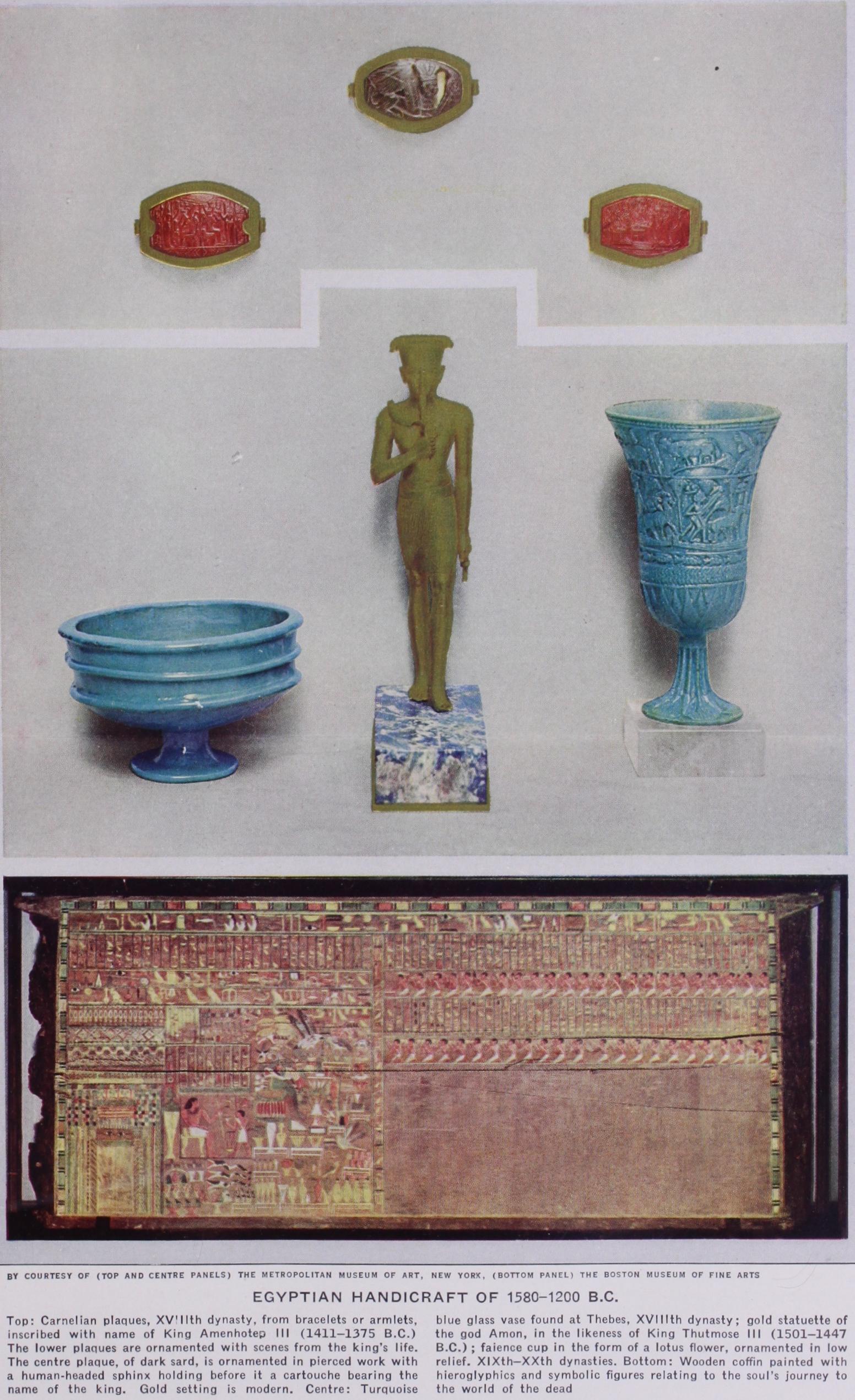
With the elder Horus we reach the group of hawk- or falcon headed deities who are naturally, gods of the sky, of the sun too, and of the moon. Hawk-headed is Rai or Ri` the sun-god, in early days the most venerated god, especially under the 5th and 6th dynasties. And he is never human-headed, whereas Horus (no doubt by confusion with the other Horus) sometimes is. But another sun-god, Itum, venerated at Heliopolis, and generally regarded as the setting sun, is always human-headed. Perhaps he was a Syrian and the hawk Rat, identified with him under the old kingdom, the old Nilotic sun-god. He was so closely identified with Rat that the latter alone was often regarded as the Heliopolitan god. The rising sun was another form of the sky-god Horus, hawk-headed, and combined with Rae as Ra` Horakhti ("Rat on the two horizons"), Ra-Harmachis. There was properly speaking no female of Ra` (as a Ra`t, occurring in later times, was a pure invention in imitation of Isis), nor was there of Horus, unless the cow-headed Hathor ("House of Horus") can be so regarded : at any rate she was clearly con nected with Horus in Upper Egypt as her name shows. She was the goddess of the deserts, and at Thebes a form of her, the snake Mersegret, protected the desert tombs. Sekhmet ("Power"), the lioness-headed, might be regarded as a female Ra`, but she is always described as the consort of Ptah : Bastet or Bubastis, the cat-goddess was a northern Hathor, and like her also by some twist of thought was the patroness of love, of mat ters feminine and of fashion. Like her she has no official con sort, as Sekhmet has. To Ptah and Sekhmet are later given, when somebody tried desperately to introduce logic into the "system," a deified human being, a historical personage turned god, Imhotep the sage, prime minister of King Zoser of the 3rd dynasty, who was naturally venerated at Memphis, the city of Ptah. Another late-deified prime minister, Amenhotep, son of Hapu (Ame nothes, son of Paapis), was not so assigned, but in revenge he seems in Roman days to have been confused with Amen, the king of the gods, himself ! Under the Theban r 2th dynasty the local god of Thebes, Amon ("the hidden one"), a form of the ancient local god Min, and like him human-headed but unlike him not ithyphallic, came to the front, and with the establishment of the imperial power of the i8th dynasty at Thebes he took place as Amon-Ra` Sunteru (Amonra-sonther), "the king of the gods." This place he held nominally till the end, but was not much venerated out side Thebes after the close of the imperial period. In late times he seems often to have been confused with Osiris. He had a wife and son, like Osiris, Mut ("Mother") a local goddess of Thebes, and Khons a local moon-god, who rarely appears at all till the loth dynasty, and then much resembles Harpokrates, with whom in later days he was often confused. He was hawk-headed at first, like Munt, the war-god of Hermonthis, a little further south, a form of Haroeris ( ?) . But later Khons was boy-headed, with the sidelock of youth, like Harpokrates. At Thebes was also venerated the well known hippopotamus-goddess Opet, called often Taueret (Thoueris, "the great one"), whose yearly festival was the greatest in the year at Thebes. Mut's animal was the vulture, Amon's the ram with curved horns. Further south, at Elephantine, was venerated Khnum the potter, ram-headed with twisted horns, a great god even till the very latest days. Onhur (Onouris), a human-headed war-god, was also Upper Egyptian. The ithyphallic Min, already mentioned, was the local god of Koptos, and was the deity of fertility.
The great god Dhuti or Thoth, never human-headed (and never ape-headed with a human body, when he is always ibis-headed), the patron of learning letters and intelligence, was one of the major deities, and was worshipped universally, but locally was the god of Hermopolis (Ekhmunu, Ashmunain). The Greeks called him Hermes as the psychoponmpos, since, by association with the Osirian cult, he ushers the dead into the presence of Osiris to be justified, naturally as he was the god who knew how to write and could record their names on his scroll. Even more closely associated with Osiris at Abydos is Anubis, the jackal-headed, originally the same as the local dead-god, Khentamentiu, and deriving his head from the desire to placate the jackals that ravaged the necropolis in the desert : wherefore the jackal was worshipped. In later days Anubis is called a son of Osiris, and is often confused with the very similar Ophois (Upuaut), the wolf-god of Siut (Lykopolis) . A foreign importation (from Babylonia early in the middle kingdom) is Bes, the grotesque bearded man who became a patron of jollity and of luxury and fashion ; ending as the Silen or satyr of the Greeks. Other (later) foreign importations are such purely Semitic deities (all of course human-headed) as Reshpu (Resheph), Baal and Anaita or Kedeshet, or Nubians like Maahes (lion-headed). Baal was often confused or identified with Bes.
Other deities to be mentioned are Hapimou, the Nile-god, Neith, the war-goddess of Sais in the Delta, very prominent naturally in Saite days, Harshafit (Arsaphes), a ram-headed war-god worshipped at Herakleopolis Magna (Ahnas), among local gods; Shu the wind-god, Nut a sky-goddess and Geb the earth-god among purely cosmogonic deities (who received little or no worship) ; Ernutet (Thermouthis) the goddess of child birth and of crops, Nepri the corn-god, and Tait the goddess of the funerary vestments, among miscellaneous minor deities ; and deifications of qualities or forces (rather in the Roman fashion), like Ma'at the goddess of law and right (well known with her ostrich-feather, the symbol of justice), and Shai or destiny.
The Sun-disc or Aten was not represented by the Atenist heretics in human or animal forms but simply as the solar disc from which spread to the earth below rays ending in human hands holding the or symbol of life (`ankh), thus symboliz ing the sun's gift of life to the world. This worship of the physi cal sun (or perhaps of a god behind the sun) as the giver of life was an eminently simple and rational one, but far too much so for the Egyptians, who, like other people, preferred irrational "mysteries" to such rational simplicity.
Lower than deities were various genii or demons like the Four Sons of Horus;—the human-headed Mesti, the hawk-headed Qebhsneuf ("Pleaser of his brethren"), the jackal-headed Duamutef ("Praiser of his mother") and the ape-headed Hapi, whose heads are found as lids on the four "canopic" jars in which the viscera of the dead were placed in the tomb. Here also hawks, jackals and apes are given the post of honour among di vine beasts. Elephants, deer, antelopes, owls and many other ani mals have no divine attributes, even the lion is rare as a divine head, and is always very late (Horus) and provincial (Nubian : the god Maahes). There existed, however, some rather holy beasts, like the crane or "phoenix" (bennu) venerated at Heli opolis. The imaginary sphinx or human-headed lion was divine in so far as it was an image typifying the king as Horus. It should be noted that the Egyptian sphinx (including of course the great sphinx at Gizeh) is male; there were no female sphinxes in Egypt till Greek times. See SPHINX.
These deities were worshipped in their temples throughout the land : contemplar gods were common. Of rites and ceremonies we have a considerable idea. Lustrations of water were common, sacrifices consisted in simple offerings of meat, honey, oils, fruit and flowers : burnt-offerings were un-Egyptian. Incense was an universal offering and a most ancient one, as its name (snutri, "that which makes divine"), shows. The use of incense probably came to Egypt from Asia in very early days. The censer was fixed at the end of a long arm which was waved in the air, the swinging censer being unknown till Christian times. Musical instruments such as trumpets, and above all the sistrum (see Music) were employed in the ritual, also singing by the priestesses.
Priests did not really form a totally distinct caste, as Herodo tus said, but they were an important and influential body from the time of the 18th dynasty, when the priesthood of Amen-Ra` at Thebes, to whom the conquered lands of Asia were largely assigned in fee, became enormously wealthy and powerful. In early days they were not so distinguished from the rest of the better class. We know the titles of the various orders of priests and their functions. High-priests often bore ancient titles, such as the "Great Chief of the Artificers" (Uer-kherp-herntiu), the high-priest of Ptah at Memphis or the "Great Seer" (Uer-maa) at Heliopolis. Of the subordinate ranks of the "Pure Ones" (uebu), there were iotu-neter or "divine fathers," hemu-neter ("prophets of the god"), "hour-priests" and the khrihabiu or "cantors" and the Inmutf and Sem who were connected with the service of the dead, and were often not regular priests but relatives of the de ceased who assumed priestly functions for the occasion, in order to carry out the ceremonies at the tomb. Lay "tertiaries" con nected with the services for the dead were called "hearers of the cry" (sedjem-`ash) in the Necropolis. The priestesses were gen erally known as "singers" (shem`a) : they also shook the sistrum, which was a woman's instrument, in processions and dances. Magic dances were usual, and we have ivory wands which were used on them, on which are engraved the figures of various demons of the underworld. Magic was of course not separated from the religion, which was after all basically magical. There were no doubt degrees of magic. The word for magic or incanta tions, sorcery, etc., was heka or hike, which is not impossibly the origin of the name of the Greek demon goddess Hekate.
Such things as scriptures and service-books we know little of. As has been said fine hymns were chanted to the sun-god under the 18th dynasty, and Ikhnaton's hymn to the Aten is famous for its resemblance to the 141st psalm (see Literature). But most of the religious writings were confined to the unintelligible spells of the so-called Book of the Dead, or "Book of Coming Forth by Day" (as the Egyptians called it), and such more sensible later developments of it as the Book of the Underworld, the Book of the Gates, and the Book of Breathings. All these were, so to speak, guide books to the next world for the use of the soul, devised to warn him of the dangers he might expect to meet and to provide him with powerful spells to guarantee his safety. These spells are most barbarous and least intelligible when we first meet them, in the "Pyramid texts" inscribed in the pyramids of the kings of the 5th and 6th dynasties. They seem to have been devised first for the protection of the king alone, afterwards being extended in use to the nobles and the mass of the nation. As time went on such magical care for the welfare of the dead, originally in all probability reserved for the ruler and his entour age only, became available for all, as the worship of Osiris spread, and almost the humblest came to be regarded in death as much Osiris as the king himself.
The preservation of the body was also no doubt originally a royal prerogative. This custom spread to the subjects with the other devices to ensure safety to the dead man. Originally the bodies of the dead no doubt dried fortuitously in their graves in the desert sand : some may have been smoked. It was seen to be possible in Egypt to preserve the dead from dissolution, and gradually the practice of mummification grew up, that was not really fully developed till the time of the i 8th dynasty. (See MUMMY.) Middle Kingdom mummies are very lightly dried and often nothing remains but the skeleton. But they were swathed in bandages and elaborately buried in great rectangular wooden coffins with models of ships, labourers at work, etc. The course of mummification from the i8th dynasty to the 26th followed a regular course of development : it is possible to tell the dynasty to which a mummy belongs by the style of bandaging and em balming even when the name and titles have disappeared from the coffin. Human-headed coffins are characteristic of this period, in which the Ushabtis and Canopic Jars appear commonly. (See Archaeology.) Under the Saites Herodotus gives us his well known description of the three methods of embalming in use in his time, which it is unnecessary to repeat. The chief process was the steeping in natron or soda. He adds the interesting detail that the incision in the abdomen, through which the entrails were removed, was made by a special priestly official, the paraschistes, who made the cut with "an Ethiopian stone," and then fled away, pursued by (ceremonial) stones thrown at him. The "Ethiopian stone" was evidently a flint knife. Stone sarcophagi first appear under the i 8th dynasty, and are specially heavy under the 26th, when two or three inner coffins of wood fitted one inside another, were usual for great people. Sacred animals, like the rams of Khnum and the Apis-bulls, were similarly embalmed and buried, the sarcophagi of the bulls in the Serapeum at Sakkarah being of enormous size and weight.
Tombs develop from the plain desert graves of the pre-dynastic period into brick structures in the case of the kings at the be ginning of the 1st dynasty, which by the 3rd have developed into the Mastaba—or "bench" type—with chambers above ground and its deep pit, at the bottom of which is the actual tomb-chamber. These upper chambers are ornamented under the 4th with reliefs (see Art) : the royal tombs have developed into the Pyramids (q.v.). Under the 6th dynasty another form of tomb appears in the south : chamber-tombs with a pit cut in the face of a cliff. This type is common under the Middle Kingdom. Owing to the steep shape of the Egyptian hills there is not much in the way of a dromos, which alone was marked by the pyramid crowned chapel outside. Under the 18th dynasty we have at Thebes the characteristic tombs of Shaikh `Abd al-Kfirna, with their pillared and painted galleries, and their stelae and statues of the deceased, while the kings have their sepulchres in the val ley of the Biban al-Muluk, cunningly concealed, with long tunnels of approach cut in the hill, with all sorts of (necessary) precau tions against tomb-robbers, and at end the vast excavated chambers in which the dead pharaoh hoped to rest amid his accumulated funeral pomp, buried with him. Actually only who was buried in a small unfinished tomb, has so survived till the present day, though the bodies of many of the other kings were found in caches to which they had been con veyed by later kings for safety's sake, and are now in the Cairo museum. In Saite times we have a return to ancient models in a sort of cross between a mastaba (brick built) with pylons (see Architecture), and a new empire tomb with columned cham bers, which was very popular. The common people attained the privilege of mummification at this time, and in Ptolemaic and Roman days were buried in small graves or thrust into the ancient tombs of others in piles, one on the top of another. Ancient tombs, vacant or not, were the usual resting place of the better classes now, and were re-used over and over again. Mummifica tion survived into Christian days, and Coptic mummies are not uncommon : good examples are in the Musee Guimet at Paris.
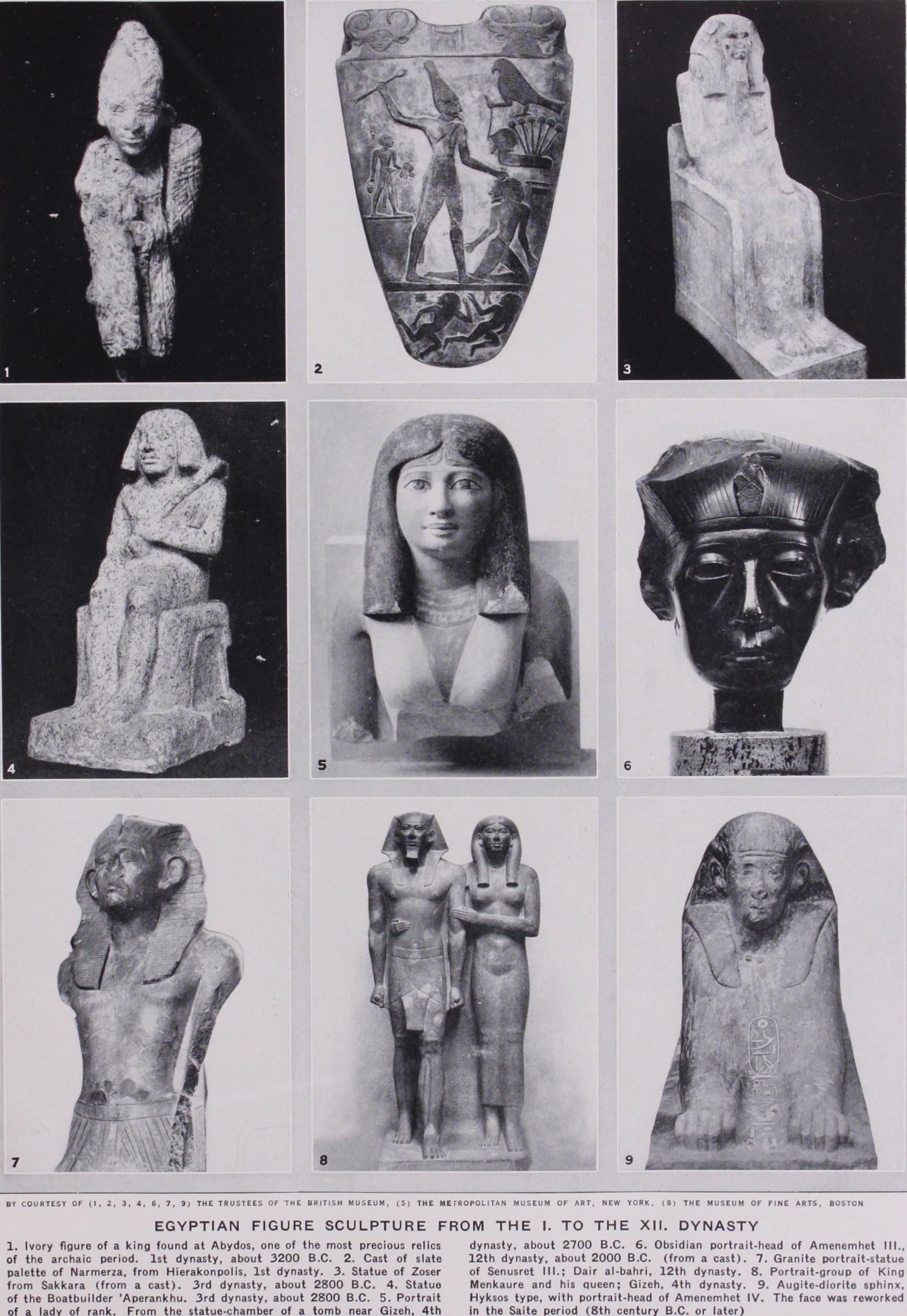
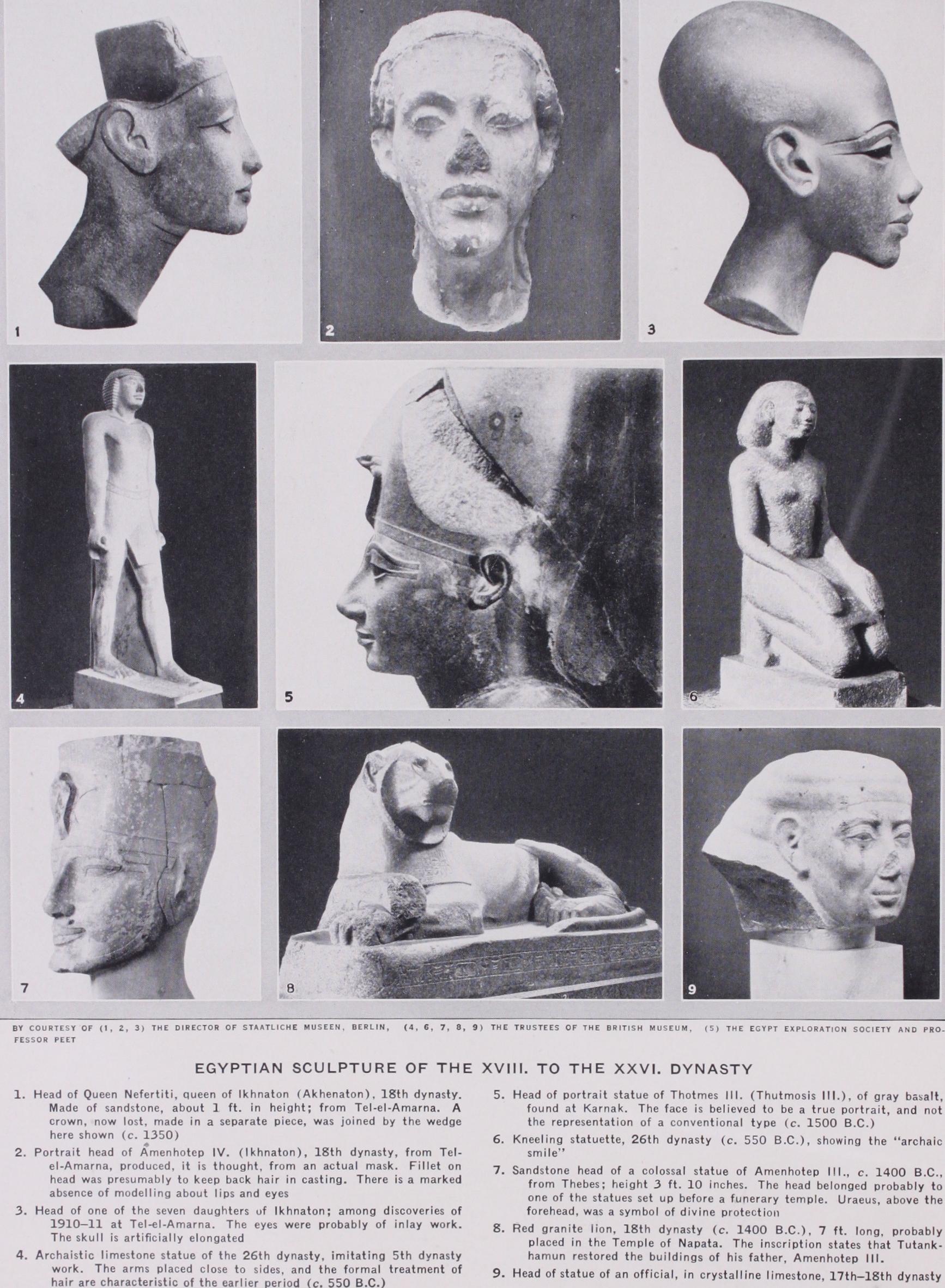
The beliefs of the Egyptians with regard to death were hope lessly confused, like those of most other peoples. The whole idea of the tomb seems originally to have been due simply to the passionate desire to deny the existence of death. "Oh ye living upon earth, who love life and hate death," begins the invocation to the living often inscribed on the tomb-walls. The Egyptians, a cheerful merry people, loathed the idea of death, and did their best to persuade themselves that the dead were not actually dead at all, but continuing to live in the underworld of the tomb in some weird fashion, and that their life there could be preserved by means of magical spells and the representations on the tomb walls or in the shape of models of their ordinary life on earth. Then there was the idea of a sort of temporary "resurrection" of the dead, who were supposed to be able to "come forth by day" from the tomb by means of spells if they liked, or like Osiris (a confusion with his agricultural aspect), to live again as the grain sprang up again each season.
Then there was the idea that the dead lived with the gods, especially those of the underworld, and accompanied Khent amentiu (Osiris), on his nightly rounds of his realm, as the dead sun. Again there was the idea of souls : the ka (ko) or double for whom, represented as a statue, a special house in the tomb was provided in early days the bai or soul proper (a human headed bird) ; the ikh or "spirit" (a bird) ; the kiiaibit or "shadow" and so on. The bai was supposed to be able to visit the khat or body in the tomb, but the ikh flew off to the heaven gods in the sky. Then there was the idea of moral justification of the deceased, his "negative confession" in the ritual and the judgment by Osiris and his "42 Assessors" (which in the time of Herodotus was probably actually enacted by priests over the body of great people) ; the weighing of the heart by Thoth against the feather of Maat, and so forth, which marked the influence on the Egyptian mind of the Semitic idea of sin, originally foreign to it. We hear very little of moral ideas except in scholastic papyri (see Literature). Religion was primarily an affair of ceremonies and spells, intended to bring about certain desired results by means of the help of one or some of the multitudinous deities. Even the monotheist hymns to the Aten are not ethical. They merely praise the sun for his life-giving heat, there is nothing in them depreciatory of the moral character of the praiser, in Sem itic fashion. The Egyptian was never a humble person, either genuinely or hypocritically. When he confessed he did not say "I am guilty" : he said "I am not guilty" ; his confession was nega tive, and the onus probandi lay on his judges who, according to the funerary papyri, always gave the verdict in his favour, or at any rate it was hoped and expected would do so.
The many-sided character of Egyptian religion and its manifold contradictions and deficiencies (human and straightforward enough), will be evident from the above description. What vary ing views on the subject can be held by writers of differing men talities will be seen from a perusal of the works mentioned in the bibliography below, which partly consists of works with whose theses the present writer entirely disagrees, but which he quotes in fairness to their authors and to those readers who see things in the same light as they do. That they will leave a confused impression on the mind is only to be expected from the nature of the subject.
Under Mohammed Ali's successors the army shrank to nothing, until Ismail who, succeeding in 1863, in seven years was able to put 1 oo,000 men, well equipped, in the field. He conquered the greater part of the (Nile) Sudan; but an expedition to Abys sinia suffered disaster. The education of Egyptians in Continental cities had not produced the class of leaders who led the fellahin to victory at Konia. Ismail's exactions from the Egyptian peas antry reacted on the army, causing discontent ; and when he was tottering on the throne he instigated military demonstrations against his own government, and by thus sapping the founda tions of discipline, assisted Arabi's revolution ; the result was the battle of Tell el Kebir, the British occupation, and the dis bandment of the army, which at that time in Egypt proper con sisted of I8,000 men. (See EGYPT AND SUDAN, CAMPAIGNS IN, 1882-1899.) In January 1883, Maj.-Gen. Sir Evelyn Wood, V.C., was given £ 200,000, and directed to spend it in raising a fellahin force of 6,000 men for the defence of Egypt. He was assisted at first by 26 officers, amongst whom was Lieut. H. Kitchener, R.E. Each bat talion of the 1st infantry brigade had three British mounted officers, Turks and Egyptians holding corresponding positions in the battalions of the 2nd Brigade. The privates were conscripted from their villages. The earlier merciless practice had been in theory abolished by decree in 1880; but actually the 6,000 recruits represented the biggest and strongest peasants who could not pur chase exemption by bribing the officials concerned. But the per severance of British officers gave the oppressed peasants, in 1885, an equitable law, which was subsequently improved by the de cree of 190o. General considerations later caused the sirdar to allow exemption by payment of (Badalia) £20 before ballot—part of this being expended in the betterment of the soldier's position.
The earlier efforts of 48 American officers, who under Gen. C. P. Stone zealously served Ismail, had failed to overcome Egyptian venality and intrigue; so that the task undertaken by the small body of British officers was difficult. That there had been no ade quate auxiliary departments, without which an army cannot move or be efficient, was comparatively a minor difficulty. To succeed, it was essential that the fellah should be taught that discipline might be strict without being oppressive, that pay and rations would be fairly distributed, that brutal usage by superiors would be checked, that complaints would be thoroughly investigated, and impartial justice meted out to soldiers of all ranks. An epi demic of cholera in the summer of 1883 gave the British officers their first chance of acquiring the esteem and confidence of their men, and the regeneration of the fellahin army dates from that ' epidemic.
When the Egyptian Army of the Delta was dispersed at Tell el Kebir, the khedive had still 40,000 troops scattered in the Sudan. These were composed of Turks, Albanians, Circassians and some Sudanese. Ten thousand fellahin, collected mainly from Arabi's former forces, set out in September 1883, under Hicks Pasha, a dauntless retired Indian Army officer, to vanquish the Mandi. They disappeared in the deserts of Kordofan, where they were destroyed by the mandists about 5om. south of El Obeid. Baker Pasha, with about 4,000 constabulary, who were old soldiers, attempted to relieve Tokar in February 1884, but was attacked by 1,200 tribesmen and utterly routed.
It was then deemed advisable to rely on blacks to stiffen the fellahin—five Sudanese battalions being successively formed. But in the Gordon relief expedition of 1884 the Egyptians did re markably good work on the line of communication from Assiut to Korti, a distance of 800m., and the honesty and discipline of the fellah were shown to be undoubtedly of a high order. By the time of the Omdurman campaign, 1898, the standard of honesty was unimpaired, and the British officers had imparted energy and activity into Egyptians of all ranks. The large depots of stores at Aswan, Half a and Dongola could be supervised only cursorily by British officers, and yet when the stores were received at the advance depot the losses were infinitesimal.
By nature the fellah is unwarlike. Born in the valley of a great river, he resembles in many respects the Bengali, who exists under similar conditions ; but the Egyptian has proved capable of greater improvement. He is stronger in frame and can undergo greater exertion. Singularly unemotional, he stood steady at Tell el Kebir after all his officers had fled. It has been aptly said "the fellah would make an admirable soldier if he only wished to kill some one!" The well-educated Egyptian officer showed aptitude for regi mental routine, and worked well when supervised by men of stronger character. The ordinary Egyptian is not self-reliant or energetic by nature. The black soldier has, on the other hand, many of the finest fighting qualities. Sudanese are very excitable and apt to get out of hand; unlike the fellahs they are not fond of drill, and are slow to acquire it; but their dash, pugnacious instincts and desire to close with an enemy, are valuable mili tary qualities. The Sudanese, moreover, shoot better than the fellahin, whose eyesight is often defective. The Sudanese cap tain is slow, but self-reliant, and much respected by his men.
In 1908 the Egyptian army, with a total establishment of 18,000, consisted of three squadrons of cavalry (one composed of Sudanese); four batteries of field artillery and a Maxim battery; the camel corps, 626 of all ranks (fellahin and Sudanese); and nine fellahin and six Sudanese infantry battalions, 10,631 of all ranks. The stringent system of selecting British officers, orig inated by the first sirdar in 1883, is shown by the fact that of the 24 employed in creating the army, 14 rose to be generals. Corn petition for employment in the army became severe and the service attracted the very best of the British Army. In 1908 there were also 140 British warrant and non-commissioned of ficers. (E. Wo.) Modern Developments.—So matters rested, in the main, un til the World War. This had a vital influence upon military de velopments in Egypt, of which the end is not yet in sight. On August 5, 1914, the Egyptian Prime Minister signed a document which amounted virtually to a declaration of war by Egypt against the enemies of Great Britain. The alternative would have been the disarmament or internment of the British troops in the country, a policy which could hardly be contemplated. By Oc tober the impending hostility of Turkey wrought a complete change in the situation, and it was found necessary to proclaim martial law. By that time the regular British troops had been withdrawn, their place being taken by Territorial units, and from thenceforward Egyptian territory became a base of operations for British, Australasian, Indian and other troops. The defence of the Suez canal became a matter of primary importance to the Allied cause, not only for economic but also for military reasons.
The tale is told elsewhere of attacks upon the canal by Turks with German aid and instigation, of raids by Senussi (q.v.) forces in the south-west and in the west, and of subsequent British of fensive operations in Palestine (q.v.) and Syria, using Egypt as a base. Five days after war broke out with Turkey, Egyptians were informed by proclamation that they would not be called upon for assistance, but those who gave the pledge were proved to be lacking in forward vision. Only a few Egyptians, it is true, served under arms in the defence of the Suez canal against Turk ish invaders in 1914-15 but the resources of the country in man-power, in transport animals (especially camels), and in eco nomic provisions were fully exploited to meet the ultimate needs of British empire armies. Returns of the effective strength of the Egyptian expeditionary force in November 1918 show that over 96,00o Egyptians were serving in the army, 88,000 of them being in labour units, and we find a mention of over 17,600 Egyptians described as being employed "in substitution for British person nel" (Military Effort of the British Empire, p. 160. There is little doubt that, without the aid of the Egyptian labour corps and the camel transport corps, the original British advance across Sinai into Palestine would have been more protracted, and the aid of these corps was invaluable during subsequent stages of the operations. Some statistics in connection therewith will be of interest, bearing in mind throughout that Egyptians as a whole did not grasp that the prosecution of a campaign in Palestine tended to their advantage. For a time the ranks were filled volun tarily, but ultimately, in the fourth of the war, the Corvee had to be introduced again in order to obtain the monthly con tingent required, which rose from 17,00o in May 1917 to 26,00o in June 1918. In the former month it was found necessary to disarm all Egyptian citizens, military considerations being held to over-ride political consequences. With these we are not here concerned, beyond mention of the disastrous effect of military measures upon the attitude of Egyptians to the British.
The Egyptian camel transport corps of the World War has been described as a unique creation which acquitted itself glori ously. 170,000 Egyptians served in this corps. Though working behind the lines, 220 of them were killed and 1,400 wounded by enemy action, 4,000 died in field hospitals. 72,000 camels were purchased from various sources for this corps; in 1917, 12,000 out of 65,000 male camels in Egypt were taken. The culminating effect of this and of other demands upon the agricultural and economic resources of Egypt was one of the factors that con tributed to produce the unsettlement which led to the rebellion of 1919, and culminated in the assassination of the British sirdar of the Egyptian army in November 1924. That event was fol lowed in 1925 by the creation of a Sudan defence force, inde pendent of Egypt, in place of the Egyptian army garrison. There are now therefore three military forces in Egypt and the Sudan, the British troops in both countries, the Egyptian army in Egypt and the Sudan defence force from Wady Half a to the southwards.
The king is head of the army, and there is an army council on the British lines, presided over by a minister. A British General officer, with the title of Inspector-general, carries out the func tions appertaining to the post of sirdar A few British officers occupy high appointments in the army staff. The various military formations and subordinate units are now commanded by Egyp tians. There are three brigade commands, the infantry and other arms being widely distributed; the battalion at Aswan is the farthest up the Nile. From Wady Halfa southwards troops of the Sudan defence force, recently formed, are to be found.
The British troops in Egypt proper included in May 1928 one brigade (three regiments) of cavalry, two brigades (each of three battalions) of infantry, one brigade of field and one of light artillery, two field companies of engineers, three companies of signals, one section of tanks and one company of armoured cars (in process of transfer to the cavalry), besides supply, transport, medical, ordnance and veterinary units.
The 188o settlement was wrecked by the Arabi rising, the riots at Alexandria, and the events generally which led to the British occupation of Egypt in 1882, followed by the losses incurred in the Sudan in the effort to prevent it falling into the hands of the Mandi. On the initiative of Great Britain a conference between the representatives of the great powers and Turkey was held in London, and resulted in the signing of a convention in March 1885. The terms agreed upon in this instrument, known as the London Convention, were embodied in a khedivial decree, which, with some modification in detail, remained for twenty years the organic law under which the finances of Egypt were administered.
It divided the revenue of the country between the Caisse, as representing the bondholders, and the government, assigning to the service of the debt all revenue derived from the railway, tele graphs, port of Alexandria, customs (including tobacco) and from four of the provinces. It recognized, however, that the non assigned revenue was insufficient to meet the necessary expenses of government, and a scale of administrative expenditure was drawn up. The Caisse was authorized, after payment of the coupons on the debt, to make good out of their balance in hand the difference between the authorized expenditure and the non assigned revenue. If a surplus remained to the Caisse after mak ing good such deficit the surplus was to be divided equally be tween the Caisse and the government. The Convention empowered Egypt to raise a loan of nine millions, guaranteed by all the powers, at a rate of interest of 3%. For the service of this loan —known as the Guaranteed loan—an annuity of f 315,00o was provided in the Egyptian budget for interest and sinking fund. The f9,000,000 was sufficient to pay the Alexandria indemnities, to wipe out the deficits of the preceding years, to give the Egyptian treasury a working balance of fE.5oo.000, and to pro vide a million for new irrigation works. To the wise foresight which, at a moment when the country was sinking beneath a weight of debt, did not hesitate to add this million for expenditure on productive works, the present prosperity of Egypt is largely due.
The provisions of the London Convention did not exhaust the restrictions which excluded the Egyptian government from financial autonomy. It was impossible, for example, to raise a loan without the consent of the Porte. Then it was not permissible, in virtue of the Capitulations, to levy taxes on foreigners without the consent of their respective governments. Again, no financial decision could be taken by the Egyptian government without the consent of the British official called the financial adviser, who in 1883 had replaced the Dual Control; though it is fair to add that this restriction long remained the chief safeguard for the purity of Egypt's finances. Finally came the series of commissions or boards known as Mixed Administrations and having relations of a quasi-independent character with the ministry of finance. Of these boards by far the most important was the Caisse. As first constituted it consisted of a French, an Austrian, and an Italian member; a British member was added in 1877 and a German and a Russian member in 1885. The revenue assigned to the debt charges was paid direct to the Caisse without passing through the ministry of finance. The assent of the Caisse (as well as that of the sultan) was necessary before any new loan could be issued, and in the course of a few years from its creation this body acquired very extensive powers. Besides the Caisse there was the Railway Board, which administered the railways, telegraphs and port of Alexandria for the benefit of the bondholders, and the Daira and Domains commissions, which administered the estates mortgaged to the holders of those loans. Each of the three boards last named consisted of an Englishman, a Frenchman and an Egyptian.
During the years that immediately followed the signing of the London Convention, the financial policy of the Egyptian govern ment was the exercise of the most rigid economy in all branches; and in his report on the financial results of 1888 Sir Evelyn Baring (afterwards Lord Cromer) was able to inform the British government that the situation was such that "it would take a series of untoward events seriously to endanger the stability of Egyptian finance and the solvency of the Egyptian government." From this moment the corner was turned, and the era of financial prosperity commenced. The principal feature of the successive Egyptian budgets of 189o-94 was the fiscal relief afforded to the population. From 1894 onward attention was turned to the legitimate demands of the spending departments and to the prosecution of public works. Of these the most notable was the construction (1898-1902) of the Aswan dam, which by bringing more land under cultivation permanently increased the resources of the country and widened the area of taxation. At the same time various changes were made in connection with the debt charges. With the consent of the powers a General Reserve Fund was created in 1888, into which was paid the Caisse's half-share in the eventual surplus of revenue. This fund, primarily intended as a security for the bondholders, might be drawn upon for extra ordinary expenditure with the consent of the commissioners of the Caisse. Large sums were so advanced for the purposes of drainage and irrigation and other public works, and in relief of taxation. Secondly, by manipulation of certain sections of the public debt, a Conversion Economies Fund was established, for the purchase and cancellation of Egyptian stock. A Special Re serve Fund had been constituted in 1886 and was very largely made up of the net savings of the Egyptian government on its share of the annual surpluses from revenue. Of the three funds this last-named was the only one at the absolute disposal of the government. The whole of the extraordinary expenditure of the Sudan campaigns of 1896-98, with the exception of f800,000 granted by the British government, was paid out of this fund—a sum amounting in round figures to L1,500,000.
The inherent wealth of the country now began to assert itself against the artificial shackles of its State finance. During the four years 1883-86, both inclusive, the aggregate deficit amounted to .£E.2,606,000. In 1887 there was practical equilibrium in the budget, in 1889 there was a surplus of £E.218.000. In 1895 the surplus exceeded, for the first time, .M.1,000,0400. The growth of revenue was no less marked, in spite of reductions and re missions of taxation. The fact that Egypt was suffering very severely from the general fall in the price of commodities during that period makes the prosperity of the country the more re markable. Had it not been for the great increase of production as the result of improved irrigation and the fiscal relief afforded to landowners, the agricultural depression would have impaired the financial situation. As it was, a much-needed re-assessment of the land tax, which occupied from 1899 to 1907, coupled with the remission of arrears, had been a powerful stimulus to rural prosperity. The blighting influence of international control, how ever, persisted, and its net result was to impose an extra charge of about L1,750,000 a year on the Egyptian treasury.
Since 1905 the public finance of the country and its material development have progressed hand in hand. Communications by road and rail have been rapidly improved, to the great advantage of the staple industry of cotton; and even more important has been the striking extension of scientific irrigation. The margin of cultivation in the Delta has been widely enlarged, 40,000 feddans south of Cairo have been converted from single to double crop production, and the 90,000 feddans previously in constant danger of being starved by a low Nile flood have been reduced to a negligible figure ; all this being rendered possible by the con struction (1902) and heightening (191 2) of the Aswan dam, and the building of the Asyut (1902) and Isna (1909) barrages. It is the unremitting industry of the agricultural peasantry, stimulated by light and equitable taxation, by the establishment of a great measure of public security and economic freedom and by care for the public health, that has been the motive force turning these favouring conditions to such remarkable account. Private and public wealth was gradually built up thereby from impoverish ment and bankruptcy, and provided funds which enabled the cul tivable area to be employed and a greatly increased population to be supported. The vehicle of advance was unquestionably cotton. In response to the world demand, the price of Egyptian cotton in creased greatly from approximately 1902 onwards, so that the country became rapidly enriched. This fortuitous accession of wealth led to a speculative boom, which was succeeded by a sud den and complete slump in 19o7. The reaction left Egypt with a load of unproductive debt which constituted a new and heavy charge upon its prosperity. Between then and the World War two tendencies were in conflict. A succession of abundant cotton harvests realized at good prices tended to add steadily to the country's wealth, while the pressure of indebtedness seeking relief in further debt operated in the opposite direction.
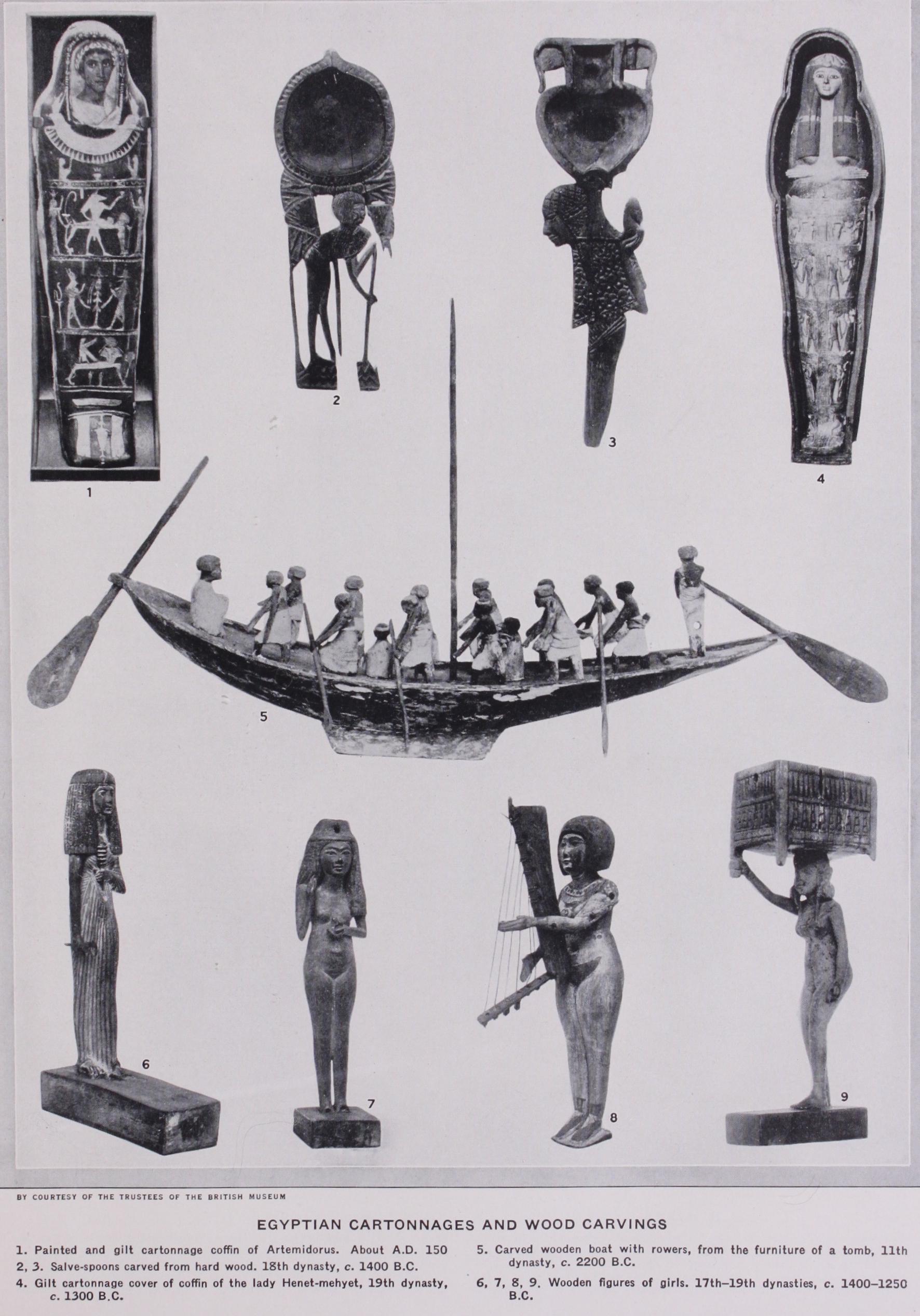
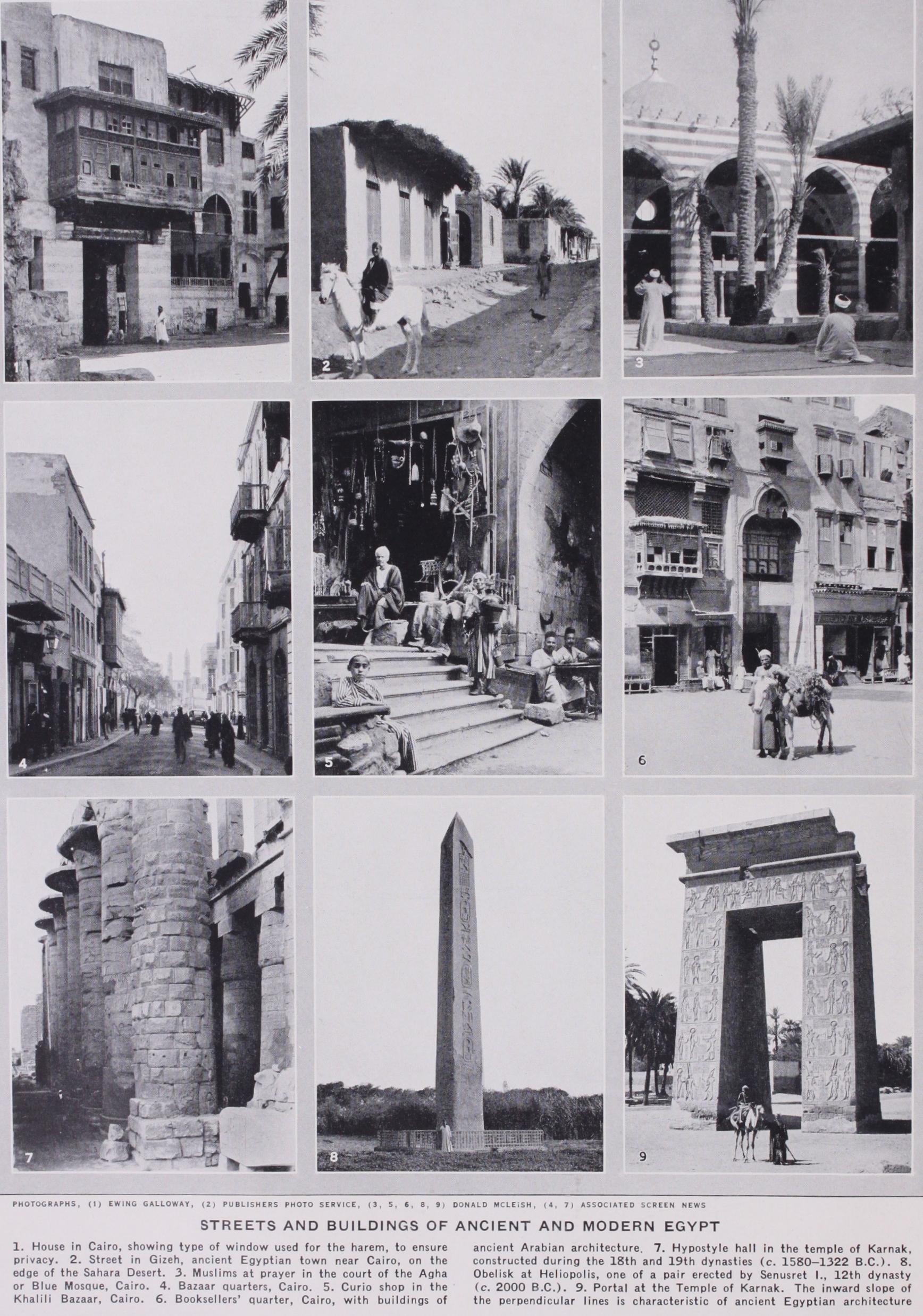
The immediate effect of the outbreak of war was to reduce the price of cotton by a third and thus deprive Egypt at a stroke of the increased income it had enjoyed for some 12 years previ ously. The sudden diminution of the country's purchasing power reacted severely on economic activity, imports fell off heavily, many debts were left undischarged and even gold hoards were dispersed. As elsewhere, emergency measures were taken. But matters soon righted themselves; for the price of cotton, stimu lated by the demand for war purposes, gradually recovered until by the end of 1915 it again reached its pre-war level. The conver sion of Egypt into a huge British military base for the Near East ern theatre of war and the paradoxical political connection be tween the two countries, which gave Egypt the benefits of being on the winning side without the financial drain of actual bellig erency, combined with the demand for Egyptian cotton, com pleted the economic rescue. Thus the maintenance of Egypt as a great base involved considerable expenditure on labour, military works, supplies and commodities of all kinds, which was defrayed by the British Government, or by the troops themselves, and ma terially contributed to the financial recovery of the country. It caused the British Government to provide and ensure the import of the coal necessary for the working of the railways, of the water supply, lighting and sewage systems of the towns, and of the thou sands of irrigation pumps on which the cotton, food and fodder harvests largely depend. It necessitated the protection of the maritime routes to Egypt and brought large volumes of shipping to her ports, which greatly facilitated the export of cotton and the import of food, fuel and other necessaries. These favourable conditions continued throughout the war, and were accompanied by a steady increase in cotton prices and a great growth in the wealth of the country.
In the middle of 1919 the prices of Egyptian cotton soared in response to a feverish post-war demand and early in 1920 stood at more than i o times the pre-war figure. They then fell as pre cipitously as they had risen, till in March 1921, they stood at little more than their pre-war level. The shock of the subsequent con traction of the national income fell most directly on the land holding population, which, however, was in a go6d position to stand it, having been able to accumulate profits practically untouched by taxation during the previous years. On the other hand, the general fall in prices brought relief to the classes which had suf fered from the continuous increase in the cost of living. For the growth of the national wealth since 1914 had been most unevenly distributed, and was accompanied by extreme contrasts of ease and want. The poorer classes in the towns, and large numbers of officials and others on small fixed salaries or purely money wages had suffered severely. The sudden fall in prices also caught the Government with large stocks of depreciated coal and cereals in its possession. For, as in other countries, the obligation to ensure essential supplies and partially to redress depreciation of the pay of public servants led the Government during the war to adopt special measures of food and fuel supply and in supplement of salaries. The liquidation of practically all these special liabilities and the reaction on public finance of the heavy fall in cotton prices fell into the working of the financial year 192o-21, which accord ingly may most fittingly be held to terminate the war period for Egypt. She emerged from it, as the following shows, at a net cost to her public finances of just over £E.2,500,000; with moderately increased taxation and with greatly increased national wealth.

*Excluding the Ottoman Tribute Loans.
tOf which the Govt. and the Caisse de la Dette held 12.3 in March 1927.
In the above table revenue and expenditure are totalled for each period, and the reserve fund and consolidated debt for first and last years of each period are given. In reading the totals the unequal lengths of the periods must of course be considered.
Up to the latter part of 1926 there was no slackening in Egypt's march towards material prosperity. Political agitation notwith standing, the public revenues moved steadily upwards; and once the post-war slump was surmounted, the period from 1921 was one of rapid growth in the foreign trade, great increase in bank de posits, a notable transfer of the public debt from European to Egyptian holders, a high level of Egyptian securities and a sub stantial discharge of agricultural debt. At the close of 1926 the situation changed somewhat, with the fall which took place in the world price of cotton. Though it probably did no more than bring the staple down to a normal post-war level, it emphasized the arti ficial rise that had occurred in the cost of living in Egypt and par ticularly the vicious inflation of agricultural rents. The purchasing power of the country was temporarily arrested, as shown by a sharp decline in imports ; but there was much accumulated wealth from the preceding good years, and recovery was not unduly pain ful. A number of useful measures were taken by the Government to assist the cotton industry, and a policy of reducing and fixing the rents of the fellahin was discussed in parliament.
The chief elements in the national revenue and expenditure will appear from a brief analysis of the budget for 1928-29 (the financial year now runs from May to April) :— Currency.—The monetary system dates from 1885, when through the efforts of Sir Edgar Vincent the currency was placed on a sound basis. Up to the World War, there was a gold mono metallic standard, the nominal unit being the Egyptian pound, sub divided into loo piastres and i,000 milliemes. The British sov ereign was legal tender at the rate of 975 milliemes, and consti tuted the real basis of the system. The notes of the National Bank of Egypt were current to a limited extent but were not legal tender. At the outbreak of the war, when the international circulation of gold stopped, it was found necessary to make these notes legal tender and to relieve the bank of the obligation to redeem them in gold. The public rapidly accustomed themselves to the use of notes and the disappearance of gold ; the notes of the National Bank remain inconvertible for internal circulation; and the ex change has been remarkably steady. The Egyptian pound (SE) is in practice equivalent to f 1–o-6 in British money, and the piastre (P.T.) to 21d. There are silver coins of 2, 5, 10 and 20 piastres; nickel coins of I, 2, 5 and 1 o milliemes, and a bronze coin of millieme; while the o of a piastre, popularly called a para, is still commonly used in reckoning among the poorer classes. The dollar (Tallari) is reckoned at 20 piastres.
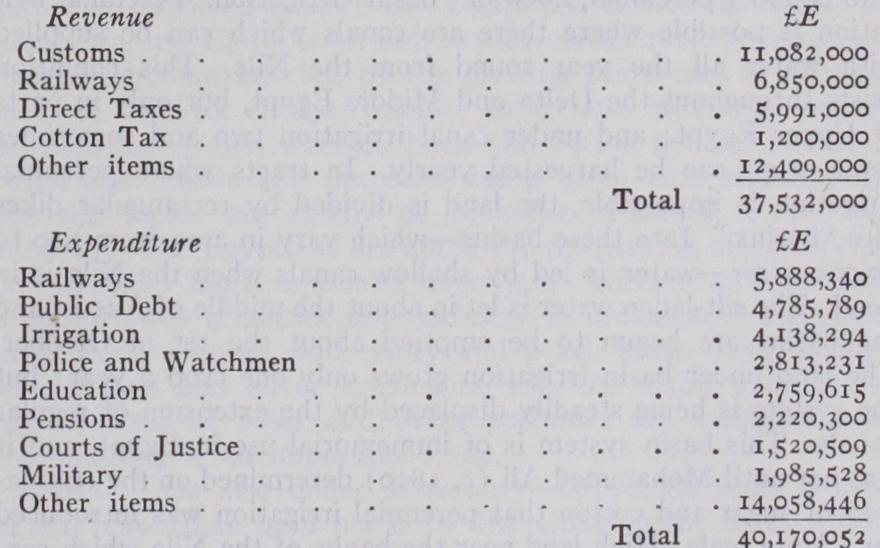
At the time of the French occupation of Egypt in 1798, it was found that the cultivable soil covered acres, but the quantity actually under cultivation did not exceed 3,520,00o acres. Under improved conditions the area of cultivated land has risen to over 51, million acres, and it is estimated that close on 8 million acres are cultivable.
Throughout Egypt the cultivable soil does not present any very great difference, being always the deposit of the river; it con tains, however, more sand near the river than at a distance from it. Towards the Mediterranean its quality is injured by the salt with which the air is impregnated, and therefore it is not so favourable to vegetation. Of the cultivated land, some three-fourths is held, theoretically, in life tenancy. The state, as ultimate proprietor, imposes a tax which is the equivalent of rent. These lands are Kharaji lands, in distinction from the Ushuri or tithe-paying lands. The Ushuri lands were originally granted in fee, and are subject to a quit-rent. All tenants are under obligation to guard or repair the banks of the Nile in times of flood, or in any case of sudden emer gency. Only to this extent does the corvee now prevail. Out of proprietors of land in 1905, I,OO5,7o5 owned less than 5 feddans. The number of proprietors owning over 5o feddans was 12,475. The acreage held by the first class was 1,264,084, that by the second class, 2,356,602. Over 1,6O0,Ooo feddans were held in holdings of from 5 to 5o feddans.
The kind of crops cultivated depends largely on whether the land is under perennial, flood or "basin" irrigation. Perennial irri gation is possible where there are canals which can be supplied with water all the year round from the Nile. This condition exists throughout the Delta and Middle Egypt, but only in parts of Upper Egypt ; and under canal irrigation two and sometimes three crops can be harvested yearly. In tracts where perennial irrigation is impossible, the land is divided by rectangular dikes into "basins." Into these basins—which vary in area from 600 to 50,000 acres—water is led by shallow canals when the Nile is in flood. The silt-laden water is let in about the middle of August and the basins are begun to be emptied about the 1st of October. The land under basin irrigation grows only one crop a year; but the system is being steadily displaced by the extension of regular canals. This basin system is of immemorial use in Egypt, and it was not until Mohammed Ali (c. 1820) determined on the cultiva tion of sugar and cotton that perennial irrigation was introduced on a large scale. High land near the banks of the Nile which can not be reached by canals is irrigated by raising water from the Nile by steam-pumps, water-wheels (sakias) worked by buffaloes, or water-lifts (shadufs) worked by hand. The fellah divides his land into little square plots by ridges of earth, and from the small canal which serves his holding he lets the water into each plot as needed. There are three agricultural seasons: (I) summer (sefi), April to October ; (2) flood (Nili), from mid-July to the end of November; and (3) winter (shetwi), from November to March. Cotton, sugar and rice are the chief summer crops; wheat, barley, flax and vegetables are chiefly winter crops; maize, millet and "flood" rice are Nili crops; millet and vegetables are also, but in a less degree, summer crops. The approximate areas under cultiva tion in the various seasons are, in summer, 2,050,00o acres; in flood, 2,200,000 acres; in winter, 4,000,00o acres. The double cropped area is over 2,500,000 acres. Although on the large farms iron ploughs, and threshing and grain-cleaning machines, have been introduced, the small cultivator prefers the simple native plough made of wood. Corn is threshed by a norag, a machine resembling a chair, which moves on small iron wheels or thin circular plates fixed to axle-trees, and is drawn in a circle by oxen.
Egypt is third among the cotton-producing countries of the world, its production per acre being the greatest of any country and its staple of a distinctive quality. Approximately 200,000 acres, chiefly in Lower Egypt, are devoted to cotton growing. The seed is sown in February in Upper Egypt and the crop is picked in September and October ; in the Southern part of the Delta, opera tions are a month later, and in the Lower Delta sowings on a large scale do not take place until April or pickings until November and December. The cotton crop increasing from I,7oo,00o cantars in 1878 to 4,100,00o in 1890, had reached 7,965,00o cantars in 1926. The cotton exported was valued in 1926 at LE 34,371,000, and in the previous year, before the slump in prices, it had reached the figure of LE 51,66o,0oo.
While cotton is grown chiefly in the Delta, the sugar plantations, which cover about 65,000 acres, are mainly in Upper Egypt. The canes are planted in March and are cut in the following January or February. Beetroot is also grown to a limited extent for the manufacture of sugar. The export of sugar varies greatly with the world demand and price; in 1920, for example, LE 1,145,00o was the value of the exports; in the following year LE 313,000. The Societe Generale des Sucreries has sugar factories scattered all over Upper Egypt, and their establishment at Nag Hamadi is said to be the largest of its kind in the world.
A coarse, strong tobacco used to be extensively grown, but its cultivation was prohibited in 1891, and the tobacco used locally and for cigarette manufacture comes chiefly from Greece, Turkey, and Syria. The duty derived from its import accounts for more than half the total customs revenue. Flax was an important crop in dynastic times : but neither it nor hemp is now grown to any large extent.
Maize (dhurra) occupies an even larger area than cotton, and is chiefly grown in Lower Egypt. In Upper Egypt its place is taken by millets. Both grains form the staple food of the peas antry. The stalk of the maize is also a very useful article. It is used in the building of the houses of the fellahin, as fuel, and, when green, as food for cattle. Wheat and barley are important crops. The barley in general is not of good quality, but the desert or "Mariut" barley, grown by the Bedouins in the coast region west of Alexandria, is highly prized for the making of beer. Beans and lentils are extensively sown, and form an important article of export. Rice is largely grown in the northern part of the Delta, where the soil is very wet. Two kinds are cultivated : Sultani, a summer crop, and Sabaini, a flood crop. Sabaini is a favourite food of the fellahin, while Sultani rice is largely exported. In the absence of grass, the chief green food for cattle and horses is clover, grown largely in the basin lands of Upper Egypt. To a less extent vetches and lucerne are grown for the same purpose.
Vegetables grow readily, and their cultivation is an important part of the work of the fellahin. The onion is grown in great quantities along the Nile banks in Upper Egypt, largely for export. Among other vegetables commonly raised are tomatoes (the bulk of which are exported), potatoes (of poor quality), leeks, mar rows, cucumbers, cauliflowers, lettuce, asparagus and spinach.
The common fruits are the date, orange, citron, fig. grape, apricot, peach and banana. Olives, melons, mulberries and straw berries are also grown, though not in very large numbers. The olive tree flourishes only in the Fayum and the oases. The Fayum also possesses extensive vineyards. The date is a valuable economic asset, being one of the chief foods of the people : and efforts are being made to improve the breeds and the fertility of the universal date-palm.
There are fields of roses in the Fayum, which supply the market with rose-water. Of plants used for dyeing, the principal are bas tard, saffron, madder, woad and the indigo plant. The leaves of the henna plant are used to impart a bright red colour to the palms of the hands, the soles of the feet, and the nails of both hands and feet, of women and children, the hair of old ladies and the tails of horses. Indigo is very extensively employed to dye the shirts of the poorer classes, and is, when very dark, the colour of mourning; therefore, women at funerals, and generally after a death, smear themselves with it.
The Egyptians are not particularly a pastoral people, though the wealth of the Bedouin in the Eastern or Arabian desert con sists in their camels, horses, sheep and goats. In the Nile valley the chief domestic animals are the camel, donkey, mule, ox, buffalo, sheep and goat. Horses are comparatively few, and are seldom seen outside the large towns, the camel and donkey being the principal beasts of burden. The cattle are short-horned, rather small and well formed. They are quiet in disposition, and much valued for agricultural labour by the people, who rarely slaughter them for meat. Buffaloes are largely employed for turning the sakias. Sheep (of which the greater number are black) and goats are abundant, and mutton is the ordinary butcher's meat. The wool is coarse and short. Poultry is plentiful and eggs form a con siderable item in the exports. Pigeons are kept in every village and their flesh is a common article of food.
The chief fishing-ground is Lake Menzala, where some 4,000 persons are engaged in the industry, but fish are caught also in large quantities along the coast of the Delta. The salting and curing of the fish is done chiefly at Mataria, on Lake Menzala, and at Damietta. Dried and salted fish eggs, called batarekk, command a ready market. The Nile abounds in fish, but they are not table delicacies.
Canals.—The irrigation canals have from time immemorial been an outstanding feature in the agricultural life of Egypt, as they supplement the operations of the annual inundation of the Nile. Their role is becoming of increasing scope and importance, with the steady substitution of systematic perennial irrigation for the old wasteful system of basin irrigation. There are about m. of irrigation canals, of which about i,000 m., particularly in the Delta, are navigable for passengers and food. An essential concomitant of both the canals and the basins is an adequate sys tem of drainage to prevent water—logging; and over 4,000 m. of main drainage courses are in operation.
The Delta canals derive their supply from four main channels. The Rayya Behera, known in its lower courses first as the Kha tatba and afterwards as the Rosetta canal, follows the west bank of the Rosetta branch of the Nile and has numerous offshoots. The most important is the Mahmudia (5o m. long), which con nects Alexandria with the Rosetta branch and supplies Alexandria with fresh water. The Rayya Menufia, or Menuf canal, connects the two branches of the Nile and supplies water to the large num ber of canals in the central part of the Delta. Following the right (eastern) bank of the Damietta branch is the Rayya Tewfiki, known below Benha as the Mansuria, and below Mansura as the Fareskur, canal. This canal has many branches. Farther east are other canals, of which the most remarkable occupy in part the beds of the Tanitic and Pelusiac branches. The superfluous water from all the Delta canals is drained off by balers (rivers) into the coast lakes.
The Ismailia or Fresh-water canal branches from the Nile at Cairo and follows, in the main, the course of the canal which anciently joined the Nile and the Red sea. It dates from Pha raonic times, having been begun by "Sesostris," continued by Necho II. and by Darius Hystaspes, and at length finished by Ptolemy Philadelphus. This canal, having fallen into disrepair, was restored in the 7th century A.D. by the Arabs who conquered Egypt, but appears not long afterwards to have again become un serviceable. The existing canal was dug in 1863 to supply fresh water to the towns on the Suez Canal.
In Upper Egypt the most important canals are the Ibrahimia and the Bahr Yusuf. They are both on the west side of the Nile. The Ibrahimia takes its water from the Nile at Assiut, and runs south to below Beni Suef. It now supplies the Bahr Yusuf, which runs parallel with and west of the Ibrahimia, until it diverges to supply the Fayum—a distance of some 35o m. It leaves the Ibrahimia at Derut near its original point of departure from the Nile. The Joseph whose name it bears was the famous Saladin: but he did little more than repair it, for it was probably executed under the Pharaohs. Besides supplying the canals of the Fayum with summer water, it fills many of the "basins" of Upper Egypt with water in flood time.
At the time of the French occupation of Egypt in 1798, it was found that the cultivable soil covered 4,429,400 acres, but the quantity actually under cultivation did not exceed 3,520,000 acres. Under improved conditions the area of cultivated land has risen to over million acres, and it is estimated that close on 8 million acres are cultivable.
Throughout Egypt the cultivable soil does not present any very great difference, being always the deposit of the river; it con tains, however, more sand near the river than at a distance from it. Towards the Mediterranean its quality is injured by the salt with which the air is impregnated, and therefore it is not so favourable to vegetation. Of the cultivated land, some three-fourths is held, theoretically, in life tenancy. The state, as ultimate proprietor, imposes a tax which is the equivalent of rent. These lands are Kharaji lands, in distinction from the Ushuri or tithe-paying lands. The Ushuri lands were originally granted in fee, and are subject to a quit-rent. All tenants are under obligation to guard or repair the banks of the Nile in times of flood, or in any case of sudden emer gency. Only to this extent does the corvee now prevail. Out of proprietors of land in 1905, owned less than 5 feddans. The number of proprietors owning over 5o feddans was 12,475. The acreage held by the first class was 1,264,084, that by the second class, 2,3 56,602. Over 1,600,00o feddans were held in holdings of from 5 to 5o feddans.
The kind of crops cultivated depends largely on whether the land is under perennial, flood or "basin" irrigation. Perennial irri gation is possible where there are canals which can be supplied with water all the year round from the Nile. This condition exists throughout the Delta and Middle Egypt, but only in parts of Upper Egypt ; and under canal irrigation two and sometimes three crops can be harvested yearly. In tracts where perennial irrigation is impossible, the land is divided by rectangular dikes into "basins." Into these basins—which vary in area from 60o to 50,000 acres—water is led by shallow canals when the Nile is in flood. The silt-laden water is let in about the middle of August and the basins are begun to be emptied about the 1st of October. The land under basin irrigation grows only one crop a year; but the system is being steadily displaced by the extension of regular canals. This basin system is of immemorial use in Egypt, and it was not until Mohammed Ali (c. 1820) determined on the cultiva tion of sugar and cotton that perennial irrigation was introduced on a large scale. High land near the banks of the Nile which can not be reached by canals is irrigated by raising water from the Nile by steam-pumps, water-wheels (sakias) worked by buffaloes, or water-lifts (shadufs) worked by hand. The fellah divides his land into little square plots by ridges of earth, and from the small canal which serves his holding he lets the water into each plot as needed. There are three agricultural seasons: (I) summer (se fi), April to October ; (2) flood (Nili), from mid-July to the end of November; and (3) winter (shetwi), from November to March. Cotton, sugar and rice are the chief summer crops; wheat, barley, flax and vegetables are chiefly winter crops; maize, millet and "flood" rice are Nili crops; millet and vegetables are also, but in a less degree, summer crops. The approximate areas under cultiva tion in the various seasons are, in summer, 2,050,00o acres; in flood, 2,200,000 acres; in winter, 4,000,00o acres. The double cropped area is over 2,500,000 acres. Although on the large farms iron ploughs, and threshing and grain-cleaning machines, have been introduced, the small cultivator prefers the simple native plough made of wood. Corn is threshed by a norag, a machine resembling a chair, which moves on small iron wheels or thin circular plates fixed to axle-trees, and is drawn in a circle by oxen.
Egypt is third among the cotton-producing countries of the world, its production per acre being the greatest of any country and its staple of a distinctive quality. Approximately 200,000 acres, chiefly in Lower Egypt, are devoted to cotton growing. The seed is sown in February in Upper Egypt and the crop is picked in September and October; in the Southern part of the Delta, opera tions are a month later, and in the Lower Delta sowings on a large scale do not take place until April or pickings until November and December. The cotton crop increasing from 1,700,00o cantors in 1878 to 4,100,000 in 1890, had reached 7,965,000 cantors in 1926. The cotton exported was valued in 1926 at LE 34,371,000, and in the previous year, before the slump in prices, it had reached the figure of LE 51,660,000.
While cotton is grown chiefly in the Delta, the sugar plantations, which cover about 65,000 acres, are mainly in Upper Egypt. The canes are planted in March and are cut in the following January or February. Beetroot is also grown to a limited extent for the manufacture of sugar. The export of sugar varies greatly with the world demand and price; in 1920, for example, LE 1,145,000 was the value of the exports; in the following year LE 313,00o. The Societe Generale des Sucreries has sugar factories scattered all over Upper Egypt, and their establishment at Nag Hamadi is said to be the largest of its kind in the world.
A coarse, strong tobacco used to be extensively grown, but its cultivation was prohibited in 1891, and the tobacco used locally and for cigarette manufacture comes chiefly from Greece, Turkey, and Syria. The duty derived from its import accounts for more than half the total customs revenue. Flax was an important crop in dynastic times : but neither it nor hemp is now grown to any large extent.
Maize (dhurra) occupies an even larger area than cotton, and is chiefly grown in Lower Egypt. In Upper Egypt its place is taken by millets. Both grains form the staple food of the peas antry. The stalk of the maize is also a very useful article. It is used in the building of the houses of the fellahin, as fuel, and, when green, as food for cattle. Wheat and barley are important crops. The barley in general is not of good quality, but the desert or "Mariut" barley, grown by the Bedouins in the coast region west of Alexandria, is highly prized for the making of beer. Beans and lentils are extensively sown, and form an important article of export. Rice is largely grown in the northern part of the Delta, where the soil is very wet. Two kinds are cultivated : Sultani, a summer crop, and Sabaini, a flood crop. Sabaini is a favourite food of the fellahin, while Sultani rice is largely exported. In the absence of grass, the chief green food for cattle and horses is clover, grown largely in the basin lands of Upper Egypt. To a less extent vetches and lucerne are grown for the same purpose.
Vegetables grow readily, and their cultivation is an important part of the work of the fellahin. The onion is grown in great quantities along the Nile banks in Upper Egypt, largely for export. Among other vegetables commonly raised are tomatoes (the bulk of which are exported), potatoes (of poor quality), leeks, mar rows, cucumbers, cauliflowers, lettuce, asparagus and spinach.
The common fruits are the date, orange, citron, fig, grape, apricot, peach and banana. Olives, melons, mulberries and straw berries are also grown, though not in very large numbers. The olive tree flourishes only in the Fayum and the oases. The Fayum also possesses extensive vineyards. The date is a valuable economic asset, being one of the chief foods of the people : and efforts are being made to improve the breeds and the fertility of the universal date-palm.
There are fields of roses in the Fayum, which supply the market with rose-water. Of plants used for dyeing, the principal are bas tard, saffron, madder, woad and the indigo plant. The leaves of the henna plant are used to impart a bright red colour to the palms of the hands, the soles of the feet, and the nails of both hands and feet, of women and children, the hair of old ladies and the tails of horses. Indigo is very extensively employed to dye the shirts of the poorer classes, and is, when very dark, the colour of mourning; therefore, women at funerals, and generally after a death, smear themselves with it.
The Egyptians are not particularly a pastoral people, though the wealth of the Bedouin in the Eastern or Arabian desert con sists in their camels, horses, sheep and goats. In the Nile valley the chief domestic animals are the camel, donkey, mule, ox, buffalo, sheep and goat. Horses are comparatively few, and are seldom seen outside the large towns, the camel and donkey being the principal beasts of burden. The cattle are short-horned, rather small and well formed. They are quiet in disposition, and much valued for agricultural labour by the people, who rarely slaughter them' for meat. Buffaloes are largely employed for turning the sakias. Sheep (of which the greater number are black) and goats are abundant, and mutton is the ordinary butcher's meat. The wool is coarse and short. Poultry is plentiful and eggs form a con siderable item in the exports. Pigeons are kept in every village and their flesh is a common article of food.
The chief fishing-ground is Lake Menzala, where some 4,000 persons are engaged in the industry, but fish are caught also in large quantities along the coast of the Delta. The salting and curing of the fish is done chiefly at Mataria, on Lake Menzala, and at Damietta. Dried and salted fish eggs, called batarekh, command a ready market. The Nile abounds in fish, but they are not table delicacies.
The Delta canals derive their supply from four main channels. The Rayya Behera, known in its lower courses first as the Kha tatba and afterwards as the Rosetta canal, follows the west bank of the Rosetta branch of the Nile and has numerous offshoots. The most important is the Mahmudia (5o m. long), which con nects Alexandria with the Rosetta branch and supplies Alexandria with fresh water. The Rayya Menufia, or Menuf canal, connects the two branches of the Nile and supplies water to the large num ber of canals in the central part of the Delta. Following the right (eastern) bank of the Damietta branch is the Rayya Tewfiki, known below Benha as the Mansuria, and below Mansura as the Fareskur, canal. This canal has many branches. Farther east are other canals, of which the most remarkable occupy in part the beds of the Tanitic and Pelusiac branches. The superfluous water from all the Delta canals is drained off by bahrs (rivers) into the coast lakes.
The Ismailia or Fresh-water canal branches from the Nile at Cairo and follows, in the main, the course of the canal which anciently joined the Nile and the Red sea. It dates from Pha raonic times, having been begun by "Sesostris," continued by Necho II. and by Darius Hystaspes, and at length finished by Ptolemy Philadelphus. This canal, having fallen into disrepair, was restored in the 7th century A.D. by the Arabs who conquered Egypt, but appears not long afterwards to have again become un serviceable. The existing canal was dug in 1863 to supply fresh water to the towns on the Suez Canal.
In Upper Egypt the most important canals are the Ibrahimia and the Bahr Yusuf. They are both on the west side of the Nile. The Ibrahimia takes its water from the Nile at Assiut, and runs south to below Beni Suef. It now supplies the Bahr Yusuf, which runs parallel with and west of the Ibrahimia, until it diverges to supply the Fayum--a distance of some 35o m. It leaves the Ibrahimia at Derut near its original point of departure from the Nile. The Joseph whose name it bears was the famous Saladin: but he did little more than repair it, for it was probably executed under the Pharaohs. Besides supplying the canals of the Fayum with summer water, it fills many of the "basins" of Upper Egypt with water in flood time.
The chief means of internal communication are, in the Delta the railways, in Upper Egypt the railway and the river. The rail ways are of two kinds: (I) those state-owned and state-worked, (2) light railways owned and worked by private companies. Railway construction dates from 1852, when the line from Alex andria to Cairo was begun, by order of Abbas I. The state rail ways have a gauge of 4 ft. 81 in. The main system is extremely simple. Trunk lines from Alexandria (via Damanhur and Tanta) and from Port Said (via Ismailia) traverse the Delta and join at Cairo. From Cairo the railway is continued south up the valley of the Nile and close to the river. At first it follows the west bank, crossing the stream at Nag Hamadi, 354 m. from Cairo, by an iron bridge 437 yd. long. Thence it continues on the east bank to Shellal, 3 m. above Aswan and 685 m. from Alexandria. This main line service is supplemented by a steamer service on the Nile from Shellal to Wadi Half a, on the northern frontier of the Anglo-Egyptian Sudan, whence there is direct railway communication with Khartum and the Red sea (see SUDAN).
Branch lines connect Cairo and Alexandria with Suez and with almost every town in the Delta. Before the Suez canal was opened passengers and goods were taken to Suez from Cairo by a railway 84 m. long which ran across the desert. This line, now disused, had itself superseded the "overland route" organized by Lieu tenant Thomas Waghorn, R.N., c. 183o, for the conveyance of passengers and mails to India. In Upper Egypt a line, 4o m. long, runs west from Wasta, a station 56 m. S. of Cairo, to Abuksa in the Fayum. Another railway (narrow gauge) goes from Kharga Junction, a station on the main line 24 m. S. of Girga, to the oasis of Kharga.
In the Delta the light railways supplement the ordinary lines and connect the villages with the towns and seaports. There is also a network of private lines in the Fayum : all these being on the 75 c.m. gauge. In 1880 944 m. of state lines were open; in i9oo the figure was 1,393, and it is now close on 2,50o m. For several years before 1904 the administration of the railways was carried on by an international or mixed board for the security of foreign creditors. In the year named the railways came directly under the control of the Egyptian government, and development has been steady though not rapid. The light railways owned by private companies are over Boo m. in length.
Westward from Alexandria a railway, begun in 1904 by the khedive, Abbas II., runs parallel with the coast, and is intended to be continued to Tripoli. The line forms the eastern end of the great railway system which will eventually extend from Tangier to Alexandria. During the World War railway connection with Palestine was effected from Kantara on the Canal across North ern Sinai, and has since been maintained.
The Nile is navigable throughout its course in Egypt, and is largely used as a means of cheap transit of heavy goods. Lock and bridge tolls were abolished in 1899 and 1901, respectively. Above Cairo the Nile is the favourite tourist route, while between Shellal and the Sudan frontier it is the only means of communi cation. Among the craft using the river the dahabiya is a char acteristic native sailing vessel, somewhat resembling a house-boat. From the Nile, caravan routes lead westward to the various oases and eastward to the Red sea, the shortest (12o m.) and most used of the eastern routes being that from Kena to Kosseir.
Roads suitable for wheeled vehicles are found in Lower Egypt, but the majority of the tracks are bridle-paths, the camel being still the chief vehicle of trade, especially in the desert. Modern methods, however, are asserting themselves. The use of the motor car is increasing; and in 1927 the number of motor vehicles registered was 9,712 cars, 3,195 cycles, 1,866 vans, 5,086 cabs and 1,o87 omnibuses. The Imperial Airways, Ltd., has begun a weekly service for mails and passengers between Cairo and Basra, via Gaza and Baghdad.
The Egyptian postal system is highly organized and efficient, and in striking contrast with its condition in 1870, when there were but nineteen post-offices in the country. All the branches of business transacted in European post-offices are carried on by the Egyptian service, Egypt being a member of the Postal Union. It was the first foreign country to establish a penny postage with Great Britain, and there are now over 500 post-offices and 3,000 postal stations. Post-office savings banks are making substantial headway.
All the important towns are connected by telegraph, the tele graphs being state-owned and worked by the railway administra tion. Egypt is also connected by cables and land-lines with the outside world. One land-line connects at El-Arish with the line through Syria and Asia Minor to Constantinople. Another line connects at Wadi Haifa with the Sudan system, affording direct telegraphic communication via Khartum and Gondokoro with Uganda and Mombasa. The Eastern Telegraph Company, by concessions, have telegraph lines across Egypt from Alexandria via Cairo to Suez, and from Port Said to Suez, connecting their cables to Europe and the East. The principal cables are from Alexandria to Malta, Gibraltar and England ; from Alexandria to Crete and Brindisi; from Suez to Aden, Bombay, China and Australia. Wireless stations at Alexandria and Cairo are open to the public, and an agreement was concluded with the Marconi Co. in 1926 for establishing commercial wireless telegraphy at Abu Zabal near Cairo.
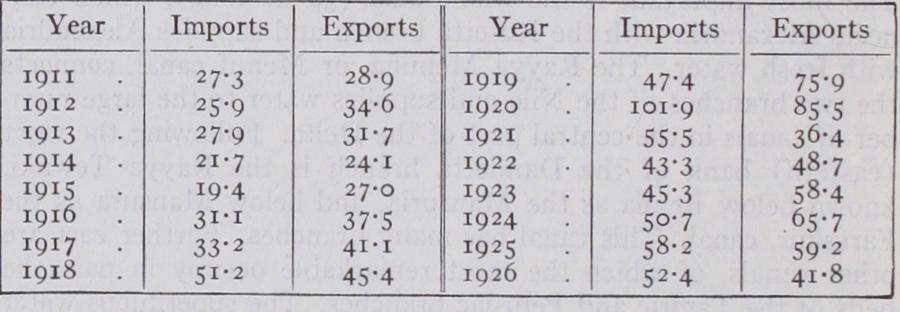
In comparison with cotton, all other exports are of minor account. The cotton exported, of which Great Britain takes nearly one-half, is worth over four-fifths of the total value of goods sent abroad. Next to cotton, sugar is the most important article exported. A large proportion of the sugar manufactured is, however, consumed in the country and does not figure in the trade returns. Of the imports the largest single item is cotton goods, three-fourths of which are sent from England. Woollen goods come chiefly from England and Germany, silk goods from France. Iron and steel goods, machinery, locomotives, etc., come chiefly from England, Belgium, the U.S.A. and Germany, coal from Eng land, live stock from Turkey and the Red sea ports, coffee from Brazil, timber from Russia, Turkey and Sweden.
In 1926 the largest importing nation was Great Britain, though its share in the total imports was down to 22% against a con siderably higher ratio in previous years ; the rest of the British empire provided another 11%. France had a fairly steady share in the import business at I I %; and Italy had fallen to 9%. Next to these countries came Germany with 7%, the U.S.A. with 5%, and Belgium with 4%; while Turkey, which once ranked second in the list, had less than 3%. In her export trade, Egypt's best customer continues to be Great Britain, though its part in the total exports had fallen from a more predominant figure to 45% in 1926. Next came the U.S.A. with 13% and France with 12% of the trade; Italy had less than 6% and Germany less than 5%; Japan and Switzerland following with still smaller ratios. The normal distribution of the external commerce was, it should be noted, to some extent dislocated in 1926 by the coal stoppage in England and the appreciation of the lira in Italy.
disposable wealth for purposes of foreign trade is predominantly represented by the value of her cotton ex ports, which has been as high as 180 millions in 1920, and stood at millions before the great fall in prices of 1926. Although these exports satisfy only about 4% of the world's consumption, the length and strength of the best Egyptian fibre enables it to command a marked premium in price over practically all other cottons. It is this virtual monopoly of the finest cotton and the great rise in the price of cotton generally which set the scale of Egypt's leap into prosperity. No reliable analysis can be given of the amount of the total payment annually remitted by other countries to Egypt for her cotton, which represents this premium: but its importance and the seriousness of the loss if Egyptian cot ton did not possess the advantage mentioned can be gauged by comparing the average price, over a series of years of Egyptian standard cotton with what is known as American middling. At the beginning of this century, the advantage in favour of the Egyptian product was 35%. It steadily rose, until during the war period it reached the striking figure of 82% : and since the war it has averaged over 5o%. While these premiums are simply indices of the relative demand for Egyptian and American stand ard cottons in the market of the most important outside pur chaser, the maintenance of the higher quality of which they are the reflection is of outstanding importance to Egypt, as otherwise her cotton would become a satellite of American and follow its price levels. While Egypt's primary economic interest is thus the maintenance of the present pre-eminence in the quality of her cotton, the danger that this advantage may be discounted by a falling off in quantity also calls for serious attention. The general statistics of the crop have indicated for a long time past a decline in the yield per feddan; it was 5.2 cantars at the begin ning of this century; it is now under 4 cantars per feddan. Fears have been expressed that the cotton lands are suffering from want of an adequate rotation of crops ; or from over-saturation: or from the loss of fertilizing silt which the old inundation sys tem provided but which is lacking in canal water. Even, however, if we assume the dependability and equal weight of the statistics throughout, there have been important disturbing factors at work, which make it advisable to accept with caution as yet the deduc tion that the culture of the cotton plant is, for one or other reason, generally less successful than it used to be. Among such factors may be mentioned the extension of cotton culture into less fertile districts and the cultivation of varieties, such as Sakellarides, which appear to combine better quality lint with lower yield. (See COTTON.) A congress of the International Fed eration of Master Cotton Spinners' and Manufacturers' Associ ations was held in Egypt early in 1927 and urged the Government to make every effort to improve the quality and increase the yield of Egyptian cotton, and to maintain and improve the drainage system.
than 90% of the external trade used to pass through the port of Alexandria ; but the ratio has been re duced by the canal ports to about two-thirds. Over 4,000 ships enter and clear harbour at Alexandria every year. The total tonnage entering the port was 4i million tons in 1925. Of the total volume of cargo landed and shipped at all the Egyptian ports in 1926, about 45% is carried by British vessels, 14% by Italian, I I% by Greek and 6% by German. Of the total number of passengers landed and embarked, 44% travelled in British, 25% in Italian and 15% in French vessels.
(b) Administration: Sir John Bowring's Report on Egypt . . . to Lord Palmerston (1840) shows the system obtaining at that period. For the study of the state of Egypt at the time of the British occupa tion, 5882, and the development of the country since, the most valu able documents are: I. Ofcial.—The Reports on the Finances, Administration and Con dition of Egypt, issued yearly since 1892 (the reports 1888-91 were exclusively financial) . Annual returns are published in Cairo in English or French by the various ministries, and a useful report on the Eco nomic and Financial Situation of Egypt is published annually by the British department of Overseas Trade on the trade of Egypt and of Alexandria and of the tonnage and shipping of the Suez Canal are also issued yearly.
II. Non-official.—Lord Cromer, Modern Egypt (2 vols., 1908), an authoritative record; Alfred (Lord) Milner, England in Egypt, first published in 1892, the story being brought up to 1904 in the IIth edition; Sir A. Colvin, The Making of Modern Egypt (1906). See also the works cited in History, last section.
(c) Law: H. Lamba, De revolution de la condition juridique des Europeens en Egypte (1896) ; J. H. Scott, The Law affecting Foreign ers in Egypt . . . (1907) ; The Egyptian Codes (1892).
(d) Irrigation, agriculture, geology, etc.: Despatch from Sir Evelyn Baring Enclosing Report on the Condition of the Agricultural Popula tion in Egypt (1888) . The reports (Egypt, No. 2, 1901, and Egypt, No. 2, 1904), by Sir William Garstin on irrigation projects on the Upper Nile are very valuable records—notably the 1904 report. W. Willcocks, Egyptian Irrigation (2nd ed., 1899) . Annual meteorological reports are issued by the Public Works Department, Cairo. The same department issues special irrigation reports. See for geology Carl von Zittel, Beitrdge zur Geologie and Paldontologie der libyschen Wiiste (Cassel, 1883) ; Reports of the Geological Survey of Egypt (Cairo, 190o, et seq.) .