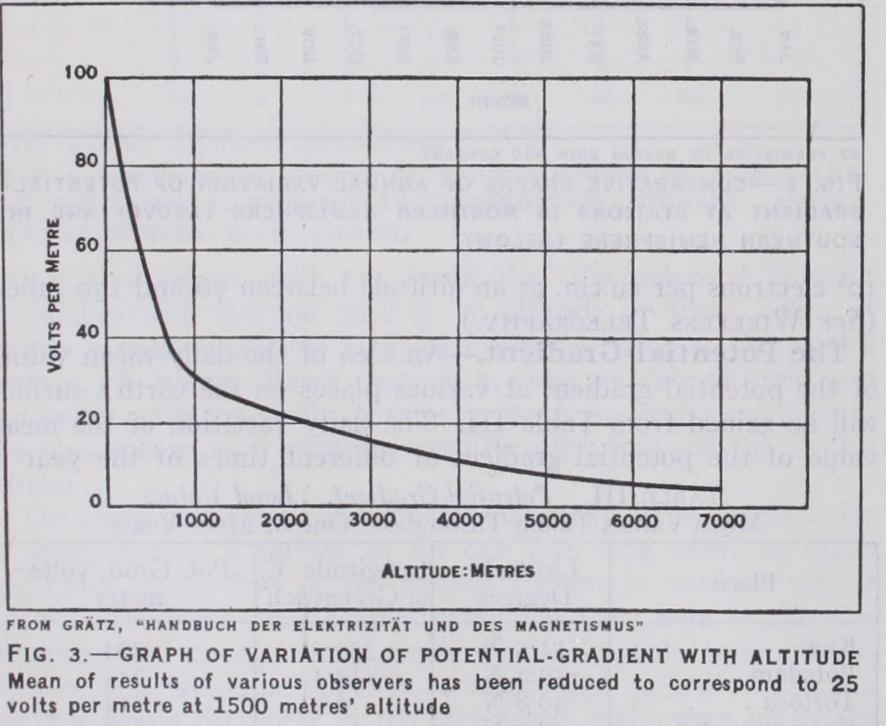
NORMAL ATMOSPHERIC ELECTRIC PHENOMENA General Survey.—The earth is not an electrically neutral body, but its surface is negatively charged to such an extent that the increase of potential per metre increase of altitude at its surface, the potential gradient as it is called, amounts to about 150 volts per metre. The potential gradient varies throughout the day and throughout the year in a more or less systematic manner, the variations amounting at 5o% or more of its total value. Dur ing abnormal weather conditions the sign of the potential gradient may be reversed.
illustrated by fig. I, the diurnal and the annual variation by fig. 2. Thus the annual variation presents, in most cases, a maximum in winter and a minimum in summer. The diurnal variation presents rather complicated characteristics. In the simplest, the winter type there is a minimum in the early morning (4hr.-6hr.) and a maximum in the late afternoon. The summer usually presents a secondary minimum at about 14 hours. At some places, as at Kew, the secondary minimum is very marked even in winter. It is customary to analyse diurnal variation measurements by a Fourier series with a 24hr. fundamental. The afternoon minimum is then characteristic of the i 2hr. wave. This wave is usually regarded as of less fundamental cosmical significance than the 24hr. wave, on account of such facts as are illustrated by measure ments at Paris, where at the top of the Eiffel tower the i 2hr. wave is absent throughout the year, whereas it is present in the summer at the level of the base of the tower. It seems reasonable to suppose that the i 2hr. wave is the symbol of secondary and local phenomena, such as the influence of charged nuclei and currents of air in the vicinity of the earth. Over the ocean, the diurnal variation seems to partake principally of the 24hr. type ; and, by a careful analysis of the data, S. J. Mauchly (1923) has reached the conclusion that this wave progresses according to universal rather than to local time. This conclusion, if extended to the land observatory measurements on the basis of which the f ore going statements have been made, would of course modify to some extent the universality of the conclusion as to the occurrence of the principal minimum in the early morning, and the principal maximum in the late afternoon, local time.
For an explanation of the decrease of potential gradient with altitude, we need no cause further than the known fact that the atmospheric conductivity increases with altitude to a value which, at 1 okm. for example, is great compared with its value at the earth's surface. For, even though the atmosphere carried no positive charge initially, so that the potential gradient was inde pendent of altitude, the existence of a higher conductivity at the altitude h+dh than at the altitude h would cause more positive electricity to flow into the layer between h and h+dh through the plane at h+dh than flowed out of it through the plane at h. This would cause the field to become smaller at h+dh than at h; and the process would continue until finally a steady state would be attained in which the conduction current density, or the prod uct of the field X and the total conductivity X was independent of altitude.