
POST-WAR ORGANIZATION British Army.—In the regular army the principal changes have been : the separation of signals from the Royal Engineers; the addition of a small headquarters unit, termed field park corn pany, to divisional engineers ; and the formation of an anti-aircraft searchlights engineer battalion. Other units that were found neces sary in the war have since been provided as "supplementary re serve." They include transportation, army troops, electrical and mechanical, workshops and stores companies, bridging trains and postal section. The personnel of these units do short periods of training and receive a bounty, in return for which they accept liability to be called up for service in case of war. The territorial army embraces divisional, fortress and anti-aircraft searchlight engineers. Royal Engineers serving in India are organized in military engineer services and three corps of sappers and miners under the direct control of the engineer-in-chief ; officers are also regularly employed under the civil departments of railways, sur veys and public works. In the forces of the Dominions appro priate engineer troops are provided on a similar basis to the regular army. The total engineer strength of the regular army is roughly i,ioo officers and 7,700 other ranks. The latter include men of some two dozen different trades and are obtained partly by direct enlistment and partly from boys who are given a trade training before being posted to the ranks. The majority of the officers pass through the Royal Military Academy, Woolwich, as cadets, and then do a technical course of general and military engineering partly at the School of Military Engineering, Chatham, and partly at Cambridge university, where they study for the Mechanical Sciences Tripos. A few with engineering qualifications are admitted each year direct from the universities and the Dominions. Selected officers later go through practical courses in railway, electrical and mechanical engineering.
A camouflage section is now generally included among engineer troops. Searchlights form, in most cases, a function of the artil lery, and this branch has taken over considerable survey activities, including flash-spotting and sound-ranging. The organization of the German engineer and pioneer corps, as defined by the Treaty of Versailles, remains practically as in 1914. The progress of "Mechanization" has peculiar interest for military engineers ; and it is impossible to forecast the extent to which it may affect their future organization and employment. (G. H. A.) The need for military engineers was recognized in the War of the Revolution, and General Washington was authorized to raise, officer and equip a corps of engineers. Three companies of sap pers and miners were organized, and Brigadier General Louis LeBegue du Portail, of the Royal Corps of Engineers of the French Army, was made commandant of the corps. The appoint ment of a foreigner to fill this important post is indicative of the deficiency of trained engineering talent available at that time in the American states. The corps was mustered out of the service at the close of the war.
A corps of combined artillerists and engineers had a brief existence, commencing in 1794, but the disadvantage of uniting under one head the art of fortification and the service of artillery was soon apparent and the union was discontinued by the Act of Congress of March 16, 1802, which formally established the Corps of Engineers. The latter corps has constituted the prin cipal engineer component of the regular army of the United States ever since. Officers with the special functions of topographical engineers were appointed on the staff during the War of 1812, and later were formed into a topographical bureau under the Chief of Engineers. A distinct Corps of Topographical Engineers, cre ated in 1838, was merged into the Corps of Engineers in 1863. The Act of 1802 provided that the Corps should be stationed at West Point in the State of New York, where it should constitute a Military Academy, and that the officers should be available for duties elsewhere at the discretion of the President. Major Jona than Williams was the first Superintendent of the Military Academy, the supervision of which remained in the hands of the Corps of Engineers until 1866, when the superintendency passed to the Army at large.
From the first the officers of the Corps were employed upon the fortification of the coast. For a long time they were the only trained engineers in the country, and their services were utilized on many important public works. Almost all of the routes of internal communication now in existence in the United States were first explored, located and projected by them. The non military duties imposed upon the officers of the Corps of Engineers by various laws enacted from time to time by Congress embrace, to mention only a few: the improvement of the rivers and har bours of the country for commerce ; the planning and construc tion of lighthouses and other fixed aids to navigation ; the plan ning and construction of many public buildings, monuments and utilities in the National Capital, notably the Capitol, the Wash ington Monument, the Library of Congress and the Lincoln Memorial; the construction of the Panama Canal; the improve ment of the Great Lakes for navigation ; the opening of roads and trails in Alaska ; and the enforcement of certain laws per taining to water power and navigation.
Justification for employing army engineers in these civil peace time pursuits is found in the opportunities such service affords for developing the engineering skill, broad experience in affairs, and general knowledge of the country, which are so valuable in an officer in time of war, whether in the handling of large bodies of troops in military engineering operations, or in the staff work of procurement of supplies, or in the application of the latest developments of engineering science to the solution of the prob lems arising out of new forms of warfare. The soundness of this policy has been repeatedly demonstrated, notwithstanding the view held by some officers that l ong periods of service on civil work tend to take officers out of touch with military progress. What ever merit this contention may have had in the past, the statutory requirement that every officer shall serve with troops at least one year in every five largely corrects the tendency. Furthermore, it is now customary to give officers on civil assignment additional duties of a military nature, such as the conduct of military in struction for the officers of the Organized Reserves, thus ensuring that they keep abreast of changes in the tactics and technique of engineer troops. Officers of the Corps of Engineers have in variably been called upon to direct the creation and early pioneer ing of new branches of the military service. The submarine mine service, air service, chemical warfare service, the motor transport corps and the tank corps are examples. The Act of 1802, estab lishing the Corps of Engineers, made no provision for enlisting engineer troops and none were raised until 1812, when one com pany of bombardiers, sappers and miners was authorized for service in the war with Great Britain. After this company was disbanded in 1821, the army was without engineer troops until 1846 when a single company was again provided for service in the Mexican War.
Upon the outbreak of the Civil War in 1861 the number of engineer companies was increased to four, and, while no battalion organization was legally authorized, it was found expedient to form the companies into a provisional battalion to be commanded by the senior officer present. The battalion was attached to the Army of the Potomac during the winter of 1861-62, and was engaged chiefly upon the defences of Washington and in training. In the succeeding years of the war the battalion was engaged upon the construction of roads, fortifications, and bridges, with the troops in campaign. A noteworthy bridge constructed by this battalion was a pontoon bridge 1,980 feet long, built across the Chickahominy River on August 14, 1862.
The present army regulations charge the Corps of Engineers with the following duties within the theatre of operations : (1) All work of construction and the repair and maintenance of all struc tures of every character, except telephone and telegraph systems and other signal communications for the use of troops. (2) Military mining, demolitions and protective measures against enemy mines. (3) The operation of railways, portable and fixed electric light and power systems, water supply systems, and all other utilities of general service, except such as are specifically assigned to other services. (4) The execution of surveying and mapping, including the production and distribution of maps. (5) The procurement, storage and issue of all materials for con struction work, for the organization of defence systems, and for all other operations assigned to the engineer service, including all plants, tools and appliances for such work.
These duties include : the construction, repair and maintenance of roads and trails ; of bridges and other means for crossing rivers and similar obstacles ; of shelter for troops and animals, including huts, hospital buildings, barracks, stables and accessory struc tures; of storehouses, shop structures, hangars and flying fields, including in proper cases the installation of the necessary ma chinery; of wharves, railroads and light railroads; the provision of water supply, including sterilization in bulk, the provision and installation of baths, disinfectors, dipping vats and incinerators; the installation of plumbing, sewage disposal and heating plants; the installation of machinery for refrigerating plants, laundries and other mechanical plants; assistance to other arms in entrench ing, and in organizing defensive lines; the organization and con struction of rear lines of defence; the construction of bomb proofs, observation stations, machine-gun emplacements and other special works of defence; the execution of special measures for destroying or overcoming enemy obstacles ; the supply of camouflage material and the supervision and inspection of its use; the preparation of signs for the direction of troops, including road signs, traffic signs, signs indicating the location of water points and other establishments, and signs safeguarding against the use of impure water; the operation of electric light, gas and power plants and water supply plants; the operation of shops for the erection and repair of railroad rolling stock, of construc tion machinery of all kinds and for the manufacture of special appliances for engineer operations; photographic and cinemato graphic work pertaining to terrestrial reconnaissance; terrestrial surveying; map making and map reproduction; the training of engineer troops for all their duties, and the compilation of tech nical data and the preparation of training literature on subjects pertaining to any of the operations assigned to the Corps of Engineers.
The experience of the World War indicates that, to carry out these manifold duties, a proper proportion of engineer troops of all classes must be included with each field force if the combatant arms are to be free to devote their efforts to defeating the enemy, unembarrassed by diversions of fighting troops to tasks, no less essential, on the lines of communication. A field force containing an adequate proportion of supporting line-of-communication troops is called a "balanced force," and includes for each field army of 9 infantry divisions (approximately 400,000 troops) the following engineers : The combat and general service regiments, mounted battalions, and engineer battalions, are denominated general engineer troops; all others are special engineer troops. General engineer troop units which constitute 70% of the engineers in a balanced force differ among themselves principally in size and in the qualifica tions of the headquarters personnel.
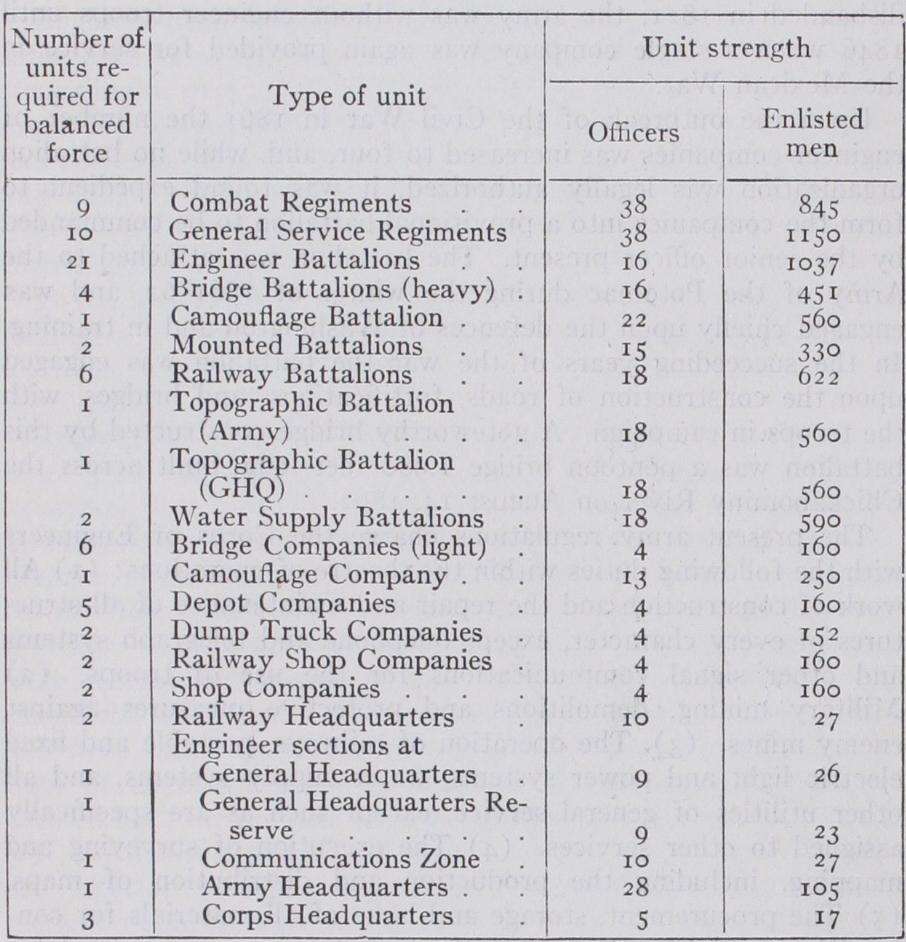
The special engineer organizations are provided for purposes suggested by their names. Bridge battalions and companies trans port the equipage with which general engineer troops construct floating bridges. Camouflage battalions manufacture and supply camouflage materials and give instructions to troops in their proper employment. Railway battalions operate and maintain railways, both narrow and broad gauge. Topographic 'battalions make terrestrial surveys and reproduce maps by photolithographic processes. Water supply battalions transport water in tank trucks. Depot companies furnish the technical personnel for engineer supply establishments. Dump truck companies furnish trans portation on engineer operations involving earthwork. Railway shop companies make major repairs to standard railway equip ment. Shop companies assemble, test and repair machinery and do manufacturing.
Most engineer units are armed and trained to engage in combat as riflemen, but, except for a few automatic rifles with the com bat and general service regiments, and machine guns with the mounted battalions, the units lack the supporting weapons and communication equipment requisite to effective infantry combat. It is only the gravest emergency that warrants the employment of the highly trained technical personnel of engineer units in combat, as such use involves the virtual abandonment of main tenance work on the routes of communication, and must ultimately result in the breakdown of supply and the curtailment of manoeuvre. The chief engineer officer at each headquarters is known as the unit engineer. He has the dual role of technical staff officer and commander of engineer troops. In the infantry and cavalry divisions the commander of the divisional engineer troops is a member of the staff of the division commander.
During the World War there was a tendency toward over specialization in engineer troop units, separate organizations being raised for many special purposes besides those outlined above. The consensus of military thought is that the most satisfactory results can be obtained when the bulk of the engineer service consists of general engineer units. These are so organized, equipped and trained, that they may be employed indiscrim inately upon engineer work of almost any character, whereas special units, being recruited usually from a limited class of artisans and being organized and equipped for particular pur poses, are not readily adaptable to employment upon tasks not closely related to the specialties with which they have long been familiar.
Most of the officers of the Corps of Engineers are obtained from the United States Military Academy at West Point. In addition to these, a small number of officers are obtained from the graduates of civil technical schools. The education of the engineer officer continues throughout his career in the Army. Those officers who graduate from West Point are sent for one year to civil institutions to supplement their instruction in tech nical subjects not included in the curriculum of the Military Academy. All the officers, including those from West Point, attend for one year the Engineer School at Fort Humphreys, Virginia, where they pursue the Company Officers' Course, covering mili tary engineering, harbour defence, tactics, logistics and certain engineering subjects pertaining to the civil work of the corps. The next step in the educational scheme is detail as student officers under district engineer officers engaged on civil works, after which the officers are available for general assignment. Engineer officers, like other army officers, are subject to further military education at the Command and General Staff School, at the Army Industrial College, and at the Army War College. it is the policy of the Chief of Engineers to broaden the officers' knowledge of the country by assigning them to duty in different localities. It will be seen from the foregoing that no effort is made to develop specialists, although, through necessity, some officers must be dedicated to such specialties as aerial photo graphic mapping, map reproduction and certain hydraulic tech nicalities incident to the civil work of the Corps. The aim is rather to give a broad and general scientific and practical train ing, looking ultimately to the application of physical science to the preparation for and conduct of military operations. A school for the instruction of enlisted specialists is conducted at Fort Humphreys. Practical experience is given selected men in suit ably equipped shops in map reproduction, photography, mechan ical drafting, surveying and machinery.
The training of the officers of the Corps of Engineers reserve comprises correspondence courses, inactive duty conference courses and fifteen-day periods of active duty training either with troops of the Regular Army or at headquarters, depending upon their individual assignments. A limited number of reserve officers attend the Engineer school.
When the United States entered the World War, the engineers available for immediate service consisted of 256 officers and 2,228 soldiers. At the time of the Armistice in November, 1918, there were under the Corps of Engineers 1o,886 engineer officers and 292,300 soldiers of whom 174,000 (officers and men) were with the American Expeditionary Forces. The Engineers with the American Expeditionary Forces, besides participating in all combat operations, handled over 3,000,000 tons of engineer sup plies, constructed an aggregate of 6,36o feet of wharves at ports, constructed 967 miles of standard gauge railroad, provided hos pital space for 141,00o beds, constructed 16,000 barracks, operated 1,390 miles of light railway and cut 218,211,00o board feet of lumber.
As now organized (1928), the engineer branch of the army of the United States includes the Corps of Engineers of the Regular Army, 5 20 officers and about 5,00o enlisted men ; the engineer organizations of the National Guard, about soo officers and 8,000 enlisted men; and the engineer section of the Officers' Reserve Corps, about 7,000 officers. The latter are given assignments to organizations which are to be mobilized in time of war, but which are without enlisted men in peace time. (G. B. T.) R. W. Porter, History of the Corps of R.E., 2 vols. (Chatham, 1889) , Work of the R.E. in the European War, 8 vols. (Chatham, 192 2-2 7) ; C. Lecomte, Les I ngenieurs militaires en France (19o4) ; H. Frobenius, Geschichte der K. preuss. Ingenieur u. Pioneer-Korps (1906) ; W. A. Ganoe, History of the U.S. Army (1924) ; Lieut.-Gen. Schwarte, Kriegsle/zrea in Beispielen aus dem Welt-Krieg, vol. i. (1925) .