
THE ESTABLISHMENT OF ENGLISH UNITY From the outset there was one powerful factor making for unity. The Angles, Saxons, and Jutes may have been distinct in origin, but there can be no doubt of their close relationship. No fundamental differences separate the culture of Angles and Saxons, and the superior arts and crafts of the Jutes in eastern Kent and in the Isle of Wight were acquired probably during temporary residence in Frankish territory immediately before their migration to Britain. The language differences between these peoples can only have been slight in the 7th century. All three peoples, for example, used the same general stock of personal names, and recent investigation of local nomenclature has brought out an essential similarity in words denoting places of settlement and natural features throughout Britain. Kent indeed stands apart from the rest of England in legal custom, agrarian organization, and at a later time to some extent in language. But Kent, save for the reign of its greatest king, Ethelbert, was never an impor tant kingdom, and though the distinctive features of its society may have intensified its particularism they did not seriously com plicate the general uniformity of the English culture of the earliest period.
It has been argued often that the influence of the church coun teracted this tendency, that the authority of the archbishop of Canterbury set an example which was ultimately followed in the temporal sphere. There is a measure of truth in this opinion. A great archbishop like Theodore of Tarsus was the effective ruler of the church everywhere among the English people. But no other archbishop was a man of Theodore's quality, and after 734, when an independent archbishopric of York was created, the organization of the church was a serious obstacle to the unifica tion of England. Moreover the administration of the church was closely adapted to the contemporary political divisions of the land. The typical bishop of the 7th century was bishop of a kingdom and counsellor of its king. It was only an exceptional man who in such a position could work for the establishment of a wider unity than prevailed in the world which alone he knew.
Reasons for West Saxon Supremacy.---On the eve of the Norman Conquest, Edward the Confessor, heir of the West Saxon dynasty, was the only king recognized in England. It is natural to attribute the ultimate supremacy of the West Saxon line to the unusual ability of kings like Alfred, Edward the Elder, and Athelstan, but they would never have achieved their place in history had it not been for the previous extinction of all com peting dynasties. At the end of the 8th century, a highly com petent observer, the Northumbrian scholar Alcuin, then resident in France, remarked that scarcely any men were left of the ancient stock of English kings. Two generations later, the West Saxon dynasty alone survived. The permanent establishment of a new royal line under the conditions which prevailed in the 9th century was an impossible task. A mere noble, however eminent his ancestry, never received the instinctive respect accorded to a man of royal birth. On three occasions before the Norman Con quest a man who was not of this class obtained temporary recog nition as king, but on each occasion the attempt led to disaster. With the disappearance of the ancient dynasties the king of the West Saxons became the natural lord of kingless men elsewhere in England. Alfred and his successors had the ability to make their lordship a reality.
The Bretwaldas.—But long before Alfred's time individual kings had succeeded in establishing a degree of authority over other rulers which in the 8th century had brought the unity of Eng land within measurable distance of realization. From the 5th cen tury onwards it had been the custom for every king south of the Humber to acknowledge the authority of a common overlord. The title borne by these early overlords, the famous style of Bretwalda (q.v.) was vague, and of poetical origin, but the powers which it implied were real. When, for example, Edwin, king of the Deirans and Bernicians, had obtained recognition at Bretwalda from the kings of the south, he anticipated for a moment the position of a later king of all England. He could summon other kings to bring their followers to join him in war, he could take tribute from them, and his safe conduct ran in their countries. It is true that no Bretwalda before the 9th century could hand on his position to his son and successor. He had won it by his own skill and reputation in war, and it inevitably ended with him. Nevertheless the habit of obedience to a common overlord did more than any other custom to break down the isolation of the different southern kingdoms, and the succession of the Bretwaldas is the one thread which holds together the confused history of England between the invasion and the age of Bede.
Offa and His Successors.—In a sense, the reign of Offa marks the culmination of the old English monarchy. Later centuries produced more famous kings, such as Alfred, Athelstan and Edgar, but by their time a new racial element had been introduced into England by the Danish settlements pf the 9th century, and the authority of the last old English kings over the Danelagh (q.v.) was dependent on the good will of its inhabitants. In the time of Offa, England was virtually homogeneous in race. Of the rival dynasties some were extinct, others had come to accept a position permanently subordinate to the head of the Mercian house, while the Northumbrian kingdom was collapsing into anarchy. Under these conditions, Offa was able to create a do minion which approximated far more nearly than is generally realized to a kingdom of all England. He was king of the Mer cians, and Mercia in his time was by far the strongest of English kingdoms. But he was also overlord of the southern English, and in his hands overlordship was passing visibly into direct rule. The heirs of the surviving southern dynasties were his men, attended his courts and sought his confirmation of their grants of land. He dealt at his will with land within the subject king doms, and brought Northumbria under his control by giving a daughter to its king. Little is known of the detailed history of his reign. No chronicle has survived from his time, and the most important materials for its history are the charters by which he granted land to his followers or to churches which en joyed his patronage. And one of these documents has unique importance, for in it Offa styles himself rex totius Anglorum patriae, "king of all England." This is the first occasion on which this famous style is known to have been employed. But the kingdom of all England which Offa claimed to rule was not identical with England of the pres ent day. In the far south-west Cornwall was still virtually in dependent, its subjection to the kingdom of Wessex belonging to the next generation. In the far north the Northumbrian king dom still stretched to the Firth of Forth, and Lothian remained English for two centuries after Offa's time. Between the English and the Britons on the border of what is now Wales Offa's memory is still preserved by the great earthwork which bears the name "Offa's Dyke." This long entrenchment, the greatest public work in early English history, was undoubtedly intended as an artificial boundary line against the Britons of the West. The wars of later centuries created a different boundary but the dyke remains a remarkable illustration of the reality of the power possessed by the greatest king of the age before the Danish wars.
Egbert of Wessex.—Both Offa and his son Egfrith died in 796, and a remote cousin named Cenwulf became king of the Mercians. He reigned until 821, maintaining the integrity of the Mercian kingdom without the wider authority which had belonged to Offa. With his successor Ceolwulf (821-823), the direct line of the Mercian dynasty ended, and after a brief interval the overlordship of the southern English was won by Egbert king of Wessex, who alone among the English rulers of his day could claim direct descent from the kings of the migration time. It was to this fact that he owed his opportunity. At his accession Wessex was an unimportant kingdom, and Egbert himself, unlike Offa, remained to the last an insular figure. But his reign marks an important stage in the unification of England. As the heir of the last of the archaic English dynasties he obtained ready recognition as overlord in the smaller kingdoms of the south, Kent, Sussex and Essex. In a battle fought at a place named Ellandun in north Wiltshire in 825 he overthrew Beornwulf, king of the Mercians, and the East Angles deliberately chose him as their protector against Mercian aggression. Four years later, he received the submission of the Mercians themselves, and im mediately imposed his overlordship on the Northumbrians. By the close of his reign he had obtained a position virtually identical with that which Offa had held.
The Danish Wars.—This fact was destined to influence the whole course of early English history. Already in Egbert's reign, isolated companies of vikings were visiting the English coasts, and within thirty years of his death in 839 an organized army was ravaging the whole land. The real importance of Egbert's career 'lies in the fact that he was able to make the king of Wessex supreme over all other English peoples before the whole fabric of English society was attacked by the new invaders from the east. It was to the king of Wessex, that the men of Mercia, East Anglia, and even Northumbria turned when their own royal lines had been overthrown. And it so happened that the West Saxon royal house produced in Alfred, the youngest grandson of Egbert, the greatest military leader whom the Scandinavian raiders ever met in western Europe.
Alfred.—Alfred's aim was to prevent the settlement of Wessex by Scandinavian invaders, and in this he was helped by fortune. So long as the Danish armies kept together they could compel the West Saxons, like every other English people, to buy peace from them. But the weight of Danish attack fell on Mercia and Northumbria, and a great part of the original army which entered England in 865 had permanently settled between Tees and Welland before the remainder of the host attempted the conquest of Wessex ten years later. In 877 they overran all Wessex, and drove Alfred into the inaccessible stretches of higher ground along the river Parret. His victory at Edington in Wiltshire in the following year is one of the battles which have influenced the course of history. Had he been defeated, Wessex would have been settled by the invaders, and all England would have become a Scandinavian colony. The battle of Edington decided that the West Saxon dynasty should survive. When Alfred died in 899 he could be described with truth as "king over all the English people except the part that was under the power of the Danes." The next generation saw his dynasty establish its overlordship over the descendants of the Danish settlers everywhere in England.
With the reign of Alfred English history enters upon a new phase. The Danish army defeated at Edington moved in 879 to East Anglia, and settled this region as their former companions had already settled the country between Welland and Tees. Smaller groups of settlers who acknowledged the East Anglian king as their lord had established themselves in the south-eastern midlands. From the estuary of the Thames to the Rere Cross on Stainmore eastern England was a Danish land when Alfred died. For a hundred years afterwards the Danes in England retained much of their original military organization. In the loth century men commonly spoke of the "army" of Northampton or Leicester when they referred to the men of Northamptonshire or Leicester shire. The most formidable of these "armies" was that established in the country round York, which at first had a king of its own, and raided English territory from time to time. But the kings of York never brought the more southerly Danes to accept their authority, and in the warfare of the next generation the initiative, almost from the first, rested with the English of Wessex and English Mercia.
Conquest of the Danelaw.—The conquest of Scandinavian Eng land and its annexation to the West Saxon kingdom spread over twenty years. It would have been a remarkable achievement if the king of Wessex had been the ruler of an English people united in feeling and in traditions. But the ancient independence of Mercia and Northumbria was not yet forgotten. The English of Northumbria, threatened by Danes on the south and Scots on the north, naturally looked to the king of Wessex as their protector. The particularism of the Mercians was more serious. Barely a century had passed since Mercia had been the dominant kingdom in the land. Fortunately for the unity of England, Alfred had established a trusted noble, named Ethelred, as ealdorman of the Mercians, and had given him Aethelflaed, his eldest daughter, in marriage. The most remarkable feature of the wars which fol lowed Alfred's death is the unbroken loyalty of Ethelred and his wife to their lord, Aethelflaed's brother, king Edward the Elder. Ethelred died in 91 o, but for the next seven years his widow co operated with her brother in a gradual encroachment upon Danish territory which ended, after her death, in the acceptance of Edward as lord by all the Danes in England. Long after this time a clear distinction was maintained between the English of Wessex and of Mercia. In the z 2th century the customary law of Mercia still differed in important points from that of Wessex. But after the reign of Edward the Elder the Mercians were nor mally content to form part of an English kingdom whose head was the West Saxon king.
Norwegian Invasions.—While Edward and Aethelflaed were engaged in their great campaigns against the Danes, a new element was being added to the complex of races which was to form the English people. In the first decade of the loth century, a con siderable number of Norwegian adventurers from Ireland invaded the north-west of England. From the region which now forms the shires of Cumberland and Westmorland the new settlers passed easily across the western hills into the North Riding of York, where their memory is still preserved by many place-names of definitely Norwegian character. In the next decade, the leader of the vikings of Waterford, Ragnall O'Ivar, made himself king of York, and thus began a connection between Northumbria and Ireland which threatened the whole work of Edward and Aethel flaed. But for the time it had little political result, and in 919 when Edward received the solemn submission of all the men of Northumbria, "English, Danes, Northmen, and others," of the kings of the Scots and of the Britons of Strathclyde, Ragnall also became his man.
Athelstan.—The position won by Edward the Elder was main tained by his son Athelstan, the most brilliant figure among the Old English kings. Early in his reign he expelled the Norse dynasty, then in possession of York, and brought the city and its dependent territory under bis direct rule. Under him, relations between the king of Wessex and the Scandinavian nobility of the north and east became friendly, and numerous earls of Danish name can be traced at his court. He enforced a real overlordship over the Welsh princes of his day, and made Cornwall an integral part of the West Saxon kingdom. Abroad, his reputation was great. His sisters were married to the chief continental rulers of his time —to Otto king of the Germans, afterwards Emperor, to Charles king of the West Franks, the descendant of Charlemagne, and to Hugh duke of the Franks, the ancestor of the house of Capet. From time to time he intervened in French affairs, protecting Breton refugees driven from their homes by Norman invasion, and giving hospitality to Louis, the heir of the Carolingian dynasty. He enters for a moment into Norwegian history, for there is no reason to doubt the ancient tradition which asserts that Hakon, son of Harold Fairhair, the creator of the Norwegian kingdom, was brought up at Athelstan's court. Not since Offa had there been an English king who played so considerable a part in the eyes of men across the seas.
It also fell to him to win one of the greatest battles ever fought between an English and a Scandinavian host. In 937 Anlaf Guthfrithson, king of Dublin, in alliance with Constantine; king of Scots, penetrated far into England, but were utterly defeated by Athelstan at a place not now to be identified, then known by the name of Brunnanburh. Less important historically than Alfred's victory at Edington, the battle of Brunnanburh greatly impressed contemporaries. A memory of it was preserved in Norse tradition, and it gave occasion for a poem which reveals with singular fidelity the merits and defects of late Old English poetic style. The details of the battle, as of most Old English battles before the last fight of Hastings, are lost. Its most signifi cant feature is that the Northumbrian Danes, who had been the greatest danger to the English monarchy in the days of Athel stan's father were not present with Anlaf and his Scotch allies.
The reign of Athelstan has moreover a place in the history of English administration. Reference has been made from time to time to those charters by which the Old English kings granted estates to the nobles and churches of their kingdom. The series of these documents, which begins in the seventh century, is broken in the latter part of the long reign of Edward the Elder. It begins again under Athelstan and is never afterwards interrupted. The interest of Athelstan's charters does not lie in their subject matter, but in the highly technical form in which they are composed. There can be no question that Athelstan kept a body of clerks in attendance at his court, who developed rules of composition, a set of formulae, a technique of draftsmanship, to which there is nothing comparable in the royal charters of any earlier time. In other words it is in the reign of Athelstan that evidence for the existence of something which may be called a civil service first appears in England. The West Saxon monarchy was beginning to develop the rudiments of an administrative system.
Final Conquest of Danish Mercia.—Athelstan died in 939. The reign of his brother and successor Edmund is marked by a curious episode which shows how easily the monarchy, after a generation of laborious consolidation, could still be shaken by attack from without. In his first year, Anlaf Guthfrithson, the king defeated at Brunnanburh, invaded England again, became master of York, and compelled the king to agree to a partition of the country. Edmund accepted Watling Street as his boundary against Anlaf, and thereby acquiesced in the destruction of all the work of Edward the Elder. Anlaf's death in the following year gave Edmund an opportunity of recovering his position in the midlands, and in 942 he conquered all Mercia as far as the Northumbrian border, and including the five boroughs of Lincoln, Stamford, Leicester, Nottingham and Derby, which had been, and long continued to be the centres of Danish influence between Welland and Humber. A contemporary poem, fortunately pre served in the Old English Chronicle, brings out the important fact that the men of these boroughs regarded their conquest by Edmund as a deliverance from heathen bondage. The later development of the English monarchy was first assured when the descendants of the Danish settlers of the 9th century decided to throw in their lot with the king of Wessex against the new aggres sive viking power established on the Irish coast.
Wessex and Northumbria.—In the following years a succession of ephemeral kings of Norse origin can be traced at York. The last of them disappeared in 954, when Edred, Edmund's brother, became, like Athelstan before him, the immediate lord of York and Yorkshire. Henceforward this region appears as an earldom, highly independent, but never breaking quite away from its allegiance to the king of Wessex. It was only on rare occasions that the latter intervened in Northumbrian affairs. He had little land beyond the Humber, and Northumbrian nobles rarely ap peared at his court. But the Northumbrian earls were his men; he appointed the archbishop of York and the bishop of the country beyond Tees, whose seat became fixed at Durham before the century was over. The Northumbrian currency bore his name, and his writ ran in the north. The last kings of the West Saxon dynasty were lords of Northumbria in something more than name.
Significance of the Danish Settlement.—The years which passed between the accession of Edward the Elder and the death of Edred had been momentous for the development of a united England. They had witnessed the acceptance of Christianity by the de scendants of the Danish settlers of Alfred's time, the failure of the Norse invasions from Ireland, and the recognition of the head of the West Saxon royal house as king of all England. Politically, the unity of England was accomplished by the end of this period. But this achievement, which in itself is one of the most remarkable facts in all English history, has often led historians to underestimate the significance of the Danish settle ment of the previous century. Long of ter this period, long, in deed, after the Norman Conquest, the Danes in England remained in language, law and society a race apart. They were an intensely conservative people, tenacious of their ancient customs, jealous of interference from without. The region of their settlement, known from the loth century onwards as the Danelaw, was sharply distinguished from Mercia and Wessex by peculiarities of customary law which long survived the overthrow of the Old English kingdom itself. In social order, the Danelaw was marked by the existence of large masses of independent peasants who never underwent the manorial discipline which converted the free ceorls of the south and west into the serfs of mediaeval economy. Even in the 13th century innumerable peasants of Scandinavian ancestry were still disposing freely of their small tenements by gift, sale or exchange without hindrance from their lords. In language, the Scandinavian speech of the Danelaw has left a permanent impression on the dialects of this region, and its per sonal nomenclature remained intensely Scandinavian until, late in the Middle Ages, the continental names which came in with the Norman Conquest found in Danish England the acceptance which they had long received in the South. Few things are more remarkable in English social history than the consistency with which the Scandinavian population of the North and East resisted the influences which were making for the assimilation of their customs to those prevalent in the South and West. The England which William of Normandy conquered formed a single monarchy, but it contained two races.
Weakness of the Monarchy.—The single monarchy itself was far stronger in appearance than in reality. Only four years after the disappearance of the last Norse Northumbrian king, the whole region north of Thames broke away from Wessex. Edred, who died in 955, left two young sons, Edwy and Edgar, of whom the former succeeded him. The most notable feature of his brief reign is the large number of grants of land made by royal charter to individual nobles. No reign in all early English history pro duced so many of these grants as the five years of Edwy's rule in Wessex. It is probable that Edwy was trying by their means to attach important persons to himself against his brother. In any case, a revolt of which Edgar was in name the head broke out in 958, and the men of Northumbria, East Anglia and Mercia chose Edgar for their king. In the following year Edwy died and the unity of England was restored by Edgar's reception as king in Wessex. But the episode shows that there was little cohesion as yet between the four great territorial units which comprised the English kingdom of the loth century.
The Reign of Edgar.—The reign of Edgar is often regarded as marking the highest point of effective power reached by the Old English monarchy. In a sense this opinion is justified. Edgar inherited a wide dominion created by earlier kings, his reign was a time of peace for the greater part of England, and he was able to impose his overlordship upon the Celtic princes beyond the English border. But he was not a constructive ruler like Edward the Elder or Athelstan, and when their achievements are remem bered his reign appears something of an anticlimax. In part his reputation is due to the evil time which fell upon England in the next generation, but it owes still more to his lavish patronage of the church, and to his encouragement which he gave to the great men, Dunstan, Ethelwold, and Oswald, who in his reign were reviving monastic life in England. A competent ruler, he left little mark upon the development of the monarchy.
Ethelred "the Unready."—But throughout the forty years which followed his death there was a singular lack of competence in high places. His eldest son, Edward "the Martyr," was murdered before he could prove either ability or incompetence. His second son, Ethelred "the Unready," appeared to contemporaries as the very type of an inefficient ruler, and there is no reason to attempt a reversal of their judgment. His troubles were not, indeed, of his own making. In the second year of his reign there began a succession of Danish raids upon England, which curiously resemble in their sporadic character and their wide range the visitations previous to the coming of the great army of Alfred's time. For more than a generation the monarchy, which Ethelred's great predecessors had created, resisted with remarkable firmness. Though there was treachery among men in high command, ineffi cient military organization and over-strained financial resources, the sense of political unity was never completely lost, and no trace of any tendency towards separatism is to be found in the Danes in England. The attitude of the men in charge of the great provincial governments is equally significant. Some of them, notably Edric Streona the ealdorman of Mercia, obviously con sidered it their right to make terms with the enemy as their own interest might dictate, even if this involved the betrayal of their men in the field. But none of them made any attempt to secure political independence, or to revive the ancient kingdoms of which they were the immediate rulers. The kingdom of England was conquered, but it escaped disintegration.
Cnut.—This singular episode had remarkably little influence on the later course of English history. The wealth and ancient civilization of England made it the centre of Cnut's incoherent empire. He ruled as an English king, with greater military power behind him than any of his predecessors, but governing with the same instruments which they had used. Individual Danes and Norwegians received high office from him. For a time Northum bria was governed under him by Eric son of Jarl Hakon of Nor way, one of the heroic figures of Norwegian saga. But already in the early part of his reign Cnut was appointing Englishmen to im portant provincial governments. The two powerful families whose rivalry fills the reign of Edward the Confessor, the house of Godwine of Wessex and that of Leofric of Mercia, both owed their position to Cnut. He granted to all his English subjects of free condition the first charter of liberties in English history. The laws which he issued form the most detailed exposition of Old English legal custom which has survived, and formed the basis of the law which prevailed in England under the Norman kings. The grants of land which, in moderation, Cnut made to his Danish followers are drawn up according to English models of com and his coinage follows earlier English types. To English men he soon became the pattern of a good king. By the eve of the Norman Conquest "Cnut's law" had become a synonym for a form of government in which ancient and approved custom was observed.
Stam f ordbradge and Hastings. —In the event, the Norman tory of 1066 was essentially due to accidental circumstances. Harold was at once accepted as king in the south ; he met no overt opposition from the rival family of the earls of Mercia, and he succeeded in conciliating the Northumbrians. His chance of defence against the threatened Norman invasion was destroyed by a sudden and formidable invasion of England from the vian north. Harold Hardrada, king of Norway, who had inherited an indefinite claim to the English throne in virtue of a treaty tween his predecessor and Harthacnut, the last Danish king of England, adopted the cause of Tostig, the exiled earl of bria, entered the Humber and occupied York. His defeat at fordbridge by Harold of England ranks with the battles of ton and Brunnanburh among the events which ruled that England should not form part of the Scandinavian world. But the wegian invasion called King Harold from the south at the very time when invasion from Normandy was imminent. William of Normandy landed at Pevensey without serious opposition, Harold engaged him in battle seven miles north-west of Hastings with the survivors of Stamf ordbridge and the men who had joined him during a hurried march from York, and in a single day the cause of English independence was lost.
Position of William the Conqueror.—It was an ancient and wealthy kingdom of which William thus became the lord. Its integrity had survived all the disasters which had fallen on it in the ninety years since King Edgar's death. But the royal authority had become dangerously weak during the last generation, and the effective power now resided, not in the king, but in the rulers of the great earldoms called into being by the administrative necessities of an earlier time. King Edward had enjoyed the royal title, and possessed a royal demesne which made him the greatest landowner in the country, but on any grave occasion he was helpless without the support of such men as the earls of Wessex, Mercia or Northumbria. They on their part treated him with the respect due to the head of his ancient house, re ceived their offices from his hand, and from time to time attended his court and gave him counsel. Nevertheless to the men of their respective governments it was they rather than the king who were responsible for public order, for the defence of the land, and for the maintenance of familiar custom. The unity of Eng land, achieved by the great kings of the i oth century, had become very superficial when Edward the Confessor died.
At this point William of Normandy exercised a determining influence on English history. He was lord of the land by conquest, and from his time the king's court became the centre of English government. To him the ancient distinction between Wessex, Mercia and the Danelaw had no political significance, and suc cessive revolts enabled him to break up the great earldoms. He was compelled to create compact military lordships in regions where especial danger threatened. The earldoms of Chester, Shrewsbury and Richmond closely resembled Norman countships, and the "rapes" of Sussex were castleries of French pattern. But each of these new military governments was given to a man whom William had reason to trust, and in his time their privileges did not impair its integrity. Indeed, it would be easy to exaggerate the centralization of the government in William's reign. Feudal custom expected a lord to do justice to his men in his own court, and the king was not yet required to intervene in private dis putes between persons of modest station. William was represen tative of his generation, and knew instinctively the sphere in which his authority could be exercised without challenge. To him belonged an unquestioned initiative in policy, the right to send his ministers into every part of the land to ascertain his interests, and a claim upon the advice and support of his barons in any undertaking which he might plan. It was to him that his barons owed their position, and though irresponsible nobles might sometimes rebel, the definite opposition between crown and baronage which colours English history in the later middle ages could not arise while the Anglo-Norman monarchy was itself on the defensive. The new power which William had created had many enemies. It was a direct challenge to the kings of Norway and Denmark, it was regarded with great suspicion in France, and for a generation the possibility of a native rising was very real. Throughout the reigns of the Conqueror and his sons there was an essential community of interest between the king and his barons, and it was from this that the strength of the Anglo-Norman monarchy was ultimately derived.
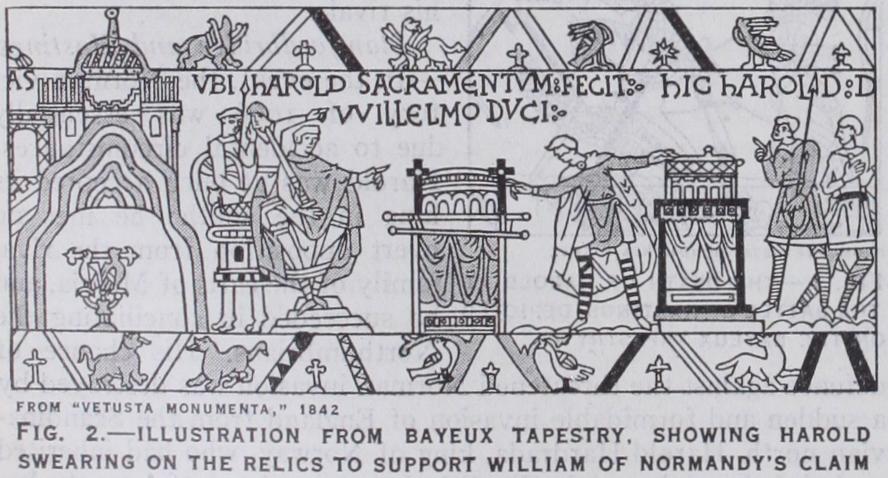
By the end of 107o the Norman rule had become finally estab lished in England. French barons had received the lands for feited by English rebels, and the North had been terrorised by the recent devastation of Yorkshire and northern Mercia. Wil liam was unwilling to allow military power to any man of English descent and the native element in the Anglo-Norman aristocracy, though strong in the North, had little political importance. But the Norman Conquest was not a national migration, and the modification of English law, language and social custom through French influence was a very gradual process. Fifty years after the Conquest the traditions of the time before that event were still strong, and Englishmen lived in the reign of Henry I. under what was still in substance and procedure essentially Old Eng lish law. To the last, England never became a mere province of the French speaking world.
The Monarchy and the Baronage.—The danger which con fronted the Anglo-Norman kings was not English disaffection but the drift towards baronial independence characteristic of contemporary feudalism. In the forty years which followed the Conquest there were f our serious baronial rebellions, each es sentially the outcome of aristocratic jealousy towards a strong monarchy. Until the succession to the throne itself fell into dispute between Stephen and the empress Maud, the common interests of crown and baronage were always strong enough to prevent the disaffection of individuals from wrecking the settle ment established by William I. But all the kings of this period were alive to the danger. In 1085 William himself received the homage of all the landholders of any account in England, thereby insisting that the vassal's fidelity to the king overrode his duty to his immediate lord. William II. understood the mental atti tude of the irresponsible baron, and attracted into his own service many of the landless knights of northern France on whom the plotters of rebellion always relied. Henry I. was interested in the business of government, and under him the Anglo-Norman monarchy reached a degree of organization which placed it above the attack of any possible combination of barons. Under him, perhaps for the first time in its history, England enjoyed un broken peace for a generation. With his death the direct line of the Norman kings ended, his successor ruined the national ad ministration by alienating the church, and the dangerous forces latent in the constitution of feudal society at last found vent. The ensuing phase of feudal anarchy was brief and the inevitable reaction lasted long. The power of the crown, restored by Henry II., was never generally attached until the generation which had known the disorders of Stephen's time had disappeared. But the history of the years of confusion illustrates what might easily have become the normal condition of society under the new French dynasty and the baronage which it has established in England.
Anglo-Norman Administration.—If the authority of the Anglo Norman kings depended in the last resort on the loyalty of the baronage, it was exercised through an administrative system which centred upon the king's court. William I. had inherited more than the nucleus of an executive organization from his English predecessors. Already before the Norman Conquest Eng land had developed a national system of taxation, and the un rivalled series of English financial records begins in William's reign with a document written in English which proves the earlier existence of a definite organization for the receipt of the royal revenue. The king's writ of later times goes back to an Old English model, and it was in English that the Conqueror in his earliest years normally addressed his subjects of every race. With few exceptions, the king's clerks of his reign are obscure people, but they and their successors were able to carry through the compilation of the greatest record in mediaeval history. From every point of view Domesday Book (q.v.) was a momen tous achievement. It incorporates the result of a national survey which was itself a political event of the first importance, and its bearing upon the origins of English mediaeval administration is equally significant. It proves the existence in the king's service of a large body of clerks, skilled in administrative routine, and able to reduce to order the verdicts of innumerable local juries drawn from every part of England between the Tees and the Channel. The creation of specialized offices within this body was only a question of time, and early in the next century the history of the English departments of state begins with the appearance of the Exchequer, the central financial bureau destined to carry down to modern times the tradition, and much of the technique, of the Anglo-Norman administration.
Church and State.—In mediaeval history it is never easy to draw a clear line between the respective spheres of church and state, and in the history of England it is long before any definite separation becomes evident. The leading churchmen of pre Conquest England had been immersed in secular business, eccles iastical pleas were commonly treated in secular courts, and the king had been far more effectively the ruler of the church than of the state. With the Norman Conquest, church and state began to fall apart. Under William I. and his friend Lanfranc, archbishop of Canterbury, the organization of the church in Eng land was remodelled according to continental ideas, the bishops gained a more direct authority over their clergy, and jurisdiction over matters affecting the cure of souls was transferred from the ancient hundred moot to the new bishop's court. But the con scious opposition between the monarchy and the church belongs to a later time. On questions of ecclesiastical policy William and Lanfranc were of one mind. Lanfranc realized that the work of ecclesiastical reform needed the support of the royal authority, that the deliverance of the church from subjection to the feudal world could only be accomplished by the exercise of the king's supremacy. It was not until the church itself was se cure that a movement towards independence could arise within it.
The intimate alliance which William and Lanfranc had founded was broken under their successors. William II., himself as ir religious as the wildest baron of his time, placed a saint in the see of Canterbury. Intellectually among the greatest of mediaeval churchmen, Anselm (q.v.) throughout his primacy felt himself an alien in England. New questions of ecclesiastical politics, on which English churchmen were themselves divided, awaited his decision. Upon the most urgent of these questions, the great controversy over Investitures (q.v.), Anselm and Henry I. reached a compromise. But their success did not affect the essential fact that the ancient unity of church and state in England was in compatible with the new ideal of ecclesiastical independence from which the investiture controversy itself had arisen. For a time the inevitable conflict between church and state was postponed. Anselm's successors, archbishops Ralf and William were mainly occupied with the detailed work of ecclesiastical administration and reform. Under Theobald of Bec, the next archbishop, the church was for a time the only institution in the land which maintained the great Norman tradition of organized government. Throughout the reign of Stephen, the church and its ministers possessed a degree of power which made the assertion of general principles irrelevant. It was Theobald's successor, Thomas Becket, who challenged at last the ecclesiastical authority of the crown.
The essential achievement of the Anglo-Norman kings had been the creation of an administrative system, centred on the royal court, which under Henry I. had destroyed all but the greatest baronial franchises and extended its influence into every depart ment of local government. In the reign of Stephen, a disputed succession and civil war broke the continuity of this development. In some respects the position attained by the monarchy under Henry I. was never completely restored until Henry VIII. had imposed his supremacy upon the church in England. In the last resort, Stephen had owed his throne to papal recognition, and the popes of the next age maintained and indeed increased the in fluence thus won.
Henry II. and Thomas Becket.—Although Henry II. in the end carried the English monarchy to a point of power never before attained, his achievement even in the temporal sphere was long delayed by the spirit of feudal independence which had found expression in the anarchy. Fortunate in all his ministers save one, a single error in judgment destroyed for ever his chance of re-establishing the relations between church and state which had prevailed under the Anglo-Norman kings. The whole of his reign thereafter was coloured by the fact that Thomas Becket (q.v.), Henry's fellow worker as Chancellor, became the uncom promising champion of ecclesiastical privilege as archbishop. Through his opposition Henry's original aim of bringing all his subjects within the sphere of royal justice became unattainable. Hoping at first to move by the establishment of general prin ciples through the settlement of individual cases, he was com pelled by the opposition of Becket to propose to his bishops in the Constitutions of Clarendon (q.v.) of I164 a comprehensive definition of the relationship which he wished to see established between church and state. The archbishop's flight prevented the settlement of the general questions raised by the Constitutions. His murder in i i 7o produced a reaction which gave to the Pope a direct influence on the administration of ecclesiastical justice in England, and secured for the clergy immunities which still com plicated the administration of English justice long after the middle ages.
Innovations in Criminal Procedure.—But even in the difficult years of Becket's exile and the crisis which followed his death the work of centralization was going on. Aided by the most remark able group of ministers which ever served an English king, min isters drawn alike from the feudal nobility of every rank and from the new administrative class which had arisen earlier in the cen tury, Henry was able to undertake the systematic reconstruction of the administration without alienating the mass of the English baronage. In i 166 in the Assize of Clarendon for the first time the king took from the individual the responsibility of instituting legal process against persons suspected of certain of the graver forms of crime. Such crimes in future came before the king's judges. Jurisdiction over them was taken from the sheriff and the feudal baronage alike. Ten years later the Assize of Northampton added further crimes to the list and made punish ment more severe. By these ordinances what was in effect a new procedure was introduced into English criminal law. The jury or sworn inquest, which was henceforward employed to inform the king's judges about crimes or accusations of crime, was no new thing. Ever since the Norman Conquest it had been used for the ascertainment of royal rights and for the occasional settlement of disputes between individuals, but there had not been any place for it in ordinary legal procedure. Its regular employment could only be secured by such deliberate innovation as the royal ordi nance of 1166. The change was sudden, but it was not pushed to an extreme, for the individual still had the right of appeal, and the native ordeal and the Norman duel still survived. As years went on the king's judges appeared almost annually in the shires, and gradually men came to realize the fundamental superiority of the king's justice. Gradually they attracted to the king's courts criminal business which formerly would have fallen to the feudal courts or the ancient courts of shire or hundred. Offences of little moment could be brought before the king's judges by the mere assertion of the plaintiff that they had been committed in contempt of the king's peace.
New Forms of Action.—Simultaneously the king was extending the influence of his justice in the sphere of civil procedure. From the early years of his reign he was enforcing the doctrine later expressed by his chief justiciar, Rannulf de Glanville in the formula "No one need answer in his lord's touching his free tene ment without the writ of the king or his chief justiciar." He rigorously followed up complaints of default of justice. He de vised the first examples of those forms of action which dominated the law of real property until the nineteenth century was well advanced. Determined by the verdict of a local jury instead of the uncertain operation of archaic forms of procedure, these possessory assizes steadily grew in popularity. For those who de sired a rapid settlement, even if it might be reversed on some future occasion, these summary processes were sufficient. For those who wished a final settlement in accordance with the verdict of a jury and in the king's court Henry provided a more solemn if less expeditious process in the Grand Assize which enabled the tenant of the land at issue to avoid the uncertain event of a judicial duel. It is not surprising that Henry's court was invoked by his free subjects of every condition. The essential step had now been taken towards the centralization of justice in England.
The King's Court and Local Officers.—The men through whom this work was carried out, the justices of Henry's court, were not experts in law alone. They were the king's executive officers to be employed on any task that the king might assign to them— administrators of the king's estates, keepers of the royal castles, financial officers of the crown. Above all they formed the essen tial link between the central government and the shires. Through them the king maintained control of the sheriffs; many of them were sheriffs themselves. Through visits of the justices on circuit the central court became informed as to the condition of the country. The ordinary freeman became acquainted with the personnel of the king's court and was continually reminded that there existed a power in the land greater than the feudal magnate who was his lord or the sheriff who presided over the ancient assemblies of his shire. On one great occasion in 1170 Henry instituted, through persons despatched from his court, an enquiry into the conduct of all local officers, and many sheriffs were dis missed as a result of this investigation. The independence of the local officer which had wrecked earlier Continental experiments in centralization was now destroyed. The king's court had become the instrument of all government in England.
It is in this development of royal power in England rather than in the magnitude of Henry's territorial position in western Europe that the greatness of his reign lies. Nevertheless, he was the strongest king of his time, inferior in rank to the Emperor, but far superior to him in material resources. His official title, King of England, Duke of Normandy and Aquitaine, count of Anjou, imperfectly expresses the significance of his position. A duke of Aquitaine was lord of one of the richest regions of the whole West whose traditions were more ancient than those which cen tred round the French monarchy itself. In Normandy it was not forgotten that his father's house had been the hereditary enemies of the Norman dukes. In this lay the weakness of his continental position, a weakness that the king of France knew only too well how to exploit. Conscious of the diverse traditions of the regions over which he ruled, Henry was unwilling to encourage local particularism by creating appanages for his sons. Their resent ment at exclusion from power was perhaps inevitable, though they showed little sense of responsibility or family solidarity. For tunately for Henry their political capacity was small. Their rebellion in I I i4, though supported by the kings of France and of Scotland, failed alike in England and France. After fifteen years of continuous disaffection they brought Henry's reign to a close in confusion and distress, his empire passing entirely to Richard, his rebellious heir.
Richard came to England in 1189 to be crowned and to raise money for the crusade to which he was already committed. Noth ing illustrates more clearly the prosperity which England had reached under Henry II. than the way in which the country met the unprecedented financial demands of Richard. To the new king the settlement of England made necessary by his impending de parture was a matter of finance. He sold offices and privileges to individuals, charters to towns, and his favour to persons whose loyalty was suspect.
The Count of Mortain and the King's Justices.—The unity of England itself was threatened by the settlement of 1189. The youngest son of Henry II., John count of Mortain, was a person to be conciliated, and he received from Richard an appanage of unprecedented extent. Six counties, Nottingham and Derby, Somerset and Dorset, Devon and Cornwall, were withdrawn from the control of the central government and placed under John's lordship. They accounted no longer at the royal exchequer but at that of the count of Mortain. He held also the honours of Lancaster, Tickhill, Peverel of Nottingham, Wallingford and Eye, which were among the greatest feudal lordships in England. In his wife's right he possessed the great inheritance of the earls of Gloucester, which gave him the formidable marcher principality of Glamorgan. Nevertheless, John was dissatisfied; he had not been recognized as his brother's heir and the greatest castles in his domain were held by his brother's officers. Inevitably he became a centre of disaffection, and the unpopularity of Rich ard's chief minister, William de Longchamps bishop of Ely, chancellor, Justiciar and Papal Legate, brought over the leading members of the king's council itself to the side of John. In the autumn of 1191 the Chancellor was driven from England by a movement led by John, and his place was taken by Walter arch bishop of Rouen, who had been sent from abroad by Richard. Until January 1193, when the news reached England that Richard had fallen into captivity on his return from crusade, the archbishop carried on the government of England in Richard's name. Then in alliance with the king of France John broke into rebellion, and thenceforward until Richard himself returned to England early in 1194 and captured the last castles which held out for his brother the peace of the land was never completely re-established. But even in these difficult months, the representatives of Richard never lost control of the situation. They were even able in to collect and despatch to Germany a large portion of the ransom demanded by the Emperor for Richard's release. The administra tive system which Henry II. had devised remained unshaken by threatened war with France, by the shock of the king's imprison ment, and by the rebellion of the man who stood nearest to the succession.
Hubert Walter, Archbishop of Canterbury.—The war with France in which Richard was thenceforward engaged belongs to French rather than to English history. In England, Hubert Walter archbishop of Canterbury, first as justiciar and after wards as chancellor maintained the traditions of Henry II.'s court. If his immediate duty was to raise money and knights, his chief interest lay in improving governmental practice at Westminster and in the country. The great eyre of 1194 is a landmark in English administrative history ; it created a new and permanent office, that of coroner, it set up new machinery for dealing with lands escheated into the king's hand, and instituted the department of government which soon became known as the Exchequer of the Jews. The office of justice of the peace can be traced back upon one of its many lines of development to an edict issued by Hubert Walter in '195. He reorganized the Chan cery and began the systematic keeping of official records. His influence survived until the whole administrative system collapsed in the troubles which preceded the issue of Magna Carta. King John.—Hubert Walter and his younger contemporary, Geoffrey fitz Peter, form a link between the reigns of Richard I. and John. With Richard's death and John's accession in 1199 the personality of the sovereign once more became the dominant fac tor in English politics. John has received hard measure from his torians, and he deserved much that they have said against him. In personal conduct, like his father, he fell below the low stand ards cif contemporary life, but he was a man of ability, interested in the routine of government and in the technique of law, and with real appreciation of forces which as yet most rulers of his time regarded with suspicion. It was not mere financial necessity which made him a patron of towns ; long after his death the cities of Aquitaine regarded him as a benefactor. It was not weakness that made him call into occasional consultation men of less than baronial rank, there was something inevitable in the disasters which fell upon England in his time. He suffered from baronial reaction against efficient bureaucracy, from popular resentment against the heavy taxation incurred through his brother's spirited policy. Above all he was thrown by circum stances into opposition to two of the greatest mediaeval states men. As a young man Philip Augustus king of France had reduced the veteran Henry II. to submission, and though Richard I. had held his own against him it had been at a heavy price. In Inno cent III. John faced a pope who brought wholly unusual qualities to the establishing of papal supremacy in western Europe. It was something more than the weakness of its king that made England a vassal state and brought upon it the first foreign invasion since 1066.
John and the Papacy.—The first significant event was the French conquest of Normandy in 1204. It marks the end of the system which had prevailed since the Conquest, by which the greatest feudal families were powerful on either side the Channel. It made possible the growth of an English national feeling, but its immediate consequence was a certain alienation of the baron age from the king. The next year saw the beginning of the events which were to lead to the central crisis of the reign. Archbishop Hubert Walter died on July 13, 1205, and a disputed election gave Innocent III. an unexpected opportunity. The struggle which began with the pope's nomination of Stephen Langton to the primacy and the refusal of John to accept him lasted till 1213. For long, the king gained rather than lost by the quarrel; he enjoyed the profits of the lands of those ecclesiastics who obeyed the Pope, and thus enriched, he was able to enforce his supremacy on Ireland and Wales and take hostages from the king of Scots. But his strength was more apparent than real. After his personal excommunication in 1209 he was left with but two supporters among the bishops, John, bishop of Norwich, absent ruling Ireland, and Peter des Roches, bishop of Win chester. Threatened by French invasion at the instigation of Innocent III., unnerved by current rumours of coming doom, uncertain of the attitude of some of his barons, John submitted unconditionally to the Pope in 1213. He promised to hold his kingdom as a papal fief and to pay a yearly tribute to his overlord. On his part, the Pope discountenanced the French invasion of England.
Magna Carta.—The coming of Stephen Langton as archbishop of Canterbury marks not only the end of the struggle between John and the Pope, but the beginning of the events which culmi nated in the issue of flit:, charter in 1215. The course of these events, the place of the charter in English history, and the war which followed its issue are described in the article Magna Carta. Had John lived there is little doubt that he would have quelled the barons and their French allies, but his victory would have meant the triumph of absolutism, the indefinite postponement of constitutional experiment. With his death (Oct. 19, 1216) the authority of the crown was disassociated from the personality of an unpopular king.
Failure of the French Invasion.—John's inheritance passed to his son Henry, a child of nine, whose supporters established a regency under William Marshall, earl of Pembroke, the oldest and most generally trusted of the English earls. With him were associated Gualo, the papal legate, Hubert de Burgh, the Justiciar, Peter des Roches, most faithful of John's ministers, and Falkes de Breaute, the ablest of his mercenary leaders. In less than a year they had secured the withdrawal of the French invaders and brought over to Henry's side the great mass of the English baronage. Two notable victories marked the war, the battle which secured the relief of Lincoln castle, held for Henry by the heiress of its hereditary castellan, and a naval victory in the straits of Dover which prevented reinforcements from reaching the French army in England. On Sept. 11, 1217 the war ended in the treaty of Lambeth.
Henry III.—Till the Marshall's death in 1219 the interests of the young king were protected by the coalition of able men who had taken control of affairs. Gualo had been replaced by Pandulf as legate and on his deathbed it was to the care of the Pope in the person of Pandulf that the Marshall entrusted Henry. The return of Stephen Langton, driven from England by his unwillingness to excommunicate the rebel barons at the papal command, meant Pandulf's recall. But the necessity for the legate's presence was over. Much work remained to be done, but it was work of settlement. There were elements of unrest in the country repre sented by the mercenaries, in particular Falkes de Breaute, and the younger nobles, such as William de Forz, count of Aumale, who were unwilling to accept a time of peace. But these forces of anarchy were easily suppressed. Within two years of the treaty of Lambeth, the administrative system, dislocated by war was once again in full operation. The elaborate series of records which illustrate in minute detail the government of England under Henry III. begins in his earliest years.
Hubert de Burgh and Peter des Roches.—From 1219 until 1232 Hubert de Burgh, the Justiciar, was ruler of England. He was far more powerful than any previous Justiciar, but was throughout confronted by the rivalry of Peter des Roches, bishop of Win chester and Henry's former tutor. The situation was still difficult, and Hubert was generally held responsible for the insecurity of the Welsh marches and the ill success of English policy in France. His resistance to papal demands upon the English church did not counteract the unpopularity which he earned from the older nobility by his determination to secure a strong territorial posi tion for himself and his family. At length his domination became insupportable to the king, to whom he did not even allow the possession of a privy seal. In 2232 Peter des Roches triumphed. A supporter of his became Justiciar without political power; his nephew, Peter de Rivaux controlled the royal household, and the royal household through its executive department, the wardrobe, controlled the administration.
Regarded as Poitevin adventurers, the bishop of Winchester and his associates were even less popular than Hubert had been, their very loyalty to the king and their interest in administrative reform alienating the baronage. The leader of the opposition, Richard, earl of Pembroke, was killed in Ireland through their contrivance, and Edmund Rich, the new archbishop of Canterbury, brought about their dismissal. With the fall of Peter des Roches the last great figure of the minority disappears from English politics, and Henry's personal rule began (1234). Two years later Peter de Rivaux held office in the wardrobe again, though with less apparent power. His reappearance coincides with the coming of many foreign relatives of the new queen, Eleanor of Provence. It was followed by the gradual replacement of English by foreign clerks in the wardrobe and by six years of far-reaching administrative reform.
The king himself was anxious to play a leading part in European politics. His sister's marriage to the Emperor, Frederick II., in I235 produced an anomalous situation. Frederick was the declared enemy of the papacy and Henry had begun his reign as a papal protege. The ally of each antagonist, Henry was too weak to follow an independent policy. He depended on papal mediation for the maintenance of tolerable relations with the king of France. Harassed as he was by the inadequacy of his resources and by baronial opposition, Henry's ambition nevertheless led him in 1255 to accept from the pope the kingdom of Sicily on behalf of his infant son Edmund. Thus, if indirectly, was produced the great crisis of his reign.
Simon de Montfort.—Throughout all the difficulties of Henry's personal rule, his brother Richard earl of Cornwall had acted as the trusted mediator between crown and baronage. In 1257 he left England to attempt with papal support to win the position of emperor. He was a moderate man respected by all parties, and his withdrawal was unfortunate. Henceforward for eight years English politics are dominated by a very different personality. Coming to England with no other advantages than an agreeable address and a claim to an English earldom which might well have been ignored, Simon de Montfort had become one of the leading barons in the land. He had secured the earldom of Leicester and married the king's sister. The only successful governor of Gas cony since the time of Richard I. he was ill rewarded by the king and joined the extreme section of the baronial opposition.
The Provisions of Oxford and the Baronial Council.—In April 1258 an opposition party was formed, and the Great Council, or Parliament, as it was coming to be called, put off the consideration of supplies until a plan of reform was agreed upon. Parliament was summoned to meet at Oxford in June, and there the Provisions of Oxford (q.v.) were drawn up, arranging for the government of the country by a baronial council. The baronial aim was to con trol and reform the central administration and the king's house hold, and to correct the abuses of local government. But before either object could be undertaken it was necessary to arrange peace with Wales and France. It is interesting to note that Simon de Montfort delayed negotiations with France because he would not give up his wife's remote claims to a share in the Norman and Angevin territories until he had been compensated by Henry III. But the main interest of the period from 1258 to 1261 lies in the baronial attempts to reform local administration; their preoccupation with the details of local government prevented them from dealing with the central administration. The office of Justiciar was revived, though with judicial rather than executive functions. The Treasury, Chancery and Household were little affected by the revolution. Peter de Rivaux lost office once more, but less important men, Englishmen or foreigners retained their positions. Even in regard to local government the baronial task was not easy. It was made more difficult by the fact that the king was working all the time for the recovery of power, and the baronial party was divided on the question of baronial franchises. Simon de Montfort won much popularity by insisting against the earl of Gloucester that not even the greatest baronial "liberty" should exclude the officers of the central government. Edward, the king's son, who was himself, as king, to legislate against both the oppressive local officer and the tyrannical baron was already showing the direction of his sympathies. He supported the move ment among the "bachelors," the unestablished members of feudal families, who demanded the extension of the reforms. The result was the issue of the Provisions of Westminster in Oct. 1259 de fining the relations between royal and seignorial justice and strengthening the power of the council over the government. For a time in 1259 Edward was closely allied with Simon de Montfort. But by the influence of his uncle, Richard king of the Romans, Edward was led to see that he was endangering royal authority for the sake of an idea, and brought back into his natural associa tion with the king. A papal Bull of April i3, 1261, absolved Henry from his oath to observe the Provisions of Oxford. Neither side was anxious for war, and for a time the wider questions at issue were postponed to a struggle over the details of local government. The earl of Gloucester died in the next year. His heir was an enthusiastic follower of de Montfort, so that Simon's leadership of the opposition was unquestioned. On the other hand Edward had won the marchers to the royal side. The inevitable war was averted for a time by an agreement to submit to the arbitration of Louis IX. of France, but despite the oaths taken by the leaders of each party to abide by the king's judgment, his decision against the Provisions of Oxford meant war. The king was stronger in 1264 than he had been in 1258, for many of the greater barons had now come over to him, Simon's followers were mainly young men full of ideas of reform, and his close alliance with Llewelyn of Wales was as much a source of weakness as of strength. Never theless, the battle of Lewes on May 14, 1264, was a defeat for the king, who was captured. England was again, as in 1258, ruled by a baronial committee, but Earl Simon was now its dominating spirit.
The Parliament of z265. The Model Parliament of 1265, to which Earl Simon owes his fame, was intended to buttress a posi tion which he knew was none too strong. It was essentially a meeting of his supporters. Its place in English history is due to the simultaneous summons of borough representatives and knights of the shires. This precedent was not, indeed, immediately or uniformly followed. The assemblies of the next thirty years still have the experimental character of those which had preceded Simon's parliament. They were still in the transition stage be tween the feudal council and the national parliament. It was not till 1295 that Edward I., in acute need of national support reverted to the example set. by Earl Simon. Contemporary opinion could not have realized that a new instrument of government was in process of development, but the germ of the future House of Commons lay in the Parliament of 1265.
Renewal and End of War.—When the Parliament met Simon's power was beginning to fail. He quarrelled publicly in Parlia ment with the earl of Derby, and even the earl of Gloucester's loyalty broke under the strain of accommodation to his arbitrary behaviour. Edward escaped from supervision, raised forces in the Welsh marches, and at Evesham in August 1265 Simon was killed and his army annihilated. The uncompromising attitude of the royalists deterred the baronial leaders from submission, and the war was now resolved into the desperate defence of isolated centres of resistance, Kenilworth castle, the Isle of Axholme, and the Isle of Ely. Among the royalist barons there was difference of opinion as to the policy to be adopted towards those implicated in the rebellion. The marcher lords would have proceeded to all extremes against them, but the more moderate opinion represented by the earl of Gloucester prevailed upon Edward and in 1 267 terms of settlement were reached and expressed in the Dictum de Kenilworth. A long series of judicial visitations at length deter mined the penalties to be inflicted on individual rebels and settled the ownership of much land and many chattels seized in the war.
Earl Simon's Place in History.—Simon de Montfort should be remembered less for his work as a founder of the English Parlia ment than for the fact that despite his personal ambition, his arbitrary character, and his insistence on his personal rights he aimed at the reform of real abuses and tried to impose upon the holders of the great feudal franchises a responsibility not less than that of the king. Good work was done in the time of baronial rule, which led directly to the administrative achievements of the reign of Edward I. The Statute of Marlborough (1267) and the statutes of the next generation work out in detail ideas which had already found expression under the regime of Simon. The nature of the central government as it had been elaborated during the minority and personal rule of Henry III., was not materially changed by the rebellion. The reign had seen the development of the Wardrobe into a principal department of state, and baronial jealousy of this new household bureau in no way affected its ad ministrative importance. Edward I. found in it the essential instrument of his rule. This continuity is only natural. The shadowy personality of Henry III. was always influenced by some one stronger than himself. At first Hubert de Burgh, then Peter des Roches, and in the last years of the reign the future Edward I. dominate English politics. Three years after the settlement at Kenilworth the royal power was so fully re-established that Ed ward could leave England upon Crusade. His father died in his absence on Nov. r 6, r 2 7 2. (F. M. S.) The succeeding reign was perhaps the most important epoch of all English mediaeval history in the way of the definition and settlement of the constitution.
Edward's reign lasted for thirty-five years. The first period of it, 12 7 2-90, was mainly notable for his great series of legis lative enactments and his conquest of Wales. The second, 1290 '307, contains his long and ultimately unsuccessful. attempt to incorporate Scotland into his realm, and his quarrels with his parliament.
Statutes of Westminster and Gloucester.—The changes made by Edward in constitutional law by his great series of stat utes were intended to strengthen the power of the crown by judicious and orderly definition of its privileges. The great enactments start with the First Statute of Westminster (1275), a measure directed to the improvement of administrative details, which was accompanied by a grant to the king of a permanent customs-revenue on imports and exports, which soon became more valuable to the royal exchequer than the old feudal taxes on land. In 1278 followed the Statute of Gloucester, an act empowering the king to make inquiry as to the right by which old royal estates, or exceptional franchises which infringed on the royal prerogative of justice or taxation, had passed into the hands of their present owners. This inquest was made by the writ Quo Warranto, by which each landholder was invited to show the charter or warrant on which his claims rested. The barons were suspicious, for many of their customary rights rested on immemorial and unchartered antiquity, while others were usurpations from the weakness of John or Henry III.
They showed signs of an intention to make open resistance; but to their surprise the king contented himself with making complete lists of all franchises then existing, and did no more; this being his method of preventing the growth of any further trespasses on his prerogative.
Statute of Mortmain.—Edward's next move was against cleri cal encroachments. In 1279 he compelled Archbishop Peckham to withdraw some legislation made in a synod called without the royal permission—a breach of one of the three great canons of William the Conqueror. Then he took the offensive himself, by persuading his parliament to pass the Statute of Mortmain (de religious). This was an act to prevent the further accumula tion of landed property in the "dead hand" of religious persons and communities. The more land the church acquired, the less feudal taxation came into the royal exchequer. For undying corporations paid the king neither "reliefs" (death duties) nor fees on wardship and marriage, and their property would never escheat to the crown for want of an heir. The Statute of Mort main forbade any man to alienate land to the church without royal licence. A distinct check in the hitherto steady growth of clerical endowments began from this time, though licences in mortmain were by no means impossible to obtain.
Second Statute of Westminster.---The great group of statutes that date from Edward's earlier years ends with the legislative enactments of 1285, the Second Statute of Westminster and the Statute of Winchester. The former contains the clause De Donis Conditionalibus, a notable landmark in the history of English law, since it favoured the system of entailing estates. Hitherto life-owners of land, holding as subtenants, had possessed large powers of alienating it, to the detriment of their superior lords, who would otherwise have recovered it, when their vassals died heirless, as an "escheat." This custom was primarily harmful to the king—the greatest territorial magnate and the one most prone to distribute rewards in land to his servants. But it was also prejudicial to all tenants-in-chief. By De Donis the tenant for life was prevented from selling his estate, which could only pass to his lawful heir ; if he had none, it fell back to his feudal superior. Five years later this legislation was supplemented by the statute Quia Emptores, equally beneficial to king and barons, which provided that subtenants should not be allowed to make over land to other persons, retaining the nominal possession and feudal rights over it, but should be compelled to sell it out and out, so that their successor in title stood to the overlord exactly as the seller had done. Hitherto they had been wont to dispose of the whole or parts of their estates while maintaining their feudal rights over it, so that the ultimate landlord could not deal directly with the new occupant, whose reliefs, wardship, etc., fell to the intermediate holder who had sold away the land. The main result of this was that, when a baron parted with any one of his estates, the acquirer became a tenant-in-chief directly de pendent on the king, instead of being left a vassal of the person who had passed over the land to him. Subinfeudation came to a complete stop, and whenever great family estates broke up the king obtained new tenants-in-chief. The number of persons holding immediately of the Crown began at once to multiply by leaps and bounds. As the process of the partition of lands con tinued, the fractions grew smaller and smaller, and many of the tenants-in-chief were ere long very small and unimportant per sons. These, of course, would not form part of the baronial interest, and could not be distinguished from any other subjects of the crown.
Statute of Winchester.—The Statute of Winchester, the other great legislative act of 1285, was mainly concerned with the keeping of the peace of the realm. It revised the arming and organization of the national militia, the lineal descendant of the old fyrd, and provided a useful police force for the repression of disorder and robbery by the reorganization of watch and ward. This was, of course, one more device for strengthening the power of the crown.
Conquest of Wales.—During the first half of his reign, Ed ward was often distracted by external matters. He was, on the whole, on good terms with his first cousin, Philip III. of France; the trouble did not come from this direction, though there was the usual crop of feudal rebellions in Gascony. Nor did Edward's relations with the more remote states of the continent lead to any important results, though he had many treaties and alliances in hand. It was with Wales that his most troublesome relations occurred. Llewelyn-ap-Gruffydd, the old ally of de Montfort, had come with profit out of the civil wars of 1263-66, and had won much land and more influence during the evil days of Henry III. Friction had begun the moment that Edward returned from the crusade. Llewelyn would not appear before him to render the customary homage due from Wales to the English crown, but sent a series of futile excuses lasting over three years. In 1277, however, the king grew tired of waiting, invaded the prin cipality and drove his recalcitrant vassal up into the fastnesses of Snowdon, where famine compelled him to surrender. Llewelyn was pardoned, but deprived of all the lands he had gained during the civil war, and restricted to his old North Welsh dominions. He remained quiescent for five years, but busied himself in knitting up secret alliances with the Welsh of the South, who were resenting the introduction of English laws and customs by the strong-handed king. In 1282 there was a sudden and well-planned rising, which extended from the gates of Chester to those of Carmarthen; several castles were captured by the insurgents, and Edward had to rescue the lords-marchers with a large army. After much checkered fighting Llewelyn was slain at the skirmish of Orewyn Bridge near Builth on Dec. 11, 1282. On his death the southern rebels submitted, but David his brother continued the struggle for three months longer in the Snowdon district, till he was taken prisoner. Edward beheaded him at Shrewsbury as a traitor, having the excuse that David had submitted once before, had been endowed with lands in the Marches, and had nevertheless joined his brother in rebellion. After this the king abode for more than a year in Wales, organ izing it into a group of counties, and founding many castles, with dependent towns, within its limits. The "statute of Wales," issued at Rhuddlan in 1284, provided for the introduction of English law into the country, though a certain amount of Celtic customs was allowed to survive. For the next two centuries and a half the lands west of Dee and Wye were divided between the new counties, forming the "principality" of Wales, and the "marches" where the old feudal franchises continued, till the marcher-lordships gradually fell by forfeiture or marriage to the crown. In 1287 and 1294-95 there were desperate and wide spread revolts, which were checked only by the existence of the new castles, and subdued by the concentration of large royal armies. In 1301 the king's eldest surviving son Edward, who had been born at Carnarvon in 1284, was created "prince of Wales," and invested with the principality, which henceforth became the regular appanage of the heirs of the English crown. This device was apparently intended to soothe Welsh national pride, by reviving in form, if not in reality, the separate exist ence of the old Cymric State. For four generations the land was comparatively quiet, but the great rebellion of Owen Glendower in the reign of Henry IV. was to show how far the spirit of particularism was from extinction.
Expulsion of the Jews.—Some two years after his long sojourn in Wales Edward crossed to Bordeaux in 1286, and abode in Guienne for no less than three years, reducing the duchy to such order as it had never known before, settling all disputed border questions with the new king of France, Philip IV., found ing many new towns, and issuing many useful statutes and ordinances. He returned suddenly in 1289, called home by com plaints as to the administration of justice by his officials, who were slighting the authority of his cousin Edmund of Cornwall, whom he had left behind as regent. He dismissed almost the whole bench of judges, and made other changes among his min isters. At the same time he fell fiercely upon the great lords of the Welsh Marches, who had been indulging in private wars; when they returned to their evil practice he imprisoned the chief offenders, the earls of Hereford and Gloucester, forfeited their estates, and only gave them back when they had paid vast fines (1291). Another act of this period was Edward's celebrated ex pulsion of the Jews from England (129o). This was the contin uation of a policy which he had already carried out in Guienne. It would seem that his reasons were partly religious, but partly economic. No earlier king could have afforded to drive forth a race who had been so useful to the crown as bankers and money lenders; but by the end of the 13th century the financial monop oly of the Jews had been broken by the great Italian banking firms, whom Edward had been employing already during his Welsh wars. Finding them no less accommodating than their rivals, he gratified the prejudices of his subjects and himself by forcing the Hebrews to quit England. The Italians in a few years became as unpopular as their predecessors in the trade of usury, their practices being the same, if their creed was not.
Edward I. and Scotland.—The latter part of Edward's reign was coloured throughout by the question of the Scotch succession, raised in 1286 by the death of Alexander III., the last king of the northern dynasty. Edward's attempt to enforce English over lordship over Scotland, the wars which followed, and the estab lishment of Robert Bruce as king of Scots form the turning point in Scotch history, and are discussed in articles relating to that sub ject (see SCOTLAND, WALLACE, BRUCE). But these events had a permanent effect on English history also. They created a new an tagonism between England and Scotland, and gave a valuable ally in the north to the king of France. They seriously weakened Edward I. in his dealings with his barons. The dangerous Scotch rising under William Wallace, coming at a time when Edward was deeply involved in continental politics, compelled him to seek baronial support for the renewal of the war. Events in Scotland thus explain Edward's re-issue of Magna Carta and the Charter of the Forest in 1297, and account for his agreement at the same time to a material limitation of the royal power of taxation. Above all, the Scotch wars of Edward I. strained the national finances to the breaking point. The task of raising and equipping armies for protracted wars in a remote land overthrew the uncer tain equilibrium which had previously been maintained between revenue and expenditure. The debts thus incurred by Edward I. contributed more than is usually realized to produce the crisis which arose in the next reign.
Despite the chequered fortunes of his later years the reign of Edward had been a time of progress for England. He had given his realm good and strong governance ; according to his lights he had striven to keep faith and to observe his coronation oath. He had on more than one occasion quarrelled with his subjects, but matters had never been pushed to an open rupture. The nation, however much it might murmur, would never have been willing to rebel against a sovereign whose only fault was that he occasion ally pressed his prerogative too far. Edward's rule was seldom or never oppressive; the seizure of the merchants' wool in 1297 was the only one of his acts which caused really widespread indig nation. The realm was on the whole contented and even flourish ing. Population and commerce were increasing; the intellectual activity which had marked the reign of Henry III. was still alive; architecture, religious and military, was in its prime. He himself was a great builder, and many of the perfected castles of that con centric style, which later ages have called the "Edwardian type," were of his own planning. In ecclesiastical architecture his reign represents the early flower of the "Decorated" order, perhaps the most beautiful of all the developments of English art. The reign may be regarded as the culmination and crowning point of the ages. It certainly gave a promise of greatness and steady prog ress which the 14th century was far from justifying.
Piers Gaveston.—Edward's first acts on coming to the throne caused patriotic Englishmen to despair. His father, on his death bed, had made him swear to conduct the Scottish expedition to its end. But he marched no further than Dumfries, and then turned back, on the pretext that he must conduct his parent's funeral in person. Leaving Bruce to gather fresh strength and to commence the tedious process of reducing the numerous Eng lish garrisons in Scotland, he betook himself to London, and was not seen on the border again for more than three years. He then dismissed all his father's old ministers, and replaced them by incompetent creatures of his own. But his most offensive act was to .promote to the position of chief councillor of the crown, and disperser of the royal favours, a clever but vain and osten tatious Gascon knight, one Piers Gaveston, who had been the companion of his boyhood, and had been banished by Edward I. for encouraging him in his follies and frivolity. Piers was given the royal title of earl of Cornwall, and married to the king's niece ; when Edward went over to France to do homage for Gascony, he even made his friend regent during his absence, in preference to any of his kinsmen.
The "Lords Ordainers."—The antagonism between Edward and the baronial opposition which had arisen at the beginning of the reign reached a climax in 1311 when the king's adversaries succeeded in placing him under the tutelage of twenty-one "lords ordainers," a baronial committee like that which had been ap pointed by the Provisions of Oxford, fifty years back. Edward was not to levy an army, appoint an official, raise a tax, or quit the realm without their leave. He had also to swear an obedience to a long string of constitutional limitations of his power, to promise to remove many practical grievances of administration and to agree to drastic changes in the personnel of his household. But there were two great faults in the proceedings of Thomas of Lancaster and his friends. The first was that they ignored the rights of the commons—save indeed that they got their ordinances confirmed by parliament—and put all power into the hands of a council which represented nothing but the baronial interest. The second, and more fatal, was that this council of "ordainers," when installed in office, showed energy in nothing save in persecuting the friends of Edward and Gaveston; it neglected the general welfare of the realm, and in particular made no effort whatever to end the Scottish war. It was clearly their duty either to make peace with Robert Bruce, or to exert themselves to crush him; but they would do neither.
Gaveston's unhappy career came to an end in 1312. After he had been twice exiled, and had been twice recalled by the king, he was besieged in Scarborough and captured by the earl of Pembroke. He was being conducted to London to be tried in parliament, when his two greatest enemies, Thomas of Lan caster and Guy, earl of Warwick, took him out of the hands of his escort, and beheaded him by the wayside without any legal authority or justification. The unhappy king was compelled to promise to forget and forgive this offence, and was then restored to a certain amount of freedom and power ; the barons believed that when freed from the influence of Gaveston he would prove a less unsatisfactory sovereign. The experiment did not turn out happily. Bruce having at last made an almost complete end of the English garrisons within his realm, laid siege to Stirling, the last and strongest of them all, in the spring of 1313. Compelled by public opinion to attempt its relief, Edward crossed the border in June 1314 and the battle of Bannockburn, which secured the independence of Scotland, placed Edward at the mercy of the baronial opposition in England.
Thomas, Earl of Lancaster.—Thomas of Lancaster, who had refused to join in the late campaign, took advantage of its results to place the king once more in complete tutelage. His household was dismissed, and all his ministers and officials were changed. For more than three years Lancaster practically reigned in his cousin's name ; it was soon found that the realm got- no profit thereby, for Earl Thomas, though neither so apathetic nor so frivolous as Edward, was not a whit more competent to conduct either war or domestic administration. The Scots swept every thing before them, ravaging the north at their will, and capturing Berwick. They even made a great expedition to Ireland, where Bruce's brother Edward was proclaimed king by the rebellious Celtic septs (see IRELAND, History). Meanwhile public order in England itself was falling into abeyance. The most extraordinary symptom of the time was a civic revolt at Bristol (1316), where the townsfolk expelled the royal judges, and actually stood a siege before they would submit. Such revolts of great towns were normal in Germany or Italy, but almost unknown on this side of the Channel. All this unrest might well be ascribed to Lancaster's want of ability, but he had also to bear—with less justice—the discontent caused by two years of famine and pestilence. In August 1318 he was removed from power by a league formed by Pembroke, VVarenne, Arundel and others of the lords or dainers, who put a new council in power, and showed themselves somewhat less hostile to the king than Earl Thomas had been. Edward was allowed to raise an army for the siege of Berwick, and was lying before its walls, when the Scots, turning his flank, made a fierce foray into Yorkshire, and routed the shire-levy under Archbishop Melton at the battle of Myton. This so dis heartened the king and the council that controlled him that they concluded a two years truce with Robert of Scotland, thus for the first time acknowledging him as a regular enemy and no mere rebel (1319) .
The Despensers.—The time of comparative quiet that followed was utilized by the king in an attempt to win back some of his lost authority. For a short space Edward showed more capacity and energy than he had ever been supposed to possess. Probably this was due entirely to the fact that he had come under the influence of two able men who had won his confidence and had promised him revenge for the murdered Gaveston. These were the two Hugh Despensers, father and son; the elder was an ambitious baron who hated Lancaster, the younger had been made Edward's chamberlain in 1318 and had become his secret councillor and constant companion. Finding that the king was ready to back them in all their enterprises, the Despensers resolved to take the fearful risk of snatching at supreme power by using their master's name to oust the barons who were now directing affairs from their position. The task was the more easy because Lancaster was at open discord with the men who had supplanted him, so that the baronial party was divided ; while the mishaps of the last six years had convinced the nation that other rulers could be as incompetent and as unlucky as the king. Indeed, there was a decided reaction in Edward's favour, since Lancaster and his friends had been tried and found wanting. Moreover, the Despensers felt that they had a great advantage over Gaveston in that they were native-born barons of ancient ancestry and good estate: the younger Hugh, indeed, through his marriage with the sister of the earl of Gloucester who fell at Bannockburn, was one of the greatest landowners on the Welsh border : they could not be styled upstarts or adventurers. Edward's growing confidence in the Despensers at last provoked the notice and jealousy of the dominant party. The barons brought up many armed retainers to the parliament of 1321, and forced the king to dismiss and to condemn them to exile. But their discomfiture was only to last a few months ; in the following October a wanton outrage and assault on the person and retinue of Edward's queen, Isabella of France, by the re tainers of Lord Badlesmere, one of Pembroke's associates, pro voked universal reprobation. The king made it an excuse for gathering an army to besiege Badlesmere's castle at Leeds; he took it and hanged the garrison. He then declared the Despensers pardoned, and invited them to return to England. On this Thomas of Lancaster and the more resolute of his associates took arms, but the majority both of the baronage and of the commons re mained quiescent, public opinion being rather with than against the king. The rebels displayed great indecision, and Lancaster proved such a bad general that he was finally driven into the north and beaten at the battle of Boroughbridge (March 16, 1322), where his chief associate, the earl of Hereford, was slain. Next day he surrendered, with the wreck of his host. But the king, who showed himself unexpectedly vindictive, beheaded him at once; three other peers, Badlesmere, Clifford and Mowbray, were sub sequently executed, with a score of knights.
Rebellion of Queen Isabella and Mortimer.—For the moment the king seemed triumphant; he called a parliament which revoked the "ordinances" of 1311, and replaced the Despensers in power. For the remaining four years of his reign they were omnipotent; but, able and unscrupulous as they were, they could not solve the problem of successful governance. To their misfortune the Scottish war once more recommenced, King Robert having refused to continue the truce. The fortune of Edward II. now hung on the chance that he might be able to maintain the struggle with success; he raised a large army and invaded Lothian, but Bruce refused a pitched battle, and drove him off with loss by devastating the countryside around him. Thereupon Edward, to the deep humiliation of the people, sued for another cessation of hostilities, and obtained it by conceding all that Robert asked, save the formal acknowledgment of his kingly title. But peace did not suffice to end Edward's troubles; he dropped back into his usual apathy, and the Despensers showed themselves so harsh and greedy that the general indignation only required a new leader in order to take once more the form of open insurrection. The end came in an unexpected fashion. Edward had quarrelled with his wife Isabella, who complained that he made her the "handmaid of the Despensers," and excluded her from her proper place and honour. Yet in 1325 he was unwise enough to send her over to France on an embassy to her brother Charles IV., and to allow his eldest son Edward, prince of Wales, to follow her to Paris. Having the boy in her power, and being surrounded by the exiles of Lancaster's faction, she set herself to plot against her husband, and opened up communications with the discontented in England. It was in vain that Edward besought her to return and to restore him his son ; she came back at last, but at the head of an army commanded by Roger, Lord Mortimer, the most prominent survivor of the party of Earl Thomas, with whom she had formed an adulterous connection.
When she landed with her son in Suffolk in Sept. 1326, she was at once joined by Henry of Lancaster, the heir of Earl Thomas, and most of the baronage of the eastern counties. Edward and the Despensers, after trying in vain to raise an army, fled into the west. They were all caught by their pursuers ; the two Despensers were executed—the one at Bristol, the other at Hereford. Several more of Edward's scanty band of friends— the earl of Arundel and the bishop of Exeter and others—were also slain. Their unhappy master was forced to abdicate on Jan. 20, 1327, his fourteen-year-old son being proclaimed king in his stead. Shortly afterwards he disappeared into close confine ment, and though the circumstances of his end are obscure, there is little doubt that he was murdered before the end of the year by the orders of the queen and Mortimer.
The three years regency of Isabella, . during the minority of Edward III., formed a disgraceful episode in the history of Eng land. She was as much the tool of Mortimer as her husband had been the tool of the Despensers, and their relations became grad ually evident to the whole nation. A new and formidable dignity was conferred on Mortimer when he was made both justiciar of the principality of Wales, and also earl of March, in which lay both his own broad lands and the estates of Despenser and Arundel, which he had recently annexed. The one politic act of Mortimer's administration, the conclusion of a permanent peace with Scotland by acknowledging Bruce as king (1328), was not one which made him more popular. But he easily overcame a con spiracy led by Edmund, Earl of Kent, the half brother of Edward II., and maintained himself in power until the young king felt strong enough to attempt a coup de main. On the night of Oct. 19, 1330, Mortimer was seized by a body of the king's friends while resident at Nottingham castle during a session of the great council, and was executed in the following month. The queen lived thenceforward in retirement and the effective reign of Edward III. began.
His first victories were won in Scotland. Robert Bruce was now dead and his throne was occupied by the young David II., whose factious nobles were occupied in civil strife when, in 1332, a pretender made a snatch at the Scottish throne. This was Edward, the son of John Baliol, an adventurous baron who col lected all the "disinherited" Scots lords, the members of the old English faction who had been expelled by Bruce, and invaded the realm at their head. He beat the regent Mar at the battle of Dupplin, seized Perth and Edinburgh, and crowned himself at Scone. But knowing that his seat was precarious he did homage to the English king, and made him all the promises that his father had given to Edward I. The temptation was too great for the young king to refuse ; he accepted the homage, and offered the aid of his arms. It was soon required, for Baliol was ere long expelled from Scotland. Edward won the battle of Halidon Hill (July 59, 1333)—where he displayed considerable tactical skill—captured Berwick, and reconquered a considerable portion of Scotland for his vassal. But he demanded too much from Baliol—forcing him to cede Lothian, Tweeddale and the larger part of Galloway, and to promise a tribute, and a Scotch reaction ended in his final expulsion. Nevertheless the fighting was all on Scottish ground, and Edward repeatedly made incursions into the very heart of the northern realm ; on one occasion he reached Inverness unopposed. He held Perth till 1339, Edinburgh till 1341, and was actually in possession of much Scottish territory when his attention was called off from this minor war to the greater question of the struggle with France. Meanwhile he had acquired no small mili tary reputation, had collected a large body of professional soldiers whose experience was to be invaluable to him in the continental war, and had practised in Scotland tactics evolved in the previous generation, which were to win Crecy and Poitiers. For the devices employed against the Scottish "schiltrons" of pikemen at Dupplin and Halidon, were the same as those which won all the great battles of the Hundred Years' War—the combination of archery, not with cavalry (the old system of Hastings and Falkirk), but with dismounted men-at-arms. The nation, meanwhile prosperous, not vexed by overmuch taxation, and proud of its young king, was ready to follow him into any adverture.