
ALLIANCE) .
Queen Victoria's personal sympathies had resulted in strained relations with France, but Edward VII. was in sympathy with France, where he had often stayed as prince of Wales, and he mistrusted his nephew William II. He prepared the way for a reversal of British policy by an understanding with France. He visited the president of the republic in Paris where he was ac claimed by the crowd in May 1901. And at the same time Italy, the enduring friend of England, officially came closer to France. Victor Emmanuel who had been king since 1900, was less at tached than his father, King Humbert, had been to the Triple Alliance. Italy had already obtained in 1891 an engagement on the part of her allies regarding Tripolitania, and in 1900 another "in favour of Albanian autonomy." A secret understanding with France (Dec. 1900) guaranteed complete liberty of action to her in Tripolitania. Then, before renewing the Triple Alliance treaty, Italy announced officially that it did not contain any engage ment to take part in a war of aggression against France (1901), and Billow, in order to induce the Reichstag to accept the atti tude of Italy, employed a famous simile in saying "In a happy marriage the husband does not make a scene if his wife now and then dances a waltz with a stranger." The entente between England and France was concluded in the form of a convention (April 18, 1904) to which was appended a number of declarations settling all the questions outstanding between the two states. Of these the principal concerned Egypt, which France abandoned to England, and Morocco in which England professed herself disinterested. Thus ended the long rivalry between England and France, and the balance of power in Europe was once again restored by the Anglo-French entente to which was added the Franco-Russian Alliance.
While the Powers that had hitherto been isolated were thus cementing an entente, the kaiser experienced a series of reverses that irritated German public opinion. The attempt made by Rus sia, Germany, France and England, to establish colonies China under the guise of long-termed concessions and to partition China into spheres of influence, led to the national rising of the Boxers, which was repressed by an international expedition in 1900, after which William found himself compelled to abandon his ambitions in China. The submission of the Boers in South Africa (see SOUTH AFRICAN WAR) was a defeat for Germany, and in Vene zuela, where William had dispatched a squadron to prepare the way for a German penetration of Latin America, his attempt was frustrated through the intervention of the United States. Again, the concession of the Baghdad railway to a German com pany was rendered nugatory by the refusal of France and England to invest the necessary capital.
In the Far East, Russia, who had attempted to occupy Korea, was checked by Japan (Feb. 1904) and after a series of naval and military defeats was compelled to sign a peace which ended her Far Eastern ambitions (1905). This disaster was followed by a revolution in Russia which weakened her military power and crippled her foreign policy. William profited by the opportunity to increase his influence over Nicholas and to detach him from the French alliance: "It is certain," the kaiser wrote, "that France wishes to remain neutral and even to give diplomatic aid to Eng land; her policy gives the English a brutal confidence." He urged Nicholas to make use of the Mohammedans—"a trump card in our hand"—for the purpose of ending "British insolence." The Second International.—Powerless in the face of the great development in the art of peace surveillance and in the equipment of troops, the revolutionaries adopted a new means for furthering their projects. There grew up in all European States Socialist parties, recruited especially from the ranks of the work ers and organized on the model of the German Socialist Party which was the strongest and most disciplined in Europe. They reconstituted the International Association of Working Men and this "Second International" to which the British Labour Party gave their support, held eight international congresses in different European cities to determine doctrine and organize a common policy. The sixth international congress at Amsterdam in 1904, acting under German influence, compelled the Socialist parties to transform themselves into sections of the workers' interna tional and to follow a common policy "founded on the Marxian principles of the class struggle, with the object, not of obtaining reforms, but of achieving the social revolution." By this decision the Socialist parties were forbidden to co-operate with bourgeois democratic parties, and were reduced to the position of Doc trinaire opposition.
The trade unions which had been established of ter the English model and which were inspired by Socialist beliefs were united in each country into confederations, and they founded an inter national federation of trade unions for co-ordinating the workers of Europe in their conflicts with their employers. These two in ternational organizations not only created among European peo ples a bond of a new kind ; they intervened in foreign policy by endeavouring to compel the Governments to work for peace.
William, who was sailing on the Russian coast, received Nich olas on board his yacht and took advantage of the absence of his principal adviser to induce him to sign with him a secret treaty for an offensive alliance directed against England (Treaty of Bjorko, July i9o5). When Nicholas wished to inform France, William forbade it. "Only the absolute certainty," he said, "that we are both bound by a treaty of mutual assistance will induce France to bring pressure to bear on England." The Russian min isters did not learn of the existence of the treaty until Germany demanded they should seek to make France a party to it; they thereupon declared it null and void.
The unity of the Triple Alliance was threatened by the policy pursued by Austria towards Italy. The chief of the Austrian imperial general staff, Field Marshal Conrad von Hotzendorf, whose patron was the Austrian heir presumptive, the Archduke Francis Ferdinand, obtained extraordinary credits for the pur pose of building fortresses on the Italian frontier, in order, as he put it, "to enable the army to win early victories outside the kingdom" (1904). But the two pacifically inclined ministers for foreign affairs, Visconti-Venosta in Italy and Goluchowski in Aus tria, prevented an outbreak of war (19o5–o6). In Serbia Aus trian policy suffered a severe reverse when the Obrenovitch dynasty, which was under Austrian influence, was overthrown by an officer's conspiracy and replaced by Peter Karageorgevitch who placed the reins of power in the hands of the Radical-Na tionalist party that was inimical to Austria.
The conference (see MOROCCO and ALGECIRAS) that had been sought by Germany did not turn out in accordance with her hopes. She was unable to prevent France from obtaining a privileged po sition in regard to the harbour police and the Bank of Morocco and even Italy, following the English example, voted against the German propositions. Austria alone gave her support. The con ference strengthened the union between the Entente Powers and exposed the weakness of the Triple Alliance. German public opin ion was enraged and William II. indulged His had temper at the ex pense of Austria—whom he congratulated on having played at Algeciras the part of a "brilliant second." Disturbed by these conflicts the European Governments sought to reassure public opinion by means of pacific manifesta tions. An international conference at the Hague, which met at the invitation of the president of the United States, failed to bring about a limitation of armaments; but it perfected the con ventions that had been concluded in 1899 and discussed the prin ciple of compulsory arbitration, determined to draw up a list of permanent arbitrators, and established an international bureau.
For the purpose of counteracting this impression a friendly interview was arranged between the kaiser and Edward VII., who was on his way to Marienbad, and the kaiser then went to England, where he had conversations with the British ministers (1907) ; but the German Government refused to agree to the British sug gestions and the kaiser, in an interview published in the Daily Telegraph in 1908, expressed his regret that his sympathy for England was not shared by the German nation. This statement aroused a burst of anger against him in Germany which revealed the hatred of the Germans for England. In June 1908 the Anglo Russian entente was confirmed by the visit of Edward VII., to the tsar at Reval.
Within the Ottoman empire the Macedonian insurgents allied themselves with the Young Turk Committee of Union and Prog ress, which had been secretly organized at Salonika, and forced Abd-ul-Hamid to accept the Constitution of 1876 (July 16, 1908). Hailed with equal enthusiasm both by the Mohammedans and the Christians, this revolution was looked upon in Europe as a victory for modern liberal ideas and the European States withdrew their officers from Macedonia and abandoned the system of control. But in truth, the only modern element in the Young Turk pro gramme was a feeling of national pride; they desired to re-estab lish the unity of the Turkish empire by welding all the inhabitants into a Turkish nation. They wished to give seats in the Ottoman parliament to representatives of the autonomous districts of Bul garia, Bosnia, and Crete. Thereupon Ferdinand of Bulgaria en tered into an understanding with the Austrian Government for the purpose of rendering Bulgaria and Bosnia independent of the Turkish empire. Aehrenthal had an interview with Isvolsky and made known to him his project, at the same time promising to await a favourable opportunity and giving Isvolsky grounds for hoping that Austria would lend her support in opening the Straits to Russia.
All of a sudden Europe was startled by the news of the declara tion of Bulgarian independence (Oct. 5), and on the following day the further news that the emperor of Austria had declared his sovereignty over Bosnia. These two declarations were violations of the Treaty of Berlin and the Russian Government demanded the assembling of a conference of the Powers signatory to that treaty, who alone had the right to authorize any alteration in its provisions. Serbia demanded autonomy for Bosnia. Aehrenthal, who was known in Austria as "the Austrian Bismarck," applied the theory of a Realpolitik founded on contempt for international law. He claimed that the matter was one that concerned only the sultan in his capacity as sovereign of Bosnia and that it could be settled with him alone. Austria mobilized against Serbia.
Austria and Germany were well aware that Russia was too weak to support Serbia in making war but William II. was annoyed at Aehrenthal's action because it risked giving the "signal for plunder ing" the Ottoman empire, which William regarded as being under his own protection. Billow, however, calculated that Germany could not afford to dispense with Austria and he did not wish to enter any conference in which Germany would find herself in the minority as at Algeciras. Hence he induced Turkey to negotiate with Austria; and Russia renounced her support to Serbia but to retain her influence in the Balkans, gained the friendship of Bulgaria by according to Prince Ferdinand the royal title of tsar and by contributing to bring about the conclusion of an agreement with the Turkish Government. Dissatisfied with the personal policy of Aehrenthal the German Government took the initiative in making a decisive demarche. The German ambassador, Count Pourtales, presented a peremptory demand to Russia to accept the abrogation of the article in the Treaty of Berlin relative to Bosnia. Russia gave way and agreed to the new arrangement. Thus Ger many achieved a diplomatic victory by seeming to have imposed her will upon Russia and to have established the supremacy of her ally, Austria, in the Balkans. Isvolsky nursed a desire for revenge, and carried it with Lim to Paris when he was appointed ambassador to France. Italy was annoyed that her consent had never been asked to the committal of an act that disturbed the balance of power in the Adriatic. Aehrenthal seems to have understood the danger implied in the discontent in Italy; for he induced the emperor to dismiss Conrad, who was the avowed enemy of Italy, as chief of the imperial general staff.
The dispute was settled after negotiations in Berlin by Germany authorizing France to establish a protectorate over Morocco while Germany received in compensation a portion of French Congo. The compromise failed to satisfy French public opinion, and in flamed the Germans, who blamed their Government for having failed to use the growing power of Germany to obtain for her a place in the world in proportion to her importance.
England and Germany.—William II., together with the chancellor, Bethmann-Hollweg, a man of peaceful disposition who had succeeded Billow in 1909, worked to establish an understand ing with England. Germany was prepared to interrupt her naval programme to allay British anxiety, and sought to assure herself of British neutrality by a reciprocal engagement in which the two States should undertake not to attack each other in event of war. Negotiations, which had been interrupted by the Agadir crisis, were resumed in Feb. 1912, when Lord Haldane, the British minister for war, was sent to Berlin where he discussed with Bethmann-Hollweg the draft convention on these points. The German secretary of state for the navy, Admiral von Tirpitz, refused the suggestion of a "naval holiday" between the two countries, and the idea of a neutrality pact also came to nothing; for the British Government proposed to undertake to remain neutral only if Germany was attacked, whereas the German Gov ernment demanded this neutrality should it declare war in conse quence of its treaty engagement as a member of the Triple Alliance, and thus would have prevented Great Britain from coming to the help of France. The naval experts of France and Great Britain came to an understanding over the distribution of their navies, and it was arranged that the bulk of the British fleet, which was scat tered over the Atlantic and Mediterranean should be concen trated in the North sea, while the bulk of the French fleet, leaving the defence of the Channel to England, would be in the Mediter ranean. The desire, however, for good relations between Germany and England continued to show itself in the speeches of the leaders of the British Labour Party and in the good relations that existed between British statesmen and Prince Lichnovsky, the new German ambassador. The negotiations over the Baghdad rail way (q.v.) and the Portuguese colonies in Africa were on the point of success at the moment when war was declared in 1914. Sir Edward (Lord) Grey, the foreign secretary of the Liberal minis ter, hoped to settle these difficulties by the frank exchange of ideas, and to prevent a collision between the two groups of Powers. The Germans were eager for a rapprochement with Eng land, in order to secure her neutrality in the event of war against France for as long as was necessary to assure them decisive victory.
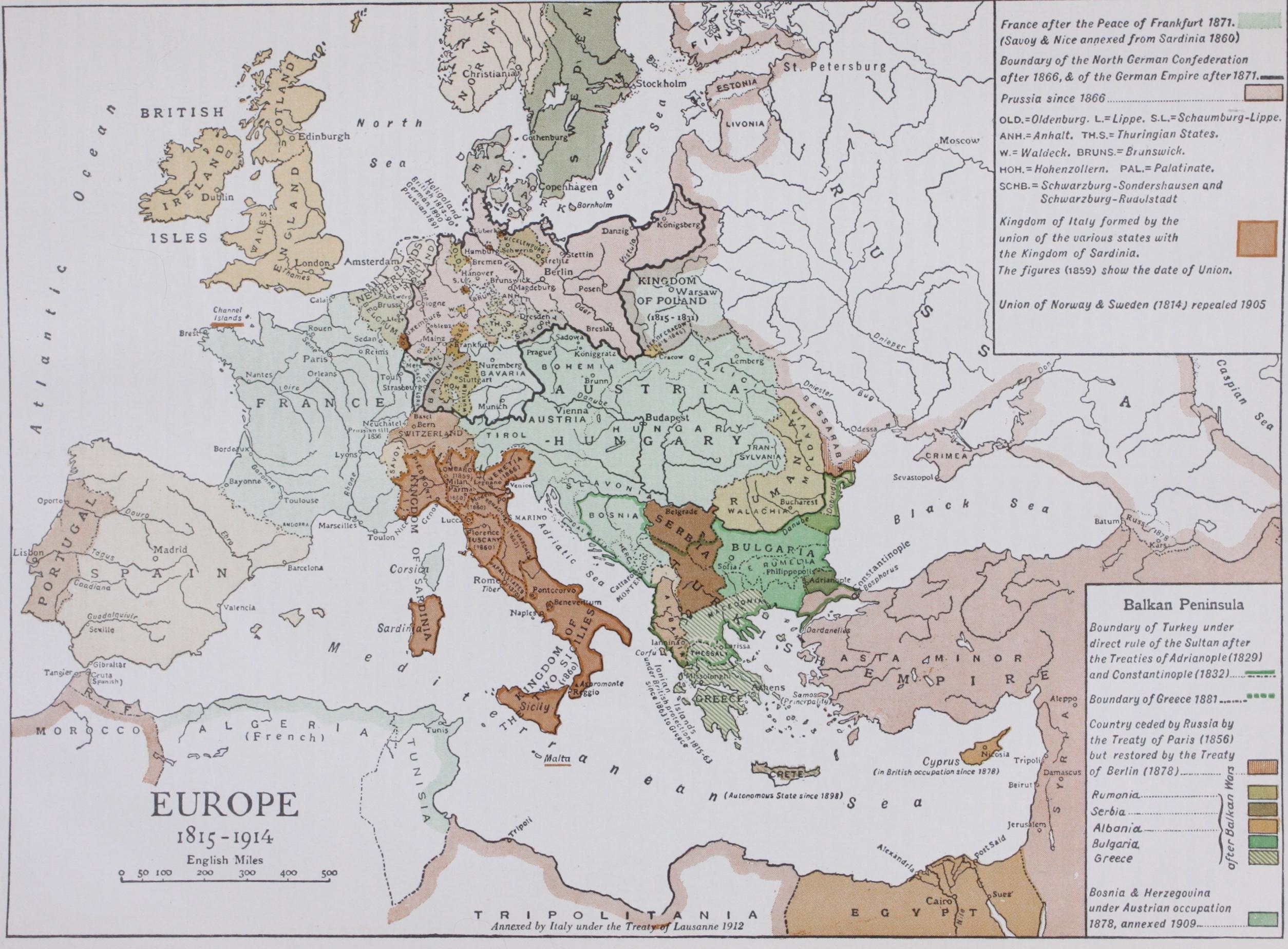
The Balkan nationalities profited by the war to bring about the dismemberment of European Turkey, while Russia took the opportunity to re-establish her influence over the Balkan peoples. In great secrecy Bulgaria signed, first with Serbia and then with Greece (March–May 1912) , treaties and military conventions that settled the division among them of the lands they were about to conquer; they communicated the treaties to Russia and undertook that in event of disagreement among themselves they would submit to the arbitration of the tsar. This alliance com pletely upset the balance of power in the Balkans.
The Italo-Turkish war was ended by the Treaty of Lausanne (Oct. 18, 1912) . The Balkan states determined to surprise Turkey before she had time to prepare herself, and despatched an ulti matum to the sultan in which they demanded autonomy for Macedonia. Then for the first time the small Balkan States, un aided, made war against the Ottoman empire. The Austrian Gov ernment, which had been apprised of their plans, offered no oppo sition because it counted on the victory of the Turks. But the Balkan allies routed the Turkish army and occupied Thrace, Macedonia, and Epirus ; the Bulgarians, indeed, were only checked within sight of Constantinople. The victory of the Balkan States was felt in Europe as a Russian success, a check for Germany, the protector of the Ottoman empire, and a defeat for Austria—inas much as the Serbian victory, which was hailed by demonstrations on the part of the Slav subjects of Austria, encouraged the nation alist movement of the southern Slays against Austria. The Aus trians, determined to prevent the Serbs from reaching the Adriatic, threatened Serbia with war and forced her to evacuate Durazzo. The great Powers, anxious to avoid war at all costs, assembled a conference of ambassadors in London and created an Albanian State under the rule of the German Prince of Wied.
Excluded from the Adriatic the Serbs sought an outlet to the sea at Salonika and demanded that part of Macedonia which bor dered on the territory conquered by the Greeks. Ferdinand of Bulgaria, however, required this country to maintain contact with Albania, and when Serbia appealed to the arbitration of the tsar, Ferdinand mistrusted Nicholas, who was disposed to favour the Serbs. To gain the advantages of offensive action Ferdinand ordered the Bulgarian army to make a surprise attack on the allied Serbians and Greeks. This resulted in the rout of the former, the invasion of Bulgaria—in which Rumania took part and the Peace of Bucharest which was disastrous to Bulgaria. The unity of the Balkan States was destroyed in this second war which assisted the revival of Austrian influence in Bulgaria.
The Balkan wars, which had taken place in spite of all efforts to preserve peace, awoke throughout Europe the fear of a general European war. The German Government announced in the Reichs tag that the disturbance of the equilibrium in the Balkans, where Germany was bound to support Austria, involved an augmentation of its military strength. A huge credit for the war-chest was ac cordingly voted, whereupon the French Government replied by voting a three years' service. Austria looked upon Serbia as a permanent source of danger to the Habsburg monarchy and de sired to reduce it to the condition of a small State dependent upon her ; in 1913 she communicated to Italy a plan for the invasion of Serbia to which the Italian Government refused to be a party. The Russian Government wished to consolidate its newly regained influence in the Balkans by supporting Serbia, and it had resumed its plans for expansion towards Constantinople and the Straits. Russia moreover was alarmed at the extent of German influence over the Young Turks and protested when the German general, Liman von Sanders, was given the command of the Turkish army corps at Constantinople. Isvolsky, who was Russian ambassador in Paris, desiring to avenge himself for his defeat in 1908, estab lished intimate relations with Poincare, president of the republic since 1913, who appointed as ambassador to St. Petersburg that enemy of Germany, Delcasse. Feeling themselves assured of the support of France the Russian Government reviewed the situation in Feb. 1913 and, confident that their plans with regard to Con stantinople could not be realized except after a European war, they ordered the preparation of plans for a landing of troops on the Bosporus. The danger came from Austro-Russian rivalry and in the enmity between the French and German nationalists. It was in vain that the democratic parties endeavoured to avert a rupture by manifestations of Franco-German rapprochement, by the socialist conference at Basle and the inter-parliamentary con ference at Berne. But the tension was maintained by incidents on the French frontier and by the centenary celebrations of the battle of Leipzig in Oct. 1913.