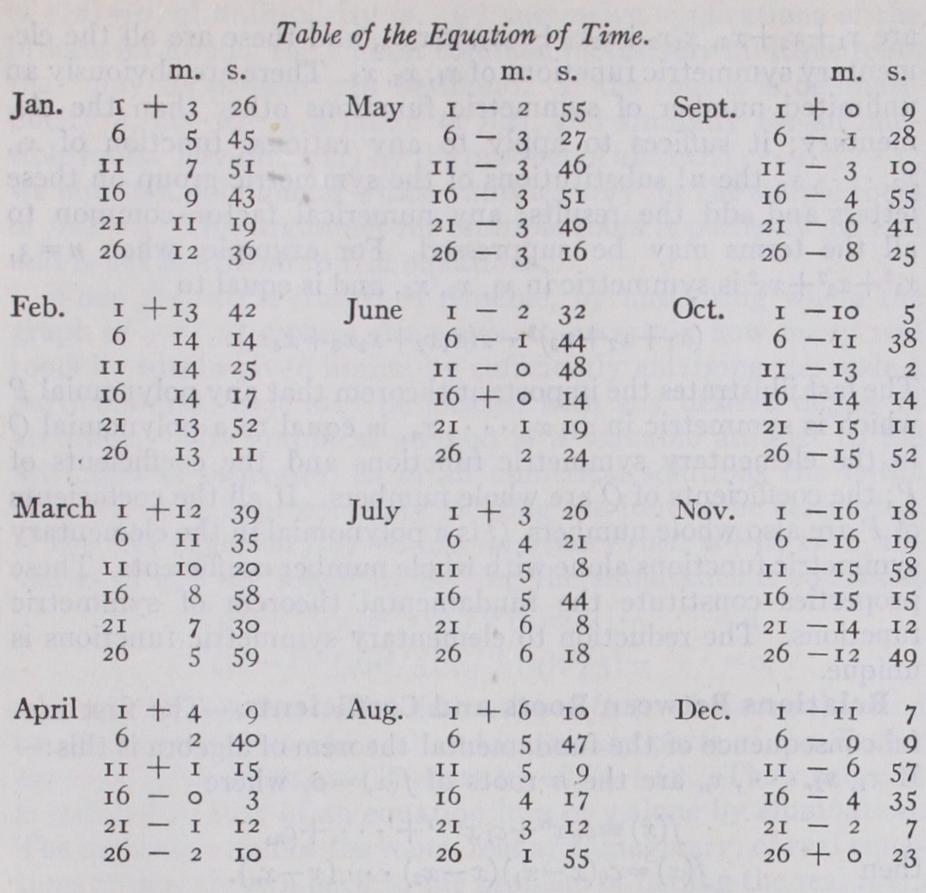
EQUATION OF TIME, the difference between apparent time (e.g., by a sun-dial) and mean time (by a standard clock) . The earth rotates on its axis in 23h. 56m. ; the interval from noon to noon is 24h. om. the extra 4m. being occupied in "catching up" the sun, which has moved on in the sky since it must make a complete circuit in a year. This 4m. (strictly 3m- is an average allowance ; the sun moves sometimes faster, sometimes slower, reflecting the varying motion of the earth in its elliptic orbit. The motion is fastest at time of perihelion (Jan. 3) ; accordingly at that time of the year the clock allowance is insuf ficient, and apparent noon by the actual sun becomes later and later according to the uniform clock. It is for this reason that after the shortest day the afternoons lengthen faster than the mornings. Another cause of difference between the sun and the clock is the inclination of the ecliptic (the sun's track in the sky) to the equator. The two causes combined give the following aver age values for different dates. The -}- sign means that the sun passes the meridian after mean noon ; the—sign before mean noon.