
ESKIMO LANGUAGE. This language is spoken with only a few varieties of dialect from Greenland along the arctic coasts of Canada to the Bering straits (Eskimo settlements on the Asiatic side) and along the southern coasts of Alaska, on the south coast near to Mt. Elias. On the Aleutian islands Eskimo influence is found. The Chukchee on the easternmost peninsula of Siberia are in touch with the Eskimo, and have some features in common. The Eskimo dialects have been regarded as akin to the Ural-Altaic family.

The consonants have a four-fold division and an abundance of fricatives and uvulars, the latter articulated in the inmost parts of the mouth. Before a uvular consonant the vowels e, o, and a become uvularized (retracted towards the uvula), e.g., in erKeK, a nit; orssoK, blubber; KaKKOK, hill. This gives the speech a guttural sound. Otherwise their speech is melodious and ex pressive. There is no system of pitch in the words to differen tiate the meanings. The stress accent is dependent on the weight of the syllable. Since both consonants and vowels occur, now short, now long, and the meaning of the word is strictly depend ent on these differences, the rhythm of speech is very irregular. somewhat like that of a drum, especially noticeable in recitation or lofty style.
In the early literary language the peculiar sounds and accents were incompletely reflected. The orthography was firstly coined by Hans Egede and his son Paul in their Greenland translations of the Bible and the linguistic pioneer works of Paul Egede (Dictionarum, 175o, Grammatica Groenl., 176o). In modern Greenland orthography, reformed by the missionary Samuel Kleinschmidt (Grammatik der gronldndischen Sprache mit theil weisem Einschluss des Labrador Dialects, Berlin, 1851), the four uvulars are rendered as K, r, rr, rng, and the aspirated fricatives as of (gf), ss (gss), dl (tdl), gg, rr. g (iga, kettle) is pronounced as in North German Regen, gg as ch in ich, j always as y in yes; in North and East Greenland dialects g is replaced by ng (iga, kettle), and dl in East Greenl. by t.
The main Greenland dialects centre around Godthaab in West Greenland and Angmagssalik (pronounced Ammassalik) on the east coast. In the Central Eskimo dialects west of Davis strait the Greenl. s and ss (isse, eye ; isse, frost) correspond to j and tj (Labrador ije; itje), and west of Hudson Bay the Greenl. initial s (siko, ice) is replaced by h (h iko). The dialects of western Alaska differ fundamentally from those of Greenland.
Grammatical Structure.—The language is polysynthetic. The grammar is extremely rich in flexional forms, the conjugation of a common verb being served by about 3 5o suffixes, equivalent to personal pronouns and verb endings. For the declension of a noun there are I5o suffixes (for dual and plural, local cases, and possessive flexion). The demonstrative pronouns have a separate flexion. The derivative endings effective in the vocab ulary and the construction of sentences or sentence-like words amount to at least 250. Notwithstanding all these constructive peculiarities, the grammatical and synthetic system is remarkably concise and, in its own way, logical.
The plural ending is t (or it), both in nouns and verbs. Be sides, there is a dual in k. 'There is no article and no gender, nor any separate auxiliaries or copulas except such as are ex pressed by means of suffixes. The possessive relation is nearly always emphasized, if the nature of the noun involves possession. There is a large system of possessive suffixes in singular, dual, and plural, which take the place of possessive pronouns; and the same endings appear in part also in the flexion of the verb.
Possessive suffixes of nouns recognizable in verb endings: The possessive flexion embraces a doubie set of suffixes, transitive and intransitive, agreeing with the fact that the noun has two basal cases of function in the sentence, the Absolutive case ending in k, K, t, or a vowel, and the Relative in p, the latter also having the function of the genitive. The Absolutive is used if the noun is the subject of an intransitive verb (KajaK tikipoK, a kayak has arrived), or object of a transitive verb (kayak takuvara, I saw a kayak). The Relative has the function of the subject of a transitive verb, e.g., puissip KajaK takuvd, the seal (puisse) saw the kayak. There are separate series of possessive suffixes for each of these functions of the noun.
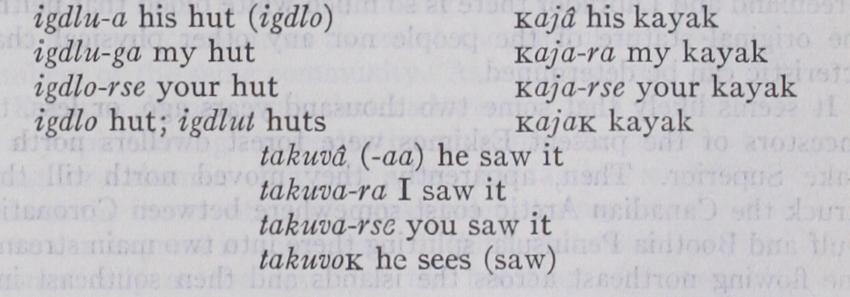
The verb has an indicative and interrogative and a great num ber of subordinate moods (contemporative participle; causal proposition, etc.). There are four degrees of conjugation and besides a special negative conjugation common to all verbs (-ngila does not, e.g., takiingilara, I did not see him). The numeral system is quinary, based on 1 to 5, though with special terms of 6, zo, II and 16, and it amounts to 21. They count by means of their fingers and toes, 20 being " a man brought to an end." Mentality.—The vocabulary is rich in expressions referring to hunting life and animals, technical terms of weapons and utensils in all their details and uses, terms of all sorts of empiric notions, and terms referring to the mind and senses, e.g., special word stems meaning to die from thirst, hunger, cold or longing. A peculiar category of basal stems expresses incapability, e.g., stems mean ing not to know, not to be able to, to have no proof, not to regard, etc., whereas the corresponding stems to know, prove, regard, do not exist. " I know " is expressed by " I do not ignore, " even " to be good " has no positive stem, but is produced by negation of being bad or evil (ajorpoK, is bad—ajungilax, is good). They have words for stones of many kinds, iron, copper, but none for metal; for the various colours, but not for colour; for numbers, but none for number; for Eskimo (inuk, in plur. inuit) and for some few neighbouring peoples in Canada, but none for man (humanity).