
EUGENICS, a word coined by the late Sir Francis Galton in 1885 and derived from the Greek e&yevrls, "well born." The latest definition of the term given by Galton runs as follows : "Eugenics is the study of agencies under social control which may improve or impair the racial qualities of future generations either phys ically or mentally." It is well established that men are what they are, partly on account of the inborn or racial qualities derived from their parents, and partly on account of their surroundings. In the fashioning of men both the nature of the material and of the workmanship applied to it affect the final product. The word eugenics is used to cover any proposals or plans for the improve ment of the racial qualities of human beings. Therefore eugenic proposals aim at social improvement. They differ fundamentally from other projects having the same object in that they are con cerned with the improvement of the human material and not of the surroundings. But they are not alternative to these projects. Im provement of the material and improvement of the surroundings should go on at the same time. A good result will only be achieved where good workmanship is applied to good material. While the word eugenics is used to mean plans for racial improvement, it is also used for the study of the part played by racial qualities in making men what they are. Galton introduced the word "study" into his definition though the definition as a whole makes it appar ent that he was thinking of such studies as would be the founda tion of plans. There is a distinction between the pure study of natural phenomena in and for itself and the study of how to apply the knowledge so gained for certain purposes. Whether or not eugenics is properly held to be a pure as well as an applied science, it remains true that the necessary knowledge must be available before any application can be attempted. It is in fact a mere matter of terminology whether we speak of a pure science of eugenics and also of an applied science of eugenics, or whether we regard eugenics wholly as an applied science. In any case those interested in eugenics must acquaint themselves with the results achieved by workers in certain fields of pure science and to them we turn.
Eugenic proposals must be based in the first place upon such knowledge as we possess of the part played by inborn qualities in making men what they are. It is evident that they do play some part. In the United States of America the surroundings of negroes are much the same as those of white men and yet they are sharply marked off from one another owing, it is to be inferred, to dif ferences in racial qualities. We may study identical twins who are derived from the division of a single fertilized cell at an early stage of development. Identical twins have therefore the same inherited qualities and differences between them must be due to differences in their surroundings. Again we may study the in mates of orphanage:. They form the reverse case. They are no more alike in inborn qualities than persons chosen at random from the public at large and they have been subjected to the same environment for varying periods of years. Other methods of ap proach are available. As a result of such studies we reach the general conclusion that the differences between men are to no small extent the result of inborn differences. This conclusion is founded upon the facts that identical twins remain closely alike in spite of diversity of experience, that orphan children tend only slightly to grow alike in spite of similarity of experience and upon other evidence. This statement should not be misunderstood. Some differences between men are wholly the result of different experiences. Thus a child may be rendered mentally deficient by an accident at birth. But at least three quarters of all mentally deficient children have mentally def cient relatives and may be supposed to have inherited the condition. What the statement means is that, when we investigate the causes of the innumerable differences between men in respect of intelligence, temperament character, health, physique and other characteristics, which we observe between those whom we meet, we find that, while almost any kind of difference can be wholly produced by differences in the environment, most differences in part, many in large part, are due to inherited differences. Inborn characters are thus of great importance and they are derived from the parents. The study of the precise manner in which they are derived is the study of heredity. This study' has been greatly advanced in the present century and we now understand the mechanism of inheritance. While the recently acquired knowledge is of great importance, when we are concerned with particular problems, for the purposes of a general review it merely explains what was known before. It has long been common knowledge that like tends to produce like, that tall parents tend to have tall children, able parents able children, and so on. We now know how this comes about. We have theref ore the position that those who differ from their fellow men in exhibiting greater ability or stature than the average do so mainly because of the possession of certain inborn qualities and that the offspring of such persons will more often than not be abler or taller than the average.
It is to students of certain branches of biology that we look for knowledge of matters such as those we have just discussed. This knowledge is not sufficient for the making of proposals to improve racial qualities. It is necessary to have information upon other subjects, which lie within the field of sociology or social science, and among these subjects that which first claims atten tion is the distribution of racial qualities within the population. Men differ profoundly in respect of their inborn endowments and it might be that all those, or the majority of those, endowed with ability above a certain level, or with physical strength above a certain standard, are to be found in certain areas, in certain occu pations or in certain classes. On the other hand inborn qualities might be so distributed that the average representative of those following each occupation, of the members of each social class or of the inhabitants of every locality had approximately similar endowments. Little is known as yet regarding the distribution of physical qualities though there is reason to believe that the average miner and agricultural labourer are physically stronger than the average working man. More is known about the distribution of those inborn mental qualities which can be measured by the use of intelligence tests. These tests have been widely used of late in Great Britain and America, and many investigators have em ployed them to throw light upon the distribution of intelligence within the population. In 1912 school children between the ages of II and 13 were tested in Northumberland and the intelli gence quotient of each child ascertained. The intelligence quotient is independent of age and an intelligence quotient of more or less than ioo is indicative of an intelligence above or below normal. The occupations of the fathers were known and the chil dren may be classified by these occupations.
Occupations of Fathers and Intelligence of Children in Northumberland Occupations of Fathers Average I.Q. of Children Professional . T12.2 Managerial . . . . . . . I I o• oHigher commercial . . . . . . I o9.3 Army, navy, police, postmen . Shopkeeping . Io5•o Engineering . . . . . . . 102.9 Foremen . . . . . . . . 10 2.7 Building . . . 102.0 Metal workers, shipbuilders . . . . Ioo•9 Miscellaneous industrial workers . . . 100.6 Miners and quarrymen . . . 97.6 Agriculture (all classes) . . . . . 97.6 Low grade occupations . . . . . 96.o It will be noticed that in general the higher economic or social position of the parents the higher the intelligence quotient of the children. Numerous other investigations point to the same con clusion. There are three points to be observed. Firstly, it is only what is to be expected from a knowledge of the social conditions. There is a mechanism which, working through free places, scholar ships and the opening generally of chances to bright children, results in a sifting out of the abler among each generation who find a place in a higher economic class than that of which their parents were members. Since the children of those thus promoted will tend to inherit the intelligence of their parents, it would be astonishing if the members of the higher economic classes were not more intelligent on the average than the members of the lower economic classes. Secondly, it should be observed that the only established differences between the average representative of the social classes are in respect of that aspect of intelligence which can be measured by tests. Social and occupational groups may differ in respect of temperamental and emotional qualities and also in respect of physical endowment. We may suspect such differences because the temperament and physique of a man is not without influence in determining his place in society; but we have no definite information on this subject. Thirdly, it does not follow that, because the members of a certain social class are on the average more highly endowed with some inborn quality, they are better in any ethical sense than members of other classes.
It is also necessary to study the contribution to the next gen eration made by persons with different inborn qualities. In this manner light can be thrown upon the problem whether the racial qualities of the population are changing. The direct method is to select those known to be endowed with qualities different from those possessed by the average number of the population and to ascertain whether the rate of contribution to the next genera tion made by the former is greater or less than that made by the latter. Many investigations of this kind have been made especially in the United States. It has been repeatedly shown that those with more than average ability contribute less than the average number of children to the next generation. It has not been proved that the mental defectives as a class contribute more than their share. This method can as a rule only be employed in enquiries of limited scope. The problem can be approached indirectly by the employment of statistics such as are collected by the census authorities. The questions asked at the English Census of 1911 were so framed that the families could be allocated to social groups according to the social class to which the head of the family belonged. Eight groups were set up. The wage earners in the textile, mining and agricultural industries were placed in classes VI., VII. and VIII. respectively. The rest of the popula tion was distributed between five classes as follows: class I., upper and middle; class II., intermediate; class III., skilled ; class IV., intermediate; class V., unskilled. The results of so doing are set out in the table on next page.
The important figures are those giving the number of children surviving per ioo families in each class and it will be seen that the lower the social class the larger the number of surviving chil dren. As we have seen there is evidence that the higher the class the greater is the average degree of intelligence. From this it is to be deduced that the changes in progress in the endow ment of the population as a whole in respect of intelligence are in the direction of a lowering of the level. Since we do not know England and Wales, I9II. Marriages where the wife had not attained the age of 45 years at census. Total and effective fertility and child mortality classified by social status (as indicated by husband's occupation) for all durations of marriage.
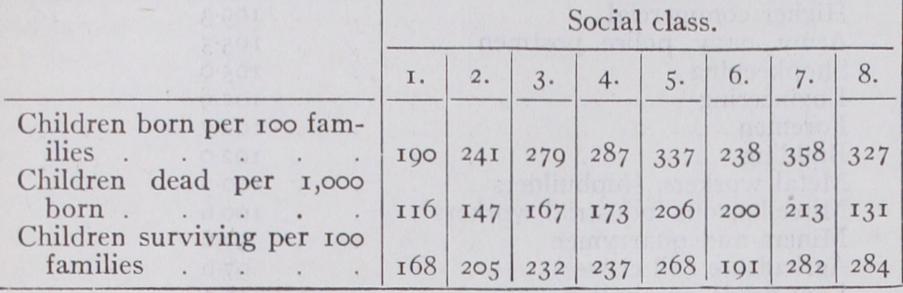
whether these social classes differ in their temperamental and physical endowment, it is not possible to say whether this process is also bringing about changes in the average endowment of the population in these respects.
Lastly before plans for racial improvement can be made it is necessary to gain some knowledge of the factors which influence the size of family. This is so because, while most proposals may contemplate prohibition of reproduction by certain persons, some proposals aim at stimulating or discouraging reproduction in cer tain groups. It is now generally agreed that the most important immediate cause of smaller families in certain classes is the greater use of family limitation. But the enquiry must be pushed further back and an attempt made to ascertain why family limitation is more employed by some classes than others. For this there are many reasons. The knowledge of methods of family limitation is not equally spread among all classes. Wage earners receive their maximum income early in life and are therefore not under any inducement to postpone marriage as are the professional classes who may only reach their maximum income when 4o years of age or more. The education of children is more of an expense to professional parents than to working-class parents and the chil dren are • less of a support to their parents in old age among the professional than among the working classes. These and other reasons may account for the different rates of reproduction be tween the classes. Unless the reasons for these conditions are understood effective proposals cannot be made for changing the situation. Again, it cannot be foretold what effects proposals made with quite other immediate objects are likely to have. Thus family endowment is widely advocated in order to alleviate poverty. It is very desirable to be able to estimate the effect of such a measure upon the size of such families.
On the basis of knowledge of this nature plans for racial im provement may be made. Stress is at times laid on evidence of racial deterioration and proposals often have as their immediate object the prevention of race deterioration. It is necessary to emphasize the urgent need and abundant opportunity for racial improvement. There are large numbers of persons who by reason of defective inborn endowment are unable to lead full lives and are a burden to themselves and others. Thus in 1925 the number of children in England and Wales certified as mentally defective amounted to about 33,000 or 6.7 per i,000 of children in average attendance at public elementary schools. It is generally acknowl edged that all mentally defective children have not been certified and that the proportion probably reaches io per i,000. Poverty, crime, drunkenness, disease and other social problems are intensi fied by defective inborn equipment. There is ample opportunity because there are persons who are generously endowed both phys ically and mentally, and it is possible to bring up the average endowment of the race to somewhere near their level. Human history is largely the story of attempts by man to bring his sur roundings under control. But if he wishes to bring his destiny under control he must turn his attention to the control of human material as well as to the control of human surroundings. He must attempt to govern his own racial evolution. Attempts to do this are in line with all that inspires man to improve his sur roundings. They do, however, depart somewhat from other pro posals in that of necessity they contemplate restrictions upon the very intimate human relationship of marriage. But it may be pointed out that this relationship is already directly affected by restrictions upon marriage by persons below a certain age or between persons within certain degrees of blood relationship and is also indirectly affected by many kinds of social legislation such, for instance, as that concerning housing or taxation. Eugenic pro posals therefore contemplate the extension of an existing principle rather than the introduction of any new principle in the field of social organization.
Eugenic proposals aim at (I) the prevention of reproduction by persons of definitely defective types and (2) the encourage ment of reproduction by persons of sound stock. (i ) The mar riage of defective persons can be prohibited. The marriage of mentally defective persons is prohibited in Russia. Again in sev eral of the United States of America marriage is prohibited on account of one or more of the following conditions : insanity, feeble mindedness, epilepsy, criminality and alcoholism. There is no such prohibition in Great Britain. Prohibition of marriage may not prevent reproduction, especially by the mentally defec tive, and therefore segregation and sterilization are sometimes recommended. Segregation is now practised to some extent in all civilized countries to safeguard the defectives and the public, but not with the deliberate intention to prevent reproduction. Over 5o,000 mentally defective persons are now segregated or under supervision in Great Britain. But segregation is expensive and is not likely to be applied to the less seriously afflicted who can wholly or partly support themselves. Therefore sterilization is advocated in some quarters. In 1926 sterilization laws had been enacted in 23 of the 48 United States, and over 6,000 operations had been performed. It has also been proposed that as a pre liminary to the issue of a marriage licence certificates should be exchanged between the parties concerned setting out certain facts relating to family and personal history. When the licence is issued an approved statement laying down in simple language what is known of the laws of inheritance might be handed to the parties. Legislation of the latter kind would not be restrictive but it might educate young persons in regard to their responsibili ties and induce certain persons to refrain from reproduction. (2) Proposals for encouraging reproduction among the fit by legal action are mainly confined to amending the system of taxa tion so that the amounts levied on married couples with children should be materially less than the amounts levied on the unmarried and the childless. It is also hoped to rouse among the fit a sense of their responsibility as bearers of desirable traits which should lead them to desire to perpetuate these traits. It will be observed that the action so far taken and the proposals most widely advo cated aim at preventing reproduction among the unfit rather than encouraging reproduction among the fit. Regarding proposals of the former kind three points may be noticed. It is not difficult to obtain a general consensus of opinion as to what constitutes unfitness though opinions may differ as to what degree of unfitness should form a bar to marriage. Secondly there is abundant evi dence that desirable qualities are not especially associated with certain undesirable traits. It is not the case that genius is asso ciated with insanity or mental ability with physical debility. Therefore fear that the cutting off of defective persons would tell against the production of genius is baseless. Such cutting off would result in a raising of the general level of the racial qualities of the population and would increase the chances of the birth of a genius. Thirdly it can be shown that the prevention of reproduc tion by the unfit would be effective within a relatively short time. This may be illustrated for mental defect. If it is supposed that mental defect is inherited as a recessive quality and that it is scattered at random among the population, it can be demonstrated that, starting with a frequency of i oo defectives per i o,000 of the population, it would be reduced by prohibition of marriage among those showing the defect to 82.6 per i o,000 in one generation, to 69.4 in the next generation and to 59.2 in the third generation. But the assumptions upon which the calculation is based are very unfavourable. It is almost certain that restriction of reproduc tion would reduce the amount of mental defect with much greater rapidity. It is most unlikely, for instance, that mental defect is equally distributed throughout the population and, to the extent to which it is concentrated in certain strains, the swifter will be the reduction of the incidence of defect. So far as proposals to encourage reproduction are concerned, it is evident that it is much more difficult to define the fit than the unfit. Such proposals usually go no further than aiming at the removal of burdens so far as possible which rest upon those of sound stock and dis courage them from contributing their share to the next generation.
During the present century organizations have been founded to promote research into eugenic problems and to conduct propa ganda in favour of eugenic proposals. Much of the research work upon which eugenic proposals must be founded lies in the field of established sciences. There are, however, other fields of re search. Such is the case, for instance, with regard to investigations into the distribution of inherited qualities within the population. Research institutes in England and America have been founded to investigate these and other problems. The Eugenics Record Office, of which Dr. C. B. Davenport is head, was founded in 191o. It is a section of the Department of Genetics of the Car negie Institution of Washington and is situated at Cold Spring Harbour (N.Y.) . Sir Francis Galton (d. 1911) founded by a bequest in his will a chair of Eugenics at University college, Lon don. Professor Karl Pearson was appointed to this chair.
It is now becoming recognized that, valuable as these research institutions may be, they cannot collect some of the most impor tant data without Government assistance. The Government could conduct periodically a census of the mental and physical qualities of all school children. It might be advisable to set up a special Government department to advise upon or conduct the collec tion of this information. Such a department has been founded in Sweden. In 1922 the Swedish State Institute of Race Biology was set up at Uppsala. It is controlled by a council of six members nominated by the Crown. The institute is primarily concerned with research. It is contemplated, however, that it may be called upon to advise as to legislation. Societies for the promotion of eugenic proposals exist in every country. The aim of these soci eties is to popularize eugenics by placing before the public concrete eugenic proposals.