EXPORTS: STATISTICS. The following tables give an account of the recorded official export statistics of the chief ex porting nations. In comparing them, it should be remembered that different nations make their records in very different ways and this has been made clear as far as possible in the notes attached to the tables. See CURRENCY for value of monetary units.
The following statistics relate to Exports of United Kingdom produce and manufacture only.
The grouping into categories in the published returns was en tirely re-cast in 192o, but figures for 1913 were republished on the revised grouping.
The following particulars relate to exports of South African produce from the Union to countries overseas, and exclude ex ports to Northern and Southern Rhodesia (and in 1937 to S.W. Africa Protectorate). Gold bullion is included, and also bunker coal. The values shown represent f.o.b. values, as declared by exporters.
The following particulars relate to the exports of the produce and manufactures of the Dominion, including gold and silver, the direct product of the mining industry. The values are those at the point in Canada at which shipped, as declared by exporters.
Particulars relate to exports of Australian produce only. The values shown represent values in the principal markets of the Commonwealth. Ships' stores are included in 1903 but not in subsequent years. Bullion and specie are shown separately; they are included in total value of exports, since they are part of the produce of the soil of the country.
The following particulars relate to the exports of the produce and manufactures of the Dominion, including bullion. The values are f.o.b. values as declared by exporters.
The particulars relate to the German Customs Union (which included Luxembourg until 1919) . The values for 1890 and 1900 are official values; those for 1913 and 1938 declared values; in both cases frontier (f.o.b.) values are intended. Bullion and specie are excluded. Owing to a change in the form of the published figures, the particulars for 1913 have been shown ac cording to both groupings.
The particulars relate to the sea-borne trade of British India, and to Indian produce only. The values are f.o.b. values as de clared by exporters. Treasure is excluded, and Government stores shown separately.
The following particulars relate to Special Trade, i.e., exports of Italian produce only. The values are official values, fixed an nually by the Valuation Commission up to 1913, and declared values in 1937, frontier (f.o.b.) values are intended throughout. Silver bullion is included but not specie or "gold bullion." The particulars given relate to exports of domestic produce and manufacture only; the values are declared and represent the value at port of shipment. Bullion and specie are excluded.
The following particulars relate to exports of Russian produce. In comparing 1913 and earlier figures with the later 1937, etc., figures it is important to remember that the former relate to Russia which then included the Baltic States and Poland and the latter to the Union of Soviet Socialist Republics as instituted after the 1917 Revolution.
The 'following particulars relate to "Commerce Special," i.e., exports of French produce. The values for 1890, and 1913 are based on official unit values, fixed annually by the Permanent Valuation Commission, those for 1938 are as declared by export ers, in both cases, frontier (f.o.b.) values are intended. Bullion and specie are excluded.
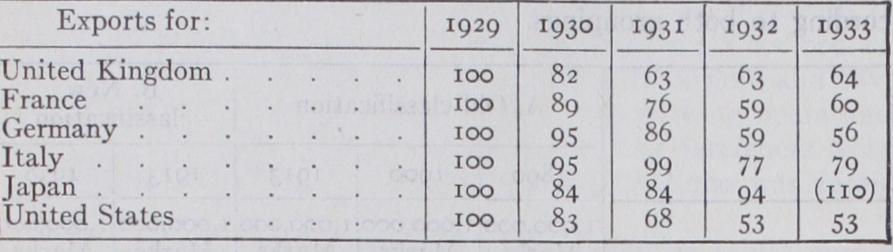
The great growth of foreign trade during the several decades covered by the above tables was enjoyed by many other countries, notably by Japan whose total exports grew from a value of Yen in 1907 to 1,992,302,00o Yen in 1927. This wide spread expansion of trade came to a sudden end in the depression of 1929-34. The value of the foreign exports of 16o countries as measured in United States gold dollars at 1929 parity declined sharply from 33,040 million in 1929 to 12,902 million in 1932 and 11,694 million in Although this decline was in part a result of price deflation, the real decrease in exports was drastic, as is shown by the index numbers below, using the exports of 1929 as the base :