FARM ORGANIZATION To facilitate the following discussion it may be stated at the outset that American writers on farm management generally make the following divisions of farm property : For purposes of taxation the items listed above under the heading fixed capital are commonly termed real estate, while those listed as working capital are termed personal property.
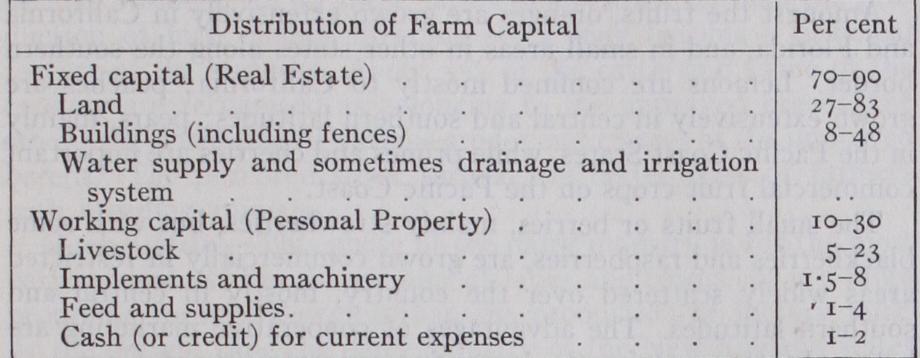
The percentage of the farm investment in the various classes of property varies with geographic conditions and with the type of farming. The figures at the right of the table show the per centage of total investment in the various items found in twenty five farm management surveys. The wide variation of percentage investment in buildings is due to the fact that the surveys cover a wide variety of types of farming in different sections of the country. In general, the percentage investment in buildings is small on large farms extensively operated, and large on small farms, particularly when devoted to intensive dairying. The wide variation in livestock investment is due to the same causes.
The first problem in the or ganization of a farm business is whether to lease or to own the land. An important factor determining the solution of this prob lem is the relative income on fixed capital and working capital. In twelve American studies involving some thousands of farms, it was found that on the average fixed capital earned an income of 5.1%, while working capital earned 22.9% on the investment. It is obvious, therefore, particularly when the amount of available capital is small, that it is more advantageous to farm leased than owned land. Nevertheless, experience has shown that the great majority of American farmers invest their capital largely in land as soon as it becomes sufficient to permit a fair standard of living on owned land. There are several reasons for this. In the first place, the managerial ability of the average man is limited. A considerable capital invested as working capital would provide a business larger than the average man is capable of managing efficiently. As the capital grows, therefore, there is a strong tendency to invest a portion of it in land. In the absence of satisfactory leasing contracts that give a tenant a share in the improvements he makes, especially in the residual fertility of the soil, the renting of farm land has usually led to the deterioration of the soil, a fact which induces many farmers to own rather than to lease land.
The high wages that have prevailed in the United States since the World War have been an important factor in increasing the number of large power units and of large ma chines on American farms. This has made it possible for the available labour to operate more acres of land and there has been a strong tendency, especially in those parts of the country where the topography is favourable to the operation of large size ma chinery, for the size of the farm to increase. The advantages of large scale operation are emphasized when farming undergoes a period of depression. This is well illustrated in the accompanying map (fig. 1), which shows decrease in percentage of land devoted to crops for the various counties of the United States during the period 1919 to 1924. This was a period of severe agricultural de pression. There was a very large decrease in crop area in the Ohio valley states, and in Virginia, Maryland, South Carolina, Georgia and Missouri. The decrease was in general greatest in those sections where large scale operation is difficult because of rough topography.
There was an increase in crop area around the western end of Lake Superior and along the western margin of the Plains Area from Texas to Montana. This represents the bringing of new land into cultivation because of its cheapness. In a large area extending from East Central Texas and northward to North Dakota, then eastward through Iowa, Minnesota, southern Wis consin and central and northern Illinois, there was very little change in the percentage of crop area. This latter region is in general one of good topography and for the most part of excellent soil. Farmers here are able to utilize large machinery to advan tage, and in consequence were able to produce without loss in spite of the low prices that prevailed for their products. It is in this region particularly that a notable increase occurred in the number of large power units and large machines during this period of depression. At the same time there was a distinct increase in the size of farms in this region.
The next important problem in farm organization is that of determining what crops to grow and what productive livestock to keep. The problem of what crops to grow is actually simpler than it would appear to be in view of the fact that the number of crops grown on American farms is very large. Many of these crops are limited by climatic and economic conditions to very small acreage or to restricted local ities. In any one locality the number of crops that may be profitably grown is usually quite limited. In general, the crop enterprises on which a farm business is based are determined by three classes of factors, physical, biological and economic.
The physical factors are comprehended under the general terms climate, topography and soil. The most important climatic factors are rainfall, tempera tures, length of growing season and liability to injurious frosts. Thus cotton is limited to the southern portion of the country by summer temperatures and the length of the growing season. Corn is limited northward by low summer temperatures and short growing season, while westward it is limited by night temperatures which are relatively low in all arid regions. Several instances are cited elsewhere in this article of the influence of topography on the choice of crops.
Biological factors are the fungous diseases and insect and other animal pests that attack growing crops. Thus wheat is excluded from warm, humid regions by rust. Flax has in the United States generally been a new land crop because of the general distribution of the disease known as flax wilt on soils that have grown flax previously. The destructiveness of the cotton boll weevil is an important factor responsible for the decrease in crop acreage in South Carolina and Georgia shown on the map referred to above. At the present time (1929) the European corn borer is causing a decrease in the acreage of corn in the northern portion of the central corn belt.
