
FENCING. From its general meaning of the art of defence or offence with the sword, the word "fencing" has become re stricted to the art and science of those regulated and artificial con ditions which govern single combat, in countries where the duel is still in favour, or competition between two or several persons in countries where swordsmanship is rather a sport than a neces sity. But all its teaching is based upon those inevitable prin ciples of practical perfection which emerge when life or death may be decided by the movements of a blade, and the gradual emergence of a deadly simplicity out of archaic complications must be traced in the history of the various forms of the sword itself. The science of fencing first became visible after gunpowder had destroyed the knight in heavy armour and the whole arsenal of armour-cracking weapons began to disappear. Yet it was long before the sword became anything save an implement for heavy downright strokes with edge. Gaps in the harness of the more lightly-clad soldier first suggested concentration of attack upon unprotected portions of his body. By slow degrees it was dis covered that, though the edge might always be useful, the point got home far more quickly. At length the sword became not merely an offensive weapon but a shield as well; men fought with one hand only, rejecting the dagger that had once served, in the other, as a protection. Only when the duel had ceased to be any thing like the social necessity it remained almost everywhere until the end of the i8th century, was the crowning miracle of the riposte invented, by which the lighter sword-blade not merely turned aside the hostile point but, in one continued phase of movement, replied to the enemy with a thrust that followed al most instantaneously upon the frustration of his original attack.
It was natural that countries which permitted duelling should pay far more attention to fencing than those nations which settled personal quarrels by other means. But good swordsman ship had for so long been a distinctively gentlemanly accomplish ment in the English-speaking countries that the fencing taught by Angelo in London was never wholly forgotten even when the swords his first pupils always wore had become the mere decorative adjunct of the soldier on parade or the courtier at some royal ceremony. Before the 19th century had closed, the London Fenc ing Club became the centre of a small but influential and enthu siastic band of amateurs, who brought the best professional teach ers from France and who, at last, dared to enter an English team for the International Fencing Tournament in Paris in 1903.
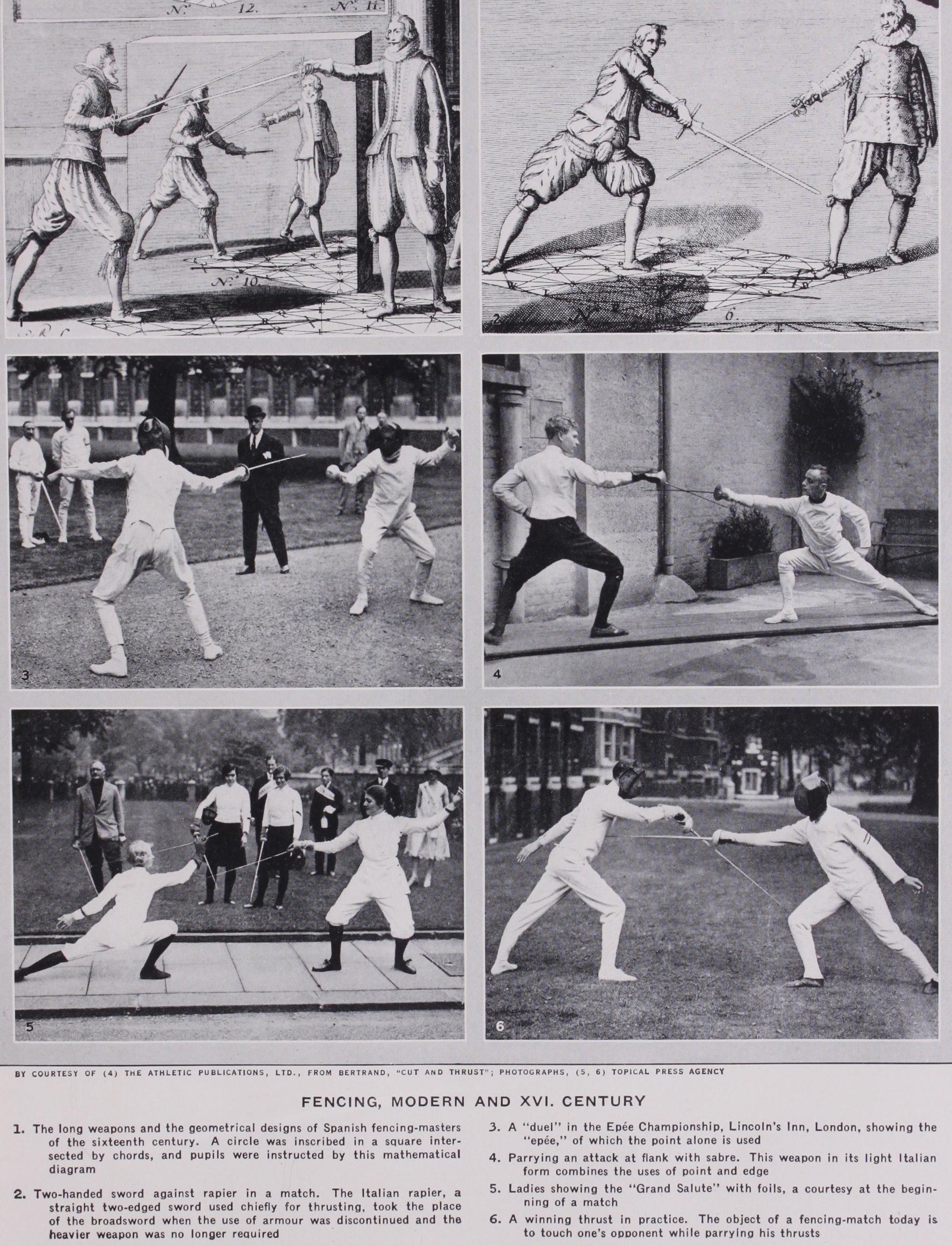
From that date fencing has grown and flourished on both sides of the Atlantic, and the development of all the possibilities of the epee (which is the French duelling-sword with a button on the point) has introduced a form of sport which takes its due place in the Olympic Games and other international meetings ; which is becoming more and more popular every year; which can be en joyed out of doors or under cover, at any hour of the day or night, and almost at any age. The three weapons are the foil, which is wholly conventional and meant to furnish the foundation of true swordsmanship; the epee, which uses the point alone and can score a hit on any part of the opponent's anatomy; and the sabre, in its light Italian form, which combines the beauties of both point and edge. These three weapons are separately de scribed under their several headings ; as are such almost obsolete survivals as Quarterstaff, singlestick and cane-fencing.
In 1923 two Grands Assauts d'Armes were held at the Hotel Cecil and the Grocers' Hall, London, and one in 1924 at the Royal Automobile Club, London. In these many of the most distin guished continental fencers took part, both amateur and profes sional, including A. Massard, M.C., L. Gaudin, R. L. Heide, C. Lafontan, A. Pope, Aldo Nadi, E. Tack, F. de Smedt, J. Rossig nol and many others. In 1927, Professor Tassart arranged another at the New Prince's Galleries, Piccadilly, when were seen Henri Hostalier, Raymond Flacher, Emile Cornic, Roger Ducret and Pro fessor Rene Haussv.
Military Academy at West Point, N.Y., and the U.S. Naval Academy at Annapolis, Md. As an organized sport it dates from 1891, when the Amateur Fencers League of America was organ ized. This league has supervised amateur fencing as a sport since that time. It is a member of the Federation Internationale d'Escrime. Intercollegiate fenc ing is supervised by the Inter collegiate Fencing Association with 15 colleges and universities as members. This association works in close harmony with the Amateur Fencers League.
Outside of institutions of learning, the art and sport of fencing is fostered by fencing clubs where the services of ex cellent European maitres d'armes may be had. These clubs exist mainly in the eastern cities of New York, Philadelphia and Boston and in the west coast cities of San Francisco and Los Angeles. A number of excellent European fencing masters have come to the United States and have done much to spread the sport and improve the quality of fencing.
The United States has been represented in fencing in the Olympic Games ; but its teams have been defeated by those of France, Italy and Hungary. At the Seventh Olympiad in Antwerp, Belgium, in 192o, the United States team won third place in the foil team competition, defeating all other nations except France and Italy. This is the only occasion on which the United States has been an Olympic point winner in team fencing. At the Ninth Olympiad, in Amsterdam, Holland, in 1928, the American fencers in the individual competitions made their best showing in the history of the Olympic Games. Lieut. G. C. Calnan, U.S.N., won third place in the individual epee championship of the world. Dr. Allen Milner reached the finals in the same weapon, as did Joseph Levis in the individual foil competition. The skill of American fencers is constantly increasing and an American team won the Anglo-American contest in 1928.
After the Seventh Olympiad of 1920 there were instituted the British-American matches for the Robert M. Thompson Per petual Trophy. These matches have created a stimulus for the growth of the art and serve as the occasion for friendly rivalry and sportsmanlike relations between British and American fencers. They are held alternately in the United States and England. The Americans were victorious in 1921, 1926, 1929-30, and in the United States. The Brit ish won in London in 1923.
(H. BRE.)