
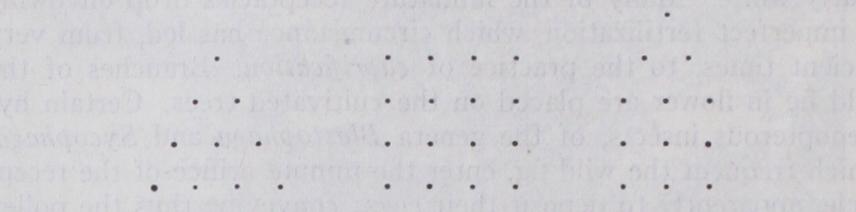
FIGURATE NUMBERS. The early Greek mathemati cians found that if groups of dots were used to represent num bers, they could be arranged so as to form geometric figures, examples of which are as follows:— Of these, the first represents a triangular number; there being dots, io is a triangular number. It is also seen that 3 and 6 are triangular numbers. The second figure is a square, and from it we see that 4, 9 and 16 are square numbers. From the third we see that 12 is a pentagonal number. The triangular numbers may be represented by -in (n-{-I where n is any positive integer. The square numbers are represented algebraically by and the pentagonal numbers by (n— I) . The Greeks also consid ered oblong (heteromecic) numbers, the sides (or factors) of which differ by unity. Thus, 3X4, 4X5, • . . are oblong numbers. There were also prolate (promecic) numbers, the factors differ ing by two or more, as in the case of 2x5 ; but these were often included under oblong numbers. Besides various other types of plane numbers there are solid numbers. For example, 8 is a cubic number, and 5 is a pyramidal one. Numbers which are related to geometric figures in such ways are called figurate numbers or figured numbers. Plane figurate numbers are also called polygonal numbers, the solid figurate numbers being designated as poly hedral. The theory probably goes back to Pythagoras (c. S4o B.c.). Such numbers were studied and described by Nicomachus (c. Theon of Smyrna (c. 125), Boethius (c. 51o) and many later writers.
BIBLIOGRAPHY. Sir Thos. L. Heath, History of Greek Mathematics Bibliography. Sir Thos. L. Heath, History of Greek Mathematics (best source for Greek history) , vol. i., p. 76 (1921) ; D. E. Smith, His tory of Mathematics, vol. ii. p. 24 (1925) . (Elementary discussion.) See NUMBERS, THEORY OF.