
FINLAND (Sziomen Tasavalta), "the land of a thousand lakes," is an independent republic of northern Europe, inhabited by a branch of the Finno-Ugrian peoples (Finns, Estonians, Magyars, etc.) . Through most of the early centuries of develop ment (10o A.D.-18o9 A.D.) it was dominated culturally and po litically by the Swedes; from 1809 to 1917 it was a Russian grand duchy. The Finns took advantage of the war of 1914-18, and the Russian Revolution of 1917, to win their independence, legalized by the Treaty of Dorpat with Soviet Russia, Oct. 14, 1920.
The area (1920-1940) was 149,588 sq.mi., of which 35% was forest, I 1% lakes, 3% arable and 5% grassland, and the rest largely swamp. The boundary with Russia bisected Lake Ladoga, largest in Europe; other lakes are—Saima, Kalla, Pajane, Nasi jarvi, and some 6o,000 more, with great rapids such as the Imatra, above Lake Ladoga. The chief rivers (none large) are the Muonio between Finland and Sweden, the Kemi and the navigable Ulea. The surface of the country is table-land 400 600f t. above sea level, with a few elevations to 2,000f t., and in the north-west, in the Halditjokko, to 4,115 feet. The coast line of 1,646km. is low, but rising over 3 f t. per 1 oo years. (For 1940 boundary changes see below.) Geologically Finland is like the Scandinavian peninsula, show ing granite and archaean rock with glacial and post-glacial de posits of both lacustrine and marine origin. The soil is largely morainic, silty gravel, but clays form the most important portion of the cultivated areas.
The climate is half-way between maritime and continental, the long severe winters being moderated somewhat along the coasts by the prevailing winds from the south-west. Summer lasts only two to two and a half months.
Native animals include the bear, wolf, fox, ermine, hare, squir rel, reindeer. Seals are found in the sea and also in Lake Ladoga and Lake Saima. Birds most common are woodcock, ptarmigan, partridge, goose, swan, duck. Salmon, perch, pike and many other fish abound.
Timber, vast in quantity and high in quality, is the richest natural resource and the chief article of export. Ownership of timber lands is about 51% in small private holdings, 8% company property, 4o% Government-owned (from 1S42 A.D.) and slightly less than 2% communal and parish. The Government controls the lumber industry and enters into agreements with the companies for co-operative exploitation. Exports of timber, pulp and paper in amounted to 123,000,000--84% of the total exports.
Finland had, in 1936, 4,078 factories employing 184,411 work ers, producing goods valued at 16,122,000,00o marks. Most im portant were the wood industries, paper, iron, textiles, leather, chemicals, graphic arts, tobacco, electricity.
The merchant marine (1937) possessed 3,713 vessels of tons. Airlines connected Helsinki with Tallinn and Stockholm, and in 1936 carried 13,639 passengers and 278,524kg. of goods and mail.
The numerous lakes are utilized freely for transport, and joined by short canals, so as to constitute continuous waterways. About 40,000 vessels pass along the canals, and about 18,000 timber rafts; the revenue of the canals amounting to about 9,000,000 marks. There are approximately 2o,000mi. of high roads and 19,000mi. of secondary roads. The first railway in Finland was completed in 1862—the Helsinki-Hame line, about 8omi. in length. By 1937 there were 3,582mi. of railway, all but i6omi. state owned. The gauge is 4.9 feet. The traffic (in 1936) was 21,000, 00o passengers and 13,671,000 tons of goods carried, representing a net revenue of 171,000,00o marks. Connection with the Swed ish railways has been established since the World War.
There were 22,364mi. of telegraph wires and 107,290mi. of telephone wires (1936) ; 191,000 wireless receiving set licences Population.—Estimated population, 1937, was 3,807,163. About 200,000 of this number were non-resident ; some 2,000 were Lapps. Total population in 1750 was about 450,00o, and in 185o about 1,600,000. Since 1918 the Finnish rate of increase has been 15%, as compared with the European rate of io%. About 88.7% speak Finnish, 11% Swedish and 0.3% other tongues; 97% are Protestant, 1.7% Greek Orthodox, 0.02% Roman Catholic and 1.28% other. About 6o% are engaged in agriculture, 17% in mining and industry, 3.8% in transport, 4.3% in commerce, 2% in public administration, 2% in professions, I 1% miscellaneous. Density of population is 9.9 per square kilometre.
Capital and largest city is Helsinki (Swedish name, Helsing fors), pop. 283,598. Other important centres are Turku (Abo), 70,288; Tampere (Tammerfors), 61,208; Vaasa (Vasa), 31,499; Oulu (Uleaborg) , 26,646; Kuopio, 24,337; Pori, 20,482; Kotka, 20,679. Finland's second city, Viipuri (Viborg), which had 73,000 people, was ceded to the U.S.S.R. in March 194o.
Finland possesses one of the greatest epics of the world, the Kalevala, handed down orally for many generations, laboriously collected and written by Dr. E. Lonnrot in the early 19th century. (The Kalevala was both inspiration and model for Longfellow's Hiawatha.) All aspects of Finnish culture have blossomed most vigorously in the period of independence after 1917. Jean Sibelius is recognized as one of the world's leading symphonic composers. Architects such as Saarinen produced buildings like the Helsinki railway station which both beautified the capital and influenced the development of modern architecture everywhere.
All male Finnish citizens are liable for military service in war from age 17 to age 6o; in peace, service begins at 21. Those aged I 7-2I form the third class of the Landwehr. Those conscripted at 21 join the active army (with training of 12 months for in fantry, 15 months for air force, cavalry, artillery, etc.) ; they pass into active army reserve at 22 and into the first class of the Landwehr at 4o. Others are placed in second class of Landwehr from 21 to 6o. Reservists attend occasional training. Effectives as of 1937: 1,842 officers, 31,000 others, in army, air force, coast defence. In addition there is a voluntary force of about ioo,000 Civic Guards. There is also an active women's defence corps, the Lotta Svard organization, named for a Finnish heroine, and trained for varied special services during war. Naval forces con sisted (1939) of 2 coast defence ironclad ships of 4,000 tons, 4 gunboats, 7 motor torpedo-boats, 3 mine-layers, 5 submarines and other small boats. There was an air force of about 150 planes in The military budget of 1937 was 740,014,700 Finnish marks. The president of the republic is commander-in-chief, with pow er to delegate his authority.
A cadet school at Helsinki, controlled by the ministry of de fence, trains officers.
Until 1917 Russia remained a very important buyer of Fin nish goods, but the revolution brought about a reversal of con ditions. After the World War Finland had to shoulder the task of regaining her old markets in the west, and also of creating new markets to offset the loss of Russian trade. Similar difficulties were met in the import trade.
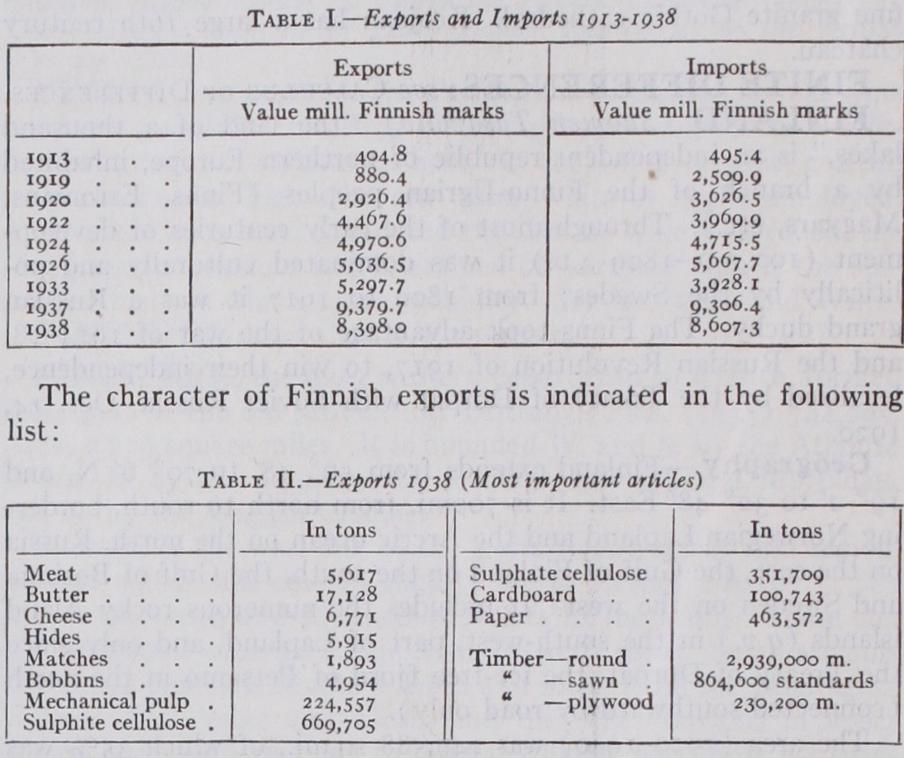
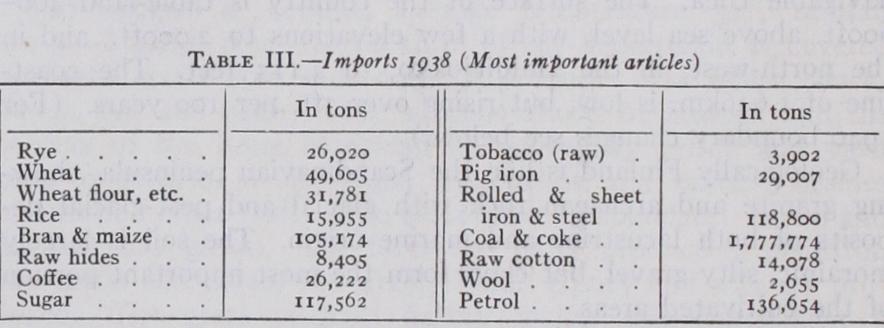
Principal markets for Finnish exports are, with purchases as of 1935: Great Britain L12,757,000; Germany £2,56o,000; United States of America £2,467,000. Finnish imports are distributed more evenly: from Great Britain £5,687,000; from Germany £4, from Sweden L2,638,000; from the U.S.A. £1,783,000. Chief imports are shown in accompanying table: Currency.—After 1917 Finland had to meet the increased ex penditures of an independent state, and that incurred by the sup pression of the Red rebellion in 1918. Tax collections were slow, hence the Government borrowed and the state bank issued notes. From 1919 to 1921 Finnish exchange declined seriously. Late in 1922 the Bank of Finland began stabilizing the mark (Finnish markka) in relation to the dollar. In 5925 a gold basis was adopted, the rate being 39.7o FM to the dollar and approximately 193.23 FM to the L sterling. World conditions forced the mark off gold in 1931; in it was restabilized at 227 to the .£ ster ling; in 1939 its parity level with the pound was abandoned in. consultation with the central banks of Denmark, Norway and Sweden, and the rate rose to 197 marks to the pound, 49 to the dollar.
The foreign debt, as of Sept. 1939, stood at 1,040,000,000 marks, and the internal debt at 2,810,000,000 marks. With small short term credits this put the total public debt at 4,074,200,00o marks. Credit abroad was good, partly because Finland was the only country to continue through 1939 to pay instalments on her "war debt" to the United States.
The co-operative movement has been very strong in Finland, and here again there has been considerable inter-Scandinavian collaboration. (F. D. S.) About 100 A.D. the first real settlements were probably made in Finland by people crossing over from the southern shores of the Gulf of Finland. These people were thus a northern offshoot from the Finno-Ugrian tribes whose story is shrouded in mystery, as is the early development of the groups in Finland. At first they wandered about, burning off the forest in order to till the soil— rather than plowing. Weapons, implements and ornaments indi cate continuing relationship with the tribes to the south. Gradu ally family homesteads were established, and settlement from the south-west reached Lake Ladoga about 700 A.D. Increasingly trade and cultural bonds were established with the Swedes to the west, and south-eastern influences all but disappeared. The tribes increased in population, warred among themselves, and were fought over by Sweden and by Novgorod.
Crusades were stimulated by the pope to win the people from their pagan beliefs (in Ukho, god of the air; Tapio, of the forests; Ahti, of the water, etc.). King Erik IX of Sweden in such a cru sade (about 115 5) conquered the Finns and left Bishop Henry (probably an Englishman) at Turku. But the Finns relapsed into paganism, though Henry became later their patron saint. Thomas, another Englisl} bishop, resumed the missionary task in 1209, and almost separated Finland from Swedish control to establish it as a papal province. The famous Birger Jarl compelled the Tavas tians, one of the subdivisions of Finlanders, to accept Christianity in 1249 ; Torkel Knutson conquered the Karelians in 1293 and built the castle of Viborg, which for centuries to come was the outpost of Swedes and Finns against the Russians.
The Swedes spread civilization and accorded to the Finns the same civil rights as belonged to themselves. Swedes settled in the Aland islands and in spots along the western and southern shores of Finland. About 1528, Gustavus Vasa introduced the Re formed religion, and King John III raised the country to the dignity of a grand duchy. Gustavus Adolphus at the beginning of the 17th century established the diet of Finland, composed of the four orders of the nobility, clergy, burghers and peasants. He and his successors did much for learning, but the country suffered terribly from war, famine and pestilence. Many Finns fought with the Swedes in Germany during the Thirty Years War.
In 1710 Peter the Great set out to wrest Finland from Sweden, and six years later the whole country was in his power. Thou sands perished in the wars of Charles XII, but by the Treaty of Nystadt in 1721 the Russians retained the province of Viborg, the eastern division of Finland. Twenty years later the Swedes attempted re-conquest, but suffered disaster. In 1788 Gustavus III confirmed those "fundamental laws" which the Finns suc ceeded in maintaining against kings and tsars for over two cen turies. Latin disappeared as the academic language, and Swedish was adopted. The same year war again broke out between Sweden and Russia, and was carried on for two years without result.
In 1807 Napoleon and the Tsar Alexander discussed at Tilsit the division of Europe between them ; in 1808 began a new Russo Swedish war. By 1809 this war resulted in the cession of Finland and the Aland islands to Russia, and helped cause the overthrow of King Gustav IV in Sweden.
The World War and the Russian Revolution.—Finland escaped invasion, but her liberties were restricted, and her mer chant marine was bottled in the Gulf of Bothnia. The Allied blockade caused a 25% rise in living costs, but industries con nected with military supply attained unexampled prosperity. The Russians, sporadically anxious to please, abolished the annual mili tary indemnity and merely imposed a 5% tax on property and mortgages. Finland naturally feared that a victorious Russia would again turn oppressor. Only some 2,000 volunteered for the Rus sian army. About the same number enlisted on the German side, ostensibly for service only on the eastern front.
Nicholas II abdicated on March 15, and the Provisional Government restored representative government in Finland. The Russianized senate was disbanded and a temporary body of 12 (half Social Democrats, half representing the bourgeoisie) as sumed executive power. Stakovich became governor-general, Rodichev, a tried friend, secretary of state for Finland. The So cialist speaker of the diet, Tokoi, was nominated president of the senate ; Kullervo Manner, of the same party, speaker of the diet. The intense industrial development had strengthened hooliganism, and the war had brought some 40,00o Russian refugees from food shortage and incipient riot. The Swedo-Finns aimed at complete independence, and the Finnish Government proclaimed that such was its policy.
But the diet, July 18, 1917, resolved that it alone could make laws relating to home affairs and finance—thus reflecting the Social Democrats' willingness to permit Russian control of such matters as military and foreign policy. The Russian Provisional Government proved unable to take advantage of this situation. The Finnish diet passed en bloc all bills previously held up by the tsar, including the eight-hour day and the total prohibition of al cohol. Yet it failed to relieve the food shortage. From March 1917 to Feb. 1918 repeated strikes threatened the existence of the nation. Meanwhile, the advent of the Bolsheviks to power in Oct. 1917 deepened the pro-Russian sympathies of the Social Democrats, while the propertied classes sought to cut adrift from the Soviet state. On Dec. 6, 1917, the diet and the now bourgeois senate drew up a declaration of independence. The Bolsheviks, on Jan. 4, 1918, declared that the step conformed with their policy, whereupon Sweden and the other Scandinavian countries acknowledged the independence of Finland. France and other states followed. The treaty of Brest-Litovsk (March 3, 1918) confirmed Finland's independence, and four days later she con cluded a treaty which made her Germany's ally and vassal. (See BREST-LITOVSK, TREATIES OF.) "Red Guards" from the starving, unpaid garrisons, and rein forced from Russia, began to overrun the country. A hurriedly organized White Army, under Baron Carl Gustav Emil Manner heim, proved insufficient to maintain order. Sweden refused to help, but the Germans sent a composite division, initially some 12,000 strong, under General Count Riidiger von der Goltz. This enabled General Mannerheim to win the battle of Tammerfors, whereupon Goltz entered Helsingfors on April 14. Finally, the German victory over the Reds (April 3o–May 2) at Lahti Tavastehus contributed to Mannerheim's decisive victory near Viborg (April 28-29). But the cruelty of the Red insurrection aries led to a White counter-terror. Some 15,00o men, women and children were slaughtered, and by June 27, 1918, 73,915 Red rebels, including 4,60o women, were prisoners of war.
The diet, which met in June 1918, was moderate, since the So cialists who formed 46% of the electorate were excluded from the register. It authorized the Germanophil senator, Pehr Eyvind Svinhufvud, to exercise the supreme power in so far as it had not already been conferred on the senate, which offered the crown to Prince Frederick Charles of Hesse, brother-in-law of the German emperor. Prince Charles accepted the crown, but never proceeded to Finland and the question was allowed to lapse.
The Germans demanded Finnish military co-operation against the Murman railway, which was guarded by a British expedition ary force. Their claims were becoming peremptory when, on July 18, the Allied offensive in the west diverted Germany's forces. Thus time was gained until the Armistice of Nov. II, 1918 ori entated Finland toward the democratic regime associated with England and America. On December 12 Svinhufvud was suc ceeded as regent by Mannerheim. who formed a coalition Gov ernment composed of 6 Republicans and 6 Monarchists. In 1919 Mannerheim organized the "Skyddskorps" of 1 oo,000 men to maintain order. In the general election of March 1, 8o Social Democrats, 42 Agrarians, 28 Coalitionists, 26 Progressives, 22 Swedes and 2 Christian Labour members were returned. The Agrarian Party, composed of small land-owners, opposed the Swedish-speaking Monarchist section. The Social Democrats lost 12 seats owing to the disfranchisement of 40,00o voters for participation in the Red revolt.
When, at the end of May 1919, the British 237th Brigade (of the expeditionary force under Maj. Gen. Maynard's command) reached Lake Onega, Mannerheim offered co-operation in return for Petrozavodsk. The offer being declined, a Finnish volunteer force nevertheless assaulted the town, but without success. Again, at the close of the year, when the White Russian Gen. Yudenitch marched on Petrograd, Mannerheim sounded the Allies on Finnish intervention. He received no encouragement from Paris or Lon don, nor from the moderates at home.
A peace treaty was signed with Soviet Russia at Dorpat on Oct. 14, 19 2o. Pechenga (Petsamo) was ceded to Finland, which thus obtained an outlet on the Arctic ocean. On Dec. 16, 192o, Finland was admitted as a member of the League of Nations. As such it claimed sovereignty over the Aland islands (q.v.) which was dis puted by Sweden. In June 1921 the League of Nations decided in favour of Finland.
In Oct. 1921 the Karelians, racially allied to the Finns, revolted against Moscow, but the rising was crushed. The Karelian question, at the instance of Finland, occupied the League of Nations all through 1923. The Permanent Court of International Justice decided in July not to deal with this matter, as Russia was not a member of the League and might not recognize its competence. The Council of the League, however, determined that this view of the Permanent Court should not hinder a settlement, which resolve the Assembly of the League strongly supported. But the commissar for foreign affairs, M. Chicherin, declared Karelia part of Soviet Russia. His argument had the support of the Red battalions. (W. L. B. ; X.) In these years, Finnish foreign policy remained in the hands of Dr. R. Holsti. In 1922 Holsti attended the conference at Warsaw which pledged Finland, along with Estonia, Latvia and Poland, to neutrality and consultation in case of attack. The diet of Finland, however, refused to ratify this pact and enunciated a general policy of avoid ance of military obligations.
In succeeding years all attempts to form a Baltic bloc came to nought, while Finland turned more and more toward co-operation with her Scandinavian neighbours. In 1924 she signed bilateral con ventions for compulsory arbitration with Denmark, Norway and Sweden. Finland participated in the political-economic activities of the "Oslo Group" (193o— ) and .joined in still closer collaboration with the Scandinavian states proper ) emphasizing her cultural position as one of the northern countries. These four states, with Iceland, have even joined in publishing since 1938, an official quarterly, Le Nord, to explain to the world northern problems and policies; they have held several economic conferences, and through similar meetings have done much to co-ordinate their social legislation (since 1919) . Finland has also played her part as a member of the League of Nations, first being made a member of the Council in 1927. War with Russia, with the Soviet Union were never good, but the Finns did sign one of the U.S.S.R.'s network of non-aggression pacts (1932) . In Jan. 1939 Finland and Sweden signed an agreement for a joint fortification of the Aland islands; this roused Russian protests, although all the other interested states gave their approval. But neither non-aggression pacts nor friendly agree ments with her western sisters could prevent the Soviet onslaught in the chaotic autumn of 1939. Stalin first took advantage of the German invasion of Poland by pushing Soviet territory into Poland, and mili tary outposts into Estonia, Latvia and Lithuania. He next demanded a "Mutual Assistance Pact" with Finland, and offered to cede Karelian lands in return for some strategic islands near Leningrad, relinquish ment of some Finnish territory in the south-east and in the far north and garrison privileges on Hangoe. The Finns refused to yield enough to satisfy the Russians, and were bolstered at least morally by the meeting in Stockholm (Oct. 18) of the three Scandinavian kings with President Kallio. At the end of November the "Red" war machine began to pound at Finland's eastern frontiers, all the way from the Arctic peninsula of Rybachi through the eastern forest and swamp region down to the strong "Mannerheim Line" below Lake Ladoga, and warships and aeroplanes bombarded the southern coast region. Finland's energetic and able defence against her powerful enemy drew promises of aid from Britain and France, and from the League of Nations, which expelled the Soviet state from membership on account of this attack (Dec. . Sympathy for the Finns was wide spread throughout the world, but their geographical position made practical help difficult.
After 1o5 days of heavy fighting the vast manpower of the U.S.S.R., her artillery, and her aerial superiority enabled her to push the bat tling Finns back as far as Viipuri. Industrial plants, railroads and homes in all parts of the country were destroyed by bombs. Volun teer aid of men and money from Sweden and other countries was in sufficient. Britain and France prepared an expeditionary force, but Finland did not make the public appeal for it which was required, and Sweden and Norway refused to agree to its passage. The northern states evidently feared German intervention, general destruction and involvement in the war between Germany and Britain and France. Hence a Finnish delegation signed a treaty in Moscow (March 13, 1940) ceding about io% of their territory: (I) a strip in the north east including the Rybachi peninsula ; (2) the Karelian isthmus in cluding Viipuri; (3) all the Finnish shore line of Lake Ladoga. The U.S.S.R. also got a 3o-year lease on Hangoe peninsula, transit privi leges across Petsamo, and a railroad connection between the White Sea and the Gulf of Bothnia. Some 450,000 people had to choose be tween resettlement in the new Finland or acceptance of Russian sovereignty.
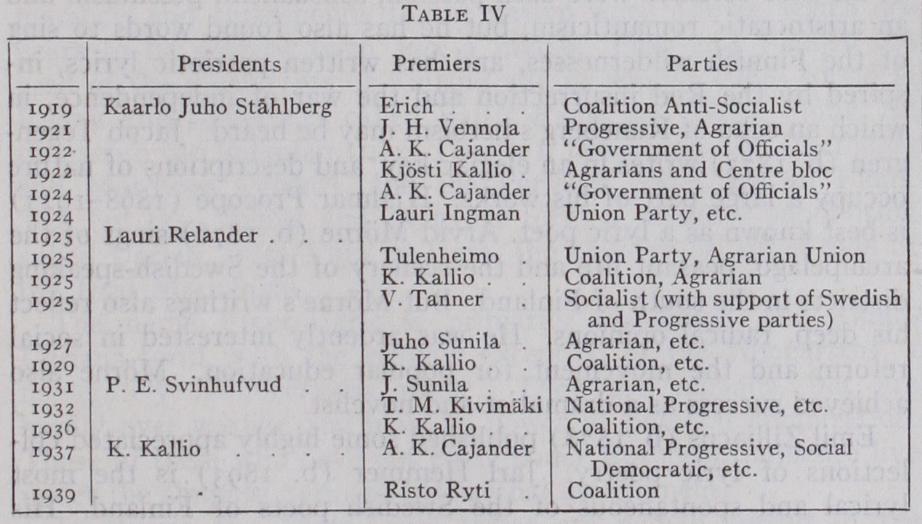
The strongest single party in the one-house diet has been the Social Democratic, representing the working-class moderate socialist position, and winning 85 seats in the elections of July ; the party leader best known abroad is V. Tanner. Two other parties were associated in the Government bloc in 1939: the small but influential National Progressives, intellectual and social reformist, with leaders such as Premier A. K. Cajander and Foreign Minister Eljas Erkko, but with only six members elected to the diet ; and the agricultural and nation alist Agrarian Party with 56 seats. The 147 seats of this bloc were four more than its previous total. The 53 seats of the opposition were distributed as follows: National Conservatives 25 (+5) ; Swedish Peoples 17 (-4) ; Small Farmers 2 (same) ; Aland islanders 1 (+I) ; and Patriotic People's Movement 8 (-6) , this party's loss evidently being due to its fascistic tendencies and the dissolution ordered against it in Nov. 1938.
Under the influence of the Russian invasion of 1939 a Communist Government (The Democratic Republic of Finland) was organized and recognized by Moscow (Dec. i, , but was disregarded in the negotiations of March 1940.
S. Mechelin (Helsingfors and London, 1894) ; M. G. Schybergson, Ur Finlands Konstitutionella historia (Helsingfors, 1898) ; J. R. Fisher, Finland and the Tsars (2nd ed. 19oo) ; Finnland and Russland; Die Finldndische Frage im Jahre 191I (Munich 191I ) ; Petition des Finn liindischen Landtages vom 26. Mai 1910 Tuber Aufrechterhaltung der Grundgesetze Finlands (1911) ; Atlas de Finlande, 3 vols. (Helsinki, 191I) ; R. Erich, Das Staatsrecht des Grossf urstentums Finnland (Tubingen, 1912) ; K. Ziliacus, Revolution and Gegenrevolution in Russland and Finnland (Munich, 1912) ; J. Ohqvist, Das politische Leben Finnlands (Leipzig, 1916) ; Olenev, Karelski Krai (Helsingfors, 1917) ; H. Stenberg, Ost Karelian in V erhdltnis zu Russland and Finn land (1917) ; V. Hilpi, Nationell sjdlo provning (1917) ; "New Europe," vol. iii, No. 3o; vol. viii, Nos. 93 and 94, by R. T. Hyndman; vol. vi, No. 67 ; vol. vii, No. 8o (by "V") ; vol. xii, No. 155, by S. E. Morison (1917-2o) ; Die Aalandfrage: das Kernproblem der Ostseepolitik (1918) ; H. Sdderhjelm, Det rode upprovet i Finland as 1918 (1918) ; T. Svedlin, Kamp och aventyr i roda Finland (1918) ; J. Aho, Hajamietteita Kapinaviikoitta (1919) ; Y. Koskelainen, Mannerheim, suomen vapanttaja ja vallionhoitaja (1919) ; Der Weisse Terror in Finnland, Beleuchtende Urkunden aus der interpellations debatte in Finnischen Landtag den 30 April, 1919 (5959); Juhani Aho, Haja mietteita Kapinaviikoitta (1919) ; R. von der Goltz, Meine Sendung in Finnland and in Baltikum (1920) ; Constitution de la Finlande (1920) ; The Republic of Finland: an Economic and Financial Survey (Helsinki, 192o) ; East Carelia and Kola Lapmark, ed. Th. Homen (1921) ; Treaty of Peace between Finland and Russian Soviet Republic (1921) ; J. R. Danielson and R. F. Hermanson, La Question des Iles d'Aland de 1914 a ; Trade and Industry of Finland, ed. F. Tidermann (1922) ; K. W. Hopper, Finnish Harbours (Helsinki, 192 2) ; S. Svechnikov, Revoliutsiia i Grazhdanskaia Voina v Finliandii (Moscow, 1923) ; G. Braun, "Das Land Kartenwesen, Finnlands. Ein Uberblick and Begleitwort zu drei Probe Karten," in Berichte aus dem Institut fur Finnlandkunde (Greifswald, 1924) ; M. G. Schybergson, Politische Geschichte Finnlands, 18o9-1929 (Stuttgart, 1925) ; S. R. Bjorksten, Das Wassergebiet Finnlands in Voelerrechtlicher Hinsicht (Helsingfors, 1925) ; J. Ohquist, Finnland (Berlin, 1928) ; Eugene VanCleef, Finland, the Republic Farthest North (1929) ; B. Estlander, Elva Artionden ur Finlands Historia (vol. 5 of extensive Swedish in terpretation of Finland since 18o8, Stockholm, 193o) ; T. W. Atchley, Finland (London, 1931) ; Fritz Werner, Die Finnische Wirtschaft (Berlin, 1931) ; John Henry Wuorinen, Nationalism in modern Fin land (1931) ; Ilmari Manninen, Die finnisch-ugrischen volker (193 2) ; Leo Harmaja, Effects of the war on economic and social life in Fin land (1933) ; Agnes Rothery, Finland, the New Nation (New York, 1936) ; The Northern Countries in World Economy (1937) ; Le Nord, (quarterly, Copenhagen, 1938–) ; Bank of Finland Monthly Bulletin (Helsinki) ; Finland Year Book (Helsinki, last English edition, 1936) ; J. Hampden Jackson, Finland (194o).
Literature: The novels of F. A. Sillanpaa, Sally Salminen, A. Kivi; Kalevala (1907, Everyman Edition) ; Runeberg, Songs of Ensign Steil.
(F. D. S.)