
FIRE ESCAPES in England refer to constructing ladders mounted on wheels which are intended to be used exclusively for the purpose of enabling people to escape from burning buildings. Abraham Wivell invented the first portable fire escape ladder of this kind about 1837. Before Wivell's time, however, various smaller fire escapes were in use. There is in existence a very interesting drawing by C. Geissler, dated 1789, showing three types employed in Geneva at that date, consisting (a) of the cloth or canvas "chute," (b) the rope and basket (or sling), and (c) sec tional ladders fitted with sockets so that several could be joined together to make one long length, the top section having running wheels to travel easily up the walls of a building. Sectional lad ders of somewhat similar build were the first fire escapes to be used in London, when John Braidwood, the famous first Chief of the London Fire Engine Establishment, put them into service there in 1832. They were made in short lengths of about 6 ft. for carrying upon the fire engines of the period.
Wivell's wheeled fire escape was not officially adopted, though it was put into service in London by the Royal Society for the Protection of Life from Fire. A few years later another type of wheeled escape known as the "fly-ladder" was evolved and this, being an improvement upon Wivell's machine, gradually super seded it. The "fly-ladder" had a main ladder about 35 ft. in length mounted upon a spring carriage, with large wheels. At about Io ft. from the top of the main ladder a folding ladder of about 20 f t. was joined by hinges, and was raised when required for use by ropes attached to projecting levers. It was possible also to detach this folding ladder when required; and in the event of greater heights having to be negotiated than the combined height of the main and fly-ladders, a separate short ladder was placed at the top of the folding ladder, and by this means a height of about 6o ft. could be reached. At the under-side of the ladder was affixed a canvas chute protected externally by copper wire netting; this was used to pass persons down when it was possible to get the top of the chute upon a suitable window-sill. For greater heights the persons had to be carried down the ladders in the same way as is done in the present day.
Another form of escape which, although introduced many years ago, is still popular, is the "pompier" ladder ; as its name indi cates, it is of French origin. It is an exceptionally light ladder usually from 16 to 18 ft. in length, and at the end an iron or steel hook is fixed for the purpose of reaching over and holding on to window-sills. In expert hands the pompier ladder is very useful, but it can only be safely worked by trained firemen. It is not always employed in the ordinary way as a fire escape, but is used for the purpose of enabling firemen to scale walls of burning build ings, and persons to be saved are lowered to the ground by ropes which the firemen carry.
Every possible precaution has been taken to secure safety in operation. Trussing is employed to increase the strength of the ladders, and an ingenious device ensures that when either of the three controlling levers are released by the operator, no matter at what angle or extension the ladders may be, the power is cut off and the ladders remain absolutely secure. Again, if either of the levers is pulled down, or kept down too long, over-elevation or over-extension is automatically prevented by a device which forcibly returns the levers to the free position before the point of danger is reached. The outstanding feature of this machine is that, contrary to the practice in some of the earlier types, the one engine performs every operation. This system was patented by Merryweathers' in 1908, and although in the interval many machines have been built in which the movements of the ladders were controlled by a separate motor, the use of the main engine for all purposes is now practically universal, Continental makers having followed English practice.
Motor turntable ladders are built in various lengths, but as they are expensive machines it is the general practice to construct them to command very considerable heights. The longest ladder of this type built up to the year 1928 was one made by Merryweathers' for the Cairo Fire Brigade in 1926, which is capable of reaching a vertical height of 95 ft. from the ground level.
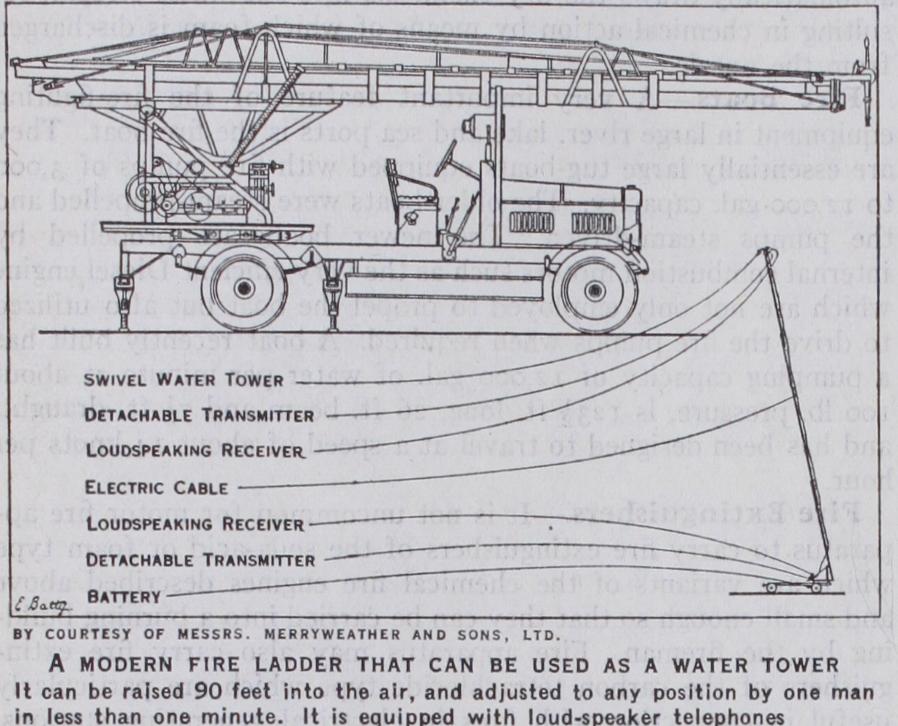
The fire ladder is usually equipped with revolving screws which raise or lower the ladders round a pivot. Steel cable is used for extending the telescopic ladders. Bracing rods are provided to stiffen the ladders when in use. In the accompanying diagram may be seen the nozzle of the "water tower" and the revolving platform on which the mechanism and ladders are mounted.
These are the principal types of escapes in general use by public fire brigades, but of course, many smaller appliances, or domestic escapes, are used independently of the assistance of trained fire men. These range from a simple knotted rope, and a plain rope with a fluffy surface to avoid chafing the hands, through various types of rope ladders, iron folding ladders, etc., to the most popu lar form of all, the canvas "chute" fire escape. Such patent self help fire escapes, which are many, do not, however, come within the scope of the present article. (J. H. Os.) In America the term "fire escape" is seldom used in the sense in which it is used in England. American fire apparatus analogous to that of the English fire escape is discussed elsewhere in another article. The term fire escape in the United States is restricted in a narrow sense to the railed balconies with iron stairways which give access from storey to storey in time of emergency. These fire escapes usually lead from the roof to the street. Such fire escapes will be found everywhere, except in the smallest towns. Nearly every city has minute rules covering fire escapes, the regu lations being promulgated by the fire department, the building department or the tenement house department. In this article attention is not confined to this type of escape, but is also directed to the building exit in a broader sense, which conforms to the building codes of most States and cities. The problem of proper exits is related to alarms and fire-drills where factories are con sidered. The ordinary iron fire escape has proved a snare on so many occasions that its real value is doubted by many authorities. Where the access to it is gained through metal doors, or wire-glass windows in metal frames, and where there is no opening directly against the ladder portion this type of escape is effective. Fire and smoke coming through windows make many fire escapes im passable, except for trained firemen.
Regular outside stairways give better protection for factories, but are not recommended for buildings over six storeys high. Wherever possible, the stairs should be placed against a blank wall. High railings filled in with wire mesh give a feeling of security. No encumbrances should be placed on the platforms or stairs, and entrances should not be through private offices or wash rooms. In winter the steps and platforms should be kept free from snow and ice ; for the escape may be needed any minute. The lower portion of the smaller fire-escapes often consists of a ladder; but a counterweighted section of the stairs is better prac tice. Straight and spiral chutes are sometimes used and are valuable for the rapid evacuation of a building. Poles are in use in powder factories, but they are not adapted for general use. Fire escapes are designed to carry a safe load of ioo lb. per sq.f t., with a factor of safety of six.
The best fire escape is a "smoke-proof tower," where each exit from the occupied floor gives access to an open air vestibule, or outside balcony, which, in turn, leads to a portion of the build ing separated by a fire wall which serves to enclose a platform and fireproof stairs. This tower cannot be obstructed by smoke from a fire on a lower floor. As such stairways must be reached from each floor by means of an outside balcony they are not generally suitable for every-day use. Such fire towers are in use in many office buildings. The interior enclosed stairway, if sur rounded by fire-resisting walls or partitions and the entrance to each floor being protected by a fire-door, affords an efficient fire-exit for every-day use. They are not quite as safe as the smoke-proof tower, but a combination of both is excellent. Both types are lighted at all times by a current from an independent circuit. In summer hotels, rope fire escapes were formerly fre quently used but this practice has largely disappeared.
BIBLIOGRAPHY.—National Fire Protective Association, Building Exits Bibliography.—National Fire Protective Association, Building Exits Code (Boston, 1927) ; National Safety Council, "Exits, Fire Alarms and Fire Drills," No. 19 of Safe Practice. See also publications of National Board of Fire Underwriters and of State department of labour and local departments, as mentioned above. (A. A. H.)