
FIRE PREVENTION AND EXTINCTION. Every fire involves a permanent and absolute loss of national capital, but the loss is usually so well distributed by the existing system of insurance that its incidence is not of ten seriously felt. Fire losses are in reality borne by the community, insurance offices being merely the medium by which the loss is distributed. The enor mous annual fire wastage passes unnoticed and it is only when a conflagration occurs by which the accumulation of years of wealth of property is swept away in a few hours that the imagination is moved.
The following is a list of notable fires : A conflagration is but the development of a small fire, and a study of the great fires in history shows that certain conditions, or a combination of circumstances, have au each occasion per mitted the individual fire to spread_ A convulsion of nature, insur rection, or interference with the civic authorities, a strong wind, scarcity of water, lack of fi;re-fighting appliances, defective con struction of buildings, all contribute to the disaster. An earth quake may destroy the water supply and leave a city to the mercy of the flames, This happened in the great conflagration in San Francisco in F906, while defective construction fed the fires which wiped out Yokohama and large districts of Ti okio following the terrible earthquake in September 1923.
Where timber buildings predominate, high winds are dreaded by firemen almost as much as a scarcity of water, but, even in the absence of wind at the outbreak. a conflagration creates its own wind as it gains in volume, which adds to the difficulty of confining the disaster.
Discipline and good housekeeping ire. shop and factory reduce the danger of fire, and every appliance deviled whereby fires are confined to the seat of outbreak is a step forward in the progress of fire protection_ "Fire protection is a combination of fire prevention,. fire com bating and fire research." Fire Prevention.—By the common law of England every householder was bound so to keep his fie as to prevent it from causing injury to others. A statute was passed in the reign of Queen Anne which enacted that after a day named: no action should be maintained against. any person in whose house any fire should accidentally begin, and these provisions were re-enacted under the Fire Prevention (Metropolis) Act r774, which is general in its application and not confined to the Metropolis. The responsibility for damage by fire is particularly expressed in the law of France under the Code Napoleon. This code,. which took effect in r8o4, was. adopted in many lands conquered by Napoleon and it has also had great influence on the legislation of countries outside Europe, particularly in Central and South. America. The following are the special. Recaurs des V oisisas (neighbours' risk).—The owner of property or goods which are burned may became responsible for any damage sustained by his neighbours through the Mining_ This is called "recourse by the neighbours." In order to obtain the bene fit of this recourse the neighbour mist prove that his loss was caused by the fault of him on whose premises the fire started. It should, perhaps, be especially emphasized that the "onus. pro bandi" rests on the neighbour and not on the owner himself..
Risque Locatif (tenants' risk).--A tenant is responsible for a fire unless he proves that it happened through unforeseen cir cumstances, by act of God, or throu24 faulty construction of the premises, or that the fire had been communicated from a neigh bouring house.. If there are several tenants, all are responsible for the fire proportionately to the value of the part of the premises which they occupy except in the two following: cases: feY where it is proved that the fire originated in the part occupied by one particular tenant, in which case he alone is held responsible.
(b) where it is proved by some of the tenants that the fire did not originate in the part occupied by them, in which. case they free them selves from liability, which falls on the remaining tenants.
This is called the "tenant risk" and in virtue of the law the owner of the house has a right to sue the tenant of the house for pay ment of the damage which his house has sustained, and in order that he may recover the law only requires proof of the damage, without any reference to the cause.
Risque Locataires (landlords' risk). The law having put this burden on the tenant also contains some provisions for his pro tection : The landlord of a building is responsible for the damage caused by this destruction when it happens in consequence of want of maintenance or by fault of its construction. The landlord is bound to guarantee the tenant for all the defects in the building which would prevent the use of it, even although the landlord may not have known of them at the time of the lease being made. If there result to the tenant any loss through these defects the landlord is bound to indemnify him. This provides for the recourse of the tenant against the landlord.
But quite apart from legal liability, it is the moral duty of every citizen to see that his building is erected or maintained in such a manner as to reduce the danger of fire and of every occupier to guard against such a danger and, in the event of an outbreak, to take every step possible to extinguish it and prevent it from spreading.
Town planning acts with their provisions for minimum widths of streets, fire prevention and building acts and municipal by-laws based on the practical experience and research of builders, engi neers and fire experts have done something to reduce fire waste. Such enactments regulate the materials used in the construction, fix the dimensions and particularly the height of buildings, and control the conditions under which hazardous processes of manu facture may be carried on, but they are not of universal applica tion. From a fire prevention point of view, the general acts are inadequate in their provisions and in some cases they are permis sive only and not compulsory.
The origin of many fires may be traced to lack of attention to details of construction. Defective chimneys, want of care in the construction of hearths, and insecure stoves and boilers are com mon causes of fire, while open wells, hoists and stairways with timber linings and partitions cause it to spread rapidly.
Loss by fire can be reduced and the safety of a building favour ably affected by the following : No timber or other combustible material should be used in the external walls or windows ; large areas should be avoided, by properly constructed division walls and cut offs carried well through the roof to a height regulated by the nature of the build ing ; Mansard roofs or high-pitched roofs are a fruitful source of extra risk, both on account of the excessive amount of wood used in their construction and the steep angle at which they are built ; the use of wood should be reduced to a minimum; all vertical openings (hoists, shafts, stairways, etc.) should be enclosed with fireproof materials—such openings are well known to be the most active factors in the rapid development of a fire ; metal posts and girders must be insulated against severe heat ; walls should not be lined with wood as the spread of a fire is accelerated by the air draughts which this mode of construction promotes and partitions should be made of non-inflammable materials; flues should only be used for the purpose for which they were designed and stoves and smoke pipes should be securely erected and free from contact with woodwork; windows should be of wired glass or protected by metal shutters where there is exposure to another building.
Every care should be taken to see that the lighting system is properly installed. Gas brackets should be securely fixed. A gas burner has been known to fire a ceiling 28 inches from it and light fabrics are frequently fired at a greater distance. Electricity, although apparently the safest method of lighting has from the mysterious and subtle nature of its working been found by ex perience to be dangerous when not properly installed. Even under the most approved methods, there is always the danger of short circuits, leaks and contacts, and numerous fires are due to these causes. Such installations should only be installed according to the rules of the institute of electrical engineers and they should be inspected at intervals by established and reputable firms of electrical engineers.
In the report of the royal commission on fire brigades and fire prevention published in 1923, the commissioners say : "We also observe that, in the report of the chief officer of the Lon don fire brigade for 1921, 2,054 fires out of 5,281, or nearly 40% of the whole number, are attributed to carelessness. The factor of care lessness, it is safe to say, can never be wholly eliminated, but in view of the very serious loss of life and property due to fires which could have been avoided by the exercise of reasonable care, we would urge the importance, in the national interest, of efforts being made in all possible directions to inculcate a more general and better instructed regard to the consequences of carelessness and negligence in matter of fire prevention. In this country the annual average direct loss of property caused by fires, attributable to all causes, amounts to about 112,000,000 per annum. If it be assumed, as we think it safe to do, that of this a considerable proportion could have been avoided by the exercise of a proper care, it will be seen that there is a wide field for further warning and instruction." In Great Britain it is difficult to interest public opinion in the subject of fire prevention. In the United States of America the tremendous annual fire wastage has roused the authorities to ac tion, and in the press and in the school they are endeavouring to create a public sentiment against what has become a national dis grace.
The danger of arson is ever prevalent and bad trade is one of the chief factors which give rise to the temptation to turn an in surance policy into a source of gain. It is remarkable how, in all parts of the world, the curve of falling business is consistently offset by the curve of rising fire losses. From this it must not be taken that moral hazard is bad all over the world, but that bad trade reveals inherent weaknesses in a community which normal or good business leaves unsuspected. When trade is bad, careless ness, to give it no worse name, increases, and the tendency is to pare down expenses in every direction until, in some cases, the safety line is passed—and the fire which results will not be at all unwelcome to the owner who finds himself in financial difficulties.
On the outbreak of a fire it is, in the first instance, the duty of the person on whose property the fire takes place to take all reasonable steps to extinguish it or to prevent it from spreading. The two most important aids to fire suppression are early dis covery of the outbreak and an immediate application of the means of putting it out. Automatic appliances are the best, as they ful fil both these requirements. Failing these, every building should be provided with some other ready means for dealing with an outbreak. A pail of water is the most primitive fire extinguisher known and is valuable if available during the first few minutes. For a chimney fire a few pounds of salt thrown in at the top is probably the best handy extinguisher. A pail of sand, dry earth, salt or even sawdust is also useful in extinguishing fires in inflam mable liquids. If such fires are not too large they may often be smothered by covering with a rug or blanket, but water will spread such burning fluids rather than extinguish them.
A garden hose stored where handy for quick attachment to a service pipe is an excellent fire protective appliance.
They should be placed on different floors and be easily acces sible. Such extinguishers should be recharged periodically because, if this is neglected, they may fail to act in an efficient manner when they are most needed.
If petrol or other inflammable liquids not easily extinguished by water are stored in the building, a foam type of chemical extin guisher should be provided and this type should be installed in every garage.
Automatic Fire Alarms.—There are several useful automatic fire alarms on the market, their purpose being to ring an alarm gong fixed outside the building or to convey a danger signal to a fire brigade station.
These alarms are brought into action whenever the temperature in the room is raised to a point well above what may be regarded as the highest natural temperature to be expected. The apparatus works by means of thermostats fixed at frequent and suitable points in the upper parts of all rooms, staircases, etc., where the heat rising from a small fire would concentrate causing expansion and electrical contact. Within a few seconds of an outbreak, alarm bells are set ringing and the position of the fire shown on an indicator board.
Automatic Sprinkler Installations.—The most effective system for automatic fire extinction and warning of fire is the sprinkler installation, which originated in America and was intro duced into Great Britain about the year 1880. The invention has been successfully applied to almost every kind of building and has undoubtedly averted much destruction of property and consider ably reduced the cost of fire insurance where it is installed ; in surance companies always being willing to grant substantial premium rebates where efficient installations have been fitted.
The protected building is provided with a system of piping con taining water under pressure and fixed near the ceiling of every room and into this piping the sprinkler heads are inserted at such intervals that every part of the area will be commanded and drenched. These sprinkler heads are constructed to open at a temperature of 155° F (=68° C) and when so open discharge water directly on to the fire within a few seconds of its outbreak. To the installation is attached an automatic alarm bell fitted outside the building which operates simultaneously with the sprinkler head, thus giving the alarm in the very act of operating. The existence of fire is notified and extinguishing operations com mence, therefore, practically instantaneously, and as efficient means are provided for turning off the water supply as soon as the fire is extinguished, the water damage is a minimum.
The safety secured by such an equipment fully justifies the expenditure, while the premium rebates referred to above are usually sufficiently substantial to repay the cost of initial instal lation in the course of a very few years.
The fixtures can be so placed as not to interfere with decorations or be otherwise obtrusive, as can be seen when visiting most of the larger departmental stores in England or abroad. In the majority of cases it takes a practised eye to detect the presence of sprinkler heads.
An extension of the sprinkler system is used when a building is subject to the risk of fire spreading from adjacent premises. In such cases external drenchers are fitted to the exposed windows and provide a curtain of water, effectually preventing entry of sparks or flame and keeping air temperature below ignition point of any inflammable goods near the openings. (E. M. M.) A special automatic fire extinguisher system, in use since 1917, is a method by which a sprinkler system (and also an alarm sys tem, if desired) is actuated when a fire causes a predetermined rate of rise of temperature. This has been approved by under writers as preaction and deluge sprinkler system. Rate of rise principle utilized by Lowe Release to close fire doors. (X.) Fire Escapes.—The protection of life from fire is quite as im portant as the saving of property. Certain building acts provide for the maintenance of means of escape in case of fire by the owner of the building. Such regulations apply more particularly in connection with public buildings and the like. Under the Factory and Workshop Act in Britain similar provision is made for factories where any considerable numbers are employed. Each individual tenant or occupier of a building has, however, a duty to perform in making provision for the escape of those employed by him or under his care.
Fire brigades in large towns are usually provided with fire escape ladders, but these may not reach the scene in time to save the lives which may be in danger. In many buildings escape by a single stairway is sometimes impossible and at least one addi tional means of safe exit should be provided, particularly for the upper storeys. The logical and natural solution of the prob lem is the introduction of an additional stairway, but, should this be impossible, a "chute" or rope ladder may save a tragedy.
The "chute" fire escape consists of a strong canvas bag fitted on a wrought iron frame specially made for each window. The rope ladder type is attached to a hook fixed in the wall and pro vides a ready means of quickly leaving a burning building. An other fire escape consists of a canvas seat, the lowering rope being attached to a hook and break-rod. The individual is strapped in securely and by this means persons can be lowered and hoisted as easily and readily as by an ordinary rope over a pulley. (See also FIRE ESCAPE.) Fire Brigades.—The gradual evolution of the modern fire brigade with its appliances in the United Kingdom from the prim itive "Couvre Feu" used in the reign of King Alfred would be a very long story. That on the Continent and other countries would be a very much longer one, for it is certain that organized brigades existed in civilized countries many centuries B.e., and they existed at a much later period with the Romans. With the decay of wealth they gradually fell into disuse, and one would suppose on the principle that there was not much to protect, and in the exact opposite direction they have risen again to their high state of efficiency proportionately to the wealth that they have to protect.
The organized fire brigades of most countries, therefore, follow very much in the same direction as that of Great Britain, propor tionately to the wealth of such other countries. There is an inter national exchange of ideas, and very little distinction in the principles of all fire brigades in civilized countries. A short history, therefore, of the fire brigade of the greatest city in the world, namely London, will suffice to indicate the general trend of things in relation to fire brigades all over the world so far as the large towns are concerned.
The establishment of fire insurance companies in Great Britain naturally brought about the question of minimizing loss by fire by preventing its spread, and as the public authorities had been diffident in this connection the offices set about establishing bri gades of their own. Probably the first insurance office to possess fire engines was the "Royal Exchange," and an announcement was made by them in 1722 that they had provided several engines with firemen and watermen and their implements for extinguish ing fires. They were followed by many other offices who placed fire marks on the buildings they insured, and no doubt each par ticular brigade gave special attention to any premises insured in their own company. In 1833 the London fire engine establish ment was formed by a combination of offices, this consisted of 76 officers and men who took upon themselves practically the fire protection of London. A year later the Houses of Parliament were destroyed by fire, and in 1861 the great fire in Tooley street occurred, when damage estimated at 11,200,000 was done. In the following year a parliamentary committee was formed "to enquire into the existing state of legislation, and of any existing arrange ments for the protection of life and property against fires in the metropolis." The result of this enquiry was to show a total in adequacy of appliances should a great fire occur in the metropolis, and in 1865 the fire offices handed over to the metropolitan board of works the fire protection of London which for over 3o years they had carried on at their own cost.
Various statutes were subsequently passed by parliament, not only in relation to London but to other towns throughout the country, by which parliament recognized as a public duty the maintenance of a proper equipment to local authorities, the cost of which is to be borne from the rates. The Metropolitan Fire Brigade Act of 1865 provided for the handing over of the fire stations, engines and property of the London fire engine estab lishment, together with the force of firemen, to the board of works, and this formed the nucleus of the new metropolitan fire brigade. The insurance companies being relieved from the burden of the onus of extinguishing fire, not only handed over their freehold and leasehold properties and valuable appliances worth many thousands of pounds, but consented to an arrangement whereby they became liable to contribute to the upkeep of the brigade.
Every insurance company that insures the risk of fire on any property within the metropolitan area must pay annually the sum of 135 per million on the gross amount insured. At the date of the passing of this act contributions made by the insurance offices thereutder amounted to a sum of 1io,000 per annum, and some idea may be gleaned of the wealth in the metropolitan area from the fact that this contribution had in 1925 amounted to no less a sum than 173,159 per annum, being at the same rate of £35 per million on sums assured of no less than f 2,090,280,942. This latter sum is double the amount of the gross sum assured in 1904.
The staff of the London fire brigade at Dec. 31, 1926, consisted of one chief officer, two divisional officers, two assistant divisional officers, one senior superintendent, seven superintendents, nine district officers, 74 station officers, 195 sub-officers, 1,62o firemen and probationary firemen and 13 pilots.
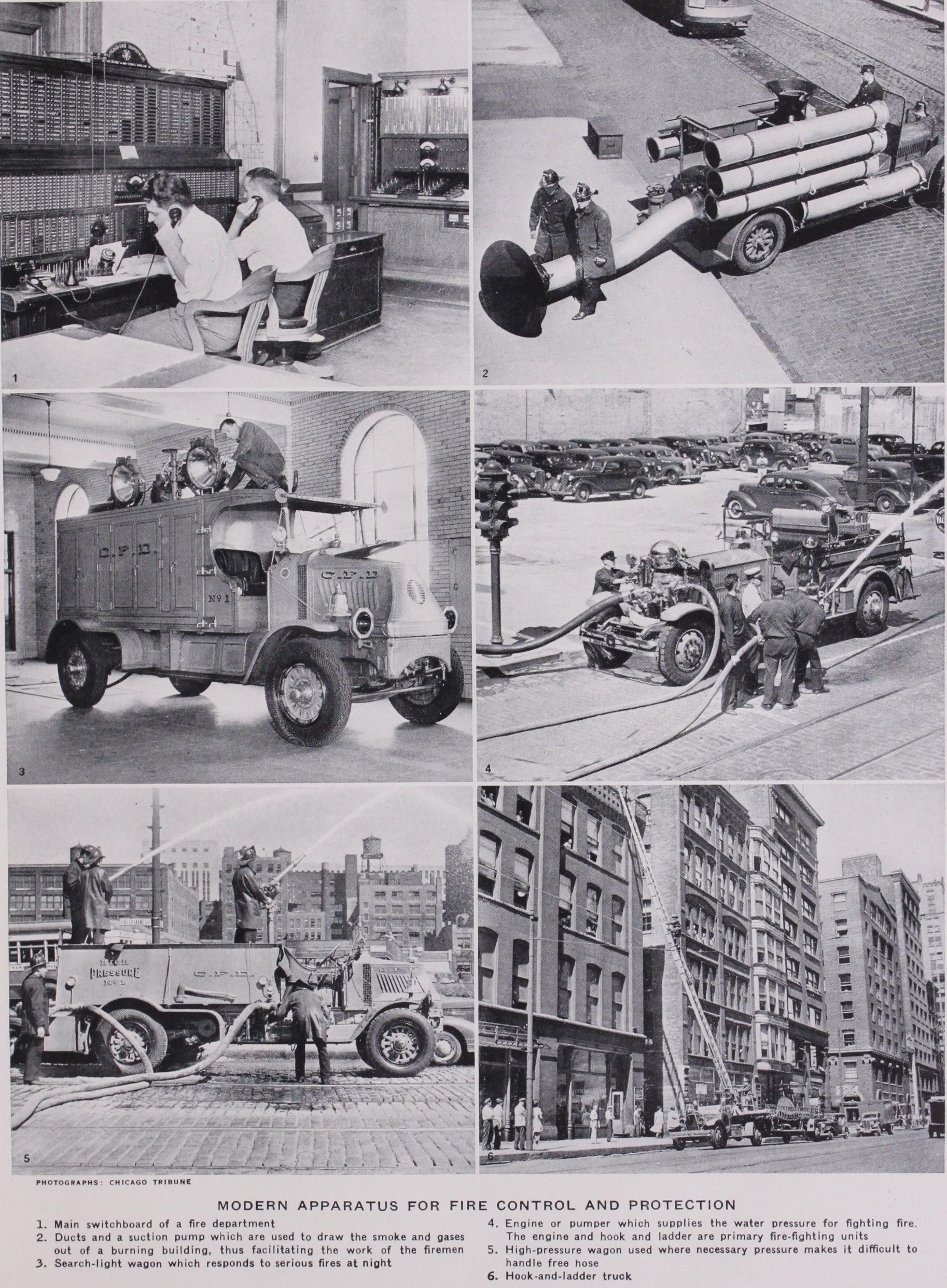
The stations and chief appliances were as follows : 62 land fire stations, three floating river stations, one river repairing depot, 87 petrol motor fire engines, 69 petrol motor escape vans, five electrically driven motor escape vans, two electrically driven motor ladders, six petrol-electric motor ladders, three petrol motor ladders, one petrol-electric emergency tender, one petrol-electric foam tender, one petrol emergency tender, five petrol motor tenders, 62 miles of hose (including first-aid hose), two steam fire floats, three motor fire floats, four store barges, 114 fire escapes, one long fire ladder, 55 smoke helmets, three cellar pipes, 399 hook ladders, 293 hook belts, 1,6J4 street fire-alarm posts, 108 telephone lines from fire stations to other fire stations, etc., 43 telephone lines between telephone exchanges and fire stations, 362 telephone lines to public and other buildings.
During 1926 there were 4,919 fires, of which 21, or .43%, were serious, 4,111, or 83.57%, were slight, and 787, or 16•o%, were chimney fires; 7,433 calls were received, of which 2,514 were false alarms. Of the false alarms 728 were malicious, i,o8o were due to defective electric circuits, one to automatic alarm and 705 to other causes. The number of serious and slight fires corn pared with 1925 shows a decrease of 43. The probable causes were : Structural defects, 228; lighting (electricity) , 259; lighting (gas), io4; lighting (oil), 222; heating, 696; in the exercise of business or industry, 1,121 ; carelessness, 1,376; suspicious, 36; unknown, 90.
No less than 265 officers and men were injured in the execu tion of their duty.
The quantity of water used for extinguishing fires was ap proximately 14,202,442 gallons or 63,403 tons.
In brigades in the United Kingdom apart from London, con ditions and regulations vary very considerably, and the report of the royal commission on fire brigades and fire prevention, 1923, states that "the existing provisions on the subject, apart from any question of their being inadequate or ill-adapted to modern conditions, are somewhat fragmentary and scattered over a number of statutes, and it would be a great advantage if, when the law is amended to meet its present defects, the opportunity were taken at the same time to consolidate the whole of the provisions relating to equipment, maintenance and operations of fire brigades in one comprehensive measure." They find that the maintenance of the fire service in all cases where authorized is a matter for the discretion of the authorities, and the extent to which that discretion has been exercised varies considerably.
Apparently there are some 1,500 fire brigades of every de scription in England and Wales.
Considerable improvement in the standard of fire protection generally has taken place throughout Great Britain in the last two decades, and broadly speaking the large cities and boroughs are fairly well protected as regards their own fire risks. In the smaller boroughs and urban districts the conditions vary very widely. Some of these authorities have built up an efficient or ganization, whilst others seem to have regarded the subject of fire protection as of minor importance. In the rural areas gener ally, probably owing to defective legislation, the fire protection provided is on the whole quite inadequate for the needs of the districts.
The report goes on to say: "In the industrial areas round Birmingham and in that portion of England which lies between Preston, Lancaster and Liverpool on the west, and Hull and Grimsby on the east there are many towns well provided with ap pliances, and probably, if all the fire brigade resources of this area were available for service independently of the local authori ties areas to which, for the most part, their operations are con fined, reasonably adequate provision would be made for most areas in this part of the country. On the other hand, taking a general view of the counties of Lincoln, Norfolk, Suffolk and Essex, we find a section of the country in which, if we apply the test of motor appliances, there are conspicuous blanks or deficiencies in equipment." With regard to the protection of Wales a rather pessimistic view is taken. The county of Glamorgan, which embraces more than one-half of the population of the principality, appears to be the only bright spot. To quote the report : "In fact, in the whole of the principality, outside Glamorgan, only five motor pumps are mentioned in the returns." So far as Scotland is concerned, "it would appear that the largest centres of population, such as Glasgow, Edinburgh, Dun dee and Aberdeen are well protected against their own fire risks and that some effort has been made to assist in the protection of neighbouring areas. The counties of Lanark and Renfrew, which are in a special position as being protected by brigades organized on a county basis, may also be considered as favourably situated as regards their arrangements for fire defence. There are in other parts of Scotland some few burghs with brigades of moderate size, mostly on a retained footing, equipped with mobile appliances, which adequately serve for the protection of the township itself and afford to a greater or less degree a measure of protection for the surrounding districts, though in Scotland, as in England, the possibilities of co-operation for this purpose do not appear to have received the attention the matter deserves. Perhaps, however, the most striking feature of the distribution of fire brigades under the present organization is the wide extent of the areas without any mobile fire equipment of any kind. This, however, is in a large measure unavoidable, on account of the nature of the country, the difficulties of communication, scanty water supplies and the very limited number of centres where there is sufficient aggregate fire risk to justify the main tenance of any costly fire brigade organization. In the Highlands, particularly, there are great stretches of mountain, moor and forest, where destructive fires from time to time occur, but against which it seems impracticable to devise any systematic protection on an economic basis.
The advent of the motor pump has done much to facilitate the solution of the problem of efficient protection of the country as a whole ; in particular it has enabled an efficient brigade in any given centre to protect a much wider area than was formerly possible with horse appliances, and has introduced entirely new possibilities in the direction of the rapid concentration of brigades in the event of any fire brigade finding itself unable to cope with an outbreak, or series of outbreaks, within its district. A brigade thus equipped can now provide normal protection over a radius up to, say, eight miles, including for example, a town of moderate size and surrounding rural area, more effectively than a brigade equipped only with horse appliances could have protected an area of half that radius.
There is no doubt that public opinion is moving in the direction of compulsory fire protection, to be controlled by the borough and urban and rural councils, with the co-ordinate authority of the county councils. The effect of this would be that the cost of the up-keep of brigades would in all cases be made payable out of the rates, so that insured and uninsured persons would be able to contribute alike, not only for the protection from fire, but against loss of life.
The following is a table of local authorities in Great Britain showing their statutory powers for the provision and maintenance of fire brigades, and indicating recovery of charges for services rendered at fires:— ity enters into an agreement with a neighbouring authority which may contribute a subsidy or grant in aid towards the mainte nance of the fire brigade, the charges to be made shall be in ac cordance with the terms of the joint agreement.
Water companies cannot be compelled to increase the pressure other than that necessary for supplying water for domestic pur poses, but where the fire service and water supply are both in the hands of the local authorities the pressure of water is usually ad justed to the circumstances of the case.
Without the consent of the owner a fire brigade cannot take water from a stream, pond or other private source for the purpose of extinguishing a fire, and the owner can either withhold his consent or make a charge for the water supplied.
In rural districts the water supply is a great difficulty, and so far nothing has been done to make it compulsory for an ade quate supply of water to be maintained for extinguishing fires.
The march of modern science, while assisting the fire fighter by the provision of more efficient apparatus, is ever creating new problems. The motor car, which enables the brigade to reach the fire in a fraction of the time taken by horse-drawn vehicles, has, by its very existence, made petrol a commodity of almost uni versal use whose storage and manipulation have created special problems which still await satisfactory solution. It is a platitude Note.—A rural district council can obtain, on application to the local government board, the powers of an urban authority under section 276 of the Public Health Act. In such a case their powers for fire protection would be under the Town Police Clauses Act.
The fire brigade committee of 190o suggested that insurance companies should pay for brigade services rendered at fires but the commissioners in the report of 1923 came to the conclusion that "there appears to be no more reason for the fire department of an insurance company to subsidize fire brigades, than for the marine department to subsidize lighthouses, or the burglary de partment to subsidize the police." In 1923 a scale of charges for Great Britain was drawn up by the National Fire Brigades Association which is now being adopted increasingly by brigades—it is in the next column.
1.—The scale of charges given covers wear, tear, fuel, clean ing and all other normal expenses incidental to the use of appli ances or sustenance allowances for men and all other out-of-pocket expenses.
3.—The brigade shall be entitled to the mileage charge for motor appliances on the total distance covered to and from the fire or other place to which the appliance is ordered. The charge shall be additional to the charge for turning out, and in the case of a steamer or manual the charge shall be the actual cost of horse hire.
4.—No charge is payable for the appliances if such are pro vided and maintained by the Local authority when attending fires in the local area, and in certain instances, where a local author to say that "plus ca change, plus c'est la meme chose," but it seems to be certain that whatever advances the future may hold, the risk of fire will be always with us. (See also SALVAGE CoRPs.) (E. M. M.) The excessive fire waste of the United States and Canada is generally credited to the lavish supplies of building lumber avail able in North America, which have made it appear more economi cal to use wood in building construction even at the cost of fre quent rebuilding than to use fire-resisting materials. The uncer tain stability of town sites in the pioneering days was also a factor in retarding the erection of more permanent buildings. During the past quarter century, however, the cities of the United States and Canada have been largely rebuilt with a liberal use of fire-resisting materials and considerable thought to their protec tion, both within and without, against fire attack. During this period there has also been general municipal improvement in cer tain items, such as water supplies for fire extinguishment, the housing of fire alarm headquarters in isolated fire-resisting build ings and the standardization of hose coupling and hydrant fittings to permit outside fire departments to operate effectively when called upon for help in fighting conflagrations.
In order to educate the public in fire safety its prevention is taught in the schools of many of the States and Canadian prov inces, and a "fire prevention week" has been instituted in the United States and Canada to call attention to this form of pre ventable waste. There is no doubt that the American mind is better informed on this subject than ever before. The fact that the aggregate of fire losses has steadily increased during recent years of active public education is due partly to increased property values, but principally to the fact that the popular and engineering knowledge now available has not yet been generally applied to the problem. While the impoverishing effect of the fire waste is national, every fire is itself local, and until in every com munity the impulse and the machinery exist to attack local fire hazards. public education is only of potential value.
The following table shows the total cost of fire increased about 2.i%, despite the 3o% decrease in the actual fire losses. While the fire losses have been decreasing, the savings on this account have been balanced by the progressive increase in insurance premiums in excess of losses paid, and by somewhat increased expenditures for public and private fire protection.
The U.S. Chamber of Commerce acting through a fire waste council conducts an annual contest among local chambers for superiority in fire prevention activities, awarding prizes therefor. The National Board of Fire Underwriters maintains laboratories for the testing of devices and materials falling within the scope of its services, and makes city surveys covering water supplies, fire department equipment and other similar items.
In most cities desirability of action along the following lines has been indicated : (a) competent inspection by the fire depart ment ; (b) a more general use of fire-resisting roof coverings, protected window and door openings and automatic sprinklers; (c) adequate ordinances governing the storage and use of ex plosives and inflammable substances; (d) adequate means for the conviction of incendiaries; (e) public education in the use of fire alarms and use of first-aid extinguishing devices. (F. H. WE.)