
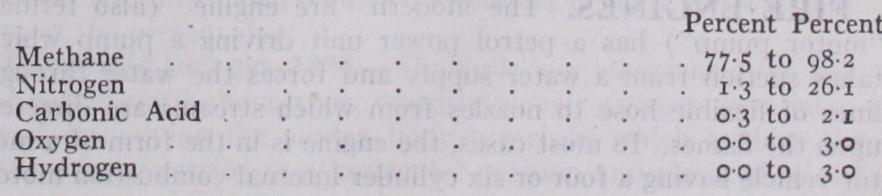
FIREDAMP, the most prevalent of the noxious and in flammable gases found in mines. The chief constituent of this gas is methane, also known as marsh gas (q.v.). Firedamp is commonly termed "gas" by the coal miner, and a mine in which its occurrence is common is known as a "gassy" or "fiery" mine. Firedamp is never found as pure methane in mines. Analyses in seams in the north of England made by Sir H. de la Beche and Mr. (afterwards Sir) Lyon Playfair in 1846 showed the gas to contain :— Sometimes, besides methane, firedamp contains a small quantity of another highly inflammable gas, ethane (q.v.). Thus samples of mine atmospheres taken in a working place (a dip drift) at the Gliickhilf colliery at Waldenburg in 1881 and analysed by Dr. Poleck for the Prussian Firedamp commission, showed its com position to be as follows 1. Percent 2. Percent Methane (CH,) . . . . . . • 32.65 Ethane (C2H6) . . . . . . 2.89 Carbonic Acid (CO2) 41.49 Carbon Monoxide (CO) 1.87 Nitrogen (N) . . . . . 20.69 20.00 Oxygen (0) S 100.00 1oo•oo The considerable quantity of carbon dioxide points to the sample being the result of decomposition. The carbon monoxide was discovered by the aid of the spectroscope. Methane is odourless, colourless and tasteless. It burns with a bluish flame forming carbonic acid and water. As it is lighter than air it rises upwards to the roof and is found in the higher parts of the workings. When mixed with air to the extent of 6.1%, the atmosphere be comes just ignitable, so that 6.1% is spoken of as the lower limit of inflammability; the most explosive mixture, however, is that which contains 9.47% of methane; that is, where there is present just sufficient methane to consume all the oxygen in the air. Eight to 14% may be regarded as the high explosive range. At 22% the mixture ceases to be explosive. Though fire damp is found chiefly in coal mines, where it exudes from the pores and cavities in the coal, its occurrence is not restricted thereto. In 1886 two explosions of firedamp occurred in the Mill Close Head mine at Darley Dale in Derbyshire, by which five persons lost their lives ; its occurrence in metalliferous mines has also been reported. It probably occurs in all coal mines, though some are commonly described as exempt, e.g., the coal mines of the Forest of Dean, but is probably generated in such small quantity as not to be detectable on the flame of a lamp or candle. The usual way of determining the presence of firedamp in the mine atmosphere is by the pale violet-blue "cap" above the flame of the safety lamp. It is detectable by this means when present to as low a percentage as (see SAFETY LAMP).
In some seams firedamp exists in a state of considerable pressure, as determined by the late Mr. (afterwards Sir) Lindsay Wood in experiments conducted by him in 188o for the royal commission on accidents in mines. For this purpose holes were driven into the solid coal, plugged and fitted with a pressure gauge, when pressures as high as 461 lb. per sq.in. were obtained after some days. The greatest volume of gas given off was equi valent to 5,927cu.ft. per hour. These, however, are abnormal figures. Sudden outbursts of firedamp, the degagements instan tanes of the Belgian miner, are an infrequent occurrence in British coal mines, usually taking place in the neighbourhood of a fault. "Blowers" of gas, the sou,ards of the French miner, are more common, a blower being a stream of gas frequently accompanied by water, continuing at a constant pressure sometimes for years.
(See also COAL AND COAL MINING.) (R. R.)