
FIREWORKS. The history of pyrotechny may be said to have begun when a prehistoric firemaker first mixed saltpetre from his cooking with charcoal from his fire, to use as tinder. In sub sequent ages other ingredients were added as pyrotechnic mixtures developed, and eventually, when the principle of the gun was evolved by Berthold Schwartz in the 13th century, the pyro technic mixture most suitable for his needs was named gun powder.
About the date of the introduction of artillery the military fire worker came into existence, whose business was to provide pyro technic engines of war, to which duty was subsequently added the provision of spectacular fireworks in celebration of victory or peace. During the i 7th and subsequent centuries most occasions of national rejoicing were celebrated by displays of fireworks; these were generally provided by the military fireworkers.
In earlier displays a limited number of pyrotechnic effects were eked out with others of a scenic or theatrical nature and the use of merely inflammable substances, in the form of torches and flares, which cannot, strictly speaking, be classed as pyrotechnics. It was not until the early part of the i 8th century that displays of a n y considerable pyrotechnic merit were produced.
During the 17th century there were two schools of pyrotechnic thought, that of northern Europe, with Nuremberg as its centre and Clarmer as its leader, and the Italian school. The former, although producing probably bet ter results from a purely pyro technic point of view, could not vie with the southern school in artistic elaboration and the scenic accessories introduced. In the earlier part of the 18th century the brothers Ruggieri, Bolognese firework artists, attracted no doubt by the lavish expenditure of Louis XV., visited Paris and produced displays at Versailles and elsewhere on a hitherto un precedented scale. One of the Ruggieris, in conjunction with one Santi, carried out the display in London which celebrated the Peace of Aix-la-Chapelle in an event which appears to have been celebrated in most of the capitals of western Europe. During the remainder of the cen tury firework displays increased both in number and scale; in addition to official exhibitions celebrating national events, the pop ular places of resort, the tea gardens and bowling greens began to add fireworks to their list of attractions. Those in the London resorts, Vauxhall, Ranelagh and Marylebone gardens, are still remembered.
As yet no real advance had been made in pyrotechnic mixtures; no colour had been introduced, the art still relied on saltpetre, which had been its foundation. (The importance attached to this salt by early writers, such as Biringoccio, is reflected in the long and elaborate dissertation they give on its preparation and refine ment.) Although some pyrotechnists claimed to produce various tints, there is no doubt De Frezier, in his two books published in and 1747, came nearest to the truth in describing the flame produced by his compositions as "reddish," "greenish," etc.
In the first quarter of the 19th century, however, the era of modern pyrotechny began with the introduction into the art of potassium chlorate, which had been discovered by Berthollet in 1788. Genuine colour effects were now possible and a field of re search was opened which, even yet, has not fully been explored. The subsequent introduction of the two metals, magnesium (about 1865) and aluminium (in 1894) also gave a brilliancy never be fore attained, and added greatly to the variety of effects produced.
The famous displays at the Crystal Palace, near London, insti tuted in 186s, have been one of the greatest factors in the devel opment of the modern display. Old-fashioned limitations and scenic accessories have been discarded and a scale and method, both in aerial and ground fireworks, have been reached which had never previously been attained, eclipsing any official effort, with the exception of the "National Peace display" in Hyde park in 1919, which was probably the greatest display produced up till that time.
Magnesium powder is used with colour compositions where ex tra brilliancy is aimed at. Most colour compositions have, in addi tion, some burnable substance which serves to increase the mass and effect without detracting from the brightness or colour. The most commonly used are shellac, sterine, sugar of milk, pitch and paraffin. Sometimes the burnable substance serves also as an agglutinant, as shellac and spirit, starch paste, gum water, linseed oil or dextrine.
Compositions are introduced into the cases in two ways, either by "charging" (when a succession of small quantities of composi tion are poured in from a scoop of suitable size, each scoopful being consolidated by a number of blows delivered by a mallet on a cylindrical wooden tool exactly fitting the bore of the case, known as a "drift"), or by "filling" with a small copper funnel having a spout of suitable size to fit the case and provided with metal rod of somewhat Iess diameter than the inside of the spout, having a knob for the hand at the upper end. Composition is placed in the funnel, the spout inserted in the case and a rapid up and down movement of the rod alternately releases a small quan tity of composition and consolidates it in the case. This method is only used with cases of small diameter.
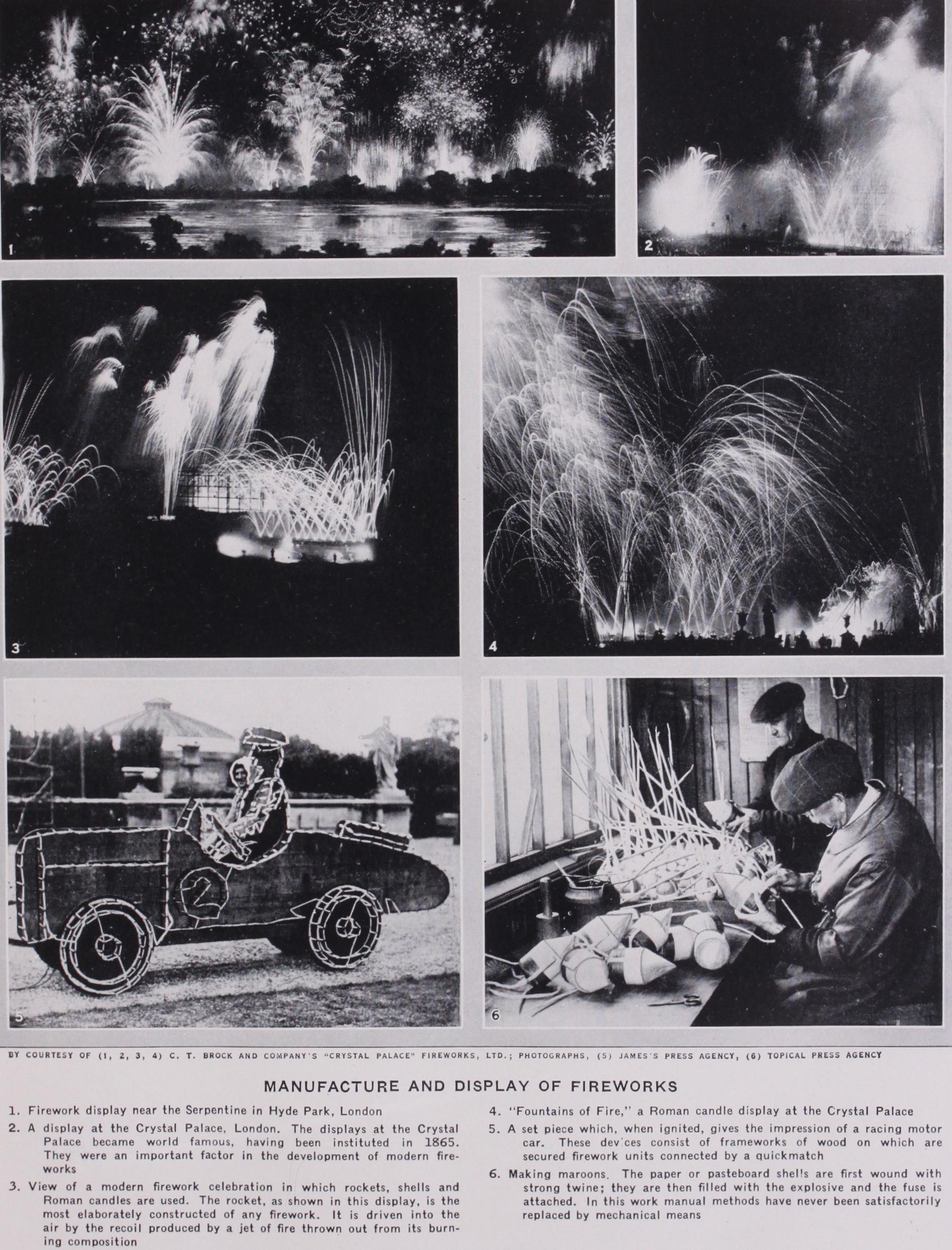
It may be as well to mention here that these manual methods have never been superseded satisfactorily by mechanical means, although many experiments have been made. In pyrotechny, as in some other crafts, hand work maintains its superiority. Rockets.—The rocket, which is the most elaborate in con struction of any single firework, also requires the highest degree of technical skill in manufacture. The sky-rocket (its most famil iar form) is driven into the air by the recoil produced from a jet of fire thrown out by its burning composition. In order to make this jet as strong as possible the case, which is wet rolled, is choked, or constricted, by pulling in with a cord near one end before dry ing. In addition, the composition is so charged into the case that a conical cavity is left from the choke or vent, nearly to the top of the case ; by so doing, when the rocket is ignited, as large an area as possible of composition is burning at the moment when it is required to give the rocket its initial impetus. This cavity is produced by charging the rocket on a tapering spindle and using drifts of varying lengths, pierced with a hole of suitable size. Above the composition in the body of the rocket is a diaphragm of compressed clay, bored with a central hole through which the fire from the top, or "heading," of the composition is communi cated to the "garniture" contained in a case, usually in the form of a truncated cone, which forms an extension of the body of the rocket and is known as the "cap." The garniture consists of "stars" of colour, or other suitable composition, either contained in short cylindrical cases, when they are known as "pinched stars" from their method of manufacture, or compressed into cylindrical form without a case, when they are known as "pumped stars." Gerbs and Fountains are charged without a central cavity, the choke generally being formed by a clay diaphragm. The composi tions are similar to those of the rocket, with the addition of spark producing ingredients. The composition for gerbs (formerly known as Chinese fire) contains iron filings; for fountains (for merly known as brilliant fire) steel filings; and for flower pots, lampblack, producing remarkable sparks, which, from their form, gave to this composition the name of spur fire. Devices and Set Pieces consist of frameworks of wood on which are secured fire work units which are connected together by quickmatch and take the form of wheels moving in the vertical or horizontal plane; stationary, or, as they are called, fixed devices, of various geo metrical forms ; waterfalls ; tree pieces and "lancework" pieces. The outline of a lancework piece is constructed in cane on a wood lattice framework and the design picked out in appropriate colour ing with lances (small cases of colour, or "bright" composition, about the size of a cigarette) ; by this means almost any pictorial design can be carried out. At the Crystal Palace, London, where this type of set piece has been most highly developed, pictures have been produced over 600ft. long and Soft. high, carried out entirely in lines of fire.
See Vannuccio Biringoccio, Pirotechnia (Venice, 1540 and De Frezier, Traite des Feux d'Artifice (17o7 and 1747) ; Ruggieri, Elemens de Pyrotechnie (18o1 and 1821) ; Chertier, Nouvelles recherches sur les f eux d'artifice (1843 and 1854) ; Websky, Lust feuerwerkkunst (Leipzig, 1878) ; Kentish, The Pyrotechnist's Treasury (1878) ; Denisse, Traite pratique complet des feux d'artifice (1882) ; A. St. H. Brock, Pyrotechnics, The History and Art of Pyrotechny (containing a complete bibliography) (1922). (A. ST. H. B.)