
FISHES, a name that has generally been applied to all those vertebrate animals that live in water, swimming by fins and breathing by gills. Most modern authorities agree in separating as a distinct class the lampreys and hagfishes, which have no gill-arches and no jaws. These are opposed as Cyclostomata (q.v.) or Agnatha to the remaining vertebrates, grouped together as Gnathostomata. The selachians (q.v.) are here also regarded as a class distinct from the true fishes, or Pisces, which are distin guished by having a more or less ossified internal skeleton, by dermal ossifications in the form of scales, bony plates and seg mented fin-rays, and by the presence of an air-bladder, or lung.
The vertebral column differs from that of the selachians in having ribs that bound the abdominal cavity, which primitively meet in the tail region to form haemal spines, and in having a series of paired elements above the neural arches that meet above to bear an unpaired series of spines. This characteristic struc ture is well seen in the living Chondrostei and Dipneusti, but is modified by fusion and reduction in other fishes.
The dermal ossification on the body, where flexibility is a re quirement, takes the form of juxtaposed rhombic bony plates or "ganoid scales" in the more generalized forms; in most recent fishes the scales are rounded and overlapping by bony plates, in cluding paired parietals and frontals on top of the skull, a para sphenoid below it, operculum, suboperculum and branchiostegals covering the gill-chamber and a series of four bones on each side overlying the pectoral arch and connecting it with the skull. Toothed bones, the premaxillaries and maxillaries, form the upper border of the mouth, and the primary upper jaw lies within the mouth, is typically connected on each side with the ethmoid region of the skull, and is generally sup ported behind by the hyomandi bular, which articulates with the skull. The septa between the gills are reduced, so that the gill lam inae project as filaments ; the gill clefts lead into the gill-chamber, which has a single external open ing. The air-bladder, originally a ventral diverticulum of the oesophagus, was perhaps first developed as an air-breathing organ. Several of the features that distinguish the Pisces from the Sela chii, especially the premaxillaries and maxillaries, the bony skele ton, the air-bladder or lung, acquire additional importance be cause they are characteristic of all terrestrial vertebrates. The Batrachia or Amphibia differ from the Pisces especially in the structure of the limbs, in having true internal nostrils, and in the modification of the hyomandibular into the stapes, but the crossopterygian fishes of the order Rhipidistia are very close to the Stegocephalia, which are the most primitive four-footed vertebrates.
The class Pisces, even as here restricted, is the largest of all the vertebrate classes, including some 20,000 living species. More over, within it is found a greater diversity of structure than in any other class of vertebrates. It has been distinct from the Selachii from Silurian times, and there is no connecting link between them. These considerations, and the important structural characters outlined above, should leave no doubt that the Pisces are entitled to be regarded as a class from which the selachians are excluded. Fishes live under a great variety of conditions, at the surface of the sea, in mid-water, at the bottom, or buried in the sand or mud, some rarely approaching the coasts, some never far from them, and some never leaving the zones between tide marks. In fresh-water they may frequent either slow rivers, mountain torrents, lakes, underground waters or swamps. Some are carnivorous, others herbivorous, others mud-eaters. They exhibit great diversity in form, coloration, size and shape of the fins, structure of the mouth and teeth, according to their mode of life.
Two general works on fishes contain good accounts of the anatomy, namely S. Bridge, Cambridge Natural History, Fishes (1904) and E. S. Goodrich, Lankester's in Treatise on Zoology, Fishes (1909) and to them the reader is referred for more details than are given below. A typical fish is spindle-shaped, laterally compressed, tapering towards the tail. The head is bounded be hind by the gill-opening, in front of which are the gill-covers: the mouth is generally terminal, the eyes lateral; in front of the eye are the nostrils, two on each side. The body is covered with scales, and the lateral line series of scales, each bearing a tubule, extends backwards from above the gill-opening. The fins, each consisting of a membrane supported by fin-rays, include one or more dorsals on the back, a caudal at the end of the tail, and an anal on the lower side of the tail, generally beginning not far behind the anus, or posterior opening of the alimentary canal. The paired fins, which are homologous with the limbs of four footed vertebrates, comprise an anterior pair, the pectorals, placed just behind the head, and a posterior pair, the pelvics.
Muscles.—The main longitudinal muscles of the fish which run backwards on each side are divided into an upper and lower portion by a horizontal septum and are divided into successive interlocking segments ; the connective tissue, septa between which are attached internally to the vertebrae and ribs, appearing exter nally, if the scales be removed, as a double series of V shaped lines. The fins have their own series of muscles ; the muscles of the eyes, jaws, etc. need not be described here.
The dermal bones that cover the upper surface of the skull include paired parietals and frontals and at the sides of the parietals in most Palaeopterygii and Crossopterygii supra temporals, which in the Neopterygii become cartilage-bones and are termed pterotics. Behind the parietals are the dermo-occipi tals, generally one median and one on each in the Crossop terygii, one or more pairs in other fishes. On the snout there are as a rule paired nasals, covering the olfactory sacs, and a mes ethmoid, which in many Neopterygii ossifies downwards into the ethmoid cartilage. Below the skull is a large parasphenoid, which, except in the Crossopterygii, generally has ascending wings in front of the prootics ; in front of the parasphenoid are the vomers, which in recent Neopterygii, except Lepidosteus and Amie, are united to form a single bone that often ossifies upwards in the ethmoid cartilage.
The upper border of the mouth is formed in the most primi tive fishes by two pairs of bony plates with toothed edges, the premaxillaries in front and the maxillaries at the sides. In the Palaeopterygii the maxillaries are attached within to the ecto pterygoids, but in the Neopterygii they are free, their front ends articulating with the ethmoid region of the skull. The premaxil laries are firmly fixed in most Palaeopterygii, and in the Cladistia, Protospondyli and Ginglymodi ossify through the ethmoid car tilage ; in other Neopterygii they are generally loosely attached, and they may extend backwards, excluding the maxillaries from the oral border, and become protractile, developing a pair of posterior processes that slide on a median keel on the ethmoid.
The eye is surrounded by a series of circumorbitals, often incomplete above; behind, the cheek may be covered by the preoperculum (Archistia, Cladistia) or there may be other bones in front of the preoperculum, a large one in the Crossopterygii be ing regarded as the homologue of the squamosal of the Tetrapoda. In the Neopterygii the preoperculum is narrow, crescentic and firmly attached to the hyomandibular and quadrate.
The membrane covering the gill-chamber contains a series of bones attached to the hyoid arch, operculum, suboperculum and branchiostegal rays ; in the Neopterygii there is an additional bone—the interoperculum—in front of the sub-operculum, be low the lower limb of the preoperculum, and attached to the lower jaw. In front of the branchiostegals and between the rami of the lower jaw there are in some Palaeoniscidae a median and paired gular plates ; the median gular persists in Arnie and the Elopidae, and in the Crossopterygii and Polypterus the paired gulars are enlarged backwards, replacing the branchiostegal rays.
The lower jaw has one or more articular bones and is sheathed by a number of bones, on the outside dentary in front, angular and supra-angular behind ; on the inside a large prae-articular and in front of it, inside the dentary, a series of bones that may extend back above the prae-articular and by some authorities are termed coronoids. Such is the structure of the lower jaw in the Archistia, Protospondyli and Ginglymodi, but in the Rhipidistia there may in addition be a series of three or four bones below the dentary, the first of which is the homologue of the splenial of the Tetrapoda. In other fishes the number of bones is re duced by loss and by fusion ; in some Neopterygii there are two only, dentary and articulo-angular.
The hyoid arch has no pharyngo- element, and the hyoman dibular or epi-hyal, generally articulates with the otic region of the skull, and at its lower end is attached to the quadrate ; but when the metapterygoid has an extensive articulation with the skull (Actinistia) the hyomandibular is small and free, and when the palato-quadrate fuses with the skull (Dipneusti) the hyoman dibular is vestigial. In the Chondrostei the attachment to the quad rate is indirect, a separate cartilaginous element intervening. In the Neopterygii the lower part of the hyomandibular ossifies as the symplectic, a bone wedged in between preoperculum and quadrate, in the Protospondyli forming an additional articulation for the lower jaw. The hyomandibular supports the operculum and suboperculum and the principal lower elements of the hyoid arch, the cerato-hyals, bear the branchiostegal rays; a median basi-hyal, the front element of the basibranchial series, may form a "tongue" in the floor of the mouth cavity.
There can be little doubt that originally the tail was straight, • ••-• ---- • • -- but it is unlikely that any known fishes with a straight tail and the caudal fin equally developed above and below are primitive in that respect. In most primitive fishes the tail bends upwards and the lower lobe is more developed than the upper (heterocercal condition) : in the lower Neopterygii and Polypterus the upturned part of the tail is so much shortened that the lower lobe becomes terminal and externally nearly symmetrical. In most Neopterygii the tail is homocercal, symmetrical, with not more than two or three upturned vertebrae, and with the upper hypurals, expanded haemal spines that bear the fin-rays, supported by the enlarged neural spines of posterior vertebrae, the centra of which have disappeared. In most Palaeopterygii the pelvic fins are similar to the anal. This is well shown in the living Chondrostei, especially Psephurus, in which the pelvic fin has a series of pterygiophores and differs from the anal in structure only in the more extensive fusion of the anterior basal segments to form a pelvis. The pec toral, from its position of greater importance, is more advanced in structure ; the coraco-scapular cartilage, formed by the fusion of the anterior basalia, is firmly anchored by dorsal and ventral outgrowths; the posterior basalia unite to form a metaptery gium. In the Neopterygii the pelvic fins are shortened, there are no basalia behind the pelvis, and the radials are reduced or absent, the fin-rays being inserted on the pelvic bones; the pectorals are as in the sturgeons in the more primitive orders, but in most there are no radials articulating with the metapterygium, which may persist as a bone that appears to be the lowest of a series of radials. The pectoral fins of the Crossopterygii differ from those of the sturgeons in that none of the radials articulates di rectly with the pectoral arch, and that the metapterygium projects outwards from the body, is segmented, and in the more advanced forms is long and bears radials on its posterior as well as its anterior side; the pelvic fins are similar, but are generally less specialized than the pectorals. These fishes have the fins more or less paddle-shaped, with long muscular lobes fringed with rays. The Actinistia are an exception, as in them the lobes are short and rounded, with a few divergent radials, perhaps articulating with the pectoral arch.
The secondary pectoral arch consists of a series of four bones overlying the primary pectoral arch, strengthening it and con necting it with the skull; from above downwards post-temporal, supra-cleithrum, cleithrum and clavicle, the last meeting its fellow in a ventral symphysis ; in the Belonorhynchii and Neop terygii clavicles are absent. In most Neopterygii the post-temporal has an upper fork attached to the epiotic and a lower to the opisthotic, but in some the lower fork is absent ; in others the post-temporal is small, simple and united to the skull; in the Apodes, Opisthomi, etc., it is absent and the pectoral arch is unconnected with the skull.
The majority of fishes exhibit obliterative countershading, that is the colour grades from dark on the back to pale below, counter acting the effect of light falling from above and producing a uni form effect. In the sucker-fishes (Echeneis), which adhere to sharks, etc., and have their backs against and in the shadow of the object to which they cling, this type of coloration is said to be reversed, as it is in the black-bellied Batensoda, a catfish of the Nile that habitually floats upside down. Oceanic fishes that swim near the surface are generally blue above and white below, e.g., tunny, flying fish; from ioo to Soo metres below the surface occur large-eyed, silvery fishes with luminous organs, such as the Myctophidae, and at greater depths Soo to 2,000 metres, where there is little or no light, the majority of the fishes are uniformly blackish, have smaller eyes and of ten have luminous organs; the Macruridae, which are believed to live at the bottom in great depths, are uniformly coloured fishes with larger eyes than those that inhabit the middle depths, a curious feature as yet unex plained. Many coastal fishes are spotted, mottled or barred in such a way that they resemble the ground, or the rocks and weeds among which they live. Without observation of a fish in its natural surroundings it may be difficult to understand its color ation. A number of unrelated species of sea-perches are covered with hexagonal reddish spots separated by a pale network; a fish so coloured, when wounded. was observed by Alcock to take refuge in a clump of corals, where it lay concealed, the red spots exactly resembling the coral polyps.
Many tropical fishes have a brilliant coloration. The chaeto donts, characteristic coral-reef fishes, exhibit an extraordinary variety of markings, all of which, however, conform to Mottram's definition of concealing patterns, in that they break out at the margin and tend to conceal the shape.
Colour Changes.—The tropical sea-perches from Bermuda in the New York aquarium are of interest for their sudden changes of colour and markings, one species changing from yellow to red or brown, another turning on or off dark cross-bars and spots; under natural conditions the different colour-phases probably harmonize with different environments. The flat-fishes have long been known to simulate closely the ground on which they lie. Sumner, experimenting with a Mediterranean flat-fish (Platoplirys podas) obtained some remarkable results by placing them on patterns such as black and white squares; on such backgrounds the fish responded more slowly than on sand, gravel or mud, but with practice changed more rapidly than at first. The capacity of this species to adapt itself is limited to the black, grey, brown and white of its usual habitat, and it has definite spots or mark ings that vary in relative intensity or may disappear, but always occupy the same position when present. Mast has found that flat fishes of the genus Paralichthys can assume various colours that correspond closely to the background, although yellows and browns take much less time to copy than reds, greens or blues. These effects are produced by the concentration or distribution of granules of pigment in the pigment cells of the skin, under the control of stimuli received through the eyes. The flat-fish has to see the ground before it can resemble it, although there is no visual comparison of skin with ground. (See also p. 328d.) The locomotion of fishes has been studied by Breder (r926); in most fishes muscle segments of one side contract successively from head to tail, and then those of the other side, progression being accomplished by alternate strokes to right and left: this is the method adopted for rapid swimming by fishes of the normal spindle-shaped form. In swift oceanic fishes the dorsal and anal fins are generally small and serve as keels, the caudal fin is strong and forked, with pointed lobes, able to cleave the water; the paired fins are pointed and are folded into the body in forward swimming, but are used in turning movements, in slowing down, etc. Such fishes have long narrow gill-openings, and the ejection of water through these—jet propulsion—is considered to be of considerable importance in forward movement.
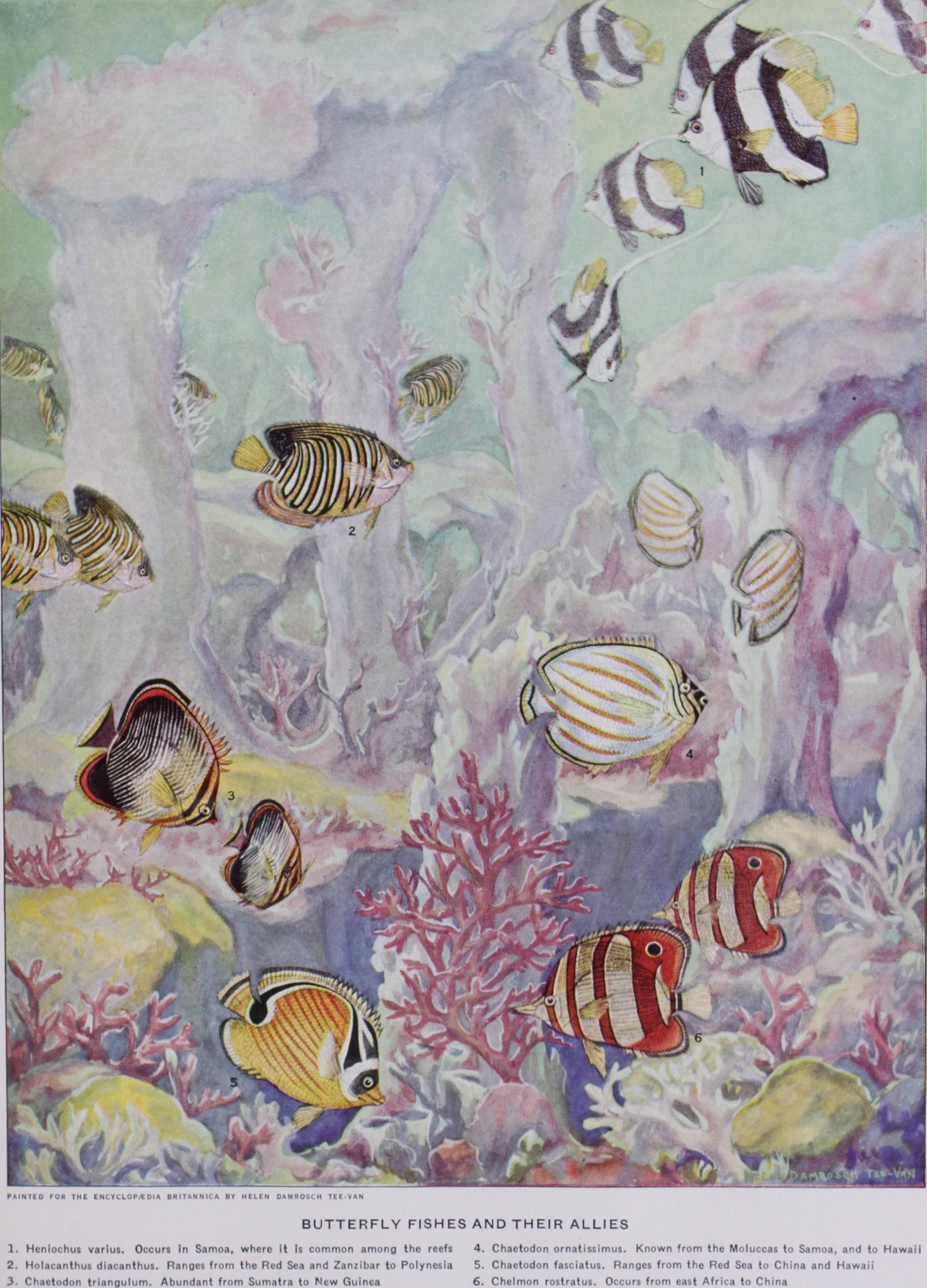
The less active fishes may show great departures from the normal, in form, structure of the fins and methods of locomotion. Elongate fishes, such as eels or ribbon-fishes, move in a serpentine manner, curves alternately to one side or the other passing back wards als ng the body ; undulating movements of the long dorsal or anal fins may assist. Deep-bodied fishes such as the plectog naths may keep the body nearly rigid, swimming by lateral strokes of the caudal and undulations of the dorsal and anal. Gobies, some wrasses, etc., swim by strokes of the pectorals.
The majority of fishes come together in large shoals at the breeding season, when the eggs and sperm are extruded in the water. There is generally a migration to the breeding places, fresh water fishes often making their way up-stream into the smaller rivers, or congregating on shallows, marine fishes seeking areas from which the eggs and larvae, if pelagic, will be carried by the currents in the right direction, or places where the ground is suitable for the eggs if these lie or are attached at the bottom. Some marine fishes, such as the shads, are anadromous, entering rivers to breed ; other fishes that may feed and grow in fresh water breed in the sea; these are termed katadramous; the eels (Anguilla) and Galaxias attenuatus are examples. J. Schmidt has shown that many fishes are peculiarly sensitive to external con ditions at the breeding season ; for example the species of Anguilla require at this time water of a high temperature and a high salinity at about 500 metres below the surface; the migration of the European eel across the Atlantic is related to this need.
In most fishes there is no definite pairing and no care for the eggs and young. All the important northern food-fishes except the salmon, herring and shad produce great numbers of eggs that float in the sea ; in some species of Gadidae a single fish sheds millions of eggs annually. The Salmonidae breed on gravelly shallows in rivers, and bury the eggs, so that these and the larvae are protected. Many Cyprinidae breed among weeds, to which the eggs adhere.
In other fishes there may be a definite courtship and pairing; it is among these that marked sexual differences may occur, the males being brightly coloured, with enlarged and beautifully marked fins ; the eggs are generally few in number and are cared for by one or both parents, usually the male. A nest may be made, either by excavating and clearing a hollow at the bottom, as in some Centrarchidae and Cichlidae, by clearing a space among the weeds in a swamp (Heterotis, Ophiocephalus), or by cementing together bits of weeds (sticklebacks). In some Anabantidae the male blows bubbles that form a mass of foam floating on the water ; as the eggs shed by the female fall through the water he collects them in his mouth and sticks them on to the under side of the nest, which he guards. In many Cichlidae the mother keeps the eggs in her mouth until they hatch; afterwards she swims with the brood, and opens her mouth for the little fish to swim into it at any sign of danger. Many gobies, cling-fishes, etc., lay their eggs in the shells of oysters or mussels, or on the under side of a stone. In the pipe-fishes and sea-horses the male receives the eggs into a groove or pouch on the under side of the tail or belly, and keeps them until they hatch.
Some fishes are viviparous, such as Embiotocidae or surf fishes of the north Pacific, and many cyprinodonts.
Larvae.—The time of hatching and the size of the newly hatched larvae vary greatly according to the size of the egg, some species starting life at a length of about 3 mm. The larva is generally transparent, with pectoral fins, a continuous median fin without rays, a notochord and a straight gut ; the mouth may not be formed until the yolk-sac disappears, when the little fish begins to feed. As it grows the dorsal, anal and caudal fins appear in the continuous fin-fold, and the pelvics are developed. The tail is at first straight and symmetrical, and the first indication of a caudal is the development of a mass of pro-cartilage, which later becomes the hypurals, below the notochord at some distance from the end of the tail; in connection with this the caudal fin rays are developed ; next the end of the tail turns upwards, so that the caudal fin becomes terminal, and the projecting end of the notochord, with its membranous fin, disappears. The ossifi cation of the skeleton and other changes that give the young fish nearly the organization of the adult occur when it is quite small, usually less than an inch long. Some pelagic larval and post-larval fish have curious structures that disappear later, such as the long spines on the body of the larval Mola, or the long filamentous fin-rays of the larval Trachypterus.
The fins vary in their development, the dorsal appearing before the anal in the Clupeidae, the anal before the dorsal in the Iniomi. In some Nototheniiformes the larvae have large pelvic fins. In the Clupeidae the dorsal is fully developed far back, and then moves forward to its position in the middle of the length. In the young swordfishes both jaws are produced, and the lower becomes the shorter later on, but in the Belonidae the lower jaw is first prolonged and the upper grows out to equal it afterwards. In the Elopidae, Albulidae and Apodes the larval life is prolonged, the transparent compressed larva attains a considerable size, in some Apodes as much as a foot in length, and the change into the young fish is accompanied by a shrinkage in depth and length.
Among fresh-water fishes many larval adaptations may occur, such as adhesive organs (sturgeons, Lepidosirenidae, etc.) external gills (Lepidosirenidae, Polypterus), and the prolongation of the gill-filaments to the exterior (Heterotis, Gymnnarchus) .
In Middle Devonian strata the Palaeopterygii are represented by Palaeoniscidae (Cheirolepis, Rhadinichthys) and the Cros sopterygii by both Rhipidistia and Dipneusti, so that already the Pisces had had a long history and undergone considerable differ entiation. The Palaeoniscidae flourished until the Jurassic, and with them from the Carboniferous the Platysomidae, and later, in Triassic times, another off-shoot, the Catopteridae. The Archistia became extinct in the Cretaceous period ; the Belono rhynchii flourished in the Triassic and became extinct in the Jurassic. The Chondrostei began in the Jurassic with Chondros teus, but little is known of other forms leading to the modern stur geons, and of the Cladistia (Polypterus) no fossils are known. Throughout Palaeozoic times the Rhipidistia and Dipneusti flourished, but in the Triassic dwindled. The Ceratodontidae, rep resented to-day by Neoceratodus in Queensland, date from this period. The Actinistia ranged from the Upper Devonian to the Cretaceous. Thus the subclasses Palaeopterygii and Cros sopterygii, which were dominant in Palaeozoic times, held on through the Mesozoic, during which most of the orders became extinct, and are represented to-day by a few remnants, the stur geons, polypterids and lung-fishes.
The Neopterygii began in the Upper Permian with the Semiono tidae, a family which flourished in Triassic and Jurassic times and gave rise to a number of other families of Protospondyli, which became extinct in or before the Cretaceous, except the Amiidae and Lepidosteidae, still living in North America. One Jurassic off-shoot of the Semionotidae, the herring-like Pholi dophoridae, gave rise towards the end of the Jurassic to the Leptolepidae (Isospondyli), the first fishes with a true homo cercal caudal fin, very near the Elopidae, which were abundant in the Cretaceous and are still in existence. During the Cretaceous the Isospondyli evolved and several off-shoots of this order ap peared, notably the Iniomi (Sardinioides), the Heteromi (Halo sauridae), the Apodes (Urenchelidae) and the Berycomorphi, these being the first spiny-rayed fishes. The earliest true perch (Prolates) appeared at the very end of the Cretaceous. The Tertiary history is very imperfect, but it is probable that most of the modern families date back to the early Eocene. In the Lower Eocene (London Clay) are a scorpaenid, and several sword-fishes and Scombridae. In the Upper Eocene of Monte Bolca occur several modern genera, and representatives of the Plectognathi, Pediculati, Discocephali, etc.
The microscopic plants, diatoms, etc., at the surface of the ocean are the basis of oceanic life ; these are eaten by small pelagic Crustacea, etc., these again by the fishes, and the smaller fishes by larger ones. Some authorities have asserted that the small organisms that constitute the plankton are much more abundant in the colder seas than in the tropics, and consider that the im portance of the northern fisheries is due to this. The truth is that plankton is more abundant in coastal waters than in the open ocean, and that although in northern waters there may in the right season be an abundance of plankton exceeding anything found in the tropics, this is no true index of annual production, growth and reproduction being quicker, and seasonal fluctuations less in the warmer seas. Moreover, the importance of plankton for bottom-living coastal fishes may have been overestimated. Petersen has found that detritus from the land and from sea weeds is the food of the bottom-living invertebrates on which these fishes feed. Descriptions given of the enormous shoals of gray-mullet, scombroids, etc., seen in tropical seas do not support the view that fishes are more abundant in colder waters. In the warmer seas there is a much larger number of species, and the number of individuals of any one species is consequently less; the herring must outnumber any of the numerous tropical species of Clupeidae. But the importance of the great fisheries of the north Atlantic, including the North sea, is not due to abundance of plankton, but to the presence of large areas less than 500 metres in depth, the grounds inhabited by the cod, plaice, etc.; it is these bottom-living fishes of the continental shelf on which the great trawling industries depend.
Little can be said of bathypelagic and abyssal fishes, except that some are known to have a world-wide distribution; others may be more restricted, but our knowledge is as yet incomplete. It is of considerable interest that the ridge, less than i,000 metres in depth, extending from Scotland to Iceland and Greenland, is a barrier to Macrurus, which does not occur north of it. There is some evidence that species of Macrurus may be localized in parts of the Pacific from a similar cause.
There are two main divisions of the tropical zone, American and Indo-Pacific. Jordan and Evermann, generally with good reason, separate generically most of the American species from their Old World allies. There are other American genera that have always been recognized as distinct, e.g., Centropomus, the nearest relative of which is the Indo-pacific Ambassis. The fishes of the Pacific coast present a great similarity to those of the other side, most of the genera being the same, but the species different ; this is due to the continuity of the two oceans in Eocene times across the isth mus of Panama. The Indo-pacific region extends from East Africa to Polynesia; it includes many more genera and species than the American region. West Africa has a comparatively poor fauna, but shows more affinity to the Indo-Pacific than to America. Thus of the flat-fishes Psettodes, Solea, Synaptura and Cynoglossus are genera common to West Africa and the Indian ocean. It seems probable that in Eocene times, when the Mediterranean com municated with the Indian ocean, a tropical Indo-pacific fauna ex tended through the Mediterranean to West Africa, and that the present West African fauna is mainly a remnant of this. The fishes found fossil in the Upper Eocene of Monte Bolca, Italy, include some genera now living only in the Indian ocean.
Australia and Madagascar.—Each of the great regions pro posed by A. R. Wallace and P. L. Sclater for the mammals has a well-defined fish fauna, and the proposal made by some authori ties to consider Madagascar distinct cannot be opposed from a consideration of the fishes, although its chief characteristics are negative. The Australian region and Madagascar, indeed, may be considered together, being characterized by the complete absence of Ostariophysi, except species of the secondarily marine Siluroid families Ariidae and Plotosidae. For the Australian region the only true fresh-water fishes are the archaic. Ceratodus and a species of Scleropages, the other species of this genus inhabiting Borneo. Scleropages belongs to the Osteoglossidae, a primitive and widely distributed family, probably dating back to early Cretaceous times. The rivers of Australia and New Guinea con xain many species of the marine families Ariidae, Plotosidae, Clupeidae, Serranidae, Atherinidae, Gobiidae, etc. Wallace's line may be regarded as the boundary between the Indian and Aus tralian regions ; the contrast between Borneo with its rich fauna of carps, loaches, cat-fishes, labyrinthic fishes, etc., and Celebes, without a single indigenous true fresh-water fish, is a striking one. Madagascar has none of the characteristic African families except a few peculiar Cichlidae, and as these are mainly brackish water species they do not negative other evidence that the sever ance of Madagascar from Africa is ancient, perhaps as ancient as that of Australia from Asia.
Of the siluroids, or catfishes, South America has a large and varied assemblage, belonging to nine families, all endemic, in cluding the primitive Diplornystes of Chile and such highly specialized forms as the Loricariidae, armoured, and with the lips forming a sucker. Africa and southern Asia have three families in common, one the Bagridae, rather closely related to the Pime1odidae of South America; each continent also has peculiar families. The Palaearctic region has few siluroids, Silurus, some Bagridae, etc. The North American cat-fishes are Amiuridae, a family closely related to the Bagridae.
I. Australia, with the islands east of Wallace's line. No Ostariophysi except Ariidae and Plotosidae.
2. Madagascar. No Ostariophysi except Ancharius (Ariidae) .
3. Neotropical Region. South and Central America. Characini formes ; Characinidae in common with Africa, four endemic families. Gymnotiformes. Siluroidea ; nine endemic families.
4. Ethiopian Region. Africa. Characiniformes ; Characinidae in common with South America, Citharinidae endemic. Cyprinidae: Indian genera. Siluroidea ; three families in common with India, three endemic.
5. Indian Region: India and South-East Asia, with Java, Sumatra and Borneo. Cyprinidae numerous, mostly Danioninae and Cyprininae: Cobitidae: Homalopteridae. Siluroids numerous with endemic families.
6. Palaearctic Region. Europe, and Asia to the Himalayas and Yang-tse-Kiang. Cyprinidae ; Cyprinines and many Leuciscines. Cobitidae. Siluroids few, of Indian families.
7. Nearctic Region. North America. Leuciscine Cyprinidae. Cato stomidae. Amiuridae.
The distinctness of the different regions is emphasized when other fresh-water fishes are considered, for although the Palae arctic and Nearctic regions have in common the Haplomi (Esocidae, Umbridae) and the Percidae, North America is characterized by Lepidosteus and Amia, Hiodontidae, Amblyop sidae, Percopsidae, Aphredoderidae, Centrarchidae, and the nu merous dwarfed Percidae known as darters. Africa also has sev eral endemic families, Polypteridae, Mormyridae, Kneriidae, Phractolaemidae, etc. As in Central and South America, there are in Africa numerous species of cichlid perches, but the fondness of some of these for brackish lagoons makes them, like the cyprinodonts, unreliable as evidence of former land connections. Much more important are the characins, and the Lepidosirenidae, with Protopterus in Africa and Lepidosiren in South America, the latter family specialized for fresh-water life in the tropics.
From the available palaeontological evidence it seems clear that the present distribution of fresh-water fishes was in the main accomplished at the beginning of the tertiary. In Eocene beds of North America occur Catostomidae, Amiuridae, Percidae and Centrarchidae. In Europe modern genera of Cyprinidae occur in Oligocene and Miocene deposits. It is generally accepted that in the Eocene the continents were isolated and developed peculiar faunas, and that at the end of the Eocene the present connections became established, joining North to South America, Africa and India to Eurasia, and in addition joining Asia to North America across the Bering sea. These connections allowed migrations and interchanges which produced considerable effects on the terres trial faunas; but so far as can be judged they accomplished little for fresh-water fishes, beyond the introduction of leuciscines into North America from Asia, and of Cyprinidae and perhaps Clarii dae from India to Africa. In Central America some neotropical types have penetrated to southern Mexico, but none has got on to the Mexican plateau. In the other direction the ancient Lepidosteus has reached Panama, and two or three nearctic genera are found in Guatemala. But it is a fair statement to say that the very distinct nearctic and neotropical fish faunas barely meet, much less overlap, in striking contrast to the invasion of South America by northern mammals and reptiles.
To summarize, it appears that for fresh-water fishes, as com pared with mammals, migration is much more difficult but sur vival more easy; the post-Eocene connections that enabled mammals to roam the world had little effect on the distribution of fresh-water fishes. These are, however, very important as a clue to the distribution of land and water in Cretaceous times, for it is almost impossible that the relationship between the fishes of Africa and South America is due to migration from the north. It seems probable that in early Cretaceous times South America and Africa were one continent, which extended to India, but not through Madagascar. In this con tinent the Ostariophysi originated and evolved, so that when it was broken up towards the end of the Cretaceous, these were at least Characinidae and Pimelod idae in South America, Characin idae and Bagridae in Africa, and Cyprinidae and Bagridae in India.
Since then South Africa has been isolated and has developed its rich and remarkable fauna, colonizing Central America when the connection was established. India must have been connected with eastern Asia and thus with North America during some part of the Cretaceous, for the ancestors of the Catostomidae and Amiuridae reached North America from Asia before the Eocene.
Sub-class I. PALAEOPTERYGII.-Scales, when ganoid, formed of parallel layers of ganoine near the surface, and of bone within, separated by a layer of cosmine. Dorsal and anal fins with the dermal rays more numerous than their skeletal supports (except the dorsal of Polypterus), which typically form a regular series, with the radial segments well developed. Pectoral fin with one or more anterior radials articulating with the pectoral arch the rest with a metapterygium; pelvic with a well-developed series of radials, and often with the posterior basals free, not incorporated in the pelvis. Skull with few cartilage bones, lateral ethmoids, an unpaired sphenoid in the orbital region, a basioccipital and paired opisthotics being the usual ossifications. Maxillary firmly attached to ectopterygoid. Lower jaw without splenial or other bones below the dentary. No interoperculum and no symplectic. Clavicles present (except in the Belonorhynchii).
Order I. Archistia.—Body usually covered with ganoid scales. Caudal fin heterocercal. Head covered with bones; preoperculum large, extending forward over cheek. Snout short ; mouth normally formed, with fixed premaxillaries, and with palatines attached to ethmoid region of skull. Clavicles present. Vertebral column acentrous. This order includes the Palaeoniscidae, Platysomatidae and Catopteridae.
The Palaeoniscidae, which range from the lower Devonian to the end of the Jurassic, show a combination of primitive char acters that entitles them to be regarded as the ancestors of all other fishes, except the Crossopterygii. They are elongate f uni form in shape, with a short and blunt snout projecting a little in front of the rather large mouth, which has acute conical teeth in the jaws. The dorsal fin is short, placed above or behind the pelvics. The Palaeoniscidae were evidently active, predacious fishes. Numerous genera are known, of which the Devonian Cheirolepis is remarkable for the long-based pelvic fins.
The Platysomidae, known from Carboniferous and Permian strata, are deep–bodied, with longer dorsal fin, smaller mouth and blunter teeth than the Palaeoniscidae. The Triassic Catopteridae differ from the Palaeoniscidae especially in the shortness of the upturned end of the tail.
Order 2. Belonorhynchii.—Body with four series of bony scutes. Caudal fin symmetrical. Snout and lower jaw very long; premaxillaries present, and palato-quadrates as in the Archistia. No clavicles. Veterbral column acentrous. The Triassic Saurich thyidae are pike-like fishes, whose structure has recently been elucidated by Stensio (1925).
Order 3. Chondrostei.—Body naked, or with vestigial scales, sometimes with series of bony scutes. Caudal fin heterocercal. Snout prominent : jaws toothless ; premaxillaries absent ; pterygo quadrates meeting below skull, protractile. No preoperculum. Clavicles present. Vertebral column acentrous.
The Liassic Chondrosteidae differ from the modern Acipen seridae and Polyodontidae in having a series of branchiostegal rays. The Polyodontidae include Polyodon folium, the spoon-bill of the Mississippi, and Psephurus gladius of Chinese rivers. The Acipenseridae, or sturgeons (q.v.), differ in having the mouth smaller and more protractile, with a transverse row of barbels in front of it, and in having five series of bony scutes along the body. There are about 20 species of Acipenser from north tem perate seas, entering rivers to spawn; several inhabit the Black and Caspian seas. Scaphirhynchus has four species, one from the Mississippi, three from the rivers of Tartary. All the Chondro stei are believed to feed mainly on small invertebrates found in mud, which they stir up with their snouts when feeding.
Order 4. Cladistia.—Scales, head skeleton, pectoral arch, etc. nearly as in the Palaeoniscidae ; anal fin with rays more numerous than radials, and pelvics with well-developed radials; but other fins more specialized, the pectorals with one large radial articu lating with the pectoral arch and numerous small ones articulating with a plate developed between them and the metaperygiuris ; caudal abbreviate heterocercal (as in Amia) ; dorsal long, with each ray supported by its own basal, and all but the posterior ones spaced forming strong spines. No branchiostegals, but a pair of large gular plates. Vertebral column with bony centra. The single family Polypteridae inhabits the fresh-waters of Africa ; it includes Polypterus, of which ten species are known, and the eel-shaped Calamichthys. As in the Dipneusti, the air bladder is lung-like, and is used as an accessory organ of respira tion. The larvae have a pair of large pinnate external gills.
Sub-class 2. NEOPTERYGII.-This sub-class includes the groups formerly known as Holostei and Teleostei ; to it belong the great majority of living fishes. Its characters can best be understood by comparing the organization of its earliest and most primitive family, the Semionotidae, which ranged from the Upper Permian to the Jurassic, with that of the Palaeoniscidae, the only known fishes from which they can have been derived. The typical palaeo niscids appear to have been swift-swimming predacious fishes, with a large mouth and sharp teeth, whereas the Semionotidae were slow-swimming fishes, feeding at the bottom on shell-fish, etc., and had a small mouth with styliform or tritorial teeth. Most of the differences between the Palaeoniscidae and the Semiono tidae can be interpreted as related to this difference in habits. The dorsal and anal fins of the Palaeoniscidae, with numerous rays forming a close-set series, are fitted for cleaving the water and withstanding strains. In the Semionotidae the fin-rays are much reduced in number, are set well apart and are united in pairs; the muscular lobe at the base of the fin is reduced, the radial segments of the pterygiophores are shortened, and each fin-ray articulates with its own radial and has its own muscles. Such fins can perform the delicate movements needed by a fish at rest or swimming slowly. Correlated with this modification of the dorsal and anal fins is the shortening of the upturned end of the tail, so that the caudal fin becomes terminal, and the narrowing of the bases of the paired fins. The preoperculum, which in the Palaeoniscidae was a plate covering the cheek, be came in the Semionotidae a strong crescentic bone firmly attached to the hyomandibular and quadrate, and the lower end of the elongated hyomandibular ossified as the symplectic, wedged in between quadrate and preoperculum, and at its anterior end form ing an additional articulation for the broad lower jaw. This con solidation of elements is necessary for the articulation of a lower jaw that is massive and used for crushing. In the Semionotidae, as in the Palaeoniscidae, the operculum and suboperculum are the upper elements of a series of branchiostegal rays, but in the Semionotidae there is an additional bone of some interest, the interoperculum, which lies between the suboperculum and lower jaw; it seems that the suboperculum, retaining its attachment to the posterior end of the lower jaw, has been elongated and frac tured so that the posterior part may retain its freedom of move ment, the anterior, overlapped by the lower limb of the pre operculum, being the interoperculum.
The Semionotidae also possess other important differences from the Palaeoniscidae that are not evidently related to different habits, e.g., the absence of a cosmine layer in the scales, the disappearance of the clavicles, more ossifications in the chondro cranium, etc. It is of interest that most of the adaptive features first acquired by the Semionotidae in relation to their habits have persisted in all the members of the sub-class, whatever their manner of life. Thus there are many swift and predacious Ne opterygii, in which the dorsal and anal rays have increased in number and form a close-set series; but the skeletal supports have increased in number with them and thus the essential feature, that each ray articulates with its own radial is retained : such fishes have a widely forked caudal fin, but the upper fork is formed by the outgrowth of fin-rays, not by the upturned end of the tail; they may also have a large mouth, so that the pre operculum has no lower limb ; but they retain the interoperculum, which was first developed in relation to a small mouth and a preoperculum with a long lower limb. The Neopterygii may be diagnosed as follows : Scales, when ganoid, of parallel layers of ganoine outside and of bone within, without a cosmine layer. Dorsal and anal rays equal in num ber to their skeletal supports, each articulating with its own radial, which is small, or fused with the basal. Caudal fin abbreviate hetero cercal or homocercal. Pectoral fins with all or some of the radials articulating with the pectoral arch ; pelvic fins with radials reduced or absent, the rays articulating with the pelvic bones. Typically a sym plectic and an interoperculum. Skull typically with orbitosphenoids and alisphenoids and with five otic bones on each side. No clavicles.
Order i . Protospondyli.—Caudal fin abbreviate heterocercal with all the hypurals supported by the upturned end of the verte bral column. Centra absent, or variously developed. Premaxil laries fixed, firmly attached to frontals, pierced for passage of olfactory nerves. Maxillaries movable, anteriorly articulating with ethmoid region of skull. Lower jaw with dentary, angular and supraangular on the outside, with large dentigerous pre articular on the inside, and with two articular bones for the quadrate and one for the symplectic, which articulates with it above and outside the quadrate. Hyomandibular firmly attached to quadrate, and preoperculum to both. One coracoid bone, or none ; mesocoracoid bridge cartilaginous ; one or more pectoral radials on metapterygium. Scales often ganoid.
This order includes a number of families found fossil in Mesozoic strata. The Semionotidae, with small mouth and short dorsal fin, the Macrosemiidae with a longer dorsal, the Eugna thidae, predacious fishes with large mouth, sharp teeth and forked caudal fin, the Pachycormidae, mackerel-like fishes, the Pyc nodontidae, deep-bodied fishes with crushing teeth, resembling the modern Plectognathi, and the Aspidorhynchidae, in which the premaxillaries are prolonged into a beak, as in the swordfishes. The only living member of the group is the bowfin (Amia calva), a fresh-water fish of North America, belonging to a family that dates back to Cretaceous times and is distinguished from the Eugnathidae by the longer dorsal fin, rounded caudal, thin overlapping scales, and by the solid centra of the vertebral column.
Order 2. Ginglymodi.—Distinguished from the preceding by the structure of the jaws, suspensorium and opercles. Snout and lower jaw long; maxillary segmented, the first one or two seg ments attached to premaxillary, the rest to the ectopterygoid ; metapterygoids articulating with transverse facets on wings of parasphenoid : hyoid arch free from pterygo-quadrate ; preoper culum small, its anterior end articulating with a condyle on quadrate ; interoperculum large, fixed, connecting hyomandibular with preoperculum. Vertebrae solid, opisthocoelous.
Lepidosteus, with a few species from the fresh-waters of North America, is related to the Semionotidae, and differs from them especially in structural readjustments related to the prolongation of the jaws; the quadrate retains its anterior position, and the strain imposed on the suspensorium by the long and powerful lower jaw is relieved by the support afforded by the metapterygoid articulation with the parasphenoid. The gar-pikes (q.v.) or alligator-gars, are sluggish piscivorous fishes with strong conical teeth ; they are the only living Neopterygii with ganoid scales.
Order 3. Halecostomi.—Differ from the Protospondyli in that the premaxillaries are small and loosely attached, the maxil lary has a convex oval border and bears two supplemental bones, and the lower jaw has no supraangular. Vertebral centra annular or biconcave. The Mesozoic Pholidophoridae had minute teeth, and were evidently plankton-feeders like the herrings, which they resemble in form and shape of the fins. The Oligopleuridae are distinguished by thin cycloid scales.
Order 4. Isospondyli.—Caudal fin homocercal, i.e., the up turned end of the vertebral column is short, with not more than two or three centra, and the upper hypurals are supported by paired bones—uroneurals—that appear to be the enlarged neural arches of posterior vertebrae that have aborted. Fins without spinous rays : pelvics generally abdominal in position. Air-bladder with an open duct. Maxillaries generally forming part of upper border of mouth. Lower jaw without supraangular and without or with small praearticular. An endochondral supraoccipital. Coraco-scapular cartilage typically with three ossifications, in cluding a mesocoracoid ; pectoral radials articulating direct with pectoral arch, the lowest perhaps representing the metapterygium. Vertebrae biconcave. Scales not ganoid.
The principal families may be arranged as follows: I. Parapophyses generally small distinct elements wedged into pits in the centra.
A. Oviducts generally complete.
I. No photophores; mouth toothed, the maxillary, when well developed, with two supplemental bones ; branchiostegals five or more, no adipose fin. Leptolepidae, Elopidae, Albuli dae, Saurodontidae, Alepocephalidae, Clupeidae, Cteno 2. mouth small, toothless; three or four branchiostegals ; no adipose fin. Chanidae, Kneriidae, Phrac tolaemidae, Cromeriidae.
3. Photophores present: Gonostomatidae, Sternoptychiidae, Enchodontidae, Astronesthidae, Chauliodontidae, Stomiati dae.
II. Parapophyses ankylosed with centra, appearing as strong pro cesses.
A. Parietals meeting: entopterygoid articulating with a lateral peg on parasphenoid. Osteoglossidae, Pantodontidae.
B. Parietals meeting ; air-bladder with an anterior vesicle on each side connected with otic region of skull. Hyodontidae, Notop teridae.
C. Parietals meeting ; a large cavity on each side of skull, above the pterotic, containing a vesicle detached from the air-blad der. Mormyridae, Gymnarchidae.
D. Parietals small, separated by supraoccipital ; mouth small, toothless. Gonorhynchidae.
The Jurassic and Cretaceous Leptolepidae scarcely differ from j the Elopidae, also found in Cretaceous strata and represented to-day by two genera from tropical seas. They have a large terminal mouth with bands of small conical teeth, two supple mental maxillaries, numerous branchiostegal rays, a median gular plate behind the syrrlphysis of the lower jaw, as in Amia, dorsal fin above or a little behind the many-rayed pelvics, and widely forked caudal. Megalops atlanticus, the tarpon (q.v.) found on both sides of the Atlantic, is a much larger fish than its Indian congener. Elops, with seven species, is a widely distributed genus; these are silvery fishes, slender in form, and very active. The Albulidae differ from the Elopidae in having no gular plate and the mouth small, subterminal. Albula vulpes is a silvery fish found on sandy coasts throughout the tropics. Pterotlirissus gisu, with long dorsal fin, is an albulid from deep water off Japan. The Cretaceous Saurodontidae are very near the Elopidae, but have stronger teeth. The Alepocephalidae are bathypelagic or abyssal, deep-blue, purple or blackish fishes, with the dorsal fin above the anal; some 5o species are known. The Clupeidae, with over 200 species, differ from the Elopidae in having no gular plate and in certain skeletal characters ; paired anterior diverticula of the air-bladder expand into vesicles inside the otic region of the skull. Most Clupeidae are marine, and swim in shoals near the surface, generally feeding on plankton. The herring, Clupea harengus, of the north Atlantic, is one of the most important food-fishes. Sardina includes the pilchards (q.v.) or sardines, found north and south of the tropics ; Sardinella and Harengula are allied tropical genera. Chirocentrus dorab of the Indo Pacific, a predacious fish with strong acute teeth, retains the spiral valve of the intestine. Alosa of the north Atlantic and Mediterranean comprises the shads, which enter rivers to breed; allied genera with similar habits are Caspialosa of the Black and Caspian seas, Brevoortia (menhaden) of the Atlantic coast of America and Hilsa of the Indian ocean. The anchovies (Engraulis, etc.) are small fishes of warm seas, distinguished by the project ing snout. Chows chanos of the Indo-Pacific, the only species of the Chanidae, reaches a length of five feet ; it feeds on algae and sometimes enters fresh-water. The Kneriidae, Phractolaemidae and Cromeriidae are small African fresh-water fishes. The Iso spondyli with photophores, generally arranged in two rows along each side of the body, fall into two groups, the Gonostomatidae and Argyropelicidae, with two supplemental maxillaries and re lated to the Elopidae, and the more specialized Astronesthidae, Stomiatidae, etc., with slender maxillary without supplemental bones. These are all oceanic, some living at considerable depths below the surface.
The Salmonidae are distinguished from related families with an adipose fin and without oviducts in that the last two or three vertebrae turn upwards at the base of the caudal fin. They are primarily marine fishes of arctic and northern seas that enter rivers to breed, but include a number of fresh-water species in Europe, northern Asia and North America. The principal genera are Salmo, salmon and trout (qq.v.), Salvelinus, char (q.v.), Coregonus, whitefish (q.v.) and Thymallus, grayling (q.v.). The Argentinidae and Microstomidae are marine, deep-water or oceanic fishes, and the Osmeridae, or smelts, differ from the preceding families in having no orbitosphenoid, and in the presence of a series of teeth along the inner edge of the entopterygoid, char acters that persist in the remaining salmonoid families, which, however, are distinguished by the loss of the mesocoracoid. The Osmeridae, like the Salmonidae, are northern marine fishes ; they breed in inlets, estuaries or rivers, generally in brackish water. Mallotus, capelin ; T/ialeitIithys, eulachon ; and Osmerus, smelt (q.v.) are important genera, Plecoglossus altivelis is the ayu of Japan. The Salangidae of China and Japan are small, slender, translucent fishes. Retropinna of Australia and New Zealand differs from the Osmeridae mainly in the loss of the mesocoracoid and leads to the other southern families, the Haplochitonidae, in which the premaxillaries extend nearly the whole length of the maxillaries, and the Galaxiidae, which have no adipose fin, the dorsal being above the anal. Galaxias attenuatus, from Patagonia, southern Australia and New Zealand, is remarkable in that it reverses the habits of its northern allies, descending to the sea to breed; the other species of Galaxias are mostly confined to fresh water. The Osteoglossidae have large bony scales : they are unique among fresh-water fishes in their distribution. Scleropages has one species in Sumatra and Borneo, the other in Queensland and New Guinea. Osteoglossum has a single species from South America. Arapaima gigas of South America reaches 15 ft. in length. Heterotis niloticus is African. The little African Panto don has large pectoral fins and is said to be a fresh water flying fish. The Hiodontidae include only Hiodon, with three species from rivers and lakes of North America, large-eyed, silvery fishes. The Notopteridae, with a few species from lakes and marshes of Africa and southern Asia, differ in having the long anal fin con fluent with the reduced caudal.
The Mormyridae (see MORMYR), with over coo species from the fresh waters of Africa, are queer-looking fishes with restricted gill-openings, small eyes and generally a small mouth, which in some species is situated at the end of a long tubiform snout. A thin, loosely attached bony plate overlies the cavity in the side of the skull that lodges the vesicle which is in contact with the internal ear. Gyrnnarchus niloticus is allied to the Mormyridae, but is eel-shaped. The Gonorhynchidae include only Gono r/iynchus with few species from Japan, South Africa, Australia and New Zealand, slender fishes with spiny scales, a small tooth less inferior mouth, and a prominent pointed snout with a barbel at the end.
Order 5. Haplomi.—Soft-rayed fishes with abdominal pelvic fins, with the maxillary entering the gape, and with an open duct to the air-bladder. Vertebral column with separate parapophyses inserted in pits in the centra, orbitosphenoid, and no mesocora coid ; mesethmoid represented by a pair of large dermal bones. Freshwater fishes of Europe, northern Asia and North America. Three families, each with a single genus. The Umbridae are small fishes. One species of Umbra inhabits central Europe, the other North America. The Esocidae are distinguished by the produced, flattish snout, the large mouth, the strong erect teeth of the lower jaw, and by having the premaxillaries widely sep arated from each other. The pikes are voracious, feeding mainly on other fishes. The Dalliidae differ from the Umbridae in ing the pectoral radials represented by a cartilaginous plate. Dallia pectoralis is the blackfish of Alaska and eastern Siberia.
Order 6. Iniomi.—Soft-rayed fishes with pelvic fins abdominal or thoracic and pelvic bones free from the cleithra, air-bladder usually absent, when present with an open duct, mouth bordered above by the premaxillaries; pectoral arch attached to the skull by a forked post-temporal; no mesocoracoid ; vertebral centra co-ossified with the arches ; adipose fin generally present. A large and varied group of marine fishes.
Sub-order I. Myctophoidea.—Pectoral fins lateral, pelvics be low or behind them. Palatine normal, articulating with vomer. Cleithrum attached to lower end of supracleithrum. Four families.
The Aulopidae include the Cretaceous Sardinoides and the liv ing Aulopus from the coasts of Australia and the Mediterranean, with a rather wide mouth with bands of conical teeth, a somewhat elongate dorsal fin followed by an adipose fin, and pelvic fins wide apart and placed below or a little behind the pectorals, in serted at the sides of the plate formed by the pelvic bones, which bears a pair of long posterior processes. The Synodontidae have a larger mouth with bands of depressible curved pointed teeth, the maxillary slender and adherent to or united with the pre maxillary. Synodus and Saurida include a score of species from the coastal waters of warm seas. Bathysaurus has two species from deep water in the Pacific. Harpodon of the Indian ocean has the skeleton very feebly ossified and barbed teeth. The Sudidae differ from the Aulopidae in having a short dorsal fin, the pelvic fins close together, the pelvic bones simple triangular plates, no orbitosphenoid, etc. These are oceanic fishes, some living at con siderable depths. Chlorophthalmus has a short snout. The other genera fall into two groups (A) with spatulate snout and with large mouth extending back beyond the eye, Bathypterois, Ipnops, etc. (B) More or less elongate and compressed, with produced snout, and mouth not reaching the eye, Sudis, Paralepis, etc. The Myctophidae are small silvery fishes with large eyes, and with rows of luminous organs on the body, inhabiting the ocean from the surface down to about Soo metres. The principal genera are Neoscopelus, Myctop/cum and Lampanyctus. The Rondeletiidae and Cetomimidae, deep-bodied fishes with large mouth and dorsal fin above the anal, may belong here.
Sub-order 2. Alepidosauroidea.—Pectoral fins low, pelvics far behind them. Palatine large, firmly fixed to frontals and to eth moid region of skull. Cleithrum attached near upper end of supra cleithrum, which runs downwards and backwards and bears the post-cleithrum at its lower end. Fishes with a large mouth, with strong canines on the palatines and in the lower jaw, and with the premaxillaries and maxillaries slender and united posteriorly.
The Scopelarchidae are moderately elongate in form, with a short dorsal fin, and with slender barbed canines. The Omosudidae differ in having a produced pointed snout and compressed pointed canines. The Alepidosauridae are elongate, naked fishes with a long pointed snout, compressed teeth, and a very long dorsal fin; they are large oceanic fishes probably living at considerable depths. Alepidosaurus has four or five species from the Atlantic and Pacific. Eugnathosaurus is an Antarctic genus. The Creta ceous Apateodus may belong to this family, and the Dercetidae of the Cretaceous may be related.
Sub-order 3. Ateleopoidea.—Pectorals lateral, pelvics in ad vance of them, wide apart, each of a single ray, inserted at the sides of a cartilaginous pelvis which bears a pair of long posterior processes as in Aulopus. Skull in great part cartilaginous. Elon gate, naked fishes, with short dorsal fin just behind the head, long anal joined to the small caudal, and small subterminal mouth. The genus Ateleopus includes about six species from the Indo Pacific, living at the bottom in rather deep water.
Order 7. Giganturoidea.--Sof t-rayed fishes without air bladder, without pelvic fins and with long many-rayed pectorals high up, above and behind the small gill-openings. Mouth wide, bordered above by the long premaxillaries, which are united on the inside to the ectopterygoids ; no maxillaries and no palatines. Gills small, widely separated from those of the other side, the lower parts of the gill-arches being undeveloped. Pectoral arch free from skull; no post-temporal and no supra-cleithrum; pec toral radials and coracoid ossifications thin plates. This order contains the single genus Gigantura, with four species from the Atlantic and Indian oceans. These are naked silvery fishes, with short snout, large telescopic eyes placed close together and directed forwards, slender acute depressible teeth in the jaws, and the lower lobe of the caudal fin elongate.
Order 8. Lyomeri.—Naked soft-rayed fishes with long slender tail, long dorsal and anal fins, no caudal, small pectorals and no pelvics. Gill-openings small. Mouth very large, bordered above by a pair of slender bones that meet in front and behind are attached within the quadrates, connected with head by loose skin; no palatine or pterygoid bones; hyomandibular-quadrate long, oblique ; gills and pectoral arch far behind head, with reduced skeleton ; skull with much cartilage and thin membrane bones; parietals meeting in front of supraoccipital. No ribs. No air bladder. Oceanic fishes living at considerable depths, belonging to two families, each with a single genus and species. Sacco pharynx, with curved pointed teeth and very distensible stomach, is piscivorous. Eurypharynx, with enormous mouth and minute teeth, may feed mainly on small invertebrates.
Order 9. Ostariophysi.—Closely related to the Isospondyli, but distinguished by a communication between the air-bladder and the internal ear through a chain of ossicles, which are modi fied elements of the four anterior vertebrae. An orbitosphenoid ; generally a mesocoracoid.
This order contains some 5,000 species, nearly all fresh-water fishes. The most primitive members of the group are essentially similar in structure to generalized Isospondyli such as the Elopi dae, but others, especially among the catfishes, depart widely in structure from that type. In spite of this diversity, all are held together by the essential similarity of the mechanism that trans mits vibrations from the air-bladder to the internal ear and in creases the sense of hearing. The air-bladder is divided into two parts, the anterior held by a strong pair of bones that represent the parapophyses, and ribs of the fourth vertebra ; in its wall is embedded on each side a process of the tripus, a triradiate bone that represents the rib of the third vertebra, which is connected by a ligament with the scaphium, an ossicle which is the neural arch of the first vertebra, and is embedded in the wall of a mem branous diverticulum of a cavity in the basioccipital bone that communicates with the perilymph spaces of the ear.
Sub-order Cyprinoidea.—The fishes of this sub-order are gen erally normally scaled. It comprises three well marked groups, the first including the characins, the second the electric eels, and the third the carps.
Characiformes.—In the characins the jaws are toothed, the maxillary enters the gape, and the upper and lower pharyngeals are toothed and opposed to each other in the usual way. The family Characinidae includes several hundred species from Central and South America and about 5o from Africa. The African Alestes and the American Brycon appear to be closely related. Hydrocyon of Africa includes the tiger-fishes, distinguished by the strong pointed sharp-edged teeth. Sarcodaces is a pike-like fish from West Africa. Many of the South American forms are small deep-bodied silvery fishes (Tetragonopterus, Astyanax, etc.) often seen in aquaria. Serrasalmo has a keeled and serrated abdomen, short but powerful jaws, and sharp-edged triangular teeth. Other South American families are the Gastropelecidae, Xiphostomatidae, Anostomidae and Hemiodontidae. Gastro pelecus is remarkable for its deep, strongly compressed body with the thorax and abdomen expanded into a sharp-edged semicircular disc. Within this disc is a bony lamina formed by the union of the hypocoracoid bones, on which are inserted the very large muscles of the long pectoral fins. Eigenmann has seen these fishes skim along the surface of the water, with rapid beats of the pectoral fins, and finally emerge in a true flight. The Xiphosto matidae are carnivorous pike-like fishes. The Anostomidae have incisor-like teeth, or none, and probably feed on weeds, or some on mud. The Citharinidae include about 4o species from Africa; they have ciliated scales; the majority have a small mouth and small teeth, and are herbivorous.
The Gymnotiformes are South American fishes that differ ex ternally from the characins in the anterior vent, long tapering tail with a very long anal fin and caudal small or absent, no dorsal or pelvic fins, and restricted gill openings. The palatine and ecto pterygoid are absent and the en topterygoid has an extensive at tachment to the vomer and para sphenoid. The vertebrae are nu merous, 7o-25o. There are four families. The Rhamphichthyidae and Sternarchidae are probably herbivorous ; the different genera parallel the Mormyridae in the diversity of the form of the snout, which in some is long and tube-like. The other families each contain a single species, Gymnotus carapo and Electrophorus electricus, the latter the electric eel (q.v.), which grows to a length of 8 ft. and discharges powerful electric shocks; the paired electric organs, formed of modified muscular tissue, occupy the lower half of the greater part of the fish.
The Cypriniformes differ from the characins in that there is no adipose fin, the mouth is toothless and protractile, and the lower pharyngeals are falciform, with teeth opposed to paired processes of the basioccipital that may unite below the aorta. In the Catostomidae the premaxillaries are small, the lips fleshy, the pharyngeal teeth in a single series, often numerous, and the pharyngeal processes of the basioccipital united to form an ex panded perforated lamella, rolled up at the edges, and not covered by a horny sheath. These are the suckers, of which some 6o species are known from North America, belonging to Carpiodes, Catostomus, etc. Myxocyprinus, with two species from China, has a long dorsal fin like Carpiodes, as has Amyzon from the Eocene of North America. These fishes feed on small aquatic animals, weeds and mud ; in the spring they swarm and run up the smaller streams to spawn. In the Cyprinidae, or carp family, the premaxillaries exclude the maxillaries from the gape, one or two pairs of barbels are of ten present ; the pharyngeal teeth are in one, two or three series, are not numerous, and bite against a horny pad supported by the flat or concave lower surface of the basioccipital plate. This is a very large and widely distributed family, including at least i,000 species. The form of the pharyn geal teeth, conical, molariform, compressed, etc., their number and arrangement, are of great importance in classification. The most primitive group is the Danioninae, mainly from southern and east ern Asia, but represented in Europe and Africa; the cleithra are rounded or pointed anteriorly. Opsariichthys, Chela, Barilius, Danio, Xenocypris, Aspius, Pelecus, etc., belong to this group. The leuciscines differ in that the cleithra are more expanded and truncated anteriorly; this group is well represented in Europe and northern Asia and all the American Cyprinidae seem to be long to it. Leuciscus (dace, chub, qq.v.), Rutilus (roach, q.v.), Xenocypris, Phoxinus (minnow, q.v.), Alburrvus (bleak, q.v.), Abramis (bream, q.v.), Semiplotus, Rhodeus (bitterling, q.v.), etc., are Old World genera. In the cyprinines of Eurasia and Africa the cleithra are emarginate anteriorly; this group includes Cyprinus (carp, q.v.), Barbus (barbel, q.v.), Labeo, Discog nathus, Tinca (tench, q.v.), Oreinus, Gobio (gudgeon, q.v.), etc. The majority of the Cyprinidae eat insects, worms, etc., or are herbivorous, but some have powerful jaws and are piscivorous. The Cobitidae, or loaches are small fishes with small scales; they differ from the Cyprinidae in having at least three pairs of barbels. The pharyngeal teeth are uniserial; the pharyngeal processes of the basioccipital do not unite and do not bear a horny pad; the anterior part of the air-bladder is in a bony capsule. Numerous species of this family inhabit mountain streams in tropical and temperate Asia ; three are found in Europe and one in Abyssinia. The Homalopteridae are loach-like fishes with at least three pairs of barbels, with uniserial pharyngeal teeth, with pharyngeal processes of basioccipital reduced, and without horny pad. In skeletal characters they differ widely from the Cobitidae ; the air bladder is divided into two lateral sacs, each enclosed in a bony capsule. The mouth is sub-terminal or inferior, the lower surface of head and abdomen flat, the paired fins horizontal. There are ten genera from southern Asia. In Gastromyzon of Borneo the broad flat lower surface is margined by the long many-rayed pectoral and pelvic fins and by a lateral flap of skin between them, the whole forming an enormous suctorial disc.
Sub-order 2. Siluroidea.—The siluroids or catfishes (q.v.) have the body naked or covered with bony plates, with the mouth toothed and non-protractile, without parietals, opisthotic, sym plectic or suboperculum, with first vertebra a disc rigidly united to basioccipital and to the second, third and fourth vertebrae which are ankylosed to form a complex, to which the fifth is rigidly attached, and with the parapophyses ankylosed to the centra. The mouth is generally furnished with barbels, a maxillary pair being the most constant, but one or two mandibulary pairs being present in most families, and a nasal pair in some. The second ray of the dorsal and the outermost ray of each pectoral are typically strong spines, often serrated. The pectoral arch is highly characteristic ; the post-temporal, when present, is a small plate rigidly attached to the skull ; the supra-cleithrum is typically forked, the upper limb usually rigidly attached to the epiotic and pterotic, the lower to the basioccipital; the distal part, beyond the fork, forms a socket for the head of the cleithrum. A meso coracoid is present except in the Ariidae, Doradidae and Buno cephalidae. The nuchal shield, found in many siluroids, is formed by a process of the supraoccipital and by expansions of the three first radials of the dorsal fin.
The air-bladder is divided by a partition into anterior and pos terior divisions; the anterior is connected with the tripus, and usually extends laterally to beneath the skin above the pectoral fin. The complex vertebra bears a single transverse process, which is usually divided into an anterior branch, decurved and firmly attached distally to the stem of the supra-cleithrum, and a pos terior horizontal branch; these branches support the anterior and dorsal walls of the anterior chamber of the air-bladder, which is also supported by the transverse process of the fifth vertebra. In the Doradidae, Pangasiidae, Mochochidae and Malopteuridae the anterior branch of the parapophysis of the complex vertebra loses its connection with the supra-cleithrum; its proximal part is a thin stem, its distal part an expanded plate inserted in the wall of the air-bladder and furnished with a muscle attached to the skull. This "elastic spring" mechanism is for the production of sound. In several families the posterior part of the air-bladder is absent, and the anterior is represented by two lateral portions, sometimes disconnected, and more or less encapsuled by the trans verse processes of the fifth and complex vertebrae, which in the Trichomycteridae and Clariidae are complete bony cylinders, open only at their outer ends just beneath the skin, and with a fenestra for the insertion of the tripus. In some families (Callichthyidae, Loricariidae) the supra-cleithra and exoccipitals may share in the formation of the bony capsules, which open laterally by clefts or perforations in the supra-cleithral plates.
Most Siluroids have bands of pointed teeth and are omnivorous, but some with small mouth and incisor-like or bicuspid teeth are herbivorous, or feed on organic debris. The Diplomystidae in elude only Diplomystes papillosus of Chile and Argentina, the most primitive catfish, with a well-developed maxillary, expanded distally, and toothed. In all other siluroids the maxillary is small, slender and toothless. In most of them, as in Diplomystes, the dorsal fin has a spine and is anterior in position, an adipose fin is present, the anal is short or moderately long and the caudal is well-developed; in the following account the fins will be men tioned only when they have a different arrangement. In the Bagridae of Africa and southern and eastern Asia the anterior and posterior nostrils are wide apart, the latter usually with a barbel, the gill-openings are wide, and the air-bladder is large, not encapsuled. Bagrus and Chrysiclithys in Africa, Macrones, Liocassis and Rita in Asia, are the principal genera. The Am iuridae of North America are closely related to the Bagridae. The Amblycepidae, small Asiatic cat-fishes, have the air-bladder di vided into two lateral sacs, partly enclosed in bone. The Sisoridae are also Asiatic ; they are found especially in mountain streams and have a flat lower surface and horizontal paired fins; the very strong parapophysis of the fifth vertebra extends outwards to the skin. In the more specialized forms the head is depressed, and the thorax may have longitudinal plaits (Glyptosternum) or the lips be expanded and reflected to form a sucker (Exostoina). The Amphiliidae of Africa also have a depressed head and ex panded horizontal paired fins ; the air-bladder is divided into two lateral parts enclosed in incomplete bony cylinders. The Chacidae include only the Indian Cliaca lophioides, a fish with very large flat head and very wide terminal mouth; the caudal fin extends forward above and below, simulating a second dorsal and anal.
The Schilbeidae of Africa and India are very near the Bagridae, but have a long, many-rayed anal fin; in some specialized genera the dorsal fin is small and spineless, or is absent. The Indian Entropiichthys is remarkable for having a long, toothed bone, extending from the premaxillary to the corner of the mouth, simulating a maxillary; but the true maxillary, reduced, toothless and bearing barbels, is also present. The Indian Pangasius also has a long anal fin, but the air-bladder has an elastic spring mechanism. The Mochochidae of Africa have an elastic spring apparatus; they have the external characters of the Bagridae, except that there is no nasal barbel and the gill-openings are restricted ; the nuchal shield is strongly developed. Synodontis, with branched barbels, is the largest genus. The Malopteruridae include only the African Malopterurus electricus, without dorsal fin and with a subcutaneous electric organ extending over the whole body; the air-bladder has an elastic spring mechanism. In the Siluridae of Europe and Asia the body is elongate, the dorsal, when present, is small and spineless, the adipose fin is absent, and the very long anal is contiguous to and continuous with the caudal. Silurus glanis is the "Weis" of Europe. The Clariidae of Africa and India are elongate, with depressed head, transverse terminal mouth, four pairs of barbels, spineless dorsal and long, many-rayed anal ; the cranial roof-bones are expanded, forming a shield. Above the gills is an air-breathing sac. The air-bladder is divided into two lateral portions enclosed in transverse bony cylinders.
The Ariidae, found on coasts and in estuaries throughout the tropics, are primitive in form, in the structure and position of the fins, but in skeletal characters they are more specialized than the Bagridae. The Plotosidae of the Indo-Pacific are elongate, with out adipose fin and with a very long anal confluent with the caudal. In some species the caudal fin extends forward along the back, simulating a second dorsal fin, but having no skeletal supports for the rays. Plotosus is a widely distributed marine genus; Copidoglanis, Cnidoglanis, etc., Q,re restricted to the rivers of northern Australia and New Guinea.
Of the Siluroids of South America the Pimelodidae scarcely differ from the Bagridae, but have no nasal barbel. There are numerous species of Rharndia, Pimelodella, etc. Platystoma has a long spatulate snout. The Doradidae resemble the African Mochocidae in their restricted gill-openings and large nuchal shield; but in skeletal structure they are quite different, and even the elastic spring apparatus is formed on another plan. Helogenes is the type of a distinct family; the spineless dorsal is placed above the long anal. Hypopthalmus, also forming a separate family, has a toothless mouth, eyes behind and below the angle of the mouth, a very long anal, united lower pharyngeals, and air-bladder reduced to two small sacs, each enclosed in a bony capsule with a lateral opening beneath the skin. The Trichomyc teridae have a spineless dorsal and no adipose fin; the air bladder is divided into two lateral sacs in bony capsules, which, except in Cetopsis, are united to the skull. In most of the genera the operculum and interoperculum are armed with spines. Stego pliilus and V andellia are small, slender fishes parasitic in the gill cavities of other fishes. The Bunocephalidae have a broad flat head, the gill-openings reduced to small holes, and no adipose fin. In the Callichthyidae and Loricariidae the air-bladder is reduced to a pair of sacs enclosed in bony capsules that are united with the skull. In the Callichthyidae the body is covered on each side with two series of thin overlapping bony plates. In the Lori cariidae the body is generally covered with bony scutes, anteriorly in five longitudinal series on each side; the small mouth is in ferior, with expanded lips forming a sucker; the upper part of the gill-opening is inhalent. These are herbivorous or mud-eating fishes, with a very long intestine coiled like the spring of a watch; their oral sucker enables them to fasten on to rocks. Cyclopium, with about 15 species from mountain streams of the Andes, is naked, the absence of carnivorous fishes rendering the bony armour unnecessary.
Order io. Apodes.—Soft-rayed fishes with an open duct to the air-bladder and with the pelvic fins, when present, abdominal. Body elongate ; gill-openings small ; dorsal and anal contiguous to or continuous with the caudal; pelvic fins usually absent. Skull long ; premaxillaries, mesethmoid and lateral ethmoids represented by a single toothed bone, which separates the maxillaries; parie tals meeting; pterotic extending forward to alisphenoid above sphenotic ; no opisthotic ; paired orbitosphenoids. No symplectic ; a single palato-pterygoid bone, or none. Opercular bones small, the long branchiostegals supporting the skin covering the large gill-chambers. No post-temporal; supra-cleithrum attached to vertebral column by ligament ; no mesocoracoid. Vertebrae nu merous; arches ankylosed to centra. No oviducts. A Lepto cephalus larva. The peculiarities of the skull, jaws, suspensorium and pectoral arch separate the Apodes, or eels (q.v.), very sharply from the Isospondyli. They are carnivorous and marine, except that the species of Anguilla enter fresh water. All the Apodes have a remarkable developmental history, the larvae being strongly compressed and transparent, with a single series of slender, pointed teeth in the jaws. These larvae are known as Leptocephalus; they live near the surface of the ocean and feed on minute organisms; when they have attained a certain length, which in some species may be as much as a foot, they cease feeding, shrink in depth and in length, become compact and opaque, lose their larval teeth and undergo other changes that convert them into small eels.
The Cretaceous Urenchelidae are primitive eels with the caudal fin free from the dorsal and in one genus, Anguillavus, with small, eight-rayed pelvic fins. In all other Apodes the caudal fin, when present, is continuous with the dorsal and anal, and pelvic fins are absent. There are 17 families, that may be divided into two groups, one with paired frontals, the other with the frontals united to form a single bone. Of the families with paired frontals the Anguillidae contain the single genus Anguilla, with species from the north Atlantic, Japan and the tropical Indo-Pacific. Related to the Anguillidae are the Simenchelidae, which include Simenchelys parasiticus, an eel with transverse mouth and in cisor-like teeth from deep water in the north Atlantic, that is often found burrowing in the flesh of the halibut. The Myro congridae, with a single species known from St. Helena, resemble the Anguillidae in having pectoral fins, but approach the Mur aenidae in having the pharyngeal openings of the gill-clefts nar row and the palato-pterygoid very slender. The Muraenidae, or morays (see MURAENA), include more than zoo species, voracious eels from tropical and sub-tropical seas, abounding in the crevices of coral reefs ; many have strongly marked colour patterns. They are naked, with small round gill-openings and without pectoral fins, distinguished by having "pharyngeal jaws," the upper and lower pharyngeals being long bones, each bearing a double series of strong teeth, supported by the much enlarged epi- and cerato branchials of the fourth gill-arch.
The Heterenchelidae of West Africa and the Moringuidae of the Indo-Pacific have the vertical fins well developed only near the end of the tail; they have small eyes, and a prominent otic bulla formed by the prootic and exoccipital. The Nemichthyidae are oceanic eels, very elongate, with the snout and lower jaw very long and slender, and with numerous small teeth regularly ar ranged in quincunx. The Cyemidae include a single species, Cyema atrum, an oceanic fish with the jaws and teeth of a Nemichthys, but with short body, and with the dorsal and anal fins highest posteriorly and separated by a notch at the end of the tail, simulating a forked caudal.
The families with the frontals united to form a single bone fall into two groups, the congers and their allies having strong jaws and a well-developed palato-pterygoid, the Synaphobran chidae, etc., having slender jaws and the palato-pterygoid very slender, or absent. The Muraenesocidae comprise the single genus Muraenesox, found in tropical seas, large voracious eels with strong canine teeth. In the Congridae the maxillaries articulate near the end of the snout, the caudal vertebrae have transverse processes, and the nostrils are lateral. This is a large and varied family ; some of the species live in shallow water, others at con siderable depths. The Echelidae, differing in having the nostrils in the upper lips, are small worm-like eels inhabiting sandy coasts in tropical seas. The Ophichthyidae also have labial nostrils, but have no caudal fin, the tip of the tail projecting beyond the dorsal and anal. There are more than 1 oo species from tropical seas. especially abundant about coral reefs ; many are banded or spotted with bright colours. The Synaphobranchidae are deep-sea eels with the gill-openings confluent into a single ventral slit.
Order I I. Heteromi.—Air-bladder without duct, but vertebral column primitive, with the parapophyses separate elements. Skull elongate, with parietals meeting above supraoccipital and para sphenoid joining sphenotic ; basisphenoid, alisphenoid, orbito sphenoid and opisthotic absent ; post-temporal simple or liga mentous. A long tail, with a long anal fin below it, tapering to a point, without caudal fin; pelvic fins abdominal, many-rayed. No oviducts. These are oceanic fishes, living at considerable depths; about 25 species are known. In the Halosauridae. the mouth is bordered above by the premaxillaries and maxillaries. both toothed, the dorsal fin is short and there are no spinous fin rays. In the Lipogenyidae (Lipogenys gillii from the north Atlantic) the mouth is small, toothless and thick-lipped, and the anterior rays of the dorsal and anal and the outer rays of the pelvic fins are spinous. In the Notacanthidae the mouth is bordered above by the toothed premaxillaries; the pelvic and anal fins are as in the Lipogenyidae, but the dorsal is represented by a series of isolated spines.
Order 12. Synentognathi.—Soft-rayed physoclists with ab dominal, six-rayed, pelvic fins, and with the lower pharyngeals united to form a single bone. Premaxillaries non-protractile and maxillaries entering gape to a greater or less extent ; lower jaw with laminar prearticular. Parietals, if present, very small, sepa rated by supra-occipital; no orbitosphenoid and no opisthotic; epiotic and pterotic produced back into a lamina, to which the post-temporal is attached ; supra-cleithrum reduced ; pectoral radials short, rigidly attached. Fishes with cycloid scales, low lateral line, dorsal fin above the anal, and pectoral fins placed high. The large number of branchiostegals (9-15), the structure of the mouth, the absence of spinous rays, the truly abdominal pelvic fins, etc., indicate their derivation from the Isospondyli.
Sub-order 1. Scombresocoidea.—Scales small; jaws produced. Third upper pharyngeals moderately enlarged, separate; lower pharyngeal triangular or long and narrow. Cleithrum connected with basioccipital by a strong ligament. The Belonidae, or gar fishes, are coastal fishes of warm seas, generally swimming near the surface and feeding on small fishes. The principal genera are Belone and Tylosurus, the latter with stouter jaws and stronger teeth. Potamorhaphis comprises some small fresh-water species from the Malay archipelago. The Scombresocidae include Scom bresox saurus, a widely distributed oceanic species, with minute teeth and with a series of detached finlets behind the dorsal and anal fins. Cololabis lacks the anterior extensions of the jaws.
Sub-order 2. Exocoetoidea.—Scales rather large; mouth small. Third upper pharyngeals much enlarged, together forming a some what convex ovoid plate that opposes the concave upper surface of the broad lower pharyngeal. Cleithrum articulating directly with basioccipital. In the Hemirhamphidae, the premaxillaries form a flat triangular expansion in front, and the teeth in the jaws are small and compressed, generally tricuspid. These are coastal fishes of warm seas, said to feed mainly on green algae. Few exceed a foot in length. In Hemirhamplius the lower jaw is produced into a long pointed beak. In the Exocoetidae the premaxillaries are not expanded forwards, the teeth are minute, and the pectoral fins are much enlarged. The flying-fishes (q.v.), are found in the warmer parts of the oceans.
Order 13. Microcyprini.—Soft-rayed physoclists with ab dominal pelvic fins, without lateral line, and with terminal mouth bordered above by the premaxillaries. Lower pharyngeals sepa rate, or, if united, with persistent median sutura. Parietals separated by supraoccipital; mesethmoid flat; nasals well sepa rated; no orbitosphenoid.
The Amblyopsidae have a rather wide, non-protractile mouth, and vent jugular in position. The parietals are large, the opisthotic is well-developed, and the palatine and pterygoid bones are normal. These are fresh-water fishes of North America, Chologaster is normally pigmented and has small eyes. Amblyopsis and Ty phliclithys are translucent, eyeless fishes with numerous tactile papillae on the skin, found in the subterranean streams of lime stone regions.
In the Cyprinodontidae, or Poeciliidae the mouth is generally small and somewhat protractile, the parietals are small or absent, the opisthotic, if present, is small and adherent to the exoccipital, the palatine and ectopterygoid are ankylosed, and the metaptery goid is absent. The Fundulinae, oviparous and with conical teeth, are the most generalized and the most widely distributed group. There are numerous North American species, many marine and some confined to fresh-water, mostly belonging to Fundulus. Rivulus and Cynolebias are South American fresh-water genera, the latter remarkable for the difference between the sexes, the males having the dorsal and anal fins larger and formed of many more rays than the females. In Africa there are about i oo species, mostly confined to fresh water, bet- aging I ) Notlio brancliius, Haplochilichthys, Pancliax, etc., the last also occurring in southern Asia. Haplochilus ranges from India to Japan and Celebes. The Cyprinodontidae (Cyprinodon of North America, Lebias of the Mediterranean countries) have tricuspid teeth, and the Orestiinae, from elevated lakes in the Andes, differ from the Fundulinae in having no pelvic fins. The remaining Cyprinodonts are viviparous, and in relation to the development of viviparity it is interesting to note that courtship and pairing are general among the oviparous forms, in which the male is usually more ornamental than the female and may have enlarged and brightly coloured dorsal and caudal fins. Moreover in Fundulus it has been observed that the male closely embraces the female when she sheds the eggs.
In the Characodontinae the anal fin of the male has the first five or six rays short and stiff, separated by a notch from the rest of the fin. The subfamily is almost confined to the system of the Rio Lerma in Mexico. The seventeen species belong to four genera. The Jenynsiinae comprise the genus Jenysisia, with a few species from the La Plata and Argentina; in the male the urogenital duct is produced as a tube to the end of the anterior rays of the anal fin. In the Anablepinae, comprising Anableps with three species from Central and South America, the anal fin of the male and the produced tube are covered with scales and appear as a large, conical, scaly intromittent organ. Anableps is remarkable for having the eye divided by a transverse black band into an upper and a lower portion, the former raised above the surface of the head and used for vision in the air. The Poeciliinae have the anal fin of the male advanced and modified; the third. fourth and fifth rays are enlarged and prolonged, and border a groove or tube into which the seminal duct opens; the prolonged rays may end in curved hooks or in antler-like processes, etc., the different modifications being of value in classification. Bony stays, pro jecting downwards and forwards from the posterior precaudal vertebrae, support the anal fin of the male. There are numerous species, all American, ranging on the coasts and in the rivers from the southern United States to the La Plata.
The Phallostethidae, little fresh and brackish-water fishes rang ing from Singapore to the Philippines, differ from the Cyprinodon tidae in having no pelvic fins and the vent placed just behind the head. The males have a large fleshy appendage, the priapium below the head and chest—which contains the terminal parts and openings of the intestine, genital duct and ureters, and has a skeleton of its own, including a longitudinal bone, to which are articulated movable external bony appendages, an anterior, curved and pointed, the toxactinium, present only in Phallostethus, and one or two on one side near the posterior end, sometimes with serrated edge, and termed ctenactinia. The enlarged first pair of ribs extends downwards into the priapium and support it ; it also contains longitudinal muscles that move the bony appendages, which are probably used to hold the female. The six species are referred to four genera.
Order 14. Salmopercae.—Physoclists with the dorsal and anal fins preceded by one to four spines and with sub-abdominal pelvic fins, each of a rudimentary spine and seven or eight soft rays; pelvic bones connected with post-cleithra. Premaxillaries forming upper border of mouth. No orbitosphenoid. Small fresh-water fishes of North America, including three genera, each with a single species, grouped into two families, Percopsidae (Percopsis, Columbia) with an adipose fin, and Aphredoderidae (Apjire doderus) without adipose fin, and with the vent at the throat in the adult. The head has large muciferous channels; those of the frontals are continued forwards in the large, thin, concave nasal bones, which nearly or quite meet in the middle line. This is an isolated order, without evident relationships except to the Isos pondyli or primitive Iniomi.
Order 15. Solenichthyes.—Physoclists with abdominal pelvic fins without spine, and with the mouth at the end of a long tube like snout. Parietals absent : pterotic extending downward to basioccipital; no opisthotic. A spinous dorsal fin sometimes pres ent. This order includes six families, that may be classified as follows : I. Gills pectinate.
A. First four vertebrae very long, rigidly united, with transverse processes forming a continuous shelf ; pectoral radials enlarged; mouth toothed ; body very elongate (Aulostomatoidea) .
Body scaly ; a series of isolated dorsal spines . . . i. Aulo stomatidae.
Body naked; no dorsal spines . 2. Fistulariidae.
B. Anterior vertebrae long, but with separate transverse pro cesses ; pectoral radials small ; mouth toothless ; a spinous dorsal ; body deep or moderately elongate (Centriscoidea) .
Body with bony scutes and rough scales; caudal terminal 3. Macrorhamphosidae.
Body encased in thin bony shields ; spinous dorsal terminal; soft dorsal and caudal inferior. . 4. Centriscidae.
II. Gills lobate; mouth toothless (Lophobranchii).
A. Spinous dorsal, of flexible spines; pelvics large, seven-rayed; stellate ossifications on body ; cleithrum attached to supraclei thrum. . . 5. Solenost omidae.
B. No spinous dorsal ; no pelvic fins ; body enclosed in bony rings ; cleithrum attached to transverse processes of two first verte brae. . . . 6. Syngnathidae.
Aulostoma coloratum, is the trumpet-fish of the Caribbean sea. Fistularia has three or four species from tropical seas. The Macrorhamphosidae, or snipe-fishes, include about i2 species from tropical and temperate seas. The Centriscidae (Amphisilidae) are very strongly compressed, with sharp-edged lower surface; four species are known from the Indo-Pacific. Solenostomus has a few species from the Indo-Pacific; in the female the pelvic fins form a pouch in which the eggs are carried. The Syngnathidae (pipe fishes) are found in all warm seas, generally among sea-weeds; some enter fresh-water. The males carry the eggs in a groove or pouch, which in some genera is on the abdomen, in others under the tail. The dorsal and pectoral fins are small, but many rayed, and locomotion is accomplished by their rapid undulating or vibrating movements ; the caudal is small, or absent. The most interesting genus is Hippocampus, the sea-horses (q.v.), in which the horse-like head is set at an angle to the curved neck and can be moved up and down ; the tail is prehensile, and by it these fishes attach themselves to sea-weeds ; they swim and generally anchor themselves in a vertical position.
Order 16. Anacanthini.—Soft-rayed fishes with the pelvic fins often many-rayed, thoracic or jugular in position, but with the pelvic bones not directly attached to the cleithra. Caudal fin, when present, formed mainly of dorsal and anal rays, the homo cercal fin being reduced. Air-bladder without duct. Mouth bordered above by the protractile premaxillaries. No orbito sphenoid ; opisthotic large, extending downwards to basioccipital. A large and important group of marine fishes, carnivorous and with few exceptions living at the bottom, often at considerable depths.
Family Macruridae. The first vertebra articulates with the skull in the normal manner. The tail is long and tapering, with out a caudal fin, and with the long dorsal and anal continued to its end. Large-eyed fishes, generally with a mental barbel, living at the bottom in deep water. The species are numerous.
Family Merlucciidae. First vertebra firmly attached to skull. Frontals separate, with ridges diverging from the occipital crest and bordering a large triangular depression. A short first dorsal and a long soft dorsal and anal; mouth wide, terminal, with strong teeth. Merluccius (hake, q.v.) with separate caudal fin, has three northern species, and three southern ones. Macruronus of New Zealand differs in having a tapering tail without caudal fin.
Family Gadidae. First vertebra attached to skull. Frontals united, without divergent ridges. A separate caudal fin. This large family includes a number of valuable food-fishes from northern seas. Gadus, with three dorsal and two anal fins, has the cod, haddock, whiting, pollack and coal fish (qq.v.) as its prin cipal species. Molva, with two dorsal fins and one anal, and with strong teeth includes the ling (q.v.). Lota, the burbot (q.v.) of Europe, and North America, is the only fresh-water fish of the order. Brosmius (torsk), Onos (rocklings) are other important genera.
Family Muraenolepidae. Muraenolepis is an Antarctic genus apparently related to Onos, but differing in the restricted gill openings, in having no separate caudal fin, etc.
Order 17. Allotriognathi.—Soft-rayed fishes (the first one or two rays of the dorsal sometimes spinous) with protractile maxillaries, each of an outer blade and an inner posterior process that is connected with its fellow and underlies the similar process of the premaxillary. Pectoral with horizontal base; pelvic fins, when present, below or a little behind the pectorals, often rcany rayed; pelvic bones erect, triangular, inserted between hypo coracoids and sometimes articulated to them. An orbitosphenoid, no opisthotic. This order includes marine, mostly oceanic, fishes, with large eyes, and with a rather small mouth, without or with feeble teeth. The families differ greatly, and their principal characters are shown in the following synopsis.
I. Body deep ; dorsal and anal fins long. Skeleton well ossified ; ribs strong. Epiotics separated by supraoccipital; post-temporal forked.
No anterior cranial chamber ; pelvics of 15 to 17 rays . . . 1.
Lampridae.
A large anterior cranial chamber, the walls formed by the frontals, the floor by cartilage containing the mesethmoid and orbitosphenoid bones; pelvics of 8 or 9 rays. . . . 2. Veliferidae.
II. Body elongate; dorsal fin long; anal short or absent. Skeleton weakly ossified ; ribs feeble or absent. Epiotics meeting behind supra occipital ; post-temporal a simple plate, overlying and firmly attached to parietal.
A. A cranial chamber as in Veliferidae. Eyes normal. Mouth moderately protractile; lower jaw short.
Pelvics close together, of one to nine rays.... 3. Trachypteri dae. Pelvics, if present, widely separated, of five or six rays... . 4. Lophotidae.
B. No cranial chamber ; frontals narrowed between orbits. Eyes telescopic, close together, directed forwards. Mouth extremely pro tractile ; lower jaw very long. . . . 5. Stylophoridae.
Order 18. Berycomorphi.—Physoehsts with the anterior rays of the vertical fins spinous, with pelvic fins thoracic or subab dominal, often many-rayed and with caudal that has generally 19 principal rays, 17 branched. Mouth bordered above by the pro tractile premaxillaries; one or two supplemental maxillaries. Skull with orbitosphenoid, alisphenoids and Y-shaped "basisphe noid"; opisthotic well-developed ; parietals separated by supra occipital; a thin-walled otic bulla. Hyo-palatine and opercular bones normally developed. Vertebral centra solid and co-ossified with arches. Post-temporal forked, attached to epiotic and opisthotic ; no mesocoracoid ; pectoral radials hour-glass shaped, four in number. This order is distinguished from other physoclistic groups with many-rayed pelvic fins by the retention of many primitive characters. The presence of an orbitosphenoid and the normally developed opisthotic characterize the skull ; the two supplemental maxillaries of the Berycidae and Holocentridae re semble those of the clupeoids and Aulopus; the caudal fin, except in the Polymixiidae, has the number of rays characteristic of the Isospondyli, and Myripristris has a toothed maxillary. The order appears to be directly intermediate between the clupeoid Isos pondyli and the Percomorphi. Fossil berycoids are abundant in Cretaceous strata. Synopsis of the families:— I. Pelvics subabdominal, 7 or 8 rayed, without spine. Caudal with 18 principal rays. A pair of hyoid barbels. Dorsal and anal long, with a few spines. . . . 1. Polymixiidae.
II. Pelvics thoracic, of a spine and 3 to 13 soft rays; pelvic bones attached to cleithra. No barbels.
A. Dorsal with few spines ; abdomen not ridged.
Vertebrae 26-3o. Maxillary exposed, behind the deep praeorbi tal.. . . 2. Berycopsidae.
Pelvics 17-13. Vertebrae 24. Maxillary sheathed. . . . 3. Berycidae.
Pelvics 15, with laminar spine. . . . 4. Diretmidae. Pelvics 15, with normal spine. . . . 5. Caristiidae.
B. Dorsal spines few: abdomen with a median series of ridged scales.
No subocular organ ; scales normal ; pelvics 16. . . . 6. Trachichthyidae.
No subocular organ ; scales large, bony, rigidly united ; pelvics 13. . . . 7. Monocentridae.
An evertible subocular luminous organ. . . . 8. Anomalopi dae.
C. A long spinous dorsal. ... g. Holocentridae.
All the Berycomorphi are marine, and except the Holocentridae, live in rather deep water. They are carnivorous, with bands of villiform teeth in the jaws. The Polymixiidae include the recent Polymixia, with species from the tropical Atlantic and Pacific, the Cretaceous Platycorfiaus, and perhaps some less well known Cretaceous genera. Berycopsis is a Cretaceous genus. Beryx in cludes species from the north Atlantic and Japan, deep-bodied, large-eyed, reddish fishes with the anal fin much longer than the dorsal; it or both are preceded by three or four graduated spines. Hoplopteryx has the dorsal fin longer than the anal; it is pre ceded by six to eight spines, stouter and more spaced than in Beryx. There are several Cretaceous species, and four living in southern seas. Diretmus argenteus is a small and rare fish known from near Madeira. The little-known Caristiidae include two genera each with a single species, Caristius from Japan and Platyberyx from the Atlantic. The Trachichthyidae include about 15 deep-water species belonging to Hoplostethus, Trachichthys, Gephyroberyx, etc. Aipichthys and Acrogaster are Cretaceous genera of this family. Monocentris is an Indo-Pacific genus with few species. Anomalops and Protoblepharon have a large luminous organ which can be everted or withdrawn into a cavity below the eye ; each genus has a single species from the Malay archipelago. The Holocentridae, of which Holocentrus and Myripristis are the most important genera, include some 7o species from tropical seas, particularly abundant about coral reefs.
The Melamphaidae are oceanic fishes, found at considerable depths, which resemble the Berycomorphi in the structure of the protractile mouth, in the dorsal and anal fins with a few spinous rays, the caudal with 19 principal rays, 17 branched, and spinous procurrent rays, and the pelvics thoracic, of a spine and six to nine soft rays. The Stephanoberycidae, are also deep-water fishes with a similar caudal fin ; but they have no spines in the dorsal and anal fins, and have the pelvics abdominal, five or six rayed, without spine. These families have been associated in an order, Xenoberyces, but until their osteology is better known their position is uncertain.
Order 19. Zeomorphi.—Distinguished from the Berycomorphi by certain features of specialization. A spinous dorsal; anal fin preceded by one to four spines which form a more or less dis tinct fin ; caudal with 12 or 13 principal rays; pelvics each of a spine and five to nine branched rays, thoracic. No orbito sphenoid. Post-temporal simple, rigidly united to skull ; cleithrum ending above in a pointed projection just behind post-temporal. Pelvic bones directly attached to cleithra. First vertebra very firmly united to skull.
Two families, Zeidae with 31 to 46 vertebrae, and Caproidae with 22. The Zeidae include about 4o species from tropical and temperate seas, referred to i I genera, Zeus, Cyttus, Oreosoma, Grammicolepis, etc. Most live in moderately deep water and have large eyes; they are deep strongly compressed fishes, with a very protractile mouth, which is suddenly projected to seize prey. Zeus faber is the John Dory (q.v.), which ranges from the Medi terranean to England. The Caproidae comprise two genera. Capros aper is the boar-fish, a small red fish with a very pro tractile mouth. In Antigonia the body is deeper and the mouth less protractile.
Order 20. Percomorphi.—Allied to the Berycomorphi, but without an orbitosphenoid, with not more than one supplemental maxillary ; pelvic fins with not more than six rays, caudal typically with 17 principal rays, 15 branched, never with more. Pectoral arch attached to skull by a more or less distinctly forked post temporal, and pelvic bones typically attached to cleithra, although in some groups this attachment is lost. Even after the exclusion of certain specialized offshoots as separate orders, this is a very large and diverse group, containing not only the typical perches (q.v.), but the mackerels, gobies, blennies (qq.v.), gray mullets (see MULLET), etc.
In the Berycidae the vertebrae number 24, 10 precaudal and 14 caudal. Prolates of the Upper Cretaceous, the earliest known perch, seems to have had the same number, as have several living Serranid genera. In several families of Percomorphi this num ber is constant, e.g., Lutianidae, Sparidae, Chaetodontidae, etc., and it is probable that this is a primitive percoid character derived from a berycoid ancestor.
Pelvic fins thoracic or jugular, typically of a spine and five soft rays; pelvic bones directly attached to cleithra; without special features characterizing remaining suborders. . r. Percoidea.
Hyomandibular attached to suborbitals, with inner shelf articulating with prootic. . . . 2. Teuthidoidea.
Maxillary firmly attached to premaxillary, articulating with a pre palatine bone; pelvics of two spines and three soft rays between them. . . . 3. Siganoidea.
Ribs expanded juxtaposed rings enclosing the air-bladder. . • • 4. Kurtoidea.
Premaxillaries fixed, beak-like ; hypurals not covered by bases of fin rays.... 5. Tricbiuroidea.
Premaxillaries fixed ; caudal widely forked, the bases of the rays of the upper and lower lobes meeting, concealing the hypurals. ... 6. Scombroidea.
Opisthotic enlarged, reaching basioccipital ; no parietals. . . . 7. Gobioidea.
No entopterygoid or metapterygoid ; supra-cleithrum slender, directed outwards ; pectoral radials large, laminar. . . . 8. Callionymoidea.
Pelvics jugular, with rays reduced in number ; parasphenoid with ascending wings meeting alisphenoids or frontals ; dorsal and anal rays corresponding to vertebrae, each basal attached to a neural or haemal spine. . . . 9. Blennioidea.
Pelvics jugular or mental, of one or two filamentous rays; fins with out spines; parasphenoid meeting frontals; dorsal and anal rays more numerous than vertebrae. . I o. Ophidioidea.
Oesophagus expanded to form a muscular sac with internal papillae, and often with teeth. . . . i1. Stromateoidea.
An air-breathing chamber above the gills, containing a labyrinthic organ. . . . 12. Anabantoidea.
An air-breathing chamber above the gills ; no labyrinthic organ ; no spinous fin rays; pelvics subabdominal, six-rayed. . . . 13. Ophioceph aloidea.
Pelvics subabdominal, of a spine and five branched rays ; pelvic bones not attached to cleithra ; pectorals normal. . . . 14. Mugiloidea.
Pelvics subabdominal, of a spine and five branched rays; pelvic bones not attached to cleithra ; pectoral with a detached lower part of free filamentous rays. . . . 15. Polynemoidea.
Within the limits of this article it is impossible even to men tion by name, much less to define, all the families of the Per coidea, about 8o in number.
In the typical perches the spinous dorsal is well developed, and the pelvic fins are thoracic, each of a spine and five soft rays. The most generalized family is that of the Serranidae or sea perches, which have pointed teeth, the maxillary exposed, the pelvic fins without a scaly axillary process, and the anal fin pre ceded by three spines. This large family includes carnivorous fishes that live at the bottom near the coasts in tropical and sub tropical seas. Epinip/ielus, Serranus, Polyprion, Stereolepis and Morone are important genera. To Epiniphelus and related genera belong the tropical sea-perches known as rock-fish, groupers (q.v.), etc. Polyprion cernuum is the wreck-fish of the Mediterranean and eastern Atlantic; Stereolepis gigas, the jew-fish (q.v.) of California, attains a length of seven feet and a weight of 500 lb. Morone labrax, the bass (q.v.), reaches the south coast of Great Britain ; other species are American, two being fresh-water fishes. The Chilodipteridae differ from the Serranidae in having only two anal spines; these are small prettily coloured fishes; Apogon is the principal genus. The Latilidae include the tile-fish (q.v.), Lopholatilus, and the Sillaginidae are the sand-whitings of the Indo-Pacific; in both families the dorsal spines are slender. The Cirrhitidae and allied families are marine fishes with the lower pectoral rays simple and free at the tips.
The Centrarchidae are fresh-water fishes of North America. There are about 3o species, including the sun-fishes (Lepomis) and the black bass (Micropterus). The Percidae are fresh-water fishes of northern Eurasia and North America, with only one or two anal spines; British species are the perch (Percy fluviatilis) and the pope or ruffe (Acerina cernua). The pike-perches (Lucio perca) of North America and Europe are large predacious fishes, valued as food. (See PIKE-PERCH.) The rivers of eastern North America are inhabited by a tribe of dwarfed Percidae known as "darters" (Etheostoma, etc.) of which more than so species are known, graceful little fishes that rest on the bottom and move with swift darts, propelled by their large pectoral fins. The Centro pomidae have the maxillary exposed, and a scaly process in the axil of the pelvic fins. This family includes the large Nile perch, Lates niloticus, the robalos (Centropomus), silvery fishes found on both coasts of tropical America, and the Indo-pacific Ambassis.
Several families of marine perches hive a scaly axillary pelvic process, and the maxillary sheathed by the preorbital, namely the Lutianidae, or snappers, the Pomadasidae, or grunts, the Liog nathidae, the Sciaenidae, or drums, the Mullidae, or red mullets, the Sparidae, or sea-breams, etc. Most are carnivorous fishes with conical teeth, but many of the Sparidae have blunt molars at the sides of the jaws, used for crushing shell-fish, and others with incisor-like teeth are herbivorous. The Mullidae have a pair of barbels at the chin, used to probe for the small shell-fish, worms, etc., on which they feed. The Sciaenidae, with a short spinous and long soft dorsal, make a drumming noise by the vibration of the air-bladder, which often bears a series of hollow branched appendages on each side. The Pristolepidae are fresh water fishes of India ; Pristolepis is remarkable for having a very large patch of rounded molars in the roof of the mouth, borne by the expanded parasphenoid and opposed to a similar patch on the tongue. The Hoplegnathidae of the Pacific are allied to the Lutianidae, but have the teeth united to form sharp edged plates, as in the parrot fishes. The Chaetodontidae and related families are deep and compressed fishes with a small mouth fur nished with bristle-like teeth ; they are characteristic coral-reef fishes, often fantastically coloured.

The Pomatomidae are allied to the Serranidae, but have the spinous dorsal of a few short and slender spines, depressible in a groove, the soft dorsal, and anal long, pointed in front, and the caudal wide forked; the teeth are strong, compressed and acute. The blue-fish (Pomatomus saltator) is a large voracious fish found in all warm seas, swimming in shoals and attacking other fishes with great ferocity. The Carangidae resemble the Pomatomidae in fin structure, but have small teeth. This is a very large and varied family, found in all warm seas. Naucrates ductor is the pilot-fish (q.v.), Seriola includes the yellow-tails; in Caranx, etc., the scales of the lateral line form bony shields. Other percoids with widely forked caudal are the Corylhaenidae (dolphins) and Bramidae. The Cichlidae, with nearly 600 species from the fresh and brackish waters of tropical America and Africa, are typical perches allied to the Serranidae, but have a single nostril on each side, and the lower pharyngeals coalescent or united by suture, generally forming a triangular plate.
The percoids with the lower pharyngeals ankylosed to form a single bone form three distinct and apparently unrelated groups, two with a single family, the other with three.
The Embiotocidae are the surf-fishes of California and Japan, so-named because they mostly inhabit the surf along sandy beaches ; they are viviparous. The Pomacentridae, with a single nostril on each side and with two anal spines, are small tropical marine fishes, often brilliantly coloured, and characteristic in habitants of coral reefs. The Labridae, or wrasses (q.v.), are a large family of carnivorous marine fishes, in which the lower pharyngeals form a broad triangular or T-shaped plate, bearing conical or rounded teeth that bite against similar teeth on the enlarged upper pharyngeals. Most live in shallow water among rocks and weeds, and feed on shell-fish. The premaxillaries are protractile and the teeth in the jaws are separate. There are nearly 50o species. The tropical genera of Julis, Platyglossus, Cheilinus, etc., include a number of small and brightly coloured species. Labrus and related genera inhabit the north Atlantic. Epibulus of the Indo-Pacific his a very protractile mouth and is unique among fishes in that the quadrate is a long rod, articulated to the hyomandibular, its movement thrusting the lower jaw forwards.
The Odacidae of southern Australia and New Zealand resemble the Labridae in structure, but the premaxillaries are fixed, the teeth in the jaws are united to form low sharp-edged plates, and the pharyngeal teeth are pavement-like. Siplionognathus, with long tube-like snout, recalls Fistularia of the Solenichthyes. In the Scaridae, or parrot fishes (q.v.), the teeth in the jaws coalesce to form sharp-edged plates ; the jaws are short and powerful, with the maxillaries firmly attached to the premaxillaries, and the dentaries movably articulated with the articulo-angulars. The pharyngeal teeth are flat, forming a pavement ; the upper pharyn geals bear ridges above that move backwards and forwards in a pair of grooves on the parasphenoid, their teeth grinding against those of the lower pharyngeal, which occupy a quadrangular area. These are large-scaled herbivorous fishes of warm seas, especially abundant about coral reefs. More than zoo species are known, mostly beautifully coloured ; some grow to a large size.
In the sub-order Percoidea are included a number of families that differ from the typical perches in having the pelvic fins jugular in position. The Gadopsidae include only Gadopsis marmoratus from the rivers of Australia, a perch-like fish with the pelvic fins reduced, each of a small spine and a bifid ray.
The Ammodytidae, or sand-launces (see SAND-EEL), are elongate fishes with a pointed head and long soft-rayed dorsal and anal fins; they burrow in the sand with great rapidity; Ammodytes, without pelvic fins, is a northern genus. In the remaining families with jugular pelvic fins these are formed of a spine and five soft rays; the spinous dorsal is short, the soft dorsal and anal are long. The Trachinidae, or weevers (q.v.), of the Atlantic coast of Europe and Africa, have grooved poison spines. The Uranos copidae, fishes of warm seas, have a vertical mouth and the eyes placed on top of the head; they burrow in the sand, with only the eyes projecting, and attract small fishes by the play of a membranous flap or filament protruded from the mouth. The Nototheniidae and allied families are the characteristic fishes of Antarctic seas; they exhibit great diversity, some recalling the Cottidae, others the Gadidae of northern seas. The Siganoidea include the single genus Siganus, with about 3o species, herbivo rous fishes of the Indo-Pacific, ovate and compressed in form, with small mouth and incisor-like teeth, with long dorsal and anal fins, each with several spines, and with the pelvics of two spines with three soft rays between them.
The Teuthidoidea include two families, the Zanclidae, with protractile premaxillaries and brush-like teeth, and the Teuthi didae, with the small mouth formed as in the Siganidae, the maxillary being firmly united to the premaxillary, and the teeth incisor-like. The Teuthididae are herbivorous fishes of tropical seas. Teuthis (Acanthurus) has numerous species, known as surgeon-fishes, from the movable sharp-edged spine on each side of the tail.
The Kurtoidea include only Kurtus indicus of the Indo-Pacific, in which the expanded ribs enclose the air-bladder ; it is a strongly compressed fish, with short dorsal fin and long anal; the males bear on top of the head a bony projection of the supraoccipital, curved forwards to form a hook, used for the attachment of the egg-masses, which these fishes carry about with them.
The Trichiuroids are distinguished from the percoids by the non-protractile beak-like premaxillaries, to which the maxillaries are firmly attached; the pectoral fins are placed low. These are carnivorous marine fishes with large mouth, sharp teeth, and strong anterior canines. In the Gempylidae the body is elongate, the maxillary is exposed, and the pelvic bones are directly attached to the cleithra. In the Trichiuridae the body is very long and strongly compressed, the maxillary is sheathed by the preorbital, the caudal fin is small or absent, the pelvic fins, if present, are reduced to a pair of scale-like structures attached to a slender bone connected with the cleithra by a long ligament. The Chias modontidae comprise Chiasmodus niger, a small, blackish, bathy pelagic fish of the Atlantic, which may be related to the Gempy lidae. Specimens of Chiasmodus have been captured distended with fishes they have swallowed, sometimes many times their own size.
The scombroids have the maxillaries attached to the non protractile premaxillaries, which are typically produced and pointed. The caudal peduncle is slender, the caudal fin forked, with widely divergent lobes, and with the hypural covered by the bases of the rays. In these features the scombroids are more ad vanced than the percoids, and it is remarkable that such highly specialized types as the sword-fishes (q.v.) should be known from Lower Eocene deposits. The Scombridae have beak-like premaxil laries and the pectoral fins placed high. This important family in cludes the mackerel, tunny, bonito, albacore (qq.v.), etc. They are carnivorous pelagic fishes, silvery and blue-backed, especially abundant in warm seas. The pointed head and f usif orm shape mark them as swift swimmers ; the spinous dorsal fin is formed of slender spines and is depressible in a groove; the soft dorsal and anal are composed of short anterior pointed portions, with the rays crowded together, followed by a series of detached and much branched rays, or finlets; in the oceanic species, such as the tunny, the pectoral and pelvic fins fold into depressions on the body, so as not to interrupt the contour.
The Luvaridae include a single species, Luvarus imperialis, a large pelagic fish with blunt head and small nearly toothless mouth, restricted gill-openings, and pectoral fins placed rather low. The very large epiotics meet behind the supraoccipital and carry it forward to above the ethmoid. The Eocene Semiophorus has a scombroid tail and may belong to this group, but if the large pelvic fins have more than five rays its affinities may be else where.
In the Histiophoridae (spear-fishes and sail-fishes) there is a long pointed rostrum, rounded in transverse section, formed by the united premaxillaries and by the nasals. The Xiphiidae (sword-fish) differ in that the rostrum is flat, sword-like. These families include large fishes of the warmer parts of the ocean, Xiphias gladius attaining a length of 20 feet. In the young both jaws are produced and the dorsal fin is high and continuous ; this high fin persists in the adult Histiophorus (sail-fish) but in Tetrap turns and Xiphias it becomes low and divided. The Eocene Xiphiorhynchidae and Blochiidae are closely related to the Xiphiidae, the Blochiidae having long slender jaws like a young Xiphias. In all these the vertebrae number 24 to 26, but the Palaeorhynchidae, known from Eocene and Miocene deposits, had 5o to 6o.
The gobioids are well distinguished from the percoids by the depressed skull, the absence of parietals, the enlarged opisthotic, and the large laminar pectoral radials. The spinous dorsal is formed of a few flexible spines, the anal is similar to the soft dorsal, the caudal is generally rounded. The group includes at least 600 species, mostly small, carnivorous, bottom-living, coastal fishes of tropical and temperate seas; several enter rivers, there are a number of species restricted to fresh water, especially in the Australian region. In the Eleotridae the pelvic fins are sepa rate, and the pectoral radials are inserted on the hypercoracoid and hypocoracoid and on the fibrous or cartilaginous tissue between these bones. The largest of the group, reaching a length of two to three feet, belong to the genus Philypnus; these fishes, from the rivers of tropical America, somewhat resemble the pike perches. Some eleotrids have a great likeness to Ophiocephalus. The Gobiidae differ from the Eleotridae in having the pelvic fins united to form an adhesive disc or cup, and in having the pectoral radials inserted on a ridge of the cleithrum, the hyper coracoid being absent. There are several British species of Gobius and numerous related forms in tropical and temperate seas, some on a sandy or muddy bottom, many in tidal pools, little fishes moderately elongate in form, with small terminal mouths fur nished with conical teeth, and with large broad-based pectoral fins. Aphya and Crystallogobius are translucent pelagic gobies that live one year only. Typhlogobius of California is a naked pinkish fish with vestigial eyes hidden under the skin ; it lives like a slug, fastened on to rocks or crawling about in the crevices. Perioph thaLmus and Boleophthahntus, mainly Indo-Pacific, but with one west African species, are distinguished by the large muscular lobes of the pectoral fins and by the prominent eyes, placed close together on top of the head ; at low tide these fishes walk or jump about on the mud, hunting for food.
The Callionymoidea include the Callionymidae and Dracone ttidae, distinguished from the percoids by peculiarities of the skeleton of the head and pectoral arch ; the vertebrae are com pressed, and number 21 (7+14), the precaudals without ribs but with long epipleurals. These are small naked fishes with depressed head and small terminal mouth, living at the bottom in shallow or moderately deep water in tropical and temperate seas. The spinous dorsal is short, the pectorals are large, the pelvics are jugular in position. The Callionymidae or dragonets (q.v.), have a strong preopercular spine; in the Draconettidae the preopercle is unarmed, but the operculum and sub-operculum are reduced to a pair of strong spines. In Callionymus the males have large fins and bright colours; courtship and pairing has been observed.
The blennioids have the pelvic fins jugular or mental, each of a spine and four soft rays, or still further reduced. The parasphe noid has strong ascending wings that meet the alisphenoids or frontals ; the dorsal and anal rays correspond to the vertebrae, each basal bone being attached to its own neural or haemal spine. The most generalized family is that of the Clinidae, which are moderately elongate, generally scaly fishes, with a protractile mouth and conical teeth, and with a long spinous dorsal, one or two anal spines, a separate caudal, broad-based pectorals and jugular pelvics, each of a spine and three or four unbranched rays, two or three of which are usually thickened and free dis tally. These are numerous species from tropical and temperate seas, especially California and South Africa, living near the coasts, often in rock pools or among weeds.
The Dactyloscopidae of the coasts of tropical America are related to the Clinidae. The Stichaeidae, Pholididae, Lumpenidae, etc., of arctic and northern seas, are elongate, with a long dorsal fin wholly or mainly formed of spines, and with the pelvic rays branched. The Zoarcidae are near the Clinidae; they are elongate fishes, with the long soft-rayed dorsal and anal fins joined to the caudal and with gill-openings restricted. Many, if not all, are viviparous, and most live in rather deep water. Most of the genera are arctic or northern, but the family extends down the Pacific coast of America to the Antarctic. Zoarces viviparus is the viviparous blenny. Lycodes is an important genus.
The Blenniidae, with the related Anarrhichadidae, Congro gadidae and Notograptidae, differ from the preceding families in having a stout, rigid suborbital ring firmly attached to the lateral ethmoid in front and to the frontal behind. In the Blenniidae the body is naked, the spinous and soft parts of the dorsal fin are generally equal, the pelvics are jugular, of a spine and two to four simple rays, and the mouth is non-protractile, the jaws have a single series of slender close-set teeth, within which is often a pair of strong curved canines, placed posteriorly. The main genera are Blennius, Salarias and Petroscirtes; there are numerous species from tropical and temperate seas, mostly small shore-fishes that shelter among rocks and weeds. Xiphasia of the Indo-Pacific has the characters of Petroscirtes, except that the tail is very long and tapering, with the vertebrae and dorsal and anal rays much increased in number. The Anarrhichadidae have no pelvic fins, and the mouth is provided with strong conical canines in front and large molars at the side ; these are large fishes of northern seas, belonging to two genera, Anarrhichas (wolf-fish, q.v.) and Anarrhichthys (wolf-eel).
The Ophidioidea differ from the blennioids in that the dorsal and anal rays are closer together, their basals outnumbering the corresponding neural and haemal spines. There are no spinous fin-rays; the long dorsal and anal fins are generally confluent with the reduced caudal; the pelvics are close together each of one or two filamentous rays. The mouth is terminal, with bands of villiform or cardiform teeth. The first one or two ribs are ex panded to support the air-bladder. There are three families, Brotulidae, Ophidiidae, and Fierasferidae. In the Brotulidae the pelvic fins are jugular, the parietals are separated by the supraoc cipital and the opisthotic is not enlarged. This large family in cludes a great diversity of forms, some of the deep-sea genera being extremely aberrant. Typhlonus is eyeless, Acanthonus has a strong spine at the end of the snout, and Lamprogrammus has the lateral line enlarged and luminous. The blind cave-fishes, Luci f uga and Stygicola, of the subterranean rivers of Cuba are the only fresh-water fishes of the family; they are viviparous, and the new-born young have well-formed eyes, but these soon de generate and become covered by the skin. The Ophidiidae differ from the Brotulidae in having the pelvic fins placed under the lower jaw, where they appear as a pair of forked barbels. Ophi dium (cusk eel) and related genera are found in the Mediterranean and on the coasts of tropical America; Genypterus is a southern genus. The Fierasferidae have no pelvic fins and the vent is jugular, although the skeleton is in most respects similar to that of the Brotulidae, it differs in that the parietals meet in the middle line and the large opisthotic reaches the -basioccipital. These are little eel-like fishes of warm seas that often live inside holothurians, or in the shells of living oysters.
The stromateoids differ from the percoids in that the oesophagus is expanded to form a sac with muscular walls, internally covered with papillae that bear setiform teeth in the Nomeidae and Stromateidae, but not in the Tetragonuridae. These fishes have a single series of small teeth in the jaws and are mostly oceanic, feeding on pelagic crustaceans, medusae, etc. The Nomeidae in clude the black-fish, Centrolophus ;tiger. Nomens gronovii, a little fish found in all warm seas, with very large pelvic fins that fold into a groove on the abdomen, swims in small companies under a Physalia (Portuguese man-of-war), unharmed by its stinging tentacles. The Stromateidae are deep and strongly compressed in form. Persilus triacanthus, the butter-fish of the Atlantic coast of North America, is valued as food.
The anabantoids have an air-breathing chamber above the gills containing a labyrinthic organ, the folding of which increases the respiratory surface. They are fresh-water fishes of Africa and southern Asia, perhaps related to the Nandidae. The Ana bantidae include Anabas scandens, the so-called "climbing perch," famous for its journeys on land, Osphromenus (gourami), Polyacanthus (paradise-fish), Betta (fighting-fish), etc. The Ophiocephaloids are generally considered to be related to the Anabantidae, as they have an air-breathing chamber above the gills, but this is a diverticulum of the pharynx, not of the gill chamber, and contains no labyrinthic organ. Ophiocepilalus of Africa and tropical Asia includes species that are elongate in form, with broad flattish head covered with large scales, rather large mouth with pointed teeth, long soft-rayed dorsal and anal and subabdominal six-rayed pelvic fins. These fishes are pisciv orous ; some reach a length of two feet ; when the ponds dry up they either burrow in the mud or migrate overland ; they are unique among fresh-water fishes in having floating eggs, laid in a round space cleared among the reeds by the male who guards them.
The Mugiloidea have a separate spinous dorsal and sub abdominal pelvic fins, each of a spine and five branched rays. There are three families, Sphyraenidae, Mugilidae and Atherinidae. The Sphyraenidae or barracudas, are pike-like fishes of tropical seas, with strong acute sharp-edged teeth ; some reach a length of eight feet. The Mugilidae, or gray mullets, have a small mouth, with the teeth in bands, or in Mugil reduced to a series of minute bristles ; they are found on the coasts of all tropical and temperate countries ; some species enter fresh-water. Mugil includes about Ioo species; these fishes swim in large shoals and feed mainly on mud. The Atherinidae, or sand-smelts, differ from the Mugilidae in having 32 to 6o vertebrae, instead of 24 to 26; they are small silvery carnivorous fishes that frequent inlets and often enter fresh water ; nearly i oo species are known. Chirostoma has about 20 species from the lakes of the Valley of Mexico. Melanotaenia and related genera inhabit the rivers of Australia and New Guinea. The Polynemidae resemble the mugiloids in external characters, except that the lower rays of the pectoral are detached and pro duced into filaments, used as feelers. The shoals frequent sandy bays and estuaries in the tropics.
Order 21. Scleroparei.—Allied to the Percomorphi, but with the second suborbital produced across the cheek, typically artic ulating with the preoperculum. The recognition of this large and varied group as an order is convenient. The most generalized family, the Scorpaenidae, is not very remote from the Serranidae. The families may be arranged thus : I. Mesethmoid ossified ; nasals paired ; an opisthotic. Second sub orbital rigidly attached to first. Post-temporal not enlarged. Anterior vertebrae free, normal.
A. Pelvic bones directly attached to cleithra. (Scorpaenoidae) . z . Opisthotic large ; post-temporal forked ; palatine and ptery goids normal.
a. Vertebrae 24-40 ; anterior ribs sessile.
3 pairs of toothed upper pharyngeals. . . . Scorpaenidae, Triglidae, Caracanthidae.
I pair of toothed upper pharyngeals. Aploactidae, Syn anciidae, Pataecidae.
b. Vertebrae 42-64 ; ribs on strong parapophyses. Hexa grammidae, Anoplopomatidae.
c. Vertebrae 27; xibs attached to sessile epipleurals. Platy cephalidae.
2. Opisthotic large ; palatine and ectopterygoid united to form a slender rod ; no entopterygoid. Hoplichthyidae.
3. Opisthotic large ; post-temporal simple, an integral part of skull. Congiopodidae.
4. Opisthotic small ; entopterygoid reduced.
a. Pelvic fins normal ; body naked or scaly. Cottidae, Cot tunculidae, Psychrolutidae, Comephoridae.
b. Pelvics normal ; body enclosed in bony rings. Agonidae.
c. Pelvics forming a sucker. Cyclopteridae.
Gastrosteidae, Aulorhynchidae.
II. Mesethmoid unossified ; nasals united to form a median plate ; no opisthotic. Second suborbital small, movably articulated with first and with preoperculum. Post-temporal a very large plate. First three vertebrae long, rigidly united. Pelvic bones attached to cleithra. Pec toral fin very large. (Dactylopteroidae) . Dactylopteridae.
The Scorpaenidae include some 30o species from tropical and temperate seas, but are especially abundant in the north Pacific. They are carnivorous, bottom living fishes, some with a mottled coloration that matches the rocks and weeds among which they live, others from deeper water reddish in colour. The spinous dor sal is well-developed, and the lower pectoral rays are simple, often free at the tips. In Sebastes and related northern genera the ver tebrae number more than 24. Sebastes marinas is the "Norway haddock," a reddish fish found on both sides of the ' north At lantic ; it reaches three feet in length and is viviparous. Scorpaena, with numerous tropical species, has 24 vertebrae ; the head is spiny and there are little skinny flaps on the body. Pterois is an Indo-Pacific genus; the pectorals are much enlarged and the dorsal spines are very long and inflict poisonous wounds.
In the Triglidae or gurnards (q.v.), the three lowest rays of the pectoral fins are detached to form long finger-like appendages, used for crawling about on the bottom, or for turning over the sand or gravel in search of worms, crustaceans, etc., on which these fishes feed. There are several European species of Trigla, which is also found with Lepidotrigla in the Indo-Pacific. Prionotus has about 20 American species. Peristedion, covered with bony plates and with only two detached pectoral rays, is a deep-water genus. The Caracanthidae are little fishes of the Indo-Pacific, oval and compressed in form. The Synanciidae of the Indo-Pacific include Synanceia and related genera, naked, with vertical mouth and with poisonous dorsal spines; they lie in crevices in the reefs. Pataecus from temperate Australia has a grotesque appearance ; the dorsal fin extends forward on the head, which has a vertical profile.
The Hexagrammidae and Anoplopomatidae of the north Pacific form a group apart, distinguished by the numerous vertebrae, the many rayed dorsal and anal fins, the small scales, etc.
In the Platycephalidae the head is broad and flattened ; there are about 5o species from the Indo-Pacific. The Hoplichthyidae resemble them in the form of the head, but structurally are quite different. The Congiopidae include Congiopus, with a few species from Chile, South Africa and Australia and Zanclorhynchus, with one species from Kerguelen; the snout is produced, and the mouth is small. In Congiopus it has been observed that the naked skin grows very thick and becomes dirty-brown in colour and is then cast off in patches, revealing the bright new skin underneath.
The Cottidae comprise some 30o species from northern seas and a few fresh-water forms from Europe, northern Asia and North America. They are known as sculpins and bullheads (q.v.). The majority are small fishes, rather sluggish in habit. Cottus gobio is the bullhead or miller's thumb of the rivers of Europe. Myoxocephalus scorpius, the sea-scorpion of the north Atlantic, reaches a length of two feet. The Psychrolutidae and Cottunculi dae are degenerate deep-water cottids. The Agonidae are armoured cottids. There are about 5o species, small fishes, all from northern seas except one from Patagonia.
The systematic position of the Gastrosteidae, or stickle-backs (q.v.), is uncertain, but the second suborbital extends across the cheek to the preoperculum in the typical scorpaenoid manner, and they have no characters that negative this idea of their relation ship. They differ from the scorpaenoids especially in that the pelvic fins are sub-abdominal and the pelvic bones are not attached to the cleithra, and in the presence of a pair of large dermal plates that fuse with the hypocoraroids. The body is naked, with or without a series of bony plates, the dorsal spines are isolated and the pelvic spines are strong. • Gastrosteus aculeatus, the three spined stickleback, ranges from the Arctic seas southward to California and southern Europe ; in the greater part of its range it is both marine and fresh-water, but southwards is not found in the sea. The marine forms generally have a complete series of bony plates, which are best developed in the colder seas; in fresh water the plates are absent except just behind the head and near the end of the tail. Pygosteus pungitius, the ten-spined stickleback, has many local forms in the rivers of Europe, northern Asia and North America ; northwards it enters the sea. Apeltes and Eucalia are American genera, and Spinachia is the fifteen-spined stickleback of the seas of Europe. The sticklebacks are remarkable for their voracity and pugnacity and for the nest-building habits of the males, who protect the eggs and young.
The Aulorhynchidae, with tubiform snout and ribs supporting the lateral bony plates, comprise two species from the north Pacific. The Dactylopteridae differ very markedly from the scorpaenoids. The arrangement of the suborbitals gives free play to the long spine with which the preoperculum is armed. There are four species from tropical seas, belonging to two genera, Dac tylopterus and Dactyloptena. The pectoral fins are used for flight, which is less sustained than in the flying-fishes (Exocoetidae).
Order 22. Hypostomides.—Body enclosed in a broad bony box, tail in bony rings; a rostrum formed by the coalesced nasals; behind it a bony cavity bounded by the nasals and preorbitals, open below and containing the mouth, which is small, toothless, and protractile downwards; maxillaries protractile, produced forwards above premaxillaries, meeting in front and connected by ligament to roof of bony cavity; premaxillaries retractile within maxil laries. No alisphenoids or opisthotics. No entopterygoid or meta pterygoid ; palatine and ectopterygoid unconnected with quadrate. Post-temporal an integral part of skull ; no supra-cleithrum ; pec toral fins large, horizontal; pelvics abdominal, of a spine and one or two long unbranched rays; pelvic bones large, connected with cleithra by ligaments; no spinous dorsali, 19-34 vertebrae (7+12– 2 S) the first six immovably joined. No air-bladder. The Pegasi dae are curious little fishes from tropical seas, the systematic position of which is quite uncertain.
Order 23. Heterosomata.—Allied to the Percomorphi, but asymmetrical, with both eyes on one side. Strongly compressed fishes, with long many-rayed dorsal and anal fins.
The flat-fishes differ from all other fishes in their asymmetry; they live at the bottom, with the eyed side, which is coloured, uppermost, and with the blind side, which is generally white, underneath. When they are first hatched the larvae have the eyes on opposite sides and swim near the surface in the normal manner, but at an early age one eye migrates round the top of the head to the other side and thenceforth the fish lives at the bottom, eyed side up. Williams (Bull. Mus. Comp. Zool. 1902), has studied the migration of the eye ; in the cartilaginous skull of the larva two bars above the eyes connect the lateral ethmoid cartilages with the otic capsules ; preparatory to the migration of one eye the bar above it is resorbed and becomes reduced to projections of the lateral ethmoid and otic capsule with a gap between them. Through this gap the eye migrates until it reaches the other supra orbital bar, when both eyes move to their final position, causing a torsion of the bar between them which also affects the ethmoid region ; when the shifting is complete ossification takes place, and the main part of the frontal bone of the blind side forms on the wrong side of its eye. Thus the essential feature of the skull of the flat-fishes is that the interorbital bar is formed mainly by the frontal of the eyed side and that the frontal of the blind side extends forward to the ethmoid region outside the upper eye.
A peculiarity of the flat-fishes is that they are able to raise their eyes and move them independently, so that they can survey the ground round them. Another peculiarity, which has already been referred to, is their power of changing their coloration to resemble the ground on which they lie. In certain species albinos, partial albinos, etc., are fairly common, but the most interesting varia tion is known as ambicoloration, the blind side being coloured as well as the eyed side. Ambicoloration may be incomplete, the fish having irregular spots on the blind side, or having part coloured like the eyed side and the rest white; frequently it is complete ex cept for a white patch on the head'in the orbital region, which is the first and most asymmetrical part of the fish. When ambicolor ation is complete or nearly so it is always associated with other variations towards symmetry, the scales of the blind side assum ing the structure of those of the eyed side and the migration of the eye being delayed so that it reaches only the top of the head and interferes with the growth forward of the dorsal fin, which forms a hook above it.
Reversal, the occurrence of individuals with the eyes and colour on the side which is generally eyeless and white in the species is not uncommon ; indeed, in some species of Paralichthys from the Pacific coast of America reversed specimens (with eyes on the right side) are as numerous as the normal ones. The researches of Parker on the optic nerves (Bull. Mus. Comp. Zool. 2903) are of great interest in this connection. In fishes generally the optic nerves cross each other, and the left crosses above the right as frequently as the right above the left. This has been found to be true of the soles, whether dextral or sinistral, and of Psettodes, the most primitive living flat-fish, and it follows that in these the nerves are partly uncrossed when that of the migrating eye is above the other and are nearly doubly crossed when it is below it. But in other flat-fishes, whether dextral (Pleuronectes, etc.) or sin istral (Paralichthys, etc.), Parker has found that the nerve of the migrating eye is always above the other, except in reversed ex amples, in which that nerve is dorsal which is normally dorsal in the species.
The flat-fishes are a large and varied group, and may be divided into five families. The Psettodidae include the single genus Psettodes, with two species, one west African, the other ranging from east Africa to China. Except for its asymmetry and the long dorsal and anal fins Psettodes is a typical perch and might almost be placed in the Serranidae. The combination of 24 vertebrae (io precaudal and 14 caudal), 17 principal caudal rays, 15 branched, and pelvic fins of a spine and five soft-rays, with the pelvic bones directly attached to the cleithra, is common among the percoid fishes but is not found in any other group. In Psettodes alone among the flat-fishes the dorsal fin has anterior rays with slender spines and does not extend forward on the head. Psettodes has a larger mouth than any other flat-fish and the teeth are strong and pointed; it probably lies concealed at the bottom and makes short dashes after fishes that come near. It may have retained so many percoid features because it has not adopted progression along the bottom by undulating movements of the body and mar ginal fins to the same extent as other flat-fishes. In the remain ing members of the order the dorsal fin extends forward on the head at least to above the eye, all the fin-rays are articulated, and the vertebrae are never fewer than 28.
The Bothidae are sinistral, with the nerve of the right eye dorsal. The mouth is terminal, with the lower jaw prominent, and the jaws and teeth are usually equally developed on both sides. There are three sub-families, the Paralichthinae, in which both pelvic fins are short-based, the Bothinae, in which the pelvic fin of the eyed side extends forward and is supported by a plate of cartilage; the third is the Psettinae, in which both pelvic fins are elongate and supported by cartilaginous plates. The first two sub-families include about 3o genera from tropical and temperate seas, none of which, except Paralichthys, includes fishes of great value as food. The Psettinae of the north Atlantic and Mediterranean include the turbot (q.v., Psetta maxima) and the brill (P. laevis).
The Pleuronectidae are dextral, with the nerve of the left eye dorsal; the mouth is terminal, with the lower jaw prominent. There are four sub-families, Pleuronectinae, Paralichthodinae, Samarinae and Rhombosoleinae, of which the first and last are im portant. In the Pleuronectinae the pelvic fins are short-based. This sub-family includes a number of genera from Arctic and northern seas. Of those with the mouth large and the jaws and teeth equally developed on both sides the most important is the halibut (q.v., Hippoglossus) which reaches a length of over eight feet, a vora cious fish and an active swimmer, with the body thicker and more elongate than in most flat-fishes. The genera with a small asym metrical mouth, with the jaws and teeth more developed on the blind side, include Lirnanda (dab) Pleuronectes (plaice, q.v.) Microstomus (lemon-sole) and Glyptocephalus (witch). These feed at the bottom of the sea on shell-fish and other inverte brates.
In the Rhombosoleinae the pelvic fin of the eyed-side is median, elongate, often continuous with the anal and with the rays in creased in number. The jaws of the blind side are strongly curved and toothed, those of the eyed side toothless. The principal gen era are Rhombosolea, Peltorhamphus and Ammotretes from south ern Australia and New Zealand, with Oncopterus from Patagonia.
The remaining members of the order are grouped together as soles (q.v.), distinguished by having the mouth small, with the lower jaw not prominent, and with the jaws of the blind side strongly curved and toothed, by having no free preopercular margin, by the absence of ribs, etc. In spite of these characters in common it is doubtful whether the two families, the dextral Soleidae and the sinistral Cynoglossidae, are very closely related.
The Soleidae, or true soles, include over i oo species from the sandy shores of tropical and temperate seas ; many enter rivers and there are a few permanently fluviatile forms. The eyes are small, the lower surface of the head generally bears tactile fila ments and the under nostril is frequently greatly developed. Prob ably the majority are not unlike the common sole of Europe (Solea vulgaris) in their habits; this species generally lies hidden in the sand by day and at night feeds on invertebrates, small fishes, etc., that it finds by smell and touch. The American soles (Achirus) are distinguished by the elongation of the pelvic fin of the eyed side, which is joined to the anal. Synaptura is a large genus, which like Solea ranges from the eastern Atlantic throughout the Indo-Pacific.
The Cynoglossidae or tongue-soles are sole-like fishes with eyes on the left side, vertical fins confluent, no pectorals, and the pelvic fin of the blind side median, that of the eyed side being displaced and reduced. These are slender fishes, with rounded head and tapering tail, from warm seas. Principal genera, Sym phurus, Paraplagusia, Cynoglossus.
Order 24. Discocephali.—Allied to the Percomorphi, but with the spinous dorsal fin transformed into a flat, oval, trans versely laminated, adhesive disc, which extends forward on the upper surface of the head. The spinous fin-rays are shortened, depressed backwards, divided into their two components, and expanded transversely to form pairs of broad flat laminae that are denticulated near their free posterior edges ; in the middle line, pointed posterior projections of each pair of laminae are con nected by ligament, and are joined to those of the next pair by a low fin-membrane. The small lateral expansions of the radials found in the spinous dorsal of most percoids have developed into large overlapping laminae ; the basals are nearly normal, except that they are directed very obliquely backwards.
The Echeneidae include about i o species belonging to genera, Echeneis and Remora. The largest species, Echeneis naucrates, attains a length of about three feet. They are carnivorous fishes of warm seas, attaching themselves to sharks or other marine animals, or to floating objects. By slightly raising the laminae of the suctorial disc a series of vacuum chambers is created ; to dislodge a sucker-fish from an object to which it adheres it is pulled forwards, depressing the laminae ; if it be pulled back wards the laminae are raised, and the harder the pull the more firm becomes the attachment. This is well known to the fishermen who in different parts of the world use these fishes to catch turtles. In pelagic percoids and scombroids the spinous dorsal fin is generally formed of short or slender spines and is depres sible in a groove. Some of these, such as the pilot-fish (Nau crates) associate with sharks, and it seems not unlikely that some such fish should have found that the spinous dorsal fin, if de pressed in its groove and then slightly raised, could be used more or less effectively as an adhesive organ, and should have acquired the habit of fastening on to its protector ; the development of the adhesive disc would have followed. In the Echeneidae the disc is nearly as broad as the head, extends forwards to the snout, and is formed of io to 3o segments. In the Upper Eocene Opisthomyzon the disc was narrow, about a third as broad as the head, short, being restricted to the postorbital part of the head, and formed of about six segments, in which the median projections of the laminae were relatively strong and seem to have been undivided. The broad opercles and the widely forked caudal indicate that this was a more active swimmer than its modern relatives.
Order 25. Plectognathi.—Allied to the Percomorphi. Parietals absent, or co-ossified with epiotics, which are separated by supra occipital; hyomandibular and palatine rigidly united to skull; post-temporal short, simple, completely united by suture to pterotic ; pelvic bones, when present, long, united by suture or co-ossified. Gill-openings small.
Fishes of warm seas, generally with bony or spiny scales, a small mouth with short but powerful jaws, and the teeth usually strong incisors or forming a sharp-edged beak. Except in the Tria canthidae, the premaxillaries are not protractile and the maxil laries are firmly attached to them. There are seven well defined families, which may be grouped into two sub-orders. The plecto gnaths are worthless as food, and many are poisonous.
Sub-order i. Balistoidea.—Supra-cleithrum vertical. Pectoral radials small, movable. Neural spines single. The Triacanthidae have a deep compressed body covered with small rough scales, a small mouth with a few strong teeth and with the upper jaw protractile, a spinous dorsal fin with the first spine strong, and the pelvic bones firmly attached to the cleithra and supporting the strong pelvic fin-spines, each of which has an inner basal knob that locks it when everted. Triacanthus comprises about eight species from the Indo-Pacific ; silvery blue-backed fishes with two series of teeth, the outer incisors, the inner blunt ; they live on a sandy bottom and feed mainly on shell-fish. In the other genera the teeth are conical. Halimochirurgus of the Indian ocean, a deep-water fish, is remarkable for the long tubiform snout.
In the Balistidae the maxillaries are firmly attached to the non-protractile premaxillaries, the mouth is small, with incisor like teeth in a double series in the upper jaw and a single series in the lower, the first dorsal spine is strong and when erected is locked by a knob on the second, the pelvic bones are co-ossified to form a long bone, movably attached to the cleithra, helping to expand an abdominal air-sac, and the pelvic fins are represented by a short spine at the end of the pelvis. There are about i oo species from tropical and sub-tropical seas. The most important genera are Balistes (the trigger-fish), covered with juxtaposed bony plates, and Monacanthus (the file-fish) covered with close set spinules. Species of Balistes are said to eat pearl-oysters, first making a hole in the shell with their teeth.
Triodon bursarius of the Indian ocean is the single species of the family Triodontidae, which resembles the Balistidae in having the pelvis a long movable bone that dilates the air-sac, but differs in having no spinous dorsal fin and in having the teeth represented by a beak. The Ostraciontidae, or trunk-fishes, differ from the Balistidae in that the scales are hexagonal bony plates, united to form a firm box that encloses the head and body, except for the small mouth and the short, naked tail. There is no spinous dorsal fin and no pelvis. There are about 25 species from shallow coastal waters of warm seas. Genera, Aracana, Ostracion, Lactophrys.
Sub-order 2. Tetrodontoidea.—Supra-cleithrum oblique or horizontal. Pectoral radials enlarged, fixed. Neural spines of anterior vertebrae double. Teeth in jaws enlarged or united to form a beak. No spinous dorsal. No pelvis or pelvic fins. In the Tetrodontidae the tooth-plates of the jaws are divided in the middle, and the palatines are united by suture to the mesethmoid. They are naked fishes, generally with movable spines in the skin, and have a large sac connected with the oesophagus which they can distend with either water or air until the fish is blown out like a balloon and the spines on the skin are erect. There are over r oo species, mostly marine and tropical but a few confined to fresh water. In Lagocephalus the nostrils are normal, in Spheroides they are borne on a tubular papilla, the interior of the tube representing the nasal sac ; in other genera the nostrils are confluent so that the tube has a single terminal opening with two lips; finally in Tetrodon the tube is very short and its lips appear as a pair of tentacles united at the base.
The Diodontidae differ from the Tetrodontidae in having un divided tooth-plates, with crushing surfaces developed within, and in having the palatines united by suture to the frontals, this feature being related to the fact that the head is broad and the snout very short, with the mesethmoid reduced. The spines are stronger than in the Tetrodontidae, in some species two-rooted and movable, in others three-rooted and fixed.
The Molidae are more primitive than the two preceding families in having gills on all f our branchial arches instead of on three only. In their osteology they are very similar to the Tetrodontidae, but the teeth form an undivided beak, as in the Diodontidae. The body is truncated immediately behind the dorsal and anal fins, with a deep caudal fin extending along its posterior end. These are oceanic fishes, found in the warmer seas, often seen at the surface. Ranzania includes a single species, oblong in form, with the skin tesselated with hexagonal plates, Mola has two species, deep and broad fish with a rough skin, which reach a length of over eight feet. The larvae of Mola acquire an armature of spines, and when only 5 mm. long, five of these have grown out into long horns, one on the snout, one on the back, one on the chest, and one on each side of the body. The fish loses the end of its tail and becomes very deep in form, the spines get shorter and a new caudal fin develops connecting the dorsal and anal; thus at a length of 15 mm., it has the general characters of the adult fish, except for the presence of a number of small conical spines.
Order 26. Malacichthyes.—Physoclists with the mouth bordered above by the non-protractile premaxillaries, without spinous fin-rays, and with pelvic fins, when present, sub-abdominal, five-rayed. Skeleton weakly ossified, soft, largely cartilaginous; a complete cartilaginous cranium, with the cartilage bones mostly well-separated ; no orbitosphenoid and no opisthotic ; membrane bones thin ; parietals separated by supraoccipital. Post-temporal simple, the lower fork represented by ligament ; pectoral radials on the cartilage separating the coracoid ossifications; pelvic bones small, remote from the cleithra. Vertebrae numerous (70) ; ribs feeble ; hypurals radiating.
The position of these fishes is uncertain, but they may be specialized and degenerate percoids. The single family, Icosteidae, comprises the monotypic genera Icosteus and Acrotus, from deep water off the Pacific coast of North America. They are ovate and strongly compressed, with long many-rayed dorsal and anal fins, slender caudal pedunde and fan-shaped caudal fin; the mouth is terminal; the teeth are small, pointed, uniserial.
Order 27. Xenopterygii.—Allied to the Percomorphi. Naked fishes, with broad head, pointed snout, and small mouth with conical or incisor-like teeth in the jaws; body depressed, tail short. No spinous dorsal. A large subcircular adhesive disc on lower surface of abdomen, surrounded by a fold of skin, which anteriorly is supported by the rays of the widely separated pelvic fins and posteriorly by the lower edges of the post-cleithra, the upper of which is a broad free plate, from which the lower runs across to meet its fellow in the middle line. Entopterygoid and metapterygoid absent ; ectopterygoid vestigial, attached to quadrate. Ribs attached to the ends of sessile epiplemurals. Post temporal simple, rod-like, directed outwards, at right angles to the backwardly directed supracleithrum. The cling-fishes, Gobiesocidae, are small carnivorous fishes of tropical and tern perate seas, living near the coasts, adhering to stones or shells, and feeding on small invertebrates. Most of the species are red in colour.
Order 28. Haplodoci.—Distinguished from the Percomorphi by peculiarities of the skull and of the pectoral arch. First ver tebra rigidly attached to skull, which is broad and flat ; epiotics and opisthotics absent ; post-temporal short, simple, united to skull by suture ; hypercoracoid and hypocoracoid small ; pectoral radials elongate, four or five in number, the lowest much expanded distally. No ribs, but epipleurals present. Gill-openings restricted.
This order includes the single family Batrachoididae, fishes with elongate body, depressed head and wide terminal mouth, with conical or cardiform teeth in the jaws and on the palate. There is a spinous dorsal fin of two to four sharp spines, and a long soft dorsal and anal; the pectorals are broad-based, the pelvics jugular, of a spine and two or three soft rays. The toad-fishes, of which about 20 species are known, inhabit tropical and sub tropical seas, living on the bottom in shallow or moderately deep water. They feed on crustaceans, molluscs and small fishes. Porichthys, with rows of silvery spots on the body, produces a humming sound by the vibration of the air-bladder. This is an American genus, as is Tlialassophryne, in which the spines of the dorsal fin and operculum are hollowed to transmit the venom contained in little sacs at their bases.
Order 29. Pediculati.—Distinguished by having the spinous dorsal fin formed of a few flexible rays, the first of which (the illicium) is placed on the head, generally ends in a flap, tassel or bulb, and is used as a line and bait. Pectoral arch as in the Haplodoci; but only 2 or 3 radials; skull differing especially in having particularly well-developed epiotics, which meet behind the supraoccipital. No ribs and no epipleurals. Gill-openings small.
Sub-order i. Lophioidea.—This includes the single family Lophiidae, with about 20 species, naked fishes with a large depressed head and a wide mouth, with depressible cardiform teeth in the jaws. Pelvic fins are present, jugular, each of a spine and five soft-rays. The lower pharyngeals are well developed and toothed. Lophius piscatorius is the angler-fish (q.v.) or fishing-frog of the north Atlantic ; it lives on the bottom down to depths of 200 fathoms, and lies in wait for its prey, attracting them by movements of the flap at the end of the illicium. A second species of Lophius is known from Japan. The tropical genera have fewer vertebrae and a shorter tail; some species, e.g., Chiroloppius naresii, are remarkable for the branched tags that project from the body, giving the fish the appearance of a stone with weeds on it.
Sub-order 2. Antennarioidea.—This sub-order includes anglers in which the mouth is small, or of moderate size. They resemble the lophioids in having pelvic fins and toothed lower pharyngeals, but differ in the structure of the vertebral column and skull, particularly in having the frontal bones separated for the greater part of their length. The Antennariidae are small fishes, com pressed in form, with three fin-rays on the head ; they are known as sea-toads or frog-fishes. Numerous species of Antennarius inhabit the tropical seas ; they have a prickly skin and are often coloured with bright markings; they frequent coral reefs, crawling about or hanging on by the pectoral fins, which resemble arms with many-fingered hands. Pterophryne histrio inhabits floating masses of Sargassurn, with which its coloration harmonizes.
The Chaunacidae comprise the two or three species of Chaunax, curious oceanic fishes somewhat broader than deep, red in colour, with the spinous dorsal represented only by the illicium, which is short, fleshy, transversely expanded, and placed on the upper surface of the snout. The Oncocephalidae or bat-fishes, of which some 4o species are known, have the illicium formed as in Chaunax, but it is contained in a cavity on the anterior surface of the snout, just above the mouth. The head and body are covered with bony tubercles or spines, and in most of the genera the tail is well marked off from a depressed circular or triangular disc. These are fishes of warm seas, living on the bottom, some in shallow water, but many at considerable depths. Principal genera : Onchocephalus, Halieutea, Dibranchus, Malthopsis.
Sub-order 3. Ceratioidea.—Distinguished by the absence of pelvic fins, by the reduced toothless lower pharyngeals, and by having the males dwarfed and parasitic on the females. These are oceanic fishes, inhabiting the middle depths, from about Soo to 2,000 metres below the surface; as there is little or no light in this region the majority are uniformly blackish in colour, and their bait, or terminal expansion of the illicium, is a luminous bulb. About 6o species are known, which have been grouped into ten well-defined families. From a consideration of the habits and conditions of life of these fishes, few in numbers as compared with the more active forms on which they prey, living a solitary life, floating about in the dark, it can be seen that a mature fish might have some difficulty in finding - a mate. This difficulty appears to have been overcome by the males, as soon as they are hatched, when they are relatively numerous, seeking the females and if they find one holding on to her and remaining attached for life. Even so the males are rare, and have so far been discovered only on four females, belonging to three different families. The males must first attach themselves by the mouth, nipping a piece of the skin of the female and forming a papilla with which the lips fuse. In these fishes the lower elements of the hyoid and branchial arches support a freely movable "tongue," and this may either unite with the skin of the female inside the mouth (Edriolychnus) or may be pushed forwards between the branches of the lower jaw to form an attachment below and in front of the mouth (Ceratias, Pliotocorynus) . By the former method the mouth is choked up, except for a tiny opening at the corner for the intake of water for respiration; by the latter the mouth is closed only in front, and by subsequent growth may be carried away from the female, to which the male is attached by upper and lower outgrowths from the head, which unite in front of the mouth and fuse with a projection from the skin of the female. Dissection shows that the union of male and female is complete; there is no boundary between them; they are con nected by very vascular fibrous tissue, and the male appears to be nourished by the continuity of his blood system with that of the female, a unique type of parasitism. The male has a heart and gills, but is otherwise degenerate and quite incapable of feeding ; he has no illicium, the mouth is closed and toothless, the gut is vestigial, and the testis nearly fills the abdominal cavity. Most of the ceratioids are piscivorous and have a large mouth, with slender acute depressible teeth in the jaws. In some, e.g., Melanocetus, Linophryne, the stomach is extraordi narily distensible, and they have been known to swallow fishes several times their own size. Linophryne is remarkable for its formidable teeth and for the possession of a barbel, which in some species is large and much branched. The illicium is articu lated to the anterior end of a basal bone that lies in a trough on the upper surface of the skull ; this bone may project, and in some species may be completely and permanently exserted as a long rod, which in Ceratias is nearly as long as the fish itself. Lasiognathus has such a rod, but in addition the line is produced beyond the bait to end in a triangle of hooks; this genus is also remarkable for the structure of the mouth ; the slender pre maxillaries project forwards and are connected with the head by a broad membrane, which forms the walls of a pouch when the upper jaw moves downwards; these fishes must enclose their prey whole; the bristle-like teeth cannot be used for piercing, but meet across and close the opening of the pouch in front of the lower jaw. In Gigantactis the illicium is inserted at the end of the snout, and in one species forms a fine line f our times as long as the fish itself. Himantolophus is noteworthy for the com plicated structure of the illicium, which bears several long ten tacles. Two families of ceratioids, Neoceratiidae and Aceratiidae, contain little fishes that have lost the illicium and hunt their prey by smell and sight ; in all of them the nasal sacs and nostrils are large. Neoceratias has the teeth represented by slender spines, hooked at the ends, movable and inserted in muscular pads, in two series in the lower jaw and in three above the mouth, two of which are placed on the upper surface of the snout. Aceratias is remarkable for its forwardly directed telescopic eyes.
Order 3o. Opisthomi.—Elongate fishes allied to the Perco morphi. Body covered with small scales; dorsal and anal fins long, many-rayed, contiguous to or confluent with the small caudal ; dorsal preceded by a series of isolated spines, except in Chaudhuria; pectorals well developed ; pelvics absent. Mouth terminal, with villiform teeth. Posterior nostril in front of eye, anterior tubular, at the end of a fleshy tentacle at the end of snout. Gill-openings restricted from above, the operculum with out free edge. Nasal bones very large, meeting in the middle line, and attached to the upper edge of the mesethrnoid, which forms a vertical septum between the nasal sacs. Palatine a narrow lamina firmly attached to vomer, parasphenoid and lateral eth moid; ectopterygoid articulating with lateral ethmoid external to palatine. No post-temporal; supra-cleithrum attached by liga ment to third or fourth vertebra. Carnivorous fresh-water fishes of Africa and southern Asia; probably they burrow in the mud during the day and search for food at night; the peculiarities of the nostrils and olfactory organs indicate the importance of the sense of smell.
Order 31. Symbranchii.—Eel-shaped fishes, with the caudal fin very small, 8–io rayed, and continuous with the dorsal and anal, which are rayless folds of the skin; no pectoral fins; pelvics, if present, jugular. No air-bladder. Gill-openings confluent below but restricted from above, typically appearing as a transverse ventral slit. Skeleton much as in the Percomorphi, but entoptery goid absent, skull without basisphenoid, alisphenoid or opisthotic, sphenotic with a projection directed outwards and forwards. No ribs, epipleurals present.
Sub-order I. Alabetoidea.—This group includes the single genus Alabes, little fishes of the coasts of Australia, known as "shore eels." Minute two-rayed pelvic fins are present, just behind the gill-opening, and the dorsal and anal fins are well developed. The mouth is small, with a series of blunt compressed teeth in the jaws. The skull is broad and depressed, with the parasphenoid and frontals separated by an interspace and the parietals not meeting above the supraoccipital. The premaxil laries have strong posterior prodicals.
Sub-order 2. Symbranclioidea.--In the symbranchoid eels, pelvic fins are absent and the dorsal and anal are vestigial. The mouth is moderately large with acute teeth. The skull is elongate, with the parasphenoid united to each of the frontals by a long suture, and with the parietals meeting above the supraoccipital. The premaxillaries have no pedicels.
In the family Symbranchidae there are no respiratory sacs and the pectoral arch is attached to the skull by a forked post temporal. Macrotrema caligans is a marine fish known from Penang and Singapore. The species of Symbranchus are found in fresh and brackish waters, rarely in the sea; one is known from Central and South America, one from west Africa, and one from India to New Guinea. Monopterus comprises a single species from the rivers of southern and eastern Asia. The Am phipnoidae include only Amphipnous cuchia from the fresh and brackish waters of tropical Asia, which differs from the Sym branchidae especially in the development of a pair of air breathing sacs, diverticula of the pharynx which lie on each side of the back-bone above the gills. These sacs push away the pectoral arch from the skull, and the post-temporal is absent ; on the outside the sacs are covered by the opercular bones, which are enlarged and form thin, almost membranous laminae. The cuchia spends the greater part of its life out of the water, wriggling along the banks, in which it burrows during the dry season. It visits the water in search of food, worms, crustaceans and small molluscs.
Sub-class 3. CROSSOPTERYGII.-Scales, when ganoid, with a single superficial layer of ganoine above the cosmine layer, which has a very regular structure. Pectoral fins lobate, typically with all the radials articulating with the segmented metapterygium, and none directly with the pectoral arch ; pelvic fins similar. Skull with few cartilage bones, generally differing from that of the Palaeopterygii in having the unpaired sphenoid postorbital. No branchiostegals, but often a pair of large gular plates. Clavicles present.
In the structure of the paired fins the fishes of this sub-class are more advanced than the Palaeopterygii. The scales may be regarded as derived from the palaeoniscoid scales by reduction of the ganoine and specialization of the cosmine. The ancestors of the Crossopterygii must have belonged to the Palaeopterygii, but some Rhipidistia retain primitive features unknown in any member of that group, notably the pineal foramen, and the com plex structure of the lower jaw. The replacement of the branchiostegals by the extension backwards of the paired gulars found in many Palaeoniscidae has occurred in Polypterus also, and is doubtless related to the fact that these are sluggish fishes, breathing quietly; the paddle-like paired fins also indicate slow swimming.
Order r. Rhipidistia.—Premaxillarics and maxillaries pres ent; palato-quadrate not fused with skull; hyomandibular well developed ; pectoral fins obtusely or acutely lobate, articulating with pectoral arch by the proximal segment of the metaptery gium. Devonian and Carboniferous fishes that have been arranged in three families, Osteolepidae, with simple teeth, ganoid scales, and obtusely lobate paired fins ; Rhizodontidae, differing in the teeth with radially arranged folds of dentine and the cycloid scales ; and Holoptychiidae, further differing in having acutely lobate pectoral fins. The Osteolepidae (Osteolepis, 1lfcgalichthys, etc.) appear to be the ancestors of the four-footed vertebrates ; the skull is very similar to that of the Stegocephalia (see AMPHIBIA) and the pectoral fin approaches closely the penta dactyle limb, the proximal segment of the metapterygium being the humerus, the next and the first radial the radius and ulna.
Order 2. Actinistia.—Highly specialized fishes apparently derived from the Rhipidistia (Stensio, 1921) . Hyomandibular very small; palato-quadrate articulating with otic region of skull. Paired fins with short rounded lobes, the pectorals with a few radiating radials that may articulate direct with the pectoral arch. The Coelacanthidae range from the Carboniferous to the Cretaceous. Principal genera : Coelacantlaus, Undina, Macropoma.
Order 3. Dipneusti.—Premaxillaries and maxillaries absent; palato-quadrate fused with skull; teeth forming a pair of plates on the palate, and one on the inside (prearticular) of each lower jaw. Paired fins acutely lobate, hyomandibular vestigial.
Of the Palaeozoic fishes of this order, the Devonian Dipterus resembles the Osteolepidae in having ganoid scales, two dorsal fins and a heterocercal caudal, but differs in having the top of the head covered with numerous small bones. Other genera more specialized in the structure of the scales and fins have the head roofed mainly by the large frontals and parietals.
In the living genera the bones of the cranial roof are few, with a large median bone, fronto-parietal—behind, and a smaller one ethmoid—in front, and a pair of bones flanking the f ronto parietal in the otic regions; the scales are cycloid, and the vertical fins are continuous. The living Dipneusti belong to two families, Ceratodontidae and Lepidosirenidae. Neoceratodus of the rivers of Queensland is closely related to Ceratodus, which was widely distributed in Triassic and Jurassic times. The paired fins re semble paddles, and have an internal skeleton of a segmented axis with a series of radials on each side. The air-bladder is lung-like in structure. Neoceratodus is a large, sluggish fish, inhabiting stagnant pools. The eggs are laid singly, and the larva has neither external gills nor sucker. The Lepidosirenidae are much more specialized than the Ceratodontidae, and are more or less eel-like, with filamentous paired fins. The dental plates have three strong ridges, instead of the numerous radiating ridges found in other fishes of this order. There are two genera, Protop terus in Africa and Lepidosiren in South America; they breathe air like Neoceratodus, and in the dry season hibernate in deep burrows in the mud. Both make nests, that of Protopterus being a hole in the mud near the edge of a swamp, whereas that of Lepidosiren is a burrow at the bottom of the water. When the eggs are laid the male guards the nest. When hatched the larvae adhere to the mud by means of a glandular sucker behind the mouth; they are provided with four pairs of external gills. Later the sucker is lost, the gills degenerate, and the young fish leave the nest. In view of the fact that Neoceratodus has neither external gills nor sucker it seems probable that these structures in the Lepidosirenidae are not homologous with those of amphibian larvae, but are independently developed.
BIBLIOGRAPHY.-Bashford Dean has issued a bibliography of fishes in Bibliography.-Bashford Dean has issued a bibliography of fishes in three volumes, 1916-23, published by the American Museum of Natural History ; the Pisces section of the Zoological Record, published annu ally by the Zoological Society of London, should be consulted.
General Works. A. Gunther, Introduction to the Study of Fishes (1880) ; T. W. Bridge and G. A. Boulenger, Cambridge Natural His tory, Fishes (1904) ; D. S. Jordan, Guide to the Study of Fishes (1905) ; E. S. Goodrich, Lankester's Zoology, vol. ix. Cyclostomes and Fishes (1909) ; J. Murray and J. Hjort, The Depths of the Ocean (London, 1912) .
Fossil Fishes. A. S. Woodward, Catalogue of Fossil Fishes in the British Museum, 4 vols. (1889-1901) ; E. A. Stensio, Triassic Fishes from Spitzbergen, pt. I (Vienna, 1921) and pt. 2 in Kungl. Svensk. Vetensk. Akad. Handl. (1925), an important work, containing detailed accounts of the Palaeoniscidae, Catopteridae, Belonorhynchii and Actin istia, a comparison with other Palaeopterygii and Crossopterygii, and a full bibliography.
Osteology and Classification of Neopterygii. W. G. Ridewood, papers on skull of Isospondyli, in Proc. Zool. Soc. (19o4—o5) ; Journ. Linn. Soc. (19o5) ; Ann. Mag. Nat. Hist. (19o5) ; E. C. Starks, papers on osteology, including Percesoces (Mugiloidea) , Proc. U.S. Nat. Mus. (1899) ; Haplomi, Zool. Jahrb. and Biol. Bull. (1904) ; Berycoids, Proc. U.S. Nat. Mus. (19o4) ; Gobiesocidae, Biol. Bull. (19o5) ; Sigan idae, Biol. Bull. (1907) ; Scombridae, Journ. Morph. (1910) ; Trichiu roidae and Carangidae, Stanford Univ. Publ. (191I) ; E. P. Allis, "Cranial Anatomy of Mail-cheeked Fishes (Scleroparei)," Zoologica (5909) ; C. T. Regan, papers on skeleton and classification ; in Ann. Mag. Nat. Hist. Anacanthini (19o3) ; Preliminary synopsis of orders (1909) ; Scombroidea, Zeomorphi, Heterosomata, Caudal fin of Elopi dae and Clupeidae (191o) ; Iniomi, Salmopercae, Berycomorphi, Ostar iophysi, Synentognathi, Gobioidea, Microcyprini (191I) ; Symbranchii, Discocephali, Lyomeri, Blennioidea, Pediculati, Apodes, Opisthomi (1912) ; Percoidea, Scleroparei (1913) ; Stomiatoidea, Icosteus (1923) ; Gigantura (1925) ; in Proc. Zool. Soc., Plectognathi (1902) ; Allotriog nathi (19o7) ; Phallostethidae (1917) ; Lepidosteus and lower neo pterygian fishes (1923) ; in Proc. R. Soc. B., Stylophorus (1925) ; Ceratioid Fishes of "Dana" Exped. (1926) ; H. E. Jungersen, "Solenich thyes," Dansk. Vidensk. Skrift. Natur. (1908 and 191o), and in Rep. Brit. Ass. (19o9) ; "Hypostomides," in Rep. Brit. Ass. (1914) .
Oceanic Fishes. A. Gunther, "Challenger" Deep-sea Fishes (London, 1887) ; C. B. Goode and T. H. Bean, Oceanic Ichthyology (Washington, 1895) ; S. Garman, " `Albatross' Fishes," Mem. Mus. Comp. Zool. (1899) ; A. Brauer, "Valdivia" Tiefseefische (Jena, 1908).
Faunistic. America. D. S. Jordan and B. W. Evermann, Fishes of North and Middle America (4 vols. Washington, 1896-190o) ; S. E. Meek, Freshwater Fishes of Mexico (19o4) ; C. T. Regan, Biologia Cen tral, Americana, Pisces (London, 1906) ; C. H. Eigenmann, Catalogue of Fresh-water Fishes of South America (Princeton, 191o) ; Fresh water Fishes of British Guiana (1912) ; Eurasia. L. S. Berg, Faune de la Russe, Poissons (St. Petersb., 1912) ; D. S. Jordan, S. Tanaka and J. O. Snyder, "Catalogue of the Fishes of Japan," Journ. Coll. Sci. (Tokyo, 1913) . F. A. Smitt, Scandinavian Fishes (Stockholm, 1892) . M. Weber and L. F. de Beaufort, Fishes of the Indo-Australian Archi pelago (1911— , in progress, 4 vols. published) . Africa. G. A. Boulen ger, Catalogue of the Fresh-water Fishes of Africa (Brit. Mus. 4 vols. 1911-16) ; A. K. Barnard, Catalogue of the Fishes of South Africa (2 vols. 1927). Oceania. A. Gunther, Fische der Sudsee (1873-191o) • D. S. Jordan and B. VI. Evermann, "Fishes of the Hawaiian Islands," Bull. U.S. Fisheries Bureau (19o5 ; the deep-sea fishes by C. H. Gil bert) ; D. S. Jordan and A. Seale, "Fishes of Samoa," Bull. U.S. Fish eries Bureau (1906) . Antarctic. C. T. Regan, "Antarctic Fishes of the `Scotia,' " Trans. R. Soc. Edinburgh (1913), and of the "Terra Nova" (Brit. Mus. 1914). The older faunistic works by Bleeker, Day, Rup pell, etc. are not included; numerous papers in various periodicals have been issued by the authors mentioned above and by others, especially F. Steindachner (South America), J. Pellegrin (Africa), A. R. McCulloch (Australia) and E. R. Waite (Australia and New Zealand) . Colour changes. C. H. Townsend, Rep. New York Zool. Soc. (1908) ; F. B. Sumner, Journ. Exper. Zool. (191I) ; and S. O. Mast, Bull. U.S. Fisheries Bureau (1916) .
Locomotion. C. M. Breder, Zoologica (New York, 1926) .
Habits, Breeding, etc. T. Gill, "Parental Care among Fresh-water Fishes," Smithsonian Rep. for 19o5 (19o7) ; and papers in Smithsonian Misc. Collect. (19o5—o9, etc.) ; E. W. Gudger, "Breeding Habits of the Pipe fish," Proc. U.S. Nat. Mus. (1905) ; and other papers; J. Schmidt, "Distribution of Fry and spawning regions of Gadoids," Cons. Inter nat. Explor. Mer. Rapp. (19o9) ; "Breeding place of the Eel," Phil. Trans. R. Soc. B. (1922) ; and other papers on larvae. C. G. J. Peter sen, "Animal Associations of the Sea Bottom," Rep. Danish Biol. Stat. Distribution, see General, Gunther (188o) and Murray and Hjort (1912) and Faunistic, especially Meek 0904), Berg (1913) and Regan (1914) ; also L. S. Berg, "Fischfauna des Amur-Flusses, Zool. Jahrb. (1912) ; C. T. Regan, in Biologia Centrali-Americana, Introductory Vol. (1915) ; "Distribution of Ostariophysi," Bijd. Dierk. Amsterdam (1922) ; J. Schmidt, "Distribution of Eels," Dansk. Vidensk. Selsk. Skr. (1925) ; P. Schmidt, "Distribution of Fishes in the North Pacific," C. End Internat. Congr. Zool. (19o5). (C. T. R.) Coloration of Fish.—The colours of the fishes of tropical reefs are as brilliant, and their colour patterns as bizarre, as those of any other group. Whatever proves, therefore, to be the chief function of their coloration is likely to be chief also in other vertebrate classes, insects and cephalopods, with whose system of pigmentation their own has much in common (see COLOURS OF ANIMALS). And since cryptic coloration is better known and more surely demonstrated than any other, it will be instructive to inquire how, generally, colour seems to serve for concealment among fishes. To obtain a satisfactory answer it is necessary to go down with them, and to view them as the diver sees them.
First, it must be noted that the surroundings in which the gaily coloured tropical reef-fishes live show colours as bright and varied as those of the fishes themselves. It was to demonstrate this fact objectively that the autochromes here reproduced were taken. A larger series would be necessary to show the range of the colour scale. Brown, olive and green, with many shades of grey, are the dominant bottom colours. There is much bright yellow, with buff and cream. Purple and red are not uncommon. The water itself provides another series, not to be forgotten ; green, where it is shallow, clear and looked at from above ; ultramarine, where it is both deep and clear ; blue or blue-grey, as the sky is blue, when one stands on the bottom and looks away through it toward the horizon, which is very near; blue-black or v;olet, as one looks down into it from some vantage-point on a vertical reef-front overhanging an unseen bottom far below. And finally there is the gleaming silver of the surface film, not a water colour, but an effect of reflection.
Colour that conceals for the most part repeats the background colour against which it is seen. Hence the question is asked : are the habits of the different species of fishes such that they are seen chiefly in surroundings and against backgrounds whose dom inant colours are their own? This is not a problem which may be settled after superficial observation only. It calls for precise in formation concerning the horizontal range of the fishes, the natural colour, shade and texture of the bottom over which they swim, and the colour and cover lent to it by vegetation or sessile animals. It calls, too, for data regarding the illumination to which the fishes are exposed, bringing in the relation of their activity to the time of day. The vertical range of each in the normal round of its activities must also be narrowly investigated. This is not an unnecessarily refined analysis that is proposed. In 'oft. of water at Tortugas, Florida, there are four species of Gnathy po ps which live in burrows in a rocky or sandy bottom. Three spend most of their time, by day at least, in these shelters with only their heads protruding. The fourth species, when undisturbed, spends little time in its burrow, but floats and feeds at an angle of 45° at an average height of about Bin. above it. This difference in habits brings it into very different relations with other animals from those in which the first three stand. Its food is not the same as theirs and, possibly as a direct result, its degree of infection by para sites is different also. Of a series of the three bottom-haunting forms examined, not one lacked a certain species of trematode encysted in its air-bladder. Some contained more than 5o. Of the fourth species half were uninfected, and none contained more than five of the parasites. If, with such slight difference in the plane upon which some single major activity occurs, contact with other animal species may vary so greatly, it is evident that the key to the meaning of colour may be wholly overlooked, if the study of such differences is neglected. In this instance the difference in colour is instructive. The three species whose habits are most alike are all coloured with the mottled brown and grey of the bottom. The fourth is almost wholly bluish-grey. The case is not unique ; blue-grey is a colour which is found on fishes that swim well off the bottom in the open water.
What holds good for blue holds good for other colours. Green is chiefly the colour of surface fishes of shallow water, or of fishes of green, weedy bottoms. Silver, in fishes of shallow water, seems to be confined to those which often or always swim just beneath the surface, and so with the others. Fishes whose habits confine them chiefly to one sort of habitat show in colour, and often in pattern, recognizable fitness for life in the places they occupy. They are commonly accepted examples of cryptic color ation, such as some of the flounders, and the sargassum fish, Pterophryne gibba. Others, whose habits lead them to range through a variety of surroundings or to feed at every level from the surface to the bottom, are marked, as Abudefduf marginatus is, with contrasting patterns of bands or blotches of colour dom inant in different parts of their range. If they too may not be said to be cryptically coloured, it is only because the phrase has by use become limited in application. At surprisingly short dis tance some of their colours appear continuous with the whole or patches of background colour. Silhouettes are no longer visible. Obliteration is the function of colour and pattern in these fishes as surely as in the other examples mentioned. The conditions under which reduction of conspicuousness is to be achieved are different and call for the application of another formula. This may be a difficult conclusion to accept, but there is overwhelming evidence to support it.
It is readily demonstrable that countershading—the counter gradation of pigment from darkest, on surfaces most exposed, to lightest on surfaces most hidden from light—is the basis of con cealing colouration. Solid objects when uniformly coloured and lighted from one side are shaded with tell-tale shadows on their f aces turned away from the source of illumination. But counter shaded solids fitly lighted show no such shadows revealing their rotundity. On the contrary, they seem flat silhouettes which back ground-matching patterns efface. But countershading is not a direct effect of exposure to light. It is part of an inherited mechanism whose function is concealment (W. H. Longley, Jour. Exp. Zool., 1917). Its mere presence (and it is clearly present in most fishes), is presumptive evidence that their colours and pat terns are cryptic in effect.
The patterns themselves, upon analysis, often permit of no other interpretation. Scores of species, for example, have longi tudinal, vertical or oblique dark lines crossing the eye. Some times these lines are broad enough to include the whole orbit; usually, however, they are of the width of the pupil. Upon inspec tion those of the second sort can usually be resolved into seven parts, two without the orbit, two upon the sclerotic or the con junctiva covering it, two upon the iris on opposite sides of the pupil, while the last is virtual—the retinal black seen through the pupil. It may be added that the sclerotic sectors extend peripher ally under the orbital margins, so that the apparent continuity of the line persists even when the eye rolls. These patterns and very many others, some more, some less complex, mask the moving eye. Their function may be deduced from their relation.
Finally, there is the fact that the fishes are changeable in coloration, not rarely, but usually, in the case of bottom fishes or those which approach the bottom at all often, to feed or rest. In the great majority of species, these changes in colour and pat tern, effected through a complex mechanism including the eye, nervous system and a series of chromatophores in the skin, are adaptive. By watching the fishes, or by leading them from place to place by offering them food, it may be shown clearly that in general the changes consist in putting off the colours dominant in those places from which the fishes have just come and in putting on the prevailing colours of those they have newly attained. When all is considered, there is little ground left for assuming that among fishes colour has any other really important function besides concealment. If there is another, it may be in connection with the act of breeding, for there are a good many fishes in which there is more or less display of changeable colour cor related with the exercise of the reproductive function. As a second exception may be mentioned sexually dimorphic coloration, which is fairly common. For functionless bright coloration, or for conspicuous coloration whose use lies in its conspicuousness, there is little place indeed. This is perhaps not to be wondered at. The hypothesis of immunity coloration, which would have it that bright colours in general are flaunted by creatures which are protected, by stings for example, or have a ready way of escape from their enemies, is founded in the case of fishes on superficial observation in the field and on misinterpretation of the results of uncontrolled experiments. The hypothesis of signal and recognition marks seems not to apply here, nor is there evi dence to suggest the common occurrence of mimicry. (See also