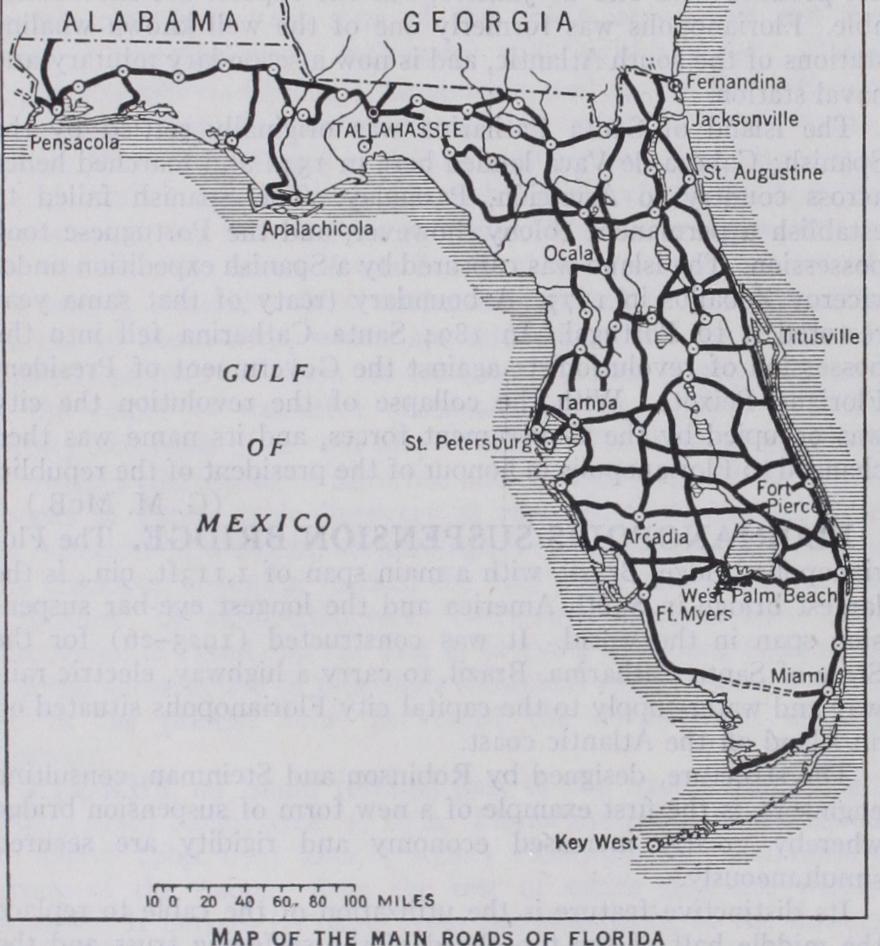
FLORIDA, called the "Peninsula State" because of its pe culiar outline, is the most southern State of the United States and is situated between 24° 3o' and 31° N., and 79° 48' and 87° 38' W. It is bounded on the north by Alabama and Georgia, on the east by the Atlantic ocean, on the south by the Strait of Florida, which separates it from Cuba, and by the Gulf of Mexico, and on the west by the Gulf and Alabama. The Florida Keys, a chain of islands extending in a general south-westerly direction from Biscayne bay, are included in the State boundaries. The coast line is greater than that of any other State, extending 472m.
on the Atlantic and 674m. on the Gulf coast. The total area of
the State is 58,666sq.m., of which 3,8o5sq.m. are water surface.
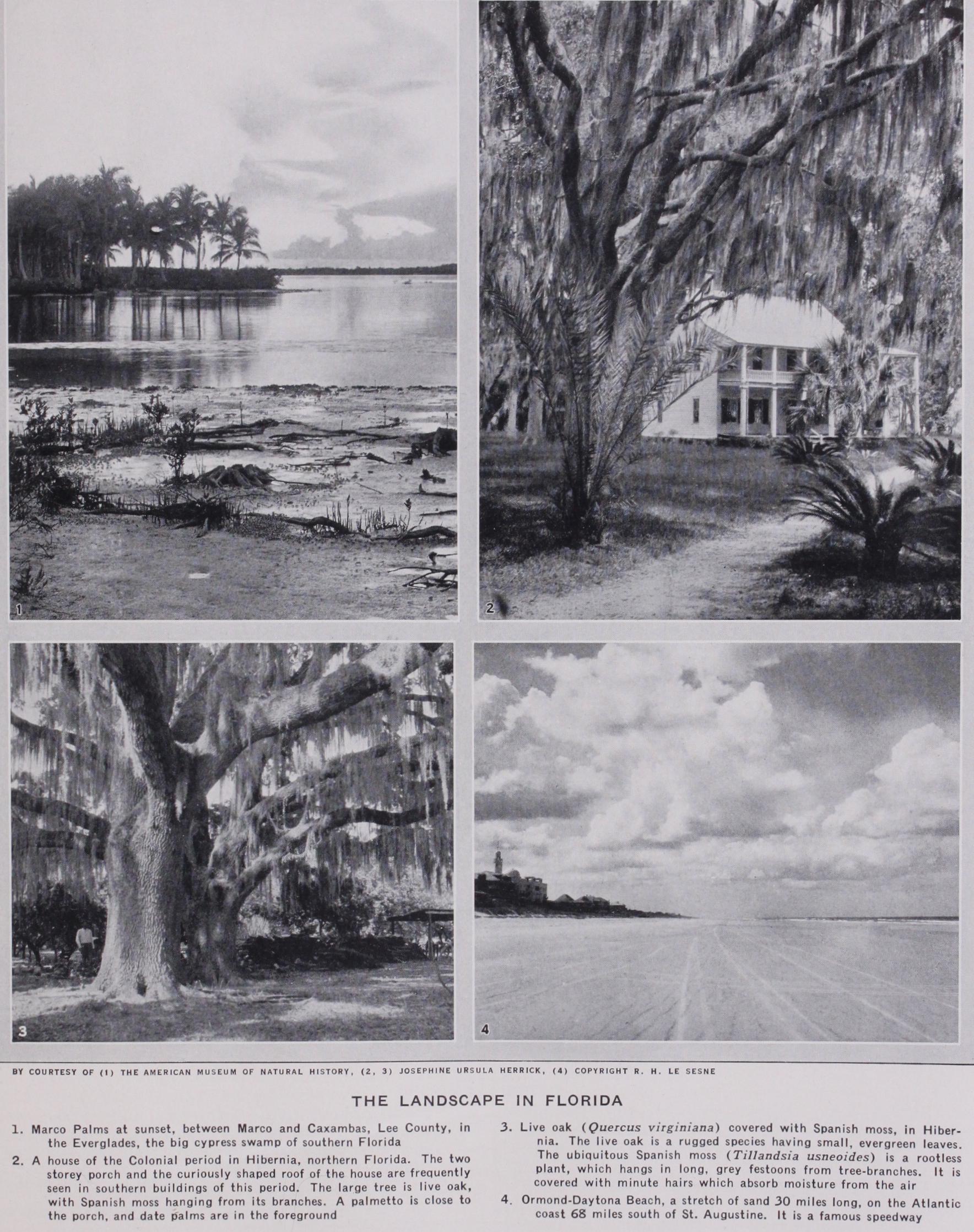
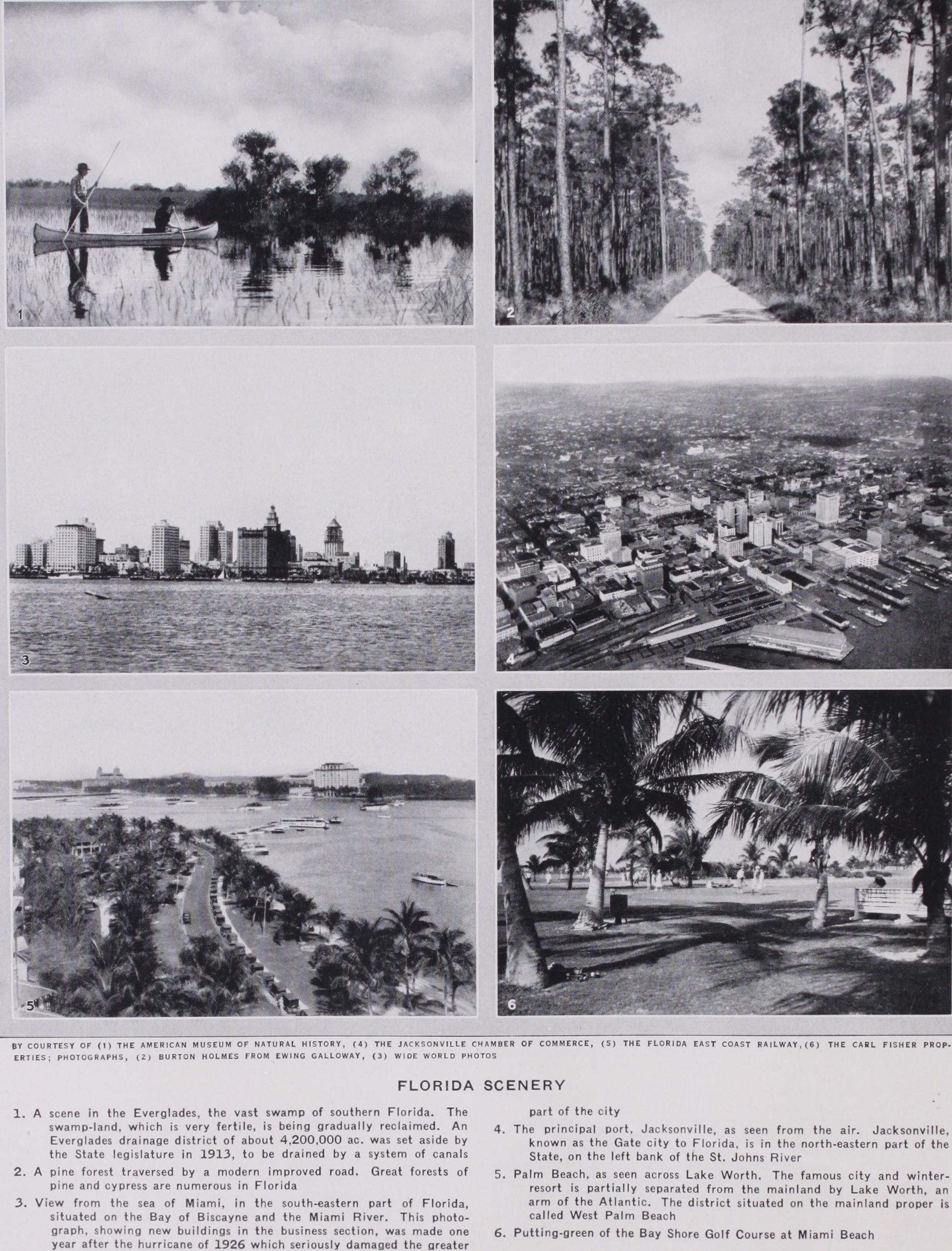
The average elevation of the surface of the State above the sea level is less than that of any other State except Louisiana, but there is not the monotony of unbroken level which descriptions and maps often suggest. The north-western portion of the State is, topographically, similar to south-eastern Alabama, being a rolling hilly country; the eastern section is a part of the Atlantic coastal plain ; the western coast line is less regular than the eastern, being indented by a number of bays and harbours, the largest of which are Charlotte harbour, Tampa bay and Pensacola bay. Along much of the western coast and along nearly the whole of the eastern coast extends a line of sand reefs and narrow islands, enclosing shallow and narrow bodies of water—such as Indian river and Lake Worth—called rivers, lakes, lagoons, bays and harbours. In the central part of the State there is a ridge extending north and south and forming a divide, separating the streams of the east coast from those of the west. Its highest elevation above sea level is about 30o feet. The central region is remarkable for its large number of lakes, about 30,00o between Gainesville (in Alachua county) and Lake Okeechobee. They are due largely to sink holes or de pressions caused by solution of the limestones of the region. Many of the lakes are connected by subterranean channels, and a change in the surface of one lake is often accompanied by a change in the surface of another. By far the largest of these lakes, nearly all of them shallow, is Lake Okeechobee, a body of water about 1,25osq.m. in area and almost uniformly shallow, its depth seldom being greater than i 5 feet. Caloosahatchee river, flowing into the Gulf of Mexico near Charlotte harbour, is its principal outlet. Among the other lakes are Orange, Crescent, George, Weir, Harris, Eustis, Apopka, Tohopekaliga, Kissimmee and Istokpoga. The chief feature of the southern portion of the State is the Everglades (q.v.), an extremely level expanse of country, about 2,86o,000ac. in area, where the natural drainage is so poor that water stands on the surface the greater portion of the year. Within the State there are many swamps, the largest of which are the Big Cypress swamp in the south, adjoining the Everglades on the west, and Okefenokee swamp, extending from Georgia into the north-eastern part of the State.
A peculiar feature of the drainage of the State is the large number of subterranean streams and of springs, always found to a greater or less extent in limestone regions. Some of them are of great size. Many of the springs have curative properties ; one of them, the Green Cove spring in Clay county, discharging about 3,000gal. of sulphuretted water per minute. Not far from St. Augustine a spring bursts through the sea itself with such force that the ocean breakers roll back from it as from a sunken reef. The springs often merge into lakes, and lake systems are usually the sources of the rivers, Lake George being the principal source of the St. Johns, and Lake Kissimmee of the Kissimmee, while a number of smaller lakes are the source of the Oklawaha, one of the most beautiful of the Floridian rivers.
The present constitution was framed in 1885 and was ratified by the people in 1886. Amended from time to time it is still the fundamental law of the State. Its most im portant feature, when compared with the previous constitution of 1868, is its provision for the choice of State officials other than the governor (who was previously elected) by elections instead of by the governor's appointment ; but the governor, who serves for four years and is not eligible for the next succeeding term, still appoints the circuit judges, who are usually nominated in primaries, and he may fill certain vacancies and may suspend, and, with the senate, remove officers not liable to impeachment. The governor is a member of the board of pardons, the other members being the attorney-general, secretary of State, controller and the commissioner of agriculture. The governor, secre tary of State, attorney-general, controller, treasurer, superin tendent of public instruction and commissioner of agriculture comprise a board of commissioners of State institutions; he is also a member of the Board of Education and of the Budget Commission. The office of lieutenant governor was abolished by the present constitution. The legislature meets biennially, the senators being chosen for four years, half from the odd numbered districts being elected in one election and two years thereafter half from the even numbered districts, and the representatives for two years. The senate consists of 38 members, and the house of representatives of 95, all chosen at one election; by a two thirds vote of members present the legislature may pass a bill over the governor's veto. The judges of the supreme court and those of the 21 judicial circuits serve for six years, those of the county courts for four years, and justices of the peace (one for each justice district, of which the county commissioners must form at least two in each county) hold office for four years. The constitutional qualifications for suffrage are: the age of 21 years, citizenship in the United States or presentation of naturalization certificates at registration centres, residence in the State one year and in the county six months, and registration. To these requirements the payment of a poll tax of one dollar has been added by legislative enactment, such an enactment having been authorized by the constitution. Insane persons and persons under guardianship are excluded by the constitution, and "all persons convicted of bribery, perjury, larceny or of infamous crime, or who shall make or become directly or indirectly interested in any bet or wager the result of which shall depend upon any election," or who shall participate as principal, second or challenger in any duel, are excluded by legislative enactment.
Amendments to the constitution may be made by a three-fifths vote of each house of the legislature, ratified by a majority vote of the people. A revision of the constitution may be made upon a two-thirds vote of all members of both houses of the legislature, if ratified by a majority vote of the people; a constitutional con vention is then to be provided for by the legislature, such conven tion to meet within six months of the passage of the law therefor, and to consist of a number equal to the membership of the house of representatives, apportioned among the counties as are the members of that house.
A homestead of i6oac. or of lac. in an incorporated town or city, owned by the head of a family residing in the State, with personal property to the value of $1,000 and the improvements on the real estate, is exempt from enforced sale except for delin quent taxes, purchase money, mortgage or improvements on the property. The wife holds in her own name property acquired before or after marriage ; the intermarriage of whites and negroes (or persons of negro descent to the fourth generation) is pro hibited. All these are constitutional provisions.
As an administrative division of the Government, the county is very important, for it is where the chief functions of local government are carried on. Each county has a clerk of circuit court, a sheriff, constables, an assessor of taxes, a tax collector, a superintendent of public instruction and a surveyor. All of these are elected for a period of four years, except the tax assessor and the tax collector, who are elected for two years. The constitution provides for the division of each county into five districts and "one county commissioner shall be selected for each such dis trict." The commissioners, who individually have supervision over bridges and highways and collectively exercise a general supervision over the property and finances of the county, are elected for a term of two years. The State census of 1925 showed Florida divided into 64 counties, but in 1927 this number was increased to 67.
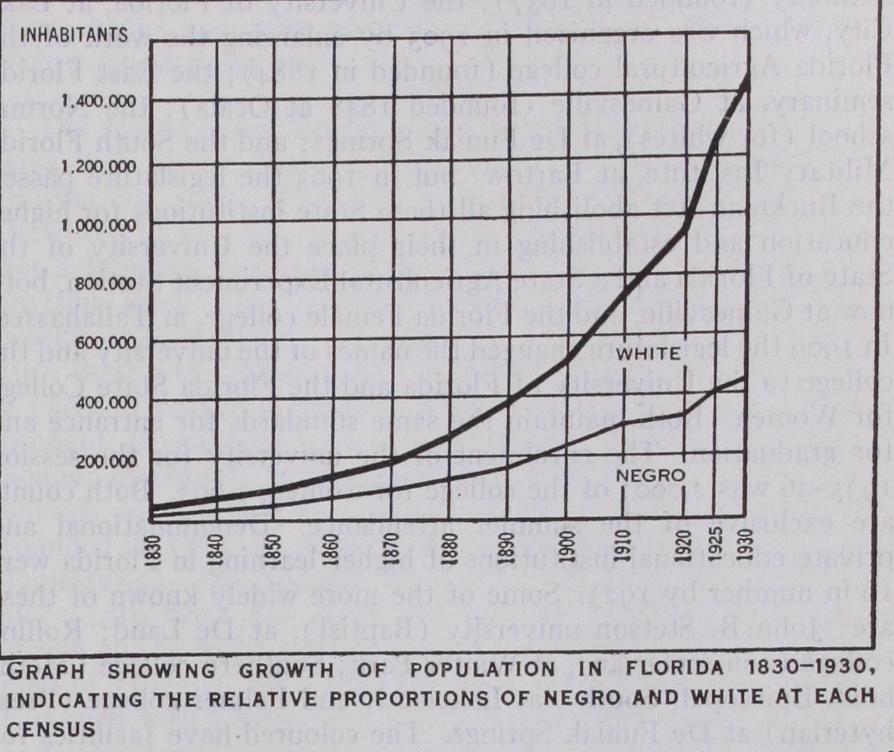
The first United States census of Florida was taken in 1830, when the territory had a population of
The population of Florida at other selected census periods was as follows: in 1850, 87,445; in 188o, 269,493; in 1890, 391,422; in 1900, 528,542; in 1910, 752,619; in 1920, 968,470. The United States census figures for April 1, 1930 were 1,468,211. The U.S. census bureau's estimate of the population for July 2, 1936 was 1,642,000. The increase for the decade 1910-20 was 28.7%, and for the decade 1920-30 it was even more remarkable, being
or 51.6%. In
were native born, 70.5% were white and 29.4% were negro. In 1930 there were 31 cities with a population of over 5,000; those then exceeding 15,000 were: Jacksonville
Miami (110,637), Tampa (I01,161), St. Petersburg (40,425), Pensacola (31,579), Orlando (27,330), West Palm Beach (26,610), Lakeland (58,554), Daytona Beach (16,598). Tallahassee is the capital of the State. The rapid development of Florida cities and towns is giving the State a larger proportion of urban population than that of any other southern State. At the time of the 1920 census its urban popula tion (living in places with over 2,500 inhabitants) was 36.7% of the whole and by 1930 it had reached 51.7%. During the winter months the population is largely augmented by thousands of tourists and winter residents, quite a number of whom become permanent residents or invest in Florida property. For many years the coast resorts were the chief objectives, but many of the inland towns and cities are now attracting visitors.
A constitutional amendment of 1930 practically denied the state the right to issue bonds, reserv ing the power to the local authorities. The total bonded indebted ness of the counties and municipalities in 1934 was
The comptroller's report for the year July 1, 1935 to June 30, 1936 showed total revenues of $44,755,410 and total disbursements of
for 1935, revenues amounted to $37,629,960, and disbursements to $36,861,208. The chief sources of revenue in 1936 were: the State road licence fund (gasolene)
; the general revenue fund, which includes charter taxes on corpora tions, motor car licence fees and other taxes; the State Federal aid road fund; State road tax fund; and drainage bond fund. The principal disbursements for 1936 were: general government
protection of person and property $1,973,231; chari ties, hospitals and correction $2,102,509; highways $10,001,246; conservation $1,383,340. Total educational appropriation was $13,282,494. The assessed values in 1934 were: real estate $412,
; personal property $45,218,423. In 1924 Florida adopted a constitutional amendment forbidding the legislature to levy income or inheritance taxes.
As early as 1831 an unsuccessful attempt was made to form an adequate public school fund ; the first real effort to establish a common school system for the territory was made after 1835; in 1840 there were altogether 18 academies and 51 common schools, and in 1849 the legislature made an appropria tion in the interest of the public instruction of white pupils, and this was supplemented by the proceeds of land granted by the United States Government for the same purpose. In 1852 Talla hassee established a public school; and in 186o, there were, ac cording to a report of the United States Census, 2,032 pupils in the public schools of the State, and 4,486 in "academies and other schools." The Civil War, however, interrupted the early progress, and the present system of common schools dates from the con stitution of 1868 and the school law of 1869. The school revenue is derived from the interest of a permanent school fund, special State and county taxes, and a poll-tax. The State constitution prescribes that "white and coloured children shall not be taught in the same school, but impartial provision shall be made for both." The total population between the ages of five and 17, inclusive, in 1934 was 401,000, of which 382,510 or 95.4%, were enrolled in public elementary and secondary schools; an increase of 36,076 over the census of 1930. The estimated attendance of private and parochial schools was 7,450. Of the 382,510 attending the public schools, 3
545 were in kindergarten and elementary schools and 57,965 in secondary schools. The average daily at tendance per year per pupil enrolled increased from 106.3 days in 1924 to 128.2 in 1934. During the session
10,891 teachers were engaged in the public schools and the average annual salary amounted to $716. The school expenditures in 1924 amounted to
in 1934 to $16,728,176; a per capita of population (5-17) of $41.48 and $41.72 respectively. Attendance is com pulsory between the ages of seven and 16.
Before 1905 the State provided for higher education by the Florida State college, at Tallahassee, formerly the West Florida seminary (founded in 1857) ; the University of Florida, at Lake City, which was organized in 1903 by enlarging the work of the Florida Agricultural college (founded in 1884) ; the East Florida seminary, at Gainesville (founded 1848 at Ocala) ; the Normal school (for whites), at De Funiak Springs; and the South Florida Military Institute, at Bartow; but in 19o5 the legislature passed the Buckman Act abolishing all these State institutions for higher education and establishing in their place the University of the State of Florida and a State Agricultural Experiment Station, both now at Gainesville, and the Florida Female college, at Tallahassee. In 1909 the legislature changed the names of the university and the college to the University of Florida and the Florida State College for Women. Both maintain the same standards for entrance and for graduation. The enrolment of the university for the session
was 2,000; of the college for women, 1,693. Both counts are exclusive of the summer attendance. Denominational and private educational institutions of higher learning in Florida were 16 in number by 1923. Some of the more widely known of these are: John B. Stetson university (Baptist), at De Land; Rollins college (non-sectarian), at Winter Park; Southern college (Meth odist Episcopal, South), at Lakeland; and Palmer college (Pres byterian) at De Funiak Springs. The coloured have facilities for advanced education in the Florida Agricultural and Mechanical college, at Tallahassee, which was organized in 1909 by enlarging the work of the State Normal school for training Negro Teachers (founded 1887). Other coloured institutions are: the Florida Baptist Academy and Cookman Institute (Methodist Episcopal, South), both at Jacksonville, and the Normal and Manual Train ing school (Congregational) at Orange Park. There is a school for the deaf and blind (founded 1885) at St. Augustine.
The early history of the penal system may be characterized as one of aimless experi ments followed by about 3o years of a lease system. The convicts were hired to the one highest bidder who contracted for their labour, and who, in turn, subleased the prisoners in smaller groups. He, moreover, undertook to lease all other persons con victed during the term of his contract. In 1889 the prisoners were placed under the care of a supervisor of convicts, and in 1905 the law was amended so that one or more supervisors might be ap pointed at the will of the governor. By 1908 there were four supervisors and one State prison physician. The present system began to take shape in 19I i when the legislature made an appro priation to establish a prison farm near Raiford. In this session also an act was passed which provided that only the physically perfect coloured males should be leased, and that all women and white males, and those not physically fit of the coloured males, should be retained at the farm. Under this arrangement about 600 coloured males were leased. Until Jan. 1, 1914, however, leaseholders of State prisoners were under contract to care for women prisoners and the infirm of both races, the State owning nothing in the way of buildings and equipment. By an act of 19 21 all persons upon being admitted to the State prison were to be examined and classified into one of two classes according to physical fitness. All able-bodied males, except a number not ex ceeding 5o for the farm and a few for other institutions, were to make up the State convict road force. Women and the physically unfit were to be retained at the farm. The lease system for State or county prisoners is prohibited by law since Dec. 31, 1923. Cor poral punishment was made unlawful by an act of the legislature in 1923. The State prison fund of three-eighths of one mill on the dollar on all property liable to assessment is to supplement the revenue of the prison farm. The general supervision of the prison farm and the convict road camps is in charge of the commissioner of agriculture and the board of commissioners of State institu tions. Florida maintains an Industrial School for Boys at Mari anna, an Industrial School for Girls at Ocala, Florida Farm Colony (for feeble minded) at Gainesville, and an Insane Hospital at Chattahoochee. Orphanages and charitable institutions are main tained in various parts of the State by religious and benevolent organizations.
Florida's most ex tensive industry is agriculture. According to figures of the Florida Experiment Station there were approximately 6,o48,4o6ac. of land in farms in 1934, not including open or fenced range lands. Of this 1,579,049ac. were in crops, and 489,006ac. of crop lands were idle; 2 7 5,000ac. were in fruit ; 2,3 2 6,6 74ac. were in pasture; and 1,14o,941ac. in woodland. On approximately one-third of the cultivated acreage crops were produced by intertillage (the grow ing of two or more crops on the same land at one time) and by succession planting (the growing of two or more crops in sequence on the same land in one year). The number of farms in Florida was 50,016 in 1910, 54,005 in 192o and 72,857 in 193o. Fruit is Florida's most important crop. The citrus industry has prospered despite the fact that some of the groves in the more northern part of the State have suffered from heavy frosts in severe winters. In 1925 the production of oranges was 10, 700,00o boxes, and of grape-fruit 6,300,00o boxes. In 1935 the production was 21,000, 00o boxes of oranges and
boxes of grape-fruit. In the sub-tropical part of the State pineapples, lemons, guavas and avocadoes are grown profitably on a commercial scale. Other fruits produced are peaches, pears, bananas, grapes, figs and limes. The more important crops with their 1934 acreage yields and values are tabulated below.
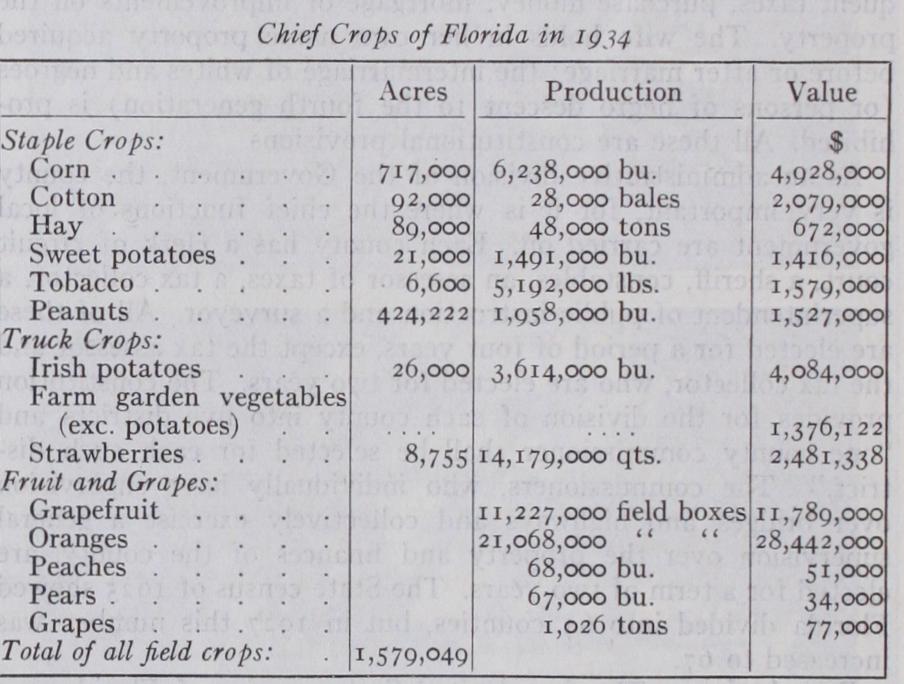
There was a falling off in the production of cotton during the decade 191 o-2o ; however, the introduction of short-staple cotton, which is more resistant to the boll weevil, caused production to rise steadily until 1931 when low prices and government policy caused it to slacken. The tobacco-growing section of western Flo rida produces profitably a shaded leaf, grown from Cuban and Su matran seed, which is in great demand in cigar manufacturing. The pecan industry is comparatively new, most of the commercial groves having been planted since 1905. It is believed that in the northern part of the State the pecan crop may soon compete closely with the citrus crop of the southern part. The production of early vegetables for the northern markets is developing rapidly, and the Florida producer can put vegetables on the markets earlier than any of his competitors. The chief obstacles are costly trans portation and inadequate railway freight and express service. Much attention was formerly paid to stock-raising, but with the slackening of production resulting from the economic depression beginning in 193o, the figures for 1934 show a falling off in the production of livestock. In 1934 there were 376,522 cattle, includ ing milch cows, 39,942 sheep, 447,135 swine, 17,976 horses, and
mules. In addition there were 2,190,189 hens which pro duced 11,698,568 dozen eggs. The gross income from livestock and livestock products amounted to $17 ,400,000.
The fisheries of Florida are valuable. In 1934 the catch was 118,801,00o lb. valued at $3,634,700 (Bureau of Fisheries report), making it the first among the southern and gulf states. The total number of species of fish is about 600, and many species found on one coast are not found on the other. The kingfish and the tarpon are caught for sport, while mullet, shad, red snapper, pom pano, trout, sheepshead and Spanish mackerel are of economic value. The sponge, oyster and turtle fisheries are also important. According to the Census of Manufactures in 1935, Florida had 1,912 manufacturing establishments, which gave employment to 44,878 persons and had a total production worth $162,358,971. In 1929 there were 2,183 establishments with a yearly output valued at $226,364,122. The chief industry in 1933 was cigar and tobacco manufacture, which engaged 8,418 persons, with an output valued at $17,809,684. Other important industries in the order of their importance were : lumber and timber products; commercial ferti lizer ; printing and publishing ; bread and bakery products ; and canning of fruits, vegetables, and sea foods.
In 1934 Florida produced mineral products to the value of $11,548,000, the principal of which were phosphates, lime, lime stone, brick, tile, kaolin and fuller's earth, of which last Florida produces about three-fourths of the entire U.S. output. In
the production of phosphates was : land pebble, 2,269,891 long tons, valued at
; and hard rock, i 16,483 long tons, valued at $500,526. Because of exploitation, Florida's lumber production shows a decline since 1916, when an output of 1,425, 000,000 board ft. was reached; the 1934 production, mainly cy press and yellow pine, was 473,000,000 board feet. Some hard wood (chiefly hickory), is produced. Naval stores are produced from the pine forests, where the sap of the trees is collected and distilled, yielding turpentine and rosin. In 1932 Florida produced 7,800,000 gal. of turpentine, and 527,000 50-lb. bbl. of rosin, with a total value of $6;500,000. In 1934 Florida manufactured 540, 243,000 cigars and 403,000 cigarettes, with a total value of $17, 809,684.
An important influence in the development of Florida has been the railways and other facilities for transportation and communi cation. In 188o the total railway mileage was 518, but since that date it has increased considerably ; in 1900 it was 3,255, and in
5,455. The largest system is the Atlantic Coast Line, consist ing of railways built or consolidated by H. B. Plant and once forming a part of the "Plant System" of railways. The railway with the next greatest mileage is the Seaboard Air Line. The Flo rida East Coast railway is an important system also. It was the product of one man's faith in the country, H. M. Flagler. Other important railways are : The Louisville and Nashville, the Georgia Southern and Florida, and the Charlotte Harbor and Northern. The total freight and passenger revenues for the parts of the sys tems operating in Florida were in
according to the report of the Florida railroad commission. This commission has certain regulatory powers over all means of transportation and communication within the State. In 1932 there were 199m. of electric railways in operation, wholly as city transportation sys tems.
Florida's highway mileage on Dec. 31, 1934, according to U.S. Census figures, was 10,708. Of this number, 4,077m. were earth and 6,631 were surfaced. During the year 1934, $16,004,000 was spent on highway construction and improvement.
In 1935, the net tonnage of all vessels engaged in foreign trade which entered the different Florida ports was, 1,641,000, and cleared 1,600,00o. The west coast ports were of the chief impor tance in both import and export trade. For the import trade the four chief ports were: Jacksonville (with 163,645 cargo tons), Tampa, Pensacola, and Miami ; in the export trade Tampa led with 952,502 cargo tons; other ports being Jacksonville, Pensacola, and Boca Grande. Within recent years much has been done by the na tional government, aided in some cases by the local authorities, to improve the harbours and to extend the limits of river naviga tion. In 1882 the Florida East Coast Line Canal and Transporta tion Co. was organized to develop a waterway from Jacksonville to Biscayne bay by connecting with canals the St. Johns, Ma tanzas and Halifax rivers, Mosquito lagoon, Indian river, Lake Worth, Hillsboro river, New river, and Snake creek; in 1908 this vast undertaking was completed, thereby opening a channel for light-draught boats. The drainage canals which connect Lake Okeechobee with the Atlantic ocean provide passage for light draught boats between the two points.
Some index of Florida's recent business condition can be gained from the following banking statistics : resources of national banks in Jan. 1931, $196,5o2,000; in Jan. 1936, $236,010,000; in State banks and trust companies in July 1931, $81,019,304; in July
The romance and the tragedies of the early history of Florida give it a unique place in the annals of the American States. Within 20 years after the first voyage of Columbus to the New World in 1492, an expedition was being organized to seek for a fabulous fountain of youth and for riches in the new and inviting land. This expedition was followed by others seeking wealth or to establish the Christian faith among the savages. In turn these were followed by French Huguenots who were seeking a place of religious freedom, but the zeal of the Spaniards soon brought an unhappy end to their search. Florida also has the honour of containing the oldest European settlement within the bounds of the original United States, as St. Augustine was founded in 1565, 42 years before the English were successful at Jamestown. The Spanish Council of the Indies claimed that since 1510 fleets and ships had gone to Florida, and Florida is shown on the earliest known map of the New World, the Cantino map of 1502. In 1513 Juan Ponce de Leon (c. 1460-1521), who had been with Christopher Columbus on his second voyage, and had later been governor of Porto Rico, obtained a royal grant authorizing him to discover and settle "Bimini"—a fabulous island believed to contain a marvellous fountain or spring whose waters would restore to old men their youth or, at least, had wonderful curative powers. Soon after Easter day he came in sight of the coast of Florida, probably near the mouth of the St. Johns river. From the name of the day in the calendar, Pascua Florida, or from the fact that many flowers were found on the coast, the country was named Florida. De Leon seems to have explored the coast, to some degree, on both sides of the peninsula, and to have turned homeward fully convinced that he had discovered an im mense island. He returned to Spain in 1514, and obtained from the king a grant to colonize "the island of Bimini and the island of Florida," of which he was appointed adelantado (civil and military governor), and in 1521 he made another expedition, this one for colonization as well as for discovery. He seems to have touched at the island of Tortugas, so named on account of the large number of turtles found there, and to have landed at several places, but many of his men succumbed to disease and he him self was wounded in an Indian attack, dying soon afterwards in Cuba. Meanwhile, in 1516, another Spaniard, Diego Miruelo, seems to have sailed for some distance along the west coast of the peninsula. The next important exploration was that of Panfilo de Narvaez. In 1527 he sailed from Cuba with about 600 men (soon reduced to less than 400) ; he landed early in 1528, probably at the present site of Pensacola, and for six months remained in the country, he and his men suffering terribly from exposure, hunger and fierce Indian attacks. In September, his ships being lost and his force greatly reduced in number, he hastily constructed a fleet of five boats, re-embarked, probably at Apalachee bay, and lost his life by having his boat blown out to sea while off the coast of Texas. Only four of his men, includ ing Nunez Cabeza de Vaca, succeeded, after eight years of Indian captivity and of long and weary wanderings, in finding their way to Spanish settlements in Mexico. Florida was also partially explored by Ferdinando de Soto (q.v.) in 1539-40. In the sum mer of 1559 another attempt at colonization was made by Tristan de Luna, who sailed from Vera Cruz, landed at Pensacola bay, and explored a part of Florida and (possibly) southern Alabama. Somewhere in that region he desired to make a per manent settlement, but he was abandoned by most of his fol lowers and gave up his attempt in 1561.
In 1562, Jean Ribaut (152o-65), with a band of French Huguenots, landed first near St. Augustine and then at the mouth of the St. Johns river, which he called the River of May, and on behalf of France claimed the country, which he described as "the fairest, f ruitf ullest and pleasantest of all the world" ; but he made his settlement on an island near what is now Beaufort, South Carolina. In 1564 Rene de Laudon niere (d. c. 1586), with another party of Huguenots, established Fort Caroline at the mouth of the St. Johns, but the colony did not prosper, and in 1565 Laudonniere was about to return to France when (on Aug. 28) he was reinforced by Ribaut and about 30o men from France. On the same day that Ribaut landed, a Spanish expedition arrived in the Bay of St. Augustine. It was commanded by Pedro Menendez de Aviles
one of whose aims was to destroy the Huguenot settlement. This he did, putting to death almost the entire garrison at Fort Caro line "not as Frenchmen but as Lutherans," on Sept. 20, 1565. The ships of Ribaut were soon afterwards wrecked near Matanzas inlet ; he and most of his followers surrendered to Menendez and were executed. Menendez then turned his attention to the found ing of a settlement which he named St. Augustine (q.v.) ; he also explored the Atlantic coast from Cape Florida to St. Helena and established forts at San Mateo (Fort Caroline), Avista, Guale and St. Helena. In 1567 he returned to Spain in the interest of his colony.
The news of the destruction of Fort Caroline and the execution of Ribaut and his followers was received with indifference at the French court ; but Dominique de Gourgues (c. 1530-93), a friend of Ribaut but probably a Catholic, so the widely accepted story goes, organized an expedition of vengeance, not informing his men of his destination until his three ships were near the Florida coast. With the co-operation of the Indians under their chief, Saturiba, he captured Fort San Mateo in the spring of 1568 and on the spot where the garrison of Fort Caroline had been exe cuted, he hanged his Spanish prisoners, inscribing on a tablet of pine the words : "I do this not as unto Spaniards but as to traitors, robbers and murderers." Feeling unable to attack St. Augustine, de Gourgues returned to France.
The Spanish settlements experienced many vicissitudes. The Indians were hostile and the missionary efforts among them failed. In 1586 St. Augustine was almost destroyed by Sir Francis Drake, and it also suffered severely by an attack of Captain John Davis in 1665. Not until the last decade of the 17th century did the Spanish authorities attempt to extend the settlements beyond the east coast. Then, jealous of the French explorations along the Gulf of Mexico, they turned their attention to the west coast, and in 1696 founded Pensacola. When the English colonies of the Carolinas and Georgia were founded, there was constant friction with Florida. The Spanish were accused of inciting the Indians to make depredations on the English settlements and of interfering with English commerce, and the Spanish were in constant fear of the encroachments of the English. In 1702, when Great Britain and Spain were contending in Europe, on opposite sides, in the war of the Spanish Succession, a force from South Carolina captured St. Augustine and laid siege to the fort, but being unable to reduce it for lack of necessary artillery, burned the town and withdrew at the approach of Spanish re inforcements. In 1706 a Spanish and French expedition against Charleston, South Carolina, failed, and the Carolinians retaliated by invading middle Florida in 1708 and again in 1722. In 1740 General James Edward Oglethorpe, governor of Georgia, sup ported by a naval force, made an unsuccessful attack upon St. Augustine ; two years later a Spanish expedition against Savannah by way of St. Simon's island failed, and in 1745 Oglethorpe again appeared before the walls of St. Augustine; but the Treaty of Aix-la-Chapelle in 1748 prevented further hostilities. Pensa cola, the other centre of Spanish settlement, though captured and occupied (1719-23) by the French from Louisiana, had a more peaceful history.
By the Treaty of Paris in 1763 Florida was ceded to England in return for Havana. The provinces of East Florida and West Florida were now formed, the boundaries of West Florida being 31° N. lat. (when civil government was organized in 1767, the northern line was made 32°28'), the Chattahoochee, and the Apalachicola rivers, the Gulf of Mexico, Mississippi sound, Lakes Borgne, Pontchartrain and Maurepas, and the' Mississippi river. A period of prosperity now set in. Civil in place of military government was instituted; immigration began; and Andrew Turnbull, an Englishman, brought over a band of about 1,500 Minorcans (1769), whom he engaged in the cultivation of indigo at New Smyrna. Roads were laid out, some of which yet remain ; and in the last three years of British occupation the Government spent $580,000 on the two provinces. Consequently, the people of Florida were for the most part loyal to Great Britain during the War of American Independence. In 1776, the Minorcans of New Smyrna refused to work longer on the indigo plantations; and many of them removed to St. Augustine, where they were pro tected by the authorities. Several plans were made to invade South Carolina and Georgia, but none matured until 1778, when an expedition was organized which co-operated with British forces from New York in the siege of Savannah, Georgia. In the following year, Spain having declared war against Great Britain, Don Bernardo de Galvez (1756-94), the Spanish gov ernor at New Orleans, seized most of the English forts in West Florida, and in 1781 captured Pensacola.
By the Treaty of Paris in 1783 Florida reverted to Spain, and, no religious liberty being promised, many of the British inhabitants left East and West Florida. A dispute with the United States concerning the northern boundary was settled by the treaty of 1795, the line 31° N. lat. being estab lished.
The westward expansion of the United States made it highly desirable to have American ports on the Gulf of Mexico ; consequently, the acquisition of West Florida as well as of New Orleans was one of the aims of the negotiations which resulted in the purchase of Louisiana in 1803. After the cession of Louisiana to the United States, the people of West Florida feared that that province would be seized by Napoleon. They, therefore, through a convention at Buhler's Plains ( July 17, 181o), formulated plans for a more effective government. When it was found that the Spanish governor did not accept these plans in good faith, another convention was held on Sept. 26 which declared West Florida to be an independent State, or ganized a government and petitioned for admission to the Union. On Oct. 27, President James Madison, acting on a theory of Robert R. Livingston that West Florida was ceded by Spain to France in 1800 along with Louisiana, and was therefore included by France in the sale of Louisiana to the United States in 1803, declared West Florida to be under the jurisdiction of the United States. Two years later the American Congress annexed the portion of West Florida between the Pearl and Mississippi rivers to Louisiana (hence the so-called Florida parishes of Louisiana), and that between the Pearl and the Perdido to the Mississippi Territory.
In the meantime war between Great Britain and the United States was imminent. The American Government asked the Spanish authorities of East Florida to permit an American occu pation of the country in order that it might not be seized by Great Britain and made a base of military operations. When the request was refused, American forces seized Fernandina in the spring of 1812, an action that was repudiated by the American Government after protest from Spain, although it was authorized in official instructions. About the same time an attempt to organize a government at St. Mary's was made by American sympathizers, and a petty civil war began between the Americans, who called themselves "Patriots," and the Indians, who were encouraged by the Spanish. In 1814 British troops landed at Pensacola to begin operations against the United States. In retaliation General Andrew Jackson captured the place, but in a few days withdrew to New Orleans. The British then built a fort on the Apalachicola river, and there directed expeditions of Indians and runaway negroes against the American settlements, which continued long after peace was concluded in 1814. In 1818 General Jackson, believing that the Spanish were aiding the Seminole Indians and inciting them to attack the Americans, again captured Pensacola. By the treaty of 1819 Spain formally ceded East and West Florida to the United States; the treaty was ratified in 1821, when the United States took formal possession, but civil govern ment was not established until 1822.
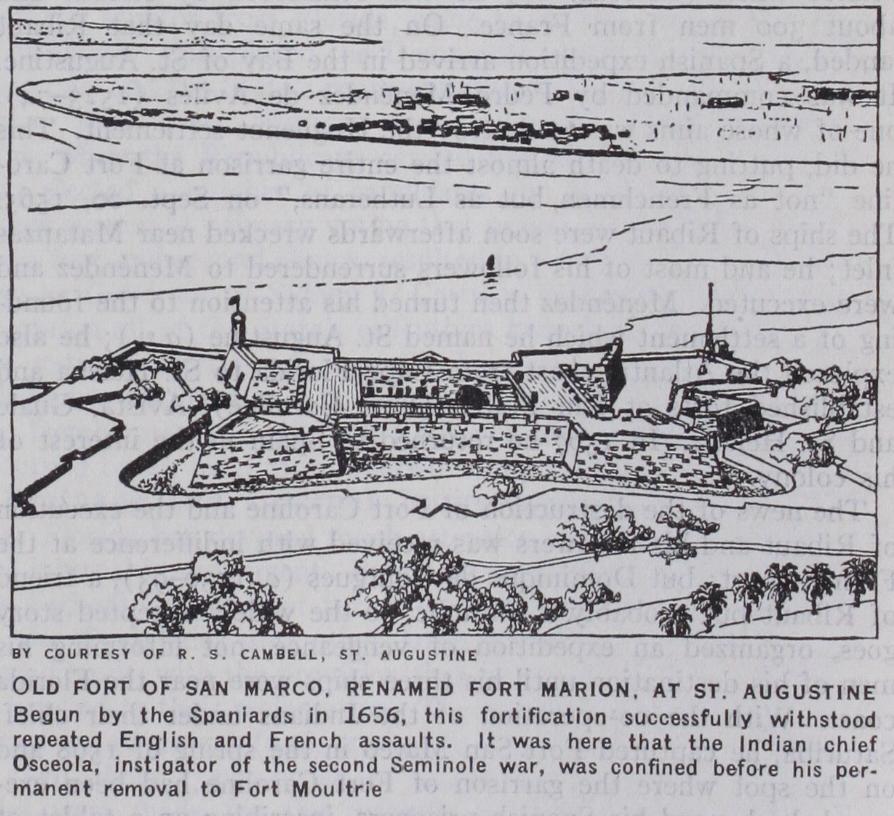
Indian affairs furnished the most serious problems of the new Territory of Florida. Immediately after the cession of Florida to the United States, pressure was brought to bear upon Congress and the President to have the Seminole Indians removed and the country thrown open to settlement. The Indians, who had been allowed to occupy their lands in peace by the Spaniards, could not understand why they should be forced to move to new lands west of the Mississippi; but they consented, by the Treaty of Fort Moultrie in 1823, to live within certain limits. Conflicts followed, however, as the population in creased, and a new demand was made to have the Indians re moved. By treaties made at Payne's landing in 1832 and Fort Gibson in 1833 the Indian chiefs agreed to exchange their Florida lands for equal territory in the western part of the United States. But a strong sentiment against removal suddenly developed, and the efforts of the United States to enforce the treaty brought on the Seminole War (1836-42), which resulted in the removal of all but a few hundred Seminoles whose descendants still live in southern Florida.
In 1845 Florida became a State of the American Union. On Jan. Io, 1861, an ordinance of secession, which de clared Florida to be a "sovereign and independent nation," was adopted by a State convention, and Florida became one of the Confederate States of America. The important coast towns were readily captured by Union forces—Fernandina, Pensacola and St. Augustine in 1862, and Jacksonville in 1863 ; but an invasion of the interior in 1864 failed, the Union forces being repulsed in a battle at Olustee on Feb. 20, 1864. In 1865 a provisional gov ernor was appointed by President Andrew Johnson, and a new State Government was organized. The legislature of 1866 rejected the Fourteenth Amendment to the Federal Constitution, and soon afterwards Florida was made a part of the Third Military District, according to the Reconstruction Act of 1867. Negroes were now registered as voters by the military authorities, and another constitutional convention met in Jan. and Feb., 1868. A factional strife in the dominant party, the Republican, threat ened to break up the convention, but through the efforts of Gen eral George M. Meade the differences were reconciled. In due time a constitution was framed and was ratified by the electors, and Florida passed from a quasi-military to a full civil govern ment on July 4, 1868.
The factional strife in the Republican party continued, a number of efforts being made to impeach Governor Harrison Reed
. The decisive year of the Recon struction period was 1876. The canvassing board, which pub lished the election returns, cast out some votes, did not wait for the returns from Dade county, and declared the Republican ticket elected. George F. Drew (1827-190o), the Democratic candidate for governor, then secured a mandamus from the circuit court restraining the board from going behind the face of the election returns; this was not obeyed and a similar mandamus was therefore obtained from the supreme court of Florida, which declared that the board had no right to determine the legality of a particular vote. According to the new count thus ordered, the Democratic state ticket was elected. By a similar process the board's decision in favour of the election of Republican presi dential electors was nullified, and the Democratic electors were declared the successful candidates; but the electoral commission, appointed by Congress, reversed this decision. (See ELECTORAL COMMISSION.) In 1879 the term of Simon B. Conover, Re publican senator from Florida, came to an end, and the election of Wilkinson Call placed the Democratic party in full control of the State and the State's representation in the national Congress. From that date, Florida was uniformly Democratic until 1928, when the Republicans carried the State for President and also elected a number of candidates for local offices. In 1916 a new system of primary voting that permitted the voter to regis ter a first and second choice, resulted in the nomination and elec tion as Governor of Sidney J. Catts, a Prohibitionist ; with this exception all of the State's executives have been Democratic. In the national election of 1932 Florida returned to her old party allegiance, voting 3 to I in favour of Franklin D. Roosevelt and the Democrats. In 1936 both Roosevelt and the Democrats were returned by an even more overwhelming majority.
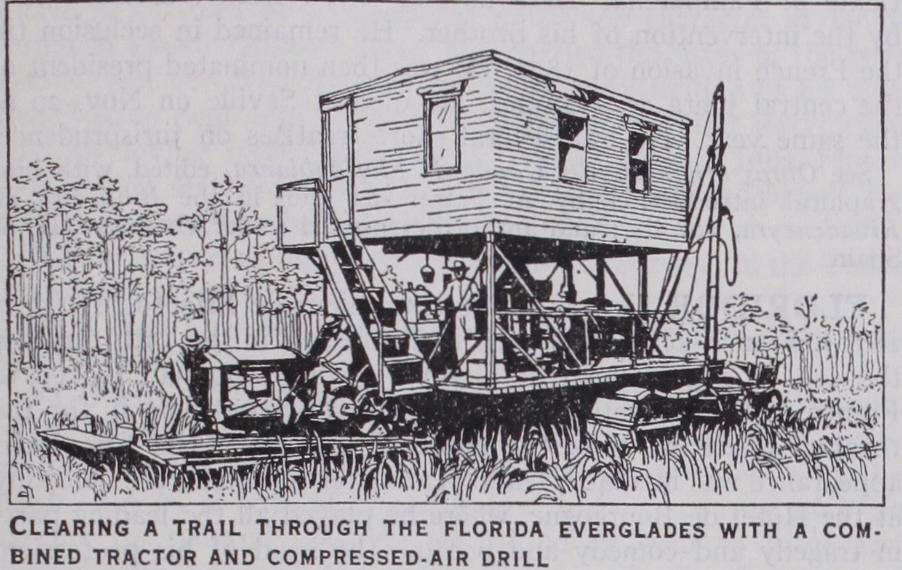
Drainage and Internal Improvement.—Since the Civil War Florida has devoted much attention and money to drainage and internal improvement. By an act of Congress passed in 185o, the Federal Government turned over to the State practically all of the Everglades and other lands known as swamp or over flowed lands, with the provision that all proceeds from such lands be applied to their reclamation. The board of trustees for the in ternal improvement fund, created in 1855, had under its control, in 1879, about 13,00o,000ac. of such land, from which grants and sales were made for the purpose of encouraging railway and drainage-canal construction. Besides the various grants made to railway companies, the trustees in 1881 sold to Hamilton Diss ton, of Philadelphia, 4,00o,000ac. of swamp land at 25 cents per ac., in order to raise funds for internal improvement projects. Be tween 1881 and 1896 a private company with large holdings in the Everglades attempted to dig a canal from Lake Okeechobee to the Gulf of Mexico, but the project had to be abandoned after over flows closed the canal in 1902. By the Drainage Act of 1905 the State board of drainage commissioners was created, with power to build canals, levees and dikes, to do other drainage work and to levy on the lands to be benefited taxes sufficient to maintain the work. Under the board's control various drainage works were started, including six canals between Lake Okeechobee and the Atlantic ocean to be used in draining the Everglades. In order to expedite the work, the legislature in 1913 created the Ever glades drainage district, consisting of about 4, 200,00o acres and placed the work under a board of commissions. Seven main canals were built connecting Lake Okeechobee with the Atlantic. They serve both for drainage, and, with the aid of locks, passageways for light-draught vessels. The completion of this work by the State, along with the construction of railways, has made possible the phenomenal development of southern Florida since 192o, and contributed to the real estate boom of 1923-26.
President Roosevelt in 1935 approved the allotment of $5,000, 00o from the Work Relief Fund to the War Department engineers for preliminary work on a sea-level ship waterway to cross the state from Jacksonville on the Atlantic side to Port Inglis on the Gulf of Mexico. The new canal was expected to provide a shorter and safer route for ocean-going vessels, shorten the voyage from New York to New Orleans by two days, and save annually $7,500,00o in transportation costs. The estimate of the cost of the canal was $147,000,000. Congress, however, in 1936, refused to grant the necessary appropriation for continuing the work on this project.